
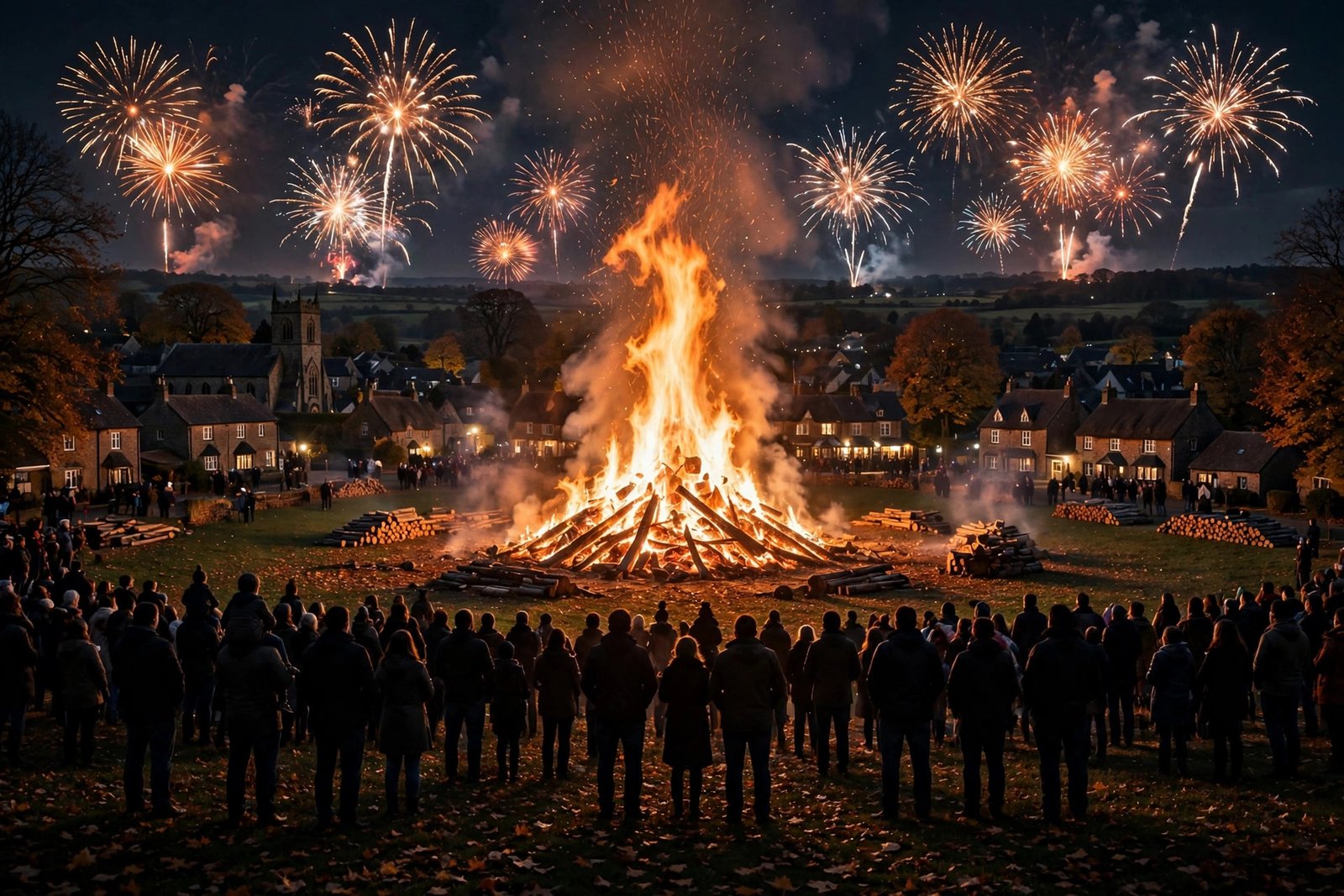
Remember, remember the Fifth of November. Those words open one of the most famous rhymes in British history, and every year on November 5, bonfires blaze and fireworks crackle across the United Kingdom. But why does Britain celebrate a failed bombing? The answer lies in Bonfire Night history, a story of religious tension, a daring plot, a dramatic arrest in a palace cellar, and a tradition that has lasted more than four centuries.
Bonfire Night, also called Guy Fawkes Night, marks the failure of the Gunpowder Plot of 1605, when a group of Catholic conspirators tried to blow up the Houses of Parliament in London. The plot was discovered just in time, and the man found guarding the explosives, Guy Fawkes, became one of history’s most famous figures. His name is still spoken every autumn, even though the original meaning of the celebration has changed a great deal over the years.
Bonfire Night History: The Gunpowder Plot of 1605
To understand Bonfire Night history, you have to go back to the early 1600s, when England was a Protestant country ruled by King James I. Catholics in England faced fines, restrictions, and persecution for practising their faith, and a small group of Catholic gentlemen decided that only a dramatic act could change the situation. Their leader was Robert Catesby, and their plan was as bold as it was shocking: they would destroy the House of Lords during the State Opening of Parliament, killing the king, his ministers, and many members of Parliament in a single explosion.
The conspirators rented a cellar beneath the House of Lords and filled it with barrels of gunpowder. Guy Fawkes, a soldier with military experience gained fighting in the Spanish Netherlands, was given the job of guarding the explosives and lighting the fuse. The plan was set for November 5, 1605, the day Parliament was due to open.
But the plot leaked. An anonymous letter warned Lord Monteagle, a Catholic peer, not to attend Parliament that day. The authorities searched the palace, and in the early hours of November 5, they found Fawkes in the cellar beside the gunpowder, with matches and a slow-burning fuse. He was arrested, and over the following days the other conspirators were hunted down. Catesby and several others were killed while resisting arrest, and the survivors, including Fawkes, were tried for treason and executed in January 1606.
The failure of the plot was greeted with relief and celebration in London. People lit bonfires in the streets to mark the king’s survival, and within months Parliament passed a law, the Observance of 5th November Act of 1606, making November 5 an annual day of thanksgiving. That law is the direct origin of the tradition we still see today.
Who Was Guy Fawkes, Really?
Guy Fawkes was born in York in 1570 and raised in a Protestant family, though he later converted to Catholicism. As a young man he left England to fight for Catholic Spain in the wars in the Netherlands, where he gained experience with explosives. When he returned, he joined Catesby’s conspiracy and became its most famous member, largely because he was the one caught red-handed in the cellar.
It is worth noting that Fawkes was not the leader of the plot. Catesby planned it, and Fawkes was essentially the explosives expert. Yet history remembers his name above all the others, partly because he was the public face of the arrest and trial, and partly because the effigies burned on bonfires each year came to be called “guys” after him. In fact, the word “guy” for an ordinary man is believed to come from these effigies, which were dressed in old clothes and paraded through the streets before being burned.
Over the centuries, Fawkes has become a complicated symbol. For generations, he was a villain in British tradition, a figure of treason to be burned in effigy. In modern times, his stylised face, popularised by the graphic novel and film V for Vendetta, has been adopted by protesters around the world as a mask of rebellion. It is a strange twist: a man arrested for plotting to destroy Parliament is now an icon of protest against authority.
Why November 5 Became a Night of Bonfires
The first November 5 celebrations were acts of thanksgiving ordered by law. Churches held services, bells rang, and bonfires were lit across the country. Over time, the religious and political meaning faded, but the bonfires stayed. By the 1700s and 1800s, Bonfire Night had become a popular folk festival, with fireworks, processions, and the burning of effigies.
Bonfires themselves have a long history in Britain. They were traditionally lit to mark celebrations, victories, and seasonal festivals, and November, with its long dark nights, was a natural time for fire festivals. The tradition of lighting a bonfire on November 5 blended the thanksgiving for the king’s survival with older autumn fire customs, and the result was a night that belonged to the whole community rather than just the church or the state.
Fireworks became part of the night too. Early fireworks were far simpler than today’s displays, but the crackle and colour suited a celebration of an explosion that never happened. The irony has not been lost on generations of revellers: Britain celebrates a failed gunpowder explosion with, well, more gunpowder.
The Rhyme, the Effigy, and the Traditions
The most famous piece of Bonfire Night folklore is the rhyme that children have chanted for centuries:
“Remember, remember the Fifth of November, gunpowder, treason and plot. I see no reason why gunpowder treason should ever be forgot.”
The rhyme is a memory aid as much as a poem. It ensured that each new generation remembered the date and the story, even when the political details faded. Children once made effigies of Guy Fawkes from old clothes stuffed with straw and asked passers-by for a “penny for the guy” to buy fireworks. The custom has faded in many places, but it survives in some towns and is still remembered fondly by older generations.
Some towns have their own spectacular traditions. Lewes, in East Sussex, is famous for its Bonfire Night celebrations, where bonfire societies parade through the streets in costume, carrying flaming torches and effigies, before huge bonfires are lit. The Lewes celebrations are among the largest and most distinctive in the country, and they show how a national tradition can take on a fiercely local character.
Food is another part of the night. Toffee apples, treacle toffee, parkin (a sticky ginger cake from northern England), jacket potatoes, and hot soup are all traditional Bonfire Night fare. The food, the fire, and the fireworks together make November 5 a sensory celebration, a night to gather outdoors even as the weather turns cold.
Bonfire Night History Today: Fireworks, Safety, and Celebration
Today, Bonfire Night history lives on in a celebration that is more about community and spectacle than about politics or religion. Towns and cities across Britain hold organised firework displays, often run by councils or charities, and families gather in parks and gardens to watch. Private fireworks are still sold and used, though there are rules about when they can be set off and who can buy them, and safety campaigns run every year.
The celebration has also spread beyond Britain. Bonfire Night is marked in parts of New Zealand, Australia, Canada, and other Commonwealth countries, though nowhere with quite the same intensity as in the UK. In the United States, the date passes largely unnoticed, though the Guy Fawkes mask has become a global symbol through popular culture.
There is also a modern debate about the night. Animal welfare groups raise concerns about pets frightened by fireworks, and some people argue that organised displays are safer and kinder than scattered private fireworks. Others defend the tradition of backyard displays as part of the night’s charm. Whatever the debate, the core of the celebration endures: fire, light, and a story that has been told for over 400 years.
Key Takeaways
- Bonfire Night marks the failure of the Gunpowder Plot of 1605, when Guy Fawkes was caught guarding gunpowder beneath the House of Lords.
- The plot was led by Robert Catesby, not Fawkes, but Fawkes became the famous face of the conspiracy.
- Parliament made November 5 an annual day of thanksgiving in 1606, and the bonfire tradition grew from there.
- The “Remember, remember” rhyme, effigy burning, and “penny for the guy” kept the story alive for generations.
- Today, Bonfire Night is a community celebration of fireworks, bonfires, and seasonal food, with famous local traditions like the Lewes bonfire parades.
Conclusion
Bonfire Night is one of those rare traditions that has survived for centuries because it keeps reinventing itself. It began as a religious thanksgiving, became a folk festival, and is now a night of fireworks and family fun. Yet the story at its heart has never changed: a plot, a cellar full of gunpowder, and a man named Guy Fawkes caught just in time. Every November 5, when the sky lights up over Britain, that story is told again in fire. Remember, remember, indeed.
For more history that reads like a thriller, see our story of the real Dracula, Vlad the Impaler, the astonishing Great Molasses Flood of 1919, and the Black Tuesday crash of 1929 that shook the world. You can also explore the background to the plot in the UK Parliament’s history of the Gunpowder Plot and the Encyclopaedia Britannica entry on the Gunpowder Plot.
What is Bonfire Night?
Bonfire Night, also called Guy Fawkes Night, is celebrated in the United Kingdom every November 5. It marks the failure of the Gunpowder Plot of 1605, when Guy Fawkes was caught guarding gunpowder beneath the House of Lords.
Who was Guy Fawkes?
Guy Fawkes was a Catholic soldier born in York in 1570. He was recruited into Robert Catesby’s Gunpowder Plot as the explosives expert and was arrested in the cellar under the House of Lords on November 5, 1605.
What was the Gunpowder Plot?
The Gunpowder Plot was a 1605 conspiracy by a group of Catholic gentlemen to blow up the House of Lords during the State Opening of Parliament, killing King James I and many members of Parliament. The plot was discovered before it could be carried out.
Why do people burn effigies on Bonfire Night?
Effigies of Guy Fawkes, traditionally called “guys,” are burned on bonfires to recall the fate of the conspirators, who were executed for treason. The custom grew out of the thanksgiving celebrations ordered after the plot failed.
Is Bonfire Night still celebrated today?
Yes. Bonfire Night is still widely celebrated across the United Kingdom with organised firework displays, bonfires, and traditional foods like toffee apples and parkin. It is also marked in some Commonwealth countries.