
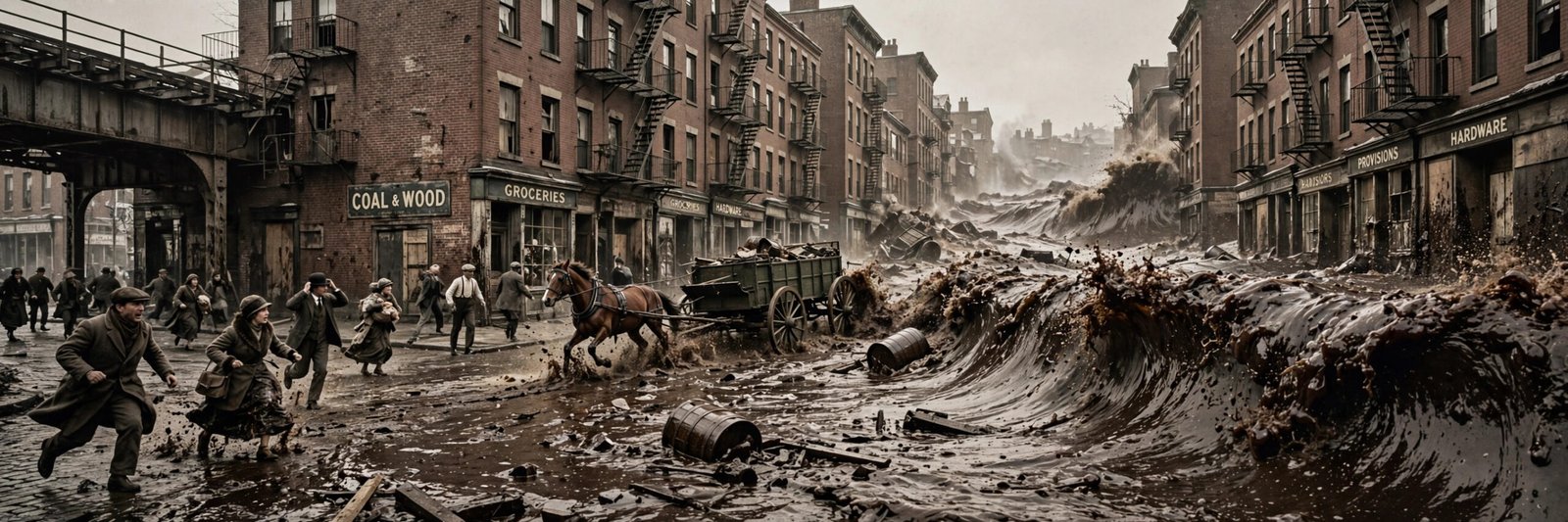
It sounds like something out of a cartoon: on a crisp winter afternoon in Boston, a giant tank split open and unleashed a 15-foot wall of molasses that roared through the streets at 35 miles per hour. It knocked a firehouse off its foundation, bent steel train tracks like pipe cleaners, and left a neighborhood drowning in sticky syrup. But the Great Molasses Flood 1919 was no joke. By the time the wave settled, 21 people were dead and roughly 150 were injured, in one of the strangest and deadliest accidents in American history.
How does sweet, slow-moving syrup become a killer? The answer involves a shoddily built tank, a freak warm day in the middle of winter, a company that cared more about money than safety, and the strange physics of a liquid that gets deadlier the colder it gets. If you love stories that feel too bizarre to be true, you will love the collection of real facts that sound completely made up — but first, settle in for the full story of Boston’s sticky disaster.
The Tank Nobody Trusted
The trouble started years before the flood, in 1915, when the Purity Distilling Company built a massive steel tank at 529 Commercial Street in Boston’s North End, right by the harbor. The tank stood 50 feet tall and 90 feet across — big enough to hold about 2.3 million gallons of molasses, weighing roughly 13,000 tons. Molasses was serious business in those days: it could be fermented into ethanol, an essential ingredient in munitions during and just after World War I, and the company had ships offloading the thick syrup straight into the tank.
Here is the first red flag: the tank was overseen by the company’s treasurer, Arthur Jell, who was not an engineer. According to historical accounts, the structure leaked from the very beginning — and by several accounts, the company had the tank painted brown to disguise the streaks of oozing molasses running down its sides. Imagine walking past a 50-foot tower that is literally weeping the stuff it is supposed to hold, and being told it is fine. The neighborhood kids reportedly helped themselves to drips of molasses off the tank. It was a disaster waiting for an excuse.
In 1917, Purity Distilling came under the control of the United States Industrial Alcohol Company (USIA), but the tank’s problems stayed the same. A 2014 engineering investigation into the failure would later find that the tank’s steel walls were about half as thick as they needed to be, and that the steel itself was brittle — the same type of steel used on the Titanic, as reported by New England media. In other words, the tank was a giant tin can trying to do a battleship’s job.
January 15, 1919: The Day Boston Turned Brown
January 15, 1919, was a Wednesday, and it was unusually warm for a Boston winter. The temperature had jumped from a frigid 2°F earlier in the week to about 40 or 41°F that day. Two days earlier, the tank had been topped off with a fresh shipment of warm molasses from the Caribbean. The physics were unforgiving: the warmer, fresher molasses began fermenting and expanding inside the already-weakened tank, and the pressure kept building.
At about 12:30 p.m., just as the city was heading out for lunch, the tank exploded. Witnesses described a dull, muffled roar, and then the top of the tank was blown into the air. Out poured 2.3 million gallons of molasses — and it did not trickle. It came as a dense, dark wave estimated at about 15 feet high and up to 160 feet wide, tearing through the North End at an estimated 35 miles per hour.
Try to picture what a 13,000-ton wave of syrup does to a city. The flood knocked Boston’s Engine 31 firehouse off its foundation. It buckled the steel girders of the elevated railway as if they were wire. It flattened buildings, uprooted lampposts, and swamped several blocks two to three feet deep in molasses. About 25 horses were killed outright, many of them trapped like flies on flypaper — the more they struggled, the deeper they sank. The Boston Post reported the next day that molasses waist-deep covered the street, and that trapped people and animals could only be found by the thrashing of their bodies in the sticky mass.
Cadets from the nearby Massachusetts Nautical School were among the first to rush in to help, soon joined by police officers, Red Cross workers, and Navy and Army personnel. Makeshift hospitals were set up to treat the injured. But the rescue effort faced an enemy no one had trained for: the molasses itself.
Why the Great Molasses Flood 1919 Was So Deadly
This is the part of the story that turns the Great Molasses Flood 1919 from a freak accident into a physics lesson. Molasses is not water. It is enormously viscous — thick and slow at room temperature — and it gets dramatically thicker as it cools. On that January day, the wave surged out fast and hot, but as it spread across the freezing streets, it cooled and turned into something closer to glue.
Victims who might have waded out of a water flood found themselves cemented in place. The harder they struggled, the more the thickened molasses held them. Rescue workers found that the usual tools were useless; horses that fell into it could not be pulled free. A 2016 study by Harvard researchers, covered widely in the press, confirmed through fluid dynamics that the cooling effect made the wave even more dangerous than witnesses estimated — the reported speeds and the deadly physics checked out.
Then came the cleanup, which lasted about two weeks. Workers flooded the streets with salt water from the harbor, trying to thin the syrup enough to wash it away. But the stickiness won for months: everything the molasses had touched stayed tacky, and Boston Harbor reportedly ran brown for a long time after. For decades afterward, North End residents swore that on hot summer days, you could still smell molasses in the air — a claim historians treat as local folklore rather than established fact, but one that shows just how deeply the disaster stuck in the city’s memory.
The Blame Game and the Lawsuit That Changed Everything
From the moment the dust — or rather, the syrup — settled, the question was who was responsible. USIA, the company that owned the tank, had an answer ready: sabotage. They claimed that anarchists had bombed the tank, a theory that was not entirely crazy in 1919, an era of labor unrest and real bombings. It was, however, almost certainly a distraction from their own negligence.
What followed was one of the longest and most complex lawsuits in Massachusetts history. The hearings dragged on for years, with 119 witnesses and mountains of evidence. Finally, in April 1925, the court-appointed auditor, Hugh W. Ogden, delivered his ruling: there was no bomb. The company was responsible for building and operating an unsafe tank. The victims and their families were awarded a total of about $628,000 in damages — a massive sum at the time — making the case one of Massachusetts’ earliest major class-action-style lawsuits.
The legal fight did more than pay the victims. The case became a landmark example of corporate accountability, and it is often credited with helping to push Massachusetts toward stricter oversight of building construction. The lesson was simple and permanent: you cannot put 13,000 tons of anything in a tank designed by a treasurer and painted to hide its leaks.
A Sticky Legacy: Remembering the Great Molasses Flood 1919
Today, the spot where the tank stood is Langone Park in Boston’s North End, a cheerful little green space with a playground and a small plaque marking what happened there in 1919. In 2019, ground-penetrating radar surveys confirmed that the tank’s concrete base was still buried under the park — the foundation of the disaster, still there a century later. The story has inspired books, including Stephen Puleo’s bestselling Dark Tide, and even an off-Broadway musical.
But the deepest legacy of the Great Molasses Flood 1919 is the way it refuses to be forgotten. It shows up on every list of the strangest disasters in history, right alongside stories that seem too odd to be real. It is a reminder that history is not just wars and presidents — sometimes it is a wave of syrup in the wrong place at the wrong time, in a tank that never should have been built.
- When: January 15, 1919, around 12:30 p.m., in Boston’s North End.
- What: A 50-foot steel tank holding about 2.3 million gallons of molasses burst, sending a wave roughly 15 feet high through the streets at about 35 mph.
- The toll: 21 people killed (ages 10 to 78) and about 150 injured, plus around 25 horses dead.
- Why it happened: A poorly designed and built tank, weakened steel, a warm winter day, and freshly added warm molasses that fermented and expanded.
- The outcome: A landmark 1925 court ruling found the company liable; victims were awarded about $628,000.
- The legacy: One of the strangest disasters in American history — and a permanent lesson in building safety.
Stories like this are why the past never gets boring. For another journey into a very different ancient world, check out the discovery of a Second Temple burial cave in Jerusalem — proof that history still hides surprises underground. And if you want your sense of what is possible stretched even further, these space facts that sound fake but are 100 percent real will do the job.
Frequently Asked Questions
How many people died in the Great Molasses Flood?
Twenty-one people were killed and about 150 were injured when the tank burst on January 15, 1919. The victims ranged in age from 10 to 78 years old. Roughly 25 horses also died in the flood.
How fast did the molasses wave move?
The wave was estimated to have traveled at about 35 miles per hour and stood roughly 15 feet high at the start. Historical estimates of the wave’s height vary between about 15 and 25 feet, but the speed estimate of 35 mph is the most widely cited figure.
What caused the Great Molasses Flood 1919?
A combination of factors: a poorly designed tank with steel walls about half as thick as needed, built under a company treasurer who was not an engineer; a rapid temperature swing from 2°F to about 40°F; and freshly added warm molasses that fermented and expanded, raising the pressure inside the weakened tank until it failed.
Did the company get punished for the disaster?
Yes. After the company blamed anarchist saboteurs, a years-long court case ended in April 1925 with auditor Hugh W. Ogden ruling that the company was responsible. Victims and families received about $628,000 in total damages, making it one of Massachusetts’ earliest major class-action-style cases.
Can you still smell molasses in Boston’s North End?
Residents claimed for decades that the area still smelled of molasses on hot summer days. Historians treat this as local folklore rather than a proven fact — but it shows how deeply the Great Molasses Flood 1919 stuck in Boston’s collective memory. The site is now Langone Park, and the tank’s buried base was located there in 2019.