
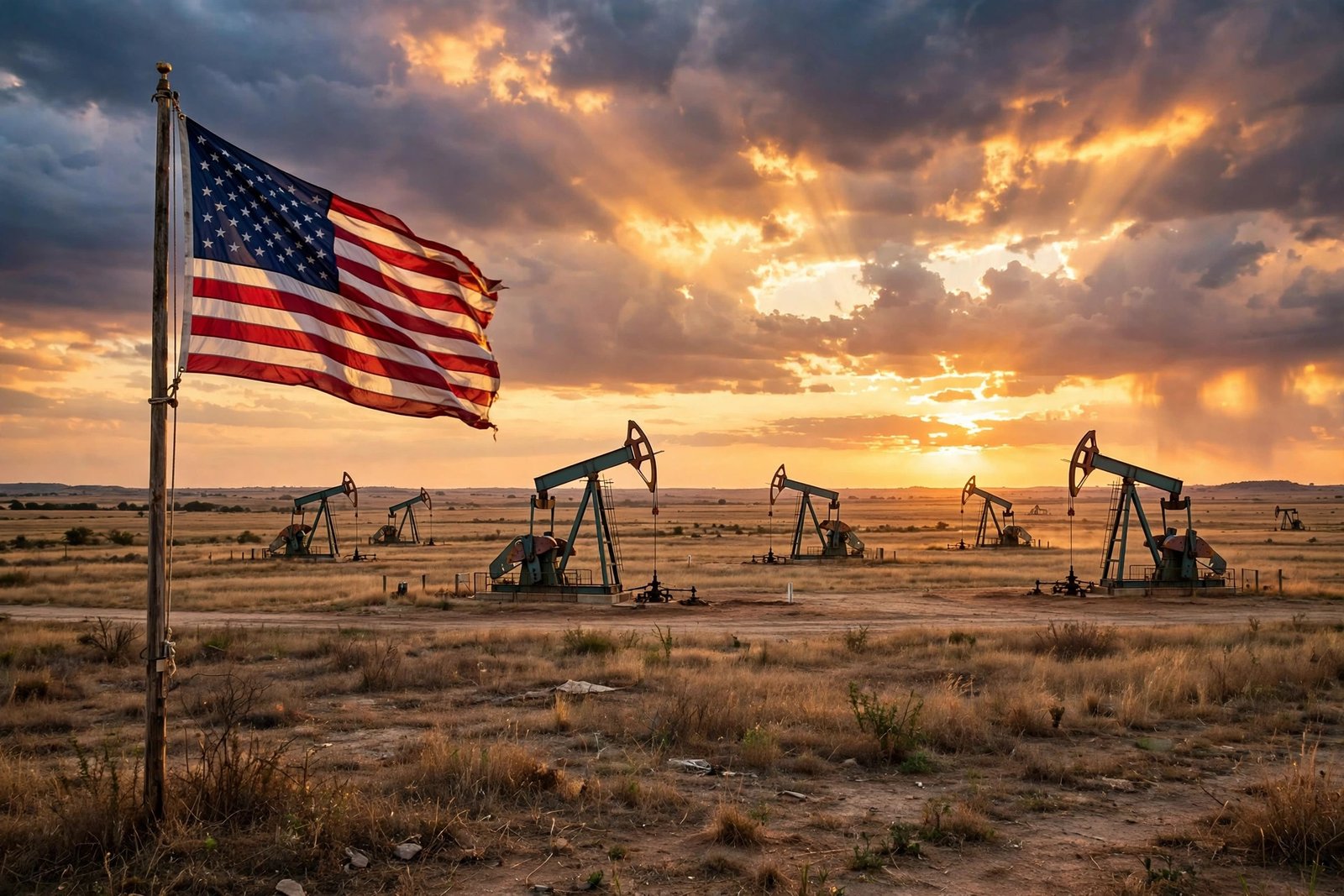
On the eve of the 2026 midterm elections, President Donald Trump took the stage for his final pitch at the Lincoln Memorial Reflecting Pool on November 2, 2026 — and energy became one of his closing arguments. The Trump oil supplier claim at the heart of that pitch was striking: that the United States is now the world’s largest oil and gas supplier, and that the United States plus Venezuela hold nearly half of the world’s oil reserves, more than Saudi Arabia and Russia combined. Big claims deserve careful checking, so this article puts each half of the claim against the public numbers, and separates what is verified from what is disputed.
That distinction matters, because this is not a case of a claim that is simply true or simply false. One part of it lines up well with official data. The other part falls apart when you do the arithmetic. Understanding why requires knowing the difference between producing oil, holding oil in the ground, and actually supplying it to the rest of the world — three things that sound alike but measure very different realities.
A note on method before we start. This article reports the pitch as a claim, not as an established fact, and checks it against published figures from the U.S. Energy Information Administration (EIA) and the Organization of the Petroleum Exporting Countries (OPEC). Where sources disagree — and on reserves, they sometimes do — we say so, and show how the conclusion changes depending on which estimate you use. No 2026 election result is reported here, because voting is still under way.
What the Trump Oil Supplier Claim Actually Says
Stripped to its essentials, the claim has two parts. First, that the United States is now the world’s largest oil and gas supplier. Second, that the United States and Venezuela together hold nearly half of the world’s oil reserves — and more than Saudi Arabia and Russia combined.
Notice how the two parts work together as a political argument. The first part says America produces more than anyone. The second part says America and its hemisphere neighbor sit on more of the world’s remaining oil than the two countries most associated with oil power. Together, they paint a picture of American energy dominance, today and into the future.
It is a powerful story, and stories like this are exactly why fact-checking exists. A claim can feel true, and even contain true ingredients, while still misleading in its total effect. The only way to judge it fairly is to test each part separately, with real numbers, and to be honest about where the evidence is strong and where it is thin.
Checking Part One: Is America the World’s Largest Oil and Gas Supplier?
On production, the evidence is strong. According to the EIA, the United States remained the world’s largest crude oil producer in 2025, extending a streak that began in 2018 when the United States overtook Russia. American crude oil production, including lease condensate, averaged a record-high 13.6 million barrels per day in 2025, breaking the previous American and global record of 13.2 million barrels per day set in 2024.
The gap is not small. The EIA reports that American crude production was about 40 percent higher on average in 2025 than that of the next two largest producers, Russia and Saudi Arabia. Russia averaged 9.9 million barrels per day in 2024 and remained largely unchanged in 2025, while Saudi Arabia’s production rose from 9.2 million barrels per day in 2024 to 9.6 million in 2025. The EIA also forecasts American production holding near 13.7 million barrels per day in 2026 before rising to 14.2 million in 2027.
On natural gas, the picture is similar. The EIA notes that the United States has been the world’s largest natural gas producer since 2011, and that total American energy production set a new record of 107 quadrillion British thermal units in 2025, driven by record production in natural gas, crude oil, natural gas plant liquids, and renewables. Most of the crude growth came from the Permian Basin of western Texas and southeastern New Mexico, where drilling productivity keeps improving.
So if “supplier” means “producer,” the first part of the claim is well supported for oil and gas alike. But the word “supplier” is doing some quiet work here, and it deserves scrutiny. Producing the most oil is not the same as exporting the most oil. The United States is also the world’s largest oil consumer — Forbes, cited in energy industry coverage of the EIA data, puts American consumption at about 19.4 million barrels per day in 2025. A country that burns most of what it pumps is a different kind of “supplier” than a country that ships most of its output abroad. The claim is at its strongest when read as a production claim, and at its weakest when read as a claim about who feeds world markets.
Verdict on part one: largely accurate as a statement about production, but the word “supplier” blurs an important distinction between producing energy and exporting it.
Checking Part Two: Do the US and Venezuela Hold Nearly Half the World’s Oil?
This is where the Trump oil supplier claim runs into trouble, and the arithmetic is simple enough for anyone to check. The most widely cited reserve figures come from OPEC’s Annual Statistical Bulletin 2025, which reports proven crude oil reserves at the end of 2024. Here are its headline numbers:
- Venezuela: about 303 billion barrels — the world’s largest proven reserves, nearly one-fifth of the global total on its own.
- Saudi Arabia: about 267 billion barrels, the second-largest holder.
- Russia: about 80 billion barrels.
- United States: about 45 billion barrels, ranking tenth in the world.
- World total: about 1,567 billion barrels of proven crude oil reserves.
Now add up the claim’s two sides. The United States plus Venezuela: 45 plus 303 equals 348 billion barrels. Saudi Arabia plus Russia: 267 plus 80 equals 347 billion barrels. On OPEC’s own figures, the two pairs are essentially tied — the American-Venezuelan total is higher by a single billion barrels, a rounding error at this scale. It is not “more” in any meaningful sense, and it is certainly not a commanding lead.
And “nearly half the world’s oil reserves”? Divide 348 billion by the world total of 1,567 billion and you get about 22 percent — roughly one-fifth, not one-half. To hold nearly half the world’s reserves, the United States and Venezuela would need something like 780 billion barrels between them. They have less than half of that. Even Venezuela alone, the world’s largest reserve holder, accounts for only about 19 percent of the global total.
It is fair to note that reserve estimates vary by source and method. Some compilations put American proven reserves higher, around 74 to 84 billion barrels, reflecting different definitions of what counts as recoverable. But even using the highest of those figures, the math does not rescue the claim: 303 plus 84 equals 387 billion barrels, or about 25 percent of the world total — still nowhere near half, and only modestly above the Saudi-Russian combined total. Under no mainstream estimate does the “nearly half” figure hold up.
There is also a practical caveat about Venezuela’s reserves. Much of Venezuela’s oil is heavy crude in the Orinoco Belt, which is costly and technically difficult to extract, and the country’s ability to export has been limited by sanctions and underinvestment. Holding the world’s largest reserves on paper is not the same as being able to pump them. That does not change the arithmetic, but it does change what the numbers mean in the real world.
Why the Trump Oil Supplier Claim Mixes Two Different Things
Part of what makes the Trump oil supplier claim persuasive is that it blends two genuinely impressive facts into one exaggerated conclusion. American production dominance is real: the United States pumps more crude oil than any country in history, and has led the world since 2018. Venezuela’s reserve dominance is also real: no country sits on more proven oil.
But production and reserves are different ledgers. The United States leads the first and ranks only tenth on the second. Venezuela leads the second but is not among the top producers. Adding a production leader to a reserve leader does not create a bloc that controls half the world’s oil — it creates a pair that holds about a fifth of it, roughly equal to the Saudi-Russian pair it was compared against.
This distinction between stocks and flows trips up even careful commentators. Reserves are a stock: oil still in the ground. Production is a flow: oil coming out of the ground each day. A country can have enormous reserves and modest production, like Venezuela, or enormous production and modest reserves, like the United States. Energy power comes from both, but they are not interchangeable, and a claim that treats them as if they were will mislead even when its ingredients are true.
For readers following the election itself, our US midterm elections November 3, 2026 guide covers what is on the ballot and when results can be expected. For the online side of this campaign, see our report on X suspending 13,000 accounts over foreign influence ahead of the midterms.
What Is Verified, What Is Disputed, and What Is Unclear
- Verified: The United States is the world’s largest crude oil producer, averaging a record 13.6 million barrels per day in 2025, about 40 percent above Russia and Saudi Arabia (EIA).
- Verified: The United States has been the world’s largest natural gas producer since 2011 (EIA).
- Verified: Venezuela holds the world’s largest proven oil reserves, about 303 billion barrels, followed by Saudi Arabia at about 267 billion (OPEC Annual Statistical Bulletin 2025).
- Disputed by the data: The claim that the United States and Venezuela hold “nearly half” the world’s oil reserves. On OPEC figures they hold about 22 percent; on the most generous American reserve estimates, about 25 percent.
- Essentially a tie, not a lead: The claim that the pair holds more than Saudi Arabia and Russia combined. On OPEC figures the totals are 348 billion versus 347 billion barrels.
- Unclear wording: “Largest supplier” is accurate for production but ambiguous for exports, since the United States is also the world’s largest oil consumer and consumes much of what it produces.
The honest overall judgment is therefore mixed: a strong production claim paired with a reserve claim that does not survive contact with the numbers. That mix is common in campaign-season energy rhetoric, where a real achievement — record American output — gets stretched into a broader assertion about control of the world’s oil that the data cannot support. Read as a whole, the Trump oil supplier claim is therefore half verified and half overstated.
Key Takeaways
- The production half of the claim is solid: the United States leads the world in both crude oil and natural gas production, with record 2025 output.
- The reserve half is not: the United States and Venezuela together hold roughly a fifth of the world’s proven oil reserves, not nearly half.
- On OPEC’s figures, the American-Venezuelan reserve total (348 billion barrels) is effectively tied with the Saudi-Russian total (347 billion), not greater than it.
- Production, reserves, and exports are three different measures. Conflating them is the easiest way to make an energy claim sound bigger than it is.
- Venezuela’s giant reserves are mostly heavy Orinoco crude, costly to extract, and its exports have been constrained by sanctions and underinvestment.
- A claim can contain true facts and still mislead overall — which is why each part deserves its own check.
Sources for the figures above include the EIA’s analysis of 2025 crude production (eia.gov), the EIA’s record energy production report (eia.gov), USAFacts’ country-by-country production breakdown (usafacts.org), and reporting on the OPEC 2025 Annual Statistical Bulletin’s reserve rankings (indianexpress.com).
Frequently Asked Questions
Is the United States really the world’s largest oil producer?
Yes. According to the EIA, the United States produced more crude oil than any other country in 2025, averaging a record 13.6 million barrels per day, and has held the top spot every year since 2018. It is also the world’s largest natural gas producer, a position it has held since 2011.
Does the United States hold the world’s largest oil reserves?
No. The United States ranks around tenth in proven reserves, at about 45 billion barrels on OPEC’s figures (some sources estimate higher, up to roughly 84 billion). Venezuela holds the largest proven reserves at about 303 billion barrels, followed by Saudi Arabia at about 267 billion.
Do the US and Venezuela hold nearly half the world’s oil reserves?
No. Together they hold about 348 billion barrels out of a world total of about 1,567 billion — roughly 22 percent, or about one-fifth. Even using the highest mainstream estimate for American reserves, the share rises only to about 25 percent, far short of half.
Do the US and Venezuela hold more oil than Saudi Arabia and Russia combined?
Only by a rounding margin on OPEC’s figures: 348 billion barrels versus 347 billion. That is effectively a tie, not the clear lead the claim suggests. Using a higher estimate for American reserves would widen the gap modestly, but would still leave the “nearly half” part of the claim unsupported.
What is the difference between oil production, reserves, and exports?
Production is how much oil a country pumps each day. Reserves are how much oil is estimated to remain recoverable in the ground. Exports are how much a country sells abroad. A country can lead on one measure and lag on another — the United States leads on production but ranks tenth on reserves, and consumes much of what it produces.