
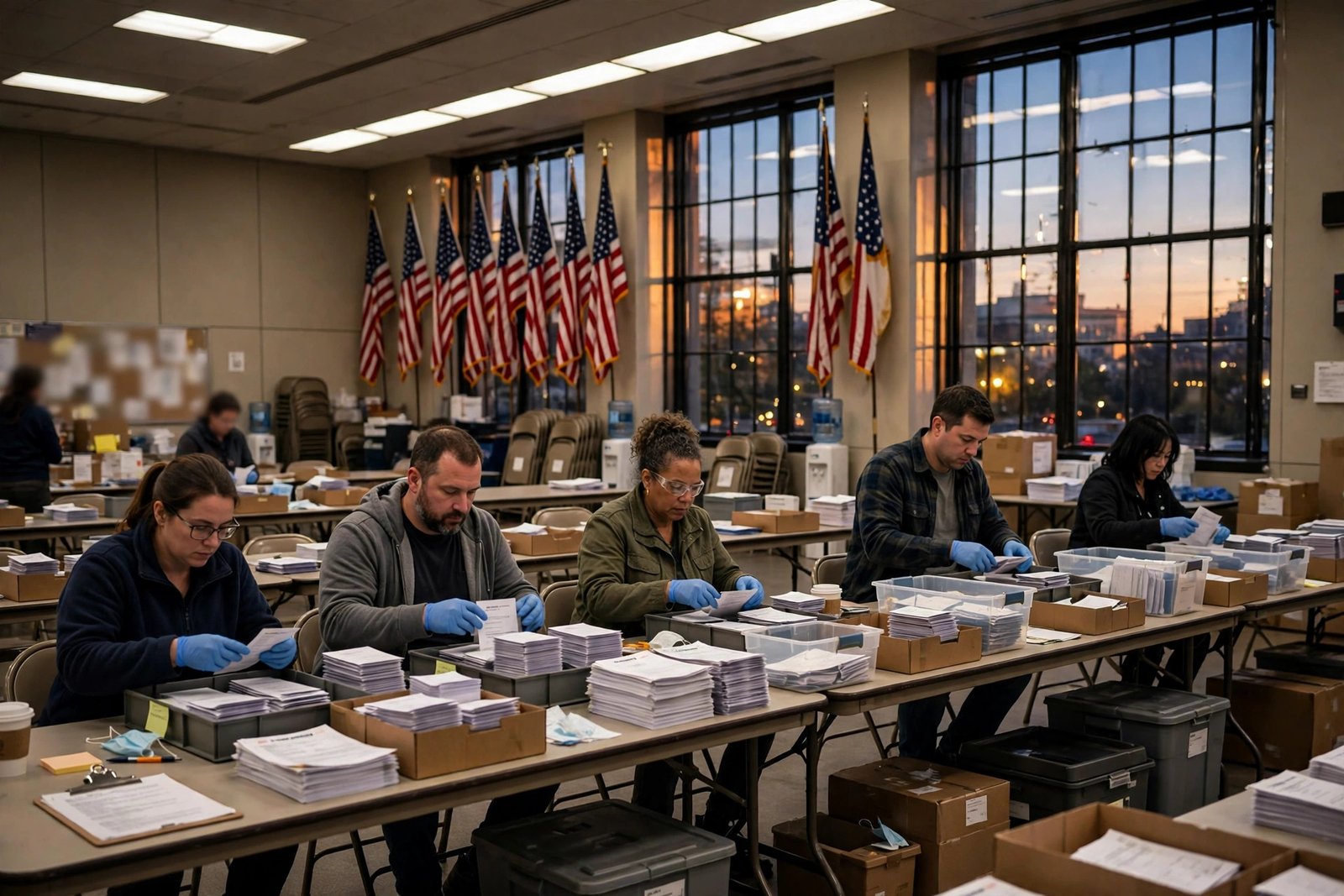
Millions of Americans will go to sleep on Tuesday, November 3, 2026, with the biggest question of the midterm elections still unanswered — and that is completely normal. If you have ever refreshed a results page at midnight and wondered why election results take days to settle, you are not alone. Every election night ends the same way: some races are called within minutes, others stay uncalled for days, and a few take weeks. That wait can feel strange in an age of instant everything, but it is built into the way American elections work.
Here is the part most people miss. On election night, nobody is announcing official results. News organizations are making projections. The real, official count happens later, county by county and state by state, under rules that differ in all 50 states. In 2026, with all 435 House seats, 35 Senate seats, and 36 governorships on the ballot, there are thousands of separate counts happening at once — and the closest ones simply cannot be finished in a single evening.
This explainer breaks down the whole process in plain language: what a race “call” really is, why mail ballots slow things down, why some states are always last, and when the official results finally become final. No results are reported here, because at the time of writing the votes are still being cast and counted. This is about the system, not the outcome.
What “Calling” a Race Actually Means
When a television network or news agency “calls” a race, it is not counting the last ballot. It is making a statistical judgment that the trailing candidate can no longer catch up. The Associated Press, whose calls most American outlets rely on, says it calls a race only when the trailing candidate no longer has a path to victory. That is a projection, not a certificate.
Think of it like a football game in the fourth quarter. If one team leads by 40 points with two minutes left, you do not need to watch the final seconds to know who won. But if the score is tied, you have to wait for the last play. Landslide races get called the moment polls close. Close races cannot be called until almost every ballot is counted, because the remaining ballots could change the result.
There is no official national results service in the United States. Each state runs its own election, publishes its own counts, and certifies its own results weeks later. News organizations fill the gap on election night with their own decision desks, exit polls, and models. That is why different networks sometimes disagree for a while on the same race — they are making independent judgments from the same partial data.
The AP says it will call nearly 7,000 races in this election cycle. In 2000, famously, it never called Florida at all. That caution is a feature, not a failure. A wrong call is far more damaging than a slow one, so decision desks would rather wait than guess.
Why Election Results Take Days in Mail-Heavy States
The single biggest reason why election results take days is mail ballots. A ballot cast in person is scanned and tallied almost immediately. A mail ballot has to go through a much longer journey before it can even be counted.
First, election workers must record each returned envelope and compare the voter’s signature with the one on file — a check that also guards against anyone voting twice. Only then can workers open the envelope, remove the ballot, flatten it, and scan it. Multiply that careful, hands-on process by millions of envelopes, and the hours add up fast.
Some states make this slower by law. According to the National Conference of State Legislatures, 44 states let election officials start processing mail ballots before Election Day, but six do not: Alabama, Mississippi, New Hampshire, Pennsylvania, West Virginia, and Wisconsin can only start on Election Day itself. Pennsylvania and Wisconsin, both home to closely watched races, cannot touch mail ballots until the morning of Election Day, so their counts often run deep into Wednesday.
Then there are the ballots that arrive after Election Day. Thirty-five states require mailed ballots to arrive by Election Day, but 15 states and Washington, D.C., count ballots that arrive afterward if they are postmarked in time. California accepts ballots postmarked by Election Day that arrive by November 10. Illinois allows up to 14 days. A close race in one of those states simply cannot be called until the last legal ballot is in.
California deserves special attention, because it is the state most likely to keep the country waiting. More than 80 percent of California voters typically vote by mail, and many counties receive a large share of their mail ballots on Election Day itself. Election researchers call this the “pig in the python” problem: a huge bulge of ballots arrives all at once and takes days to work through. California also gives voters time to fix signature problems, which is fair but slow.
Election Results Take Days Because Close Races Need Every Ballot
Here is a simple rule of thumb: the closer the race, the longer the wait. A candidate leading by 20 points can be projected safely with half the votes counted. A candidate leading by 0.3 points cannot be projected at all until nearly every vote is in — because the uncounted votes could easily erase that lead.
This is why control of Congress often takes days to determine even when most individual races are called quickly. Control can come down to a handful of seats, and if even one of those seats is close, the whole chamber stays uncalled. In both 2022 and 2024, the AP did not call control of the House until eight days after the election, largely because so many competitive seats were in California and other slow-counting states.
Close races also trigger recounts. In 26 states and Washington, D.C., a close result triggers a recount automatically, and the most common trigger is a margin of 0.5 percent, according to the National Conference of State Legislatures. Recounts take time, and they can change — or confirm — very tight results.
There is another wrinkle in 2026: ranked-choice voting. Maine and Alaska both use it, and both have competitive Senate races this year. If no candidate wins more than half of first-choice votes, the last-placed candidates are eliminated in rounds until someone has a majority. Maine has historically not known its outcome until the week after the election, and Alaska accepts ballots mailed from abroad for 15 days — its ranked-choice count is not scheduled until November 18.
Georgia adds one more possibility. If no candidate wins a majority there, the race goes to a run-off, which could push the final result into December. None of this means anything went wrong. It means the rules are working exactly as written.
The State-by-State Patchwork That Slows Everything Down
America does not have one election. It has 50 state elections, plus the District of Columbia, each with its own deadlines, equipment, and procedures. That patchwork is the deeper reason the national picture takes so long to form.
- California: ballots postmarked by Election Day count if they arrive by November 10, and counties certify by December 3. Several House seats here are usually among the last called in the country.
- Alaska: counts absentee ballots mailed in the United States that arrive by November 13 and overseas ballots through November 18. In 2024, its House race was not called by the AP until November 20.
- Pennsylvania and Wisconsin: cannot begin processing mail ballots until Election Day morning, so their counts stretch into the night and beyond.
- Maine: uses ranked-choice voting and has historically needed until the week after the election to settle a Senate race without a first-round majority.
- Nevada: counts mail ballots arriving by November 7 if postmarked by Election Day, adding days to any close contest.
- South Dakota: sits at the fast end of the spectrum, certifying within about a week, while California can take up to 38 days to certify.
Poll closing times add another layer. The first polls close at 6 p.m. Eastern in Indiana and Kentucky, while Hawaii and Alaska are still voting hours later. Early calls from the East Coast therefore arrive while millions of western votes are still being cast — another reason the full picture cannot exist until the night is over.
For readers following the midterms closely, our US midterm elections November 3, 2026 guide explains what is on the ballot and how to check results state by state. And if you are wondering how online manipulation fits into this election season, see our report on X suspending 13,000 accounts over foreign influence ahead of the midterms.
Why Early Leads Can Flip Overnight
One of the most confusing election-night moments is watching a lead change as more votes are counted. A candidate ahead at midnight can trail by morning. This has a boring, mechanical explanation: different kinds of ballots are counted at different times.
In-person votes on Election Day are usually counted first. Mail ballots, which take longer to process, are counted later. If one candidate’s supporters voted mostly in person and the other’s mostly by mail, the early results will skew toward the first candidate and then shift as mail ballots arrive. Election experts call the early skew a “mirage” — it looks like a lead, but it is just an incomplete count.
A famous example comes from 2020, when one candidate led Wisconsin by more than 100,000 votes until Milwaukee’s mail ballots were added after 3 a.m. The shift was not suspicious; it was the scheduled arrival of a large batch of legally cast ballots. Late counting is normal, not a sign of fraud, and election security experts note that the patchwork system makes large-scale fraud very difficult.
The same logic applies in reverse in some states, where mail ballots are processed early and reported first. The lesson is the same either way: never trust an election-night lead until you know which ballots are still uncounted.
From Election Night to Certification: Weeks of Official Steps
Even after every race is “called,” the process is not over. The numbers you see on election night are unofficial, and they stay unofficial through the local canvass — the careful, county-level review where officials check that every ballot is accounted for, resolve challenged ballots, and reconcile the totals.
Certification is the step where election officials attest that the counting and canvassing are complete and accurate, and that the results are a true count of every vote cast, in the definition used by the U.S. Election Assistance Commission. As the National Conference of State Legislatures puts it, the certified results are the ones that are official and determine who gets sworn in.
Every state sets its own certification timeline, and the calendar can shift because of weekends and holidays. South Dakota certifies within a week. California takes up to 38 days. Most states fall somewhere in between. Winners of the 2026 midterms take office on January 3, 2027, when the new Congress convenes — comfortably after even the slowest certification.
It is worth remembering the scale of what is being certified. Voters are not just picking members of Congress. They are deciding 36 governorships, thousands of state legislative seats, and countless local offices and ballot measures. More than 40 million Americans had already voted before Election Day itself. Counting all of that carefully simply takes time.
What This Means for the 2026 Midterms
So what should you expect as the 2026 results come in? First, expect a flood of early calls on Tuesday evening for races that are not close. Second, expect the races that decide control of Congress to take longer — possibly days, as in 2022 and 2024. If control comes down to Alaska, it may not be known until the ranked-choice count on November 18. If it comes down to Maine, expect the week after the election.
Third, expect the conversation to move in stages: projections on election night, more calls through the week as mail ballots arrive, then certification over the following weeks. Each stage is a different thing, and confusing them is the main source of election-night anxiety.
Finally, remember that a slow count is not a broken count. The delays come from signature checks, postmark grace periods, ranked-choice rounds, recount laws, and 50 different state rulebooks — all designed, for better or worse, to make sure every legal vote is counted before anyone is declared the winner.
Key Takeaways
- Race “calls” are media projections, not official results. Official results come only after certification, which takes weeks.
- Mail ballots are the main reason counts take days: each envelope must be verified, opened, and scanned by hand.
- Close races take longest, because uncounted ballots could still change the outcome.
- California, Alaska, Pennsylvania, Wisconsin, and Maine are the states most likely to keep the country waiting in 2026.
- Early leads can flip when later-counted ballots arrive. That is a normal feature of counting, not evidence of a problem.
- In 2022 and 2024, House control was not called until eight days after Election Day. A similar wait in 2026 would be entirely normal.
For more background, see the South China Morning Post’s guide to the 2026 midterms (scmp.com), a state-by-state look at counting timelines (electiontracker.live), and a guide to when each state certifies its count (pinscene.com).
Frequently Asked Questions
Why do election results take days when other countries count overnight?
Most other democracies have one national election authority, one set of rules, and far fewer races on the ballot. The United States has 50 state systems, thousands of local contests, widespread mail voting, and postmark grace periods in 15 states plus Washington, D.C. The scale and the patchwork, not incompetence, create the wait.
Are election-night results official?
No. Election-night numbers are unofficial counts and media projections. Results become official only when each state certifies them after the local canvass. Certification deadlines range from about a week in South Dakota to up to 38 days in California.
What does it mean when the AP “calls” a race?
It means the AP’s decision desk has judged that the trailing candidate can no longer catch up, based on counted votes, remaining ballots, and voting patterns. It is a projection. In rare cases, such as Florida in 2000, the AP declines to call a race at all.
Why do results sometimes change after election night?
Because different types of ballots are counted at different times. Mail ballots take longer to process than in-person votes, and ballots that arrive after Election Day under postmark rules are counted later still. As those ballots are added, totals move — sometimes enough to flip a close lead.
When will we know who controls Congress in 2026?
Possibly by Wednesday morning if the decisive races are in fast-counting states, but history suggests a longer wait. In both 2022 and 2024, House control was not called until eight days after the election. If control depends on Alaska’s ranked-choice count, it could take until November 18.