
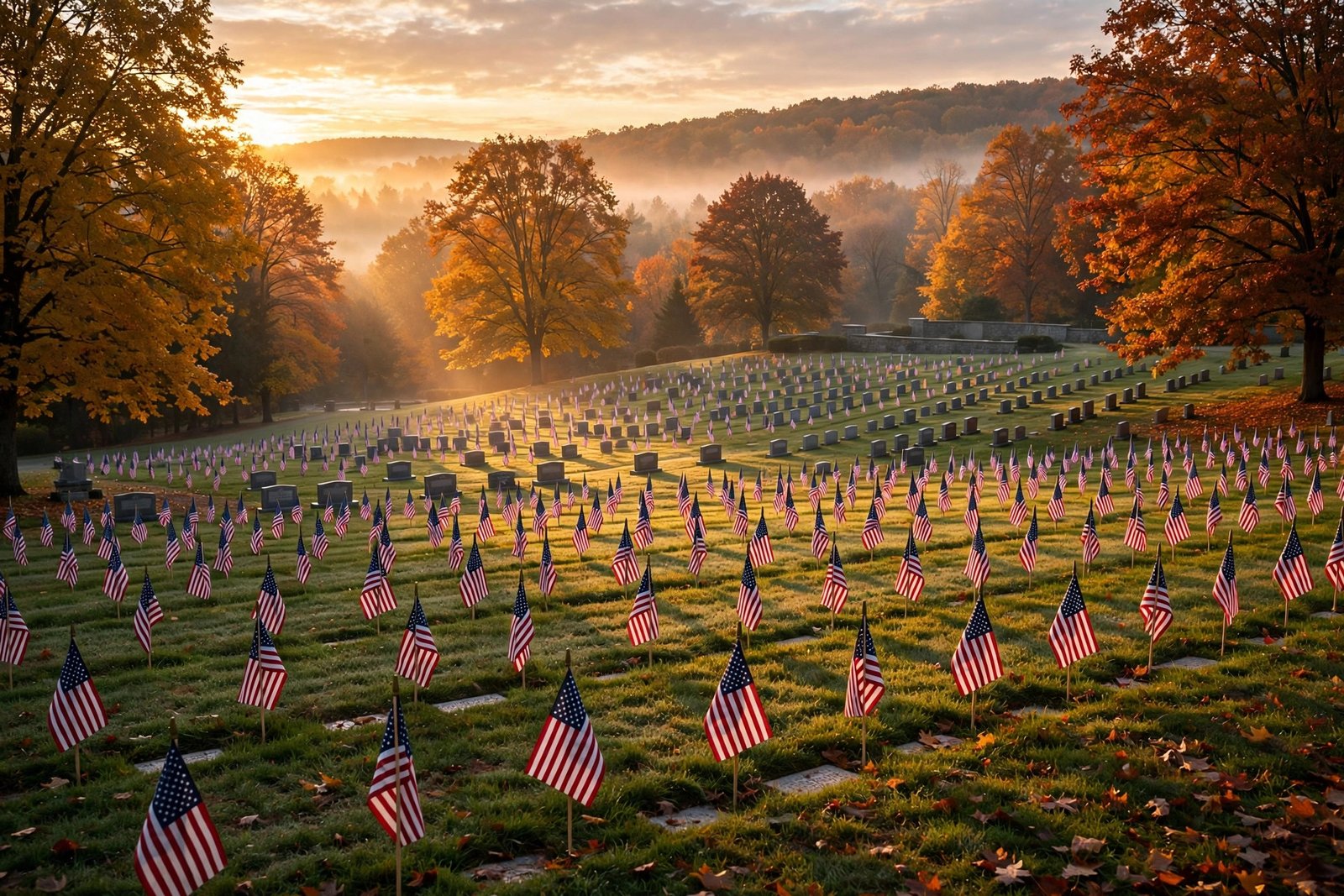
Here is a question that stumps a surprising number of Americans: why does Veterans Day always fall on November 11, even when it lands on a Tuesday, a Saturday, or any other day of the week? Most federal holidays move to a Monday to create a long weekend, but Veterans Day refuses to budge. The reason is one of the most powerful dates in modern history, and the Veterans Day November 11 history begins in the mud and smoke of World War I, at a moment the whole world was waiting for.
On the eleventh hour of the eleventh day of the eleventh month of 1918, the guns finally stopped. An armistice between the Allied nations and Germany took effect at 11 a.m., ending four years of fighting that had devastated a continent. That precise moment became sacred, and the date it happened on became a day of remembrance. More than a century later, America still honors its veterans on that exact date, no matter what day of the week it falls on.
In this article, we trace the full story: the 1918 Armistice, how Armistice Day became Veterans Day in 1954, the brief experiment with moving the holiday, how America marks the day today, and the important difference between Veterans Day and Memorial Day. If you have ever wondered why the calendar never moves this holiday, this is the answer.
Veterans Day November 11 History: The 1918 Armistice
World War I, known at the time as “The Great War,” had raged since 1914. By the autumn of 1918, Germany’s position had become untenable, and negotiations for an end to the fighting were underway. The result was an armistice, which is a temporary cessation of hostilities, rather than a final peace treaty. According to the U.S. Department of Veterans Affairs, the armistice between the Allied nations and Germany went into effect on the eleventh hour of the eleventh day of the eleventh month. For that reason, November 11, 1918, is generally regarded as the end of “the war to end all wars.”
It is worth keeping two events straight, because people often mix them up. The armistice stopped the fighting in November 1918, but the war did not officially end until the Treaty of Versailles was signed on June 28, 1919, in the Palace of Versailles outside Paris. November 11 commemorates the silencing of the guns, not the signing of the treaty. That distinction is exactly why the date carries such emotional weight: it marks the moment soldiers stopped dying, not the moment diplomats finished their paperwork.
The symmetry of the date helped it stick in public memory. Eleven, eleven, eleven at eleven o’clock is the kind of detail that feels almost designed, and it gave the new day of remembrance an instant identity. Other countries noticed too. In Britain and the Commonwealth, November 11 became Remembrance Day, marked by poppies and a two-minute silence. In France, it remains Armistice Day, a national holiday. America’s version of the story, however, would take its own path.
From Armistice Day to a National Holiday
A year after the guns fell silent, President Woodrow Wilson proclaimed the first commemoration of Armistice Day in November 1919. His words captured the mood of a nation that was relieved, proud, and grieving all at once: “To us in America, the reflections of Armistice Day will be filled with solemn pride in the heroism of those who died in the country’s service and with gratitude for the victory.” The original observance included parades, public gatherings, and a brief suspension of business at 11 a.m., a pause to remember what had happened at that exact hour one year earlier.
Congress formally recognized the end of World War I with a concurrent resolution on June 4, 1926. Then, in 1938, an act of Congress made November 11 a legal holiday, a day “dedicated to the cause of world peace and to be thereafter celebrated and known as Armistice Day.” At that point, the day was primarily set aside to honor veterans of World War I, the war whose end it marked.
Another layer of remembrance was added in 1921, when an unknown American soldier from World War I was buried at Arlington National Cemetery. That grave, on a hillside overlooking the Potomac River, became the Tomb of the Unknown Soldier, and it remains the focal point of the nation’s official Veterans Day ceremonies today. The idea of honoring an unknown soldier, someone whose name history could not recover, gave the day a deeply personal symbol that still moves visitors a century later.
How Armistice Day Became Veterans Day in 1954
The world changed dramatically between 1938 and 1954, and the holiday had to change with it. World War II required the greatest mobilization of American soldiers, sailors, Marines and airmen in the nation’s history, and then American forces fought again in Korea. A day honoring only World War I veterans no longer fit a country with veterans of three major wars.
The push for change started at the grassroots level. In 1947, Raymond Weeks, a World War II veteran in Birmingham, Alabama, organized a “National Veterans Day” celebration, complete with a parade, to honor veterans of all wars. The idea caught on. Representative Edward Rees of Kansas later proposed legislation to change Armistice Day to Veterans Day, and the 83rd Congress passed it. On June 1, 1954, President Dwight D. Eisenhower signed the bill, Public Law 380, which struck the word “Armistice” from the 1938 act and inserted “Veterans” in its place. From that day on, November 11 became a day to honor American veterans of all wars.
Eisenhower followed up later that year by issuing the first Veterans Day proclamation and creating a Veterans Day National Committee to coordinate the observance. The name change was more than cosmetic. It redefined the holiday’s purpose, and it is a central chapter of the Veterans Day November 11 history: instead of commemorating one war’s end, it would thank everyone who had ever worn the uniform, in war and in peace, living or dead. That broader mission is the reason Veterans Day still feels relevant today, long after the last World War I veteran has passed.
The Brief Experiment That Moved Veterans Day, and Why It Failed
If Veterans Day has always been November 11, why do some older Americans remember celebrating it in October? Because for a few years, it actually moved. In 1968, Congress passed the Uniform Monday Holiday Act, which shifted several federal holidays to Mondays to create more three-day weekends. Veterans Day was moved to the fourth Monday in October, and the change took effect in 1971.
The experiment did not last. Veterans groups and many ordinary citizens objected, arguing that moving the holiday stripped it of its historical meaning. November 11 was not an arbitrary date, it was the anniversary of the Armistice, and celebrating it in late October felt wrong. Congress listened. In 1975, Public Law 94-97 returned the observance to November 11, effective starting in 1978. Since then, the date has been fixed by law, regardless of the day of the week.
That history is the direct answer to our opening question. Veterans Day stays on November 11 because America already tried moving it, discovered that the date itself was part of the point, and moved it back. The failed experiment is now part of the Veterans Day November 11 history itself, a reminder that some traditions are anchored to a moment, not to a convenient weekend.
Veterans Day November 11 History: How America Marks the Day Today
Today, Veterans Day is a federal holiday, which means federal offices are closed and many schools, banks and businesses shut their doors or operate on reduced schedules. But the heart of the observance is ceremonial, and it still follows the rhythms established more than a century ago.
- The national ceremony at Arlington: The official national ceremony takes place at Arlington National Cemetery, at the Memorial Amphitheater built around the Tomb of the Unknowns. It typically includes a wreath-laying, a moment of silence, and remarks honoring veterans of every era.
- The 11 a.m. pause: Many observances still pause at 11 a.m., echoing the exact hour the Armistice took effect in 1918.
- Local parades and ceremonies: Towns and cities across the country hold parades, school assemblies, and veterans’ events, often organized by veterans’ service organizations.
- Flags and symbols: The American flag flies proudly, and many people wear a poppy, a symbol of remembrance that traces back to the poppies that grew on World War I battlefields.
- Thanking living veterans: Unlike Memorial Day, Veterans Day is a day to thank veterans who are still with us, with messages, meals, discounts, and simple conversations.
The day also has a practical side for veterans themselves. Many restaurants, retailers and attractions offer free meals or discounts to veterans on November 11, and communities organize events that connect veterans with services and support. If you are looking for a way to observe the day, the simplest and most meaningful option is also the oldest: say thank you to a veteran, and mean it.
For readers who enjoy turning points in history, our story on the night the Berlin Wall fell on November 9, 1989 covers another November date that reshaped the world, just two days earlier on the calendar.
Veterans Day vs. Memorial Day: The Difference That Matters
One of the most common confusions about American holidays is the difference between Veterans Day and Memorial Day. Both honor military service, but they honor different people, and getting it right matters to the veterans themselves.
- Veterans Day (November 11) honors all American veterans, living or dead, who served in the U.S. Armed Forces, in wartime or peacetime. It is a day of thanks to the living as much as remembrance of the dead.
- Memorial Day (last Monday in May) specifically honors those who died while serving in the U.S. military. It began after the Civil War as Decoration Day, when Americans decorated the graves of fallen soldiers.
A simple way to remember it: on Veterans Day, you thank a veteran; on Memorial Day, you remember one who never came home. Mixing them up is an honest mistake, but veterans notice, and the distinction is worth learning. Armed Forces Day, in May, adds a third note: it honors those currently serving on active duty. Together, the three holidays cover the past, the present, and the fallen, and each has its own place on the calendar.
Why November 11 Still Matters in 2026
More than a century after the Armistice, Veterans Day in 2026 falls on Wednesday, November 11. There are no living veterans of World War I left to honor, and the world that produced the Armistice is gone. So why does the date still matter? Because the holiday long ago outgrew its origins. It now honors veterans of World War II, Korea, Vietnam, the Gulf War, Iraq, Afghanistan, and every peacetime posting in between.
The date also serves as a yearly reminder of something easy to forget in everyday life: that the freedoms Americans enjoy were defended by real people, many of them young, who interrupted their lives to serve. The fixed date helps. By refusing to drift to a convenient Monday, November 11 forces the country to stop on the actual anniversary, in the middle of the week if necessary, and remember why it is stopping.
There is a lesson in that stubbornness that goes beyond the military. Some dates earn their place on the calendar by what happened on them, and moving them for convenience quietly erases the memory they exist to protect. America learned that lesson with Veterans Day in the 1970s, and the holiday has stayed put ever since. For a lighter look at how November dates make history in a very different arena, see our celebrity coverage of Kylie Jenner’s Victoria’s Secret runway moment, which also had the internet talking this season.
Key Takeaways
- The fighting in World War I stopped at 11 a.m. on November 11, 1918, under an armistice between the Allies and Germany.
- President Wilson proclaimed the first Armistice Day in November 1919; Congress made November 11 a legal holiday in 1938.
- In 1954, President Eisenhower signed legislation changing Armistice Day to Veterans Day, honoring veterans of all wars.
- A 1968 law moved the holiday to a Monday in October, but Congress returned it to November 11 in 1975, effective 1978.
- Veterans Day honors all who served, living or dead; Memorial Day specifically honors those who died in service.
- The national ceremony is held at Arlington National Cemetery, at the Tomb of the Unknowns, often with a pause at 11 a.m.
Conclusion
So why is Veterans Day always on November 11? Because that date is the reason the holiday exists, and the Veterans Day November 11 history proves it. The eleventh hour of the eleventh day of the eleventh month was the moment the guns of World War I fell silent, and every part of the holiday’s story, from Wilson’s first proclamation to the 1954 renaming to the failed Monday experiment, flows from that single fact. Moving the holiday would not just change a day off work; it would cut the thread connecting the celebration to the event it commemorates. That is why, in 2026 and every year, Veterans Day stays exactly where history put it: November 11, whatever day of the week that happens to be.
Frequently Asked Questions
Why is Veterans Day celebrated on November 11?
Veterans Day is celebrated on November 11 because the armistice that ended fighting in World War I took effect at 11 a.m. on November 11, 1918. The date became Armistice Day, and later Veterans Day, and Congress fixed it on November 11 by law in 1975.
When did Armistice Day become Veterans Day?
Armistice Day became Veterans Day in 1954. On June 1, 1954, President Dwight D. Eisenhower signed Public Law 380, which replaced the word “Armistice” with “Veterans” in the 1938 holiday act, so the day would honor American veterans of all wars.
What is the difference between Veterans Day and Memorial Day?
Veterans Day honors all American veterans, living or dead, who served in the U.S. Armed Forces. Memorial Day, on the last Monday in May, specifically honors those who died while serving in the military.
Was Veterans Day ever celebrated on a different date?
Yes. Under the Uniform Monday Holiday Act, Veterans Day was observed on the fourth Monday in October from 1971 to 1977. Public unhappiness with losing the historical date led Congress to return the observance to November 11, effective in 1978.
How is Veterans Day observed in the United States?
The national ceremony is held at Arlington National Cemetery at the Tomb of the Unknowns, often with a wreath-laying and a pause at 11 a.m. Communities also hold parades and ceremonies, and many people thank living veterans or attend local veterans’ events.