
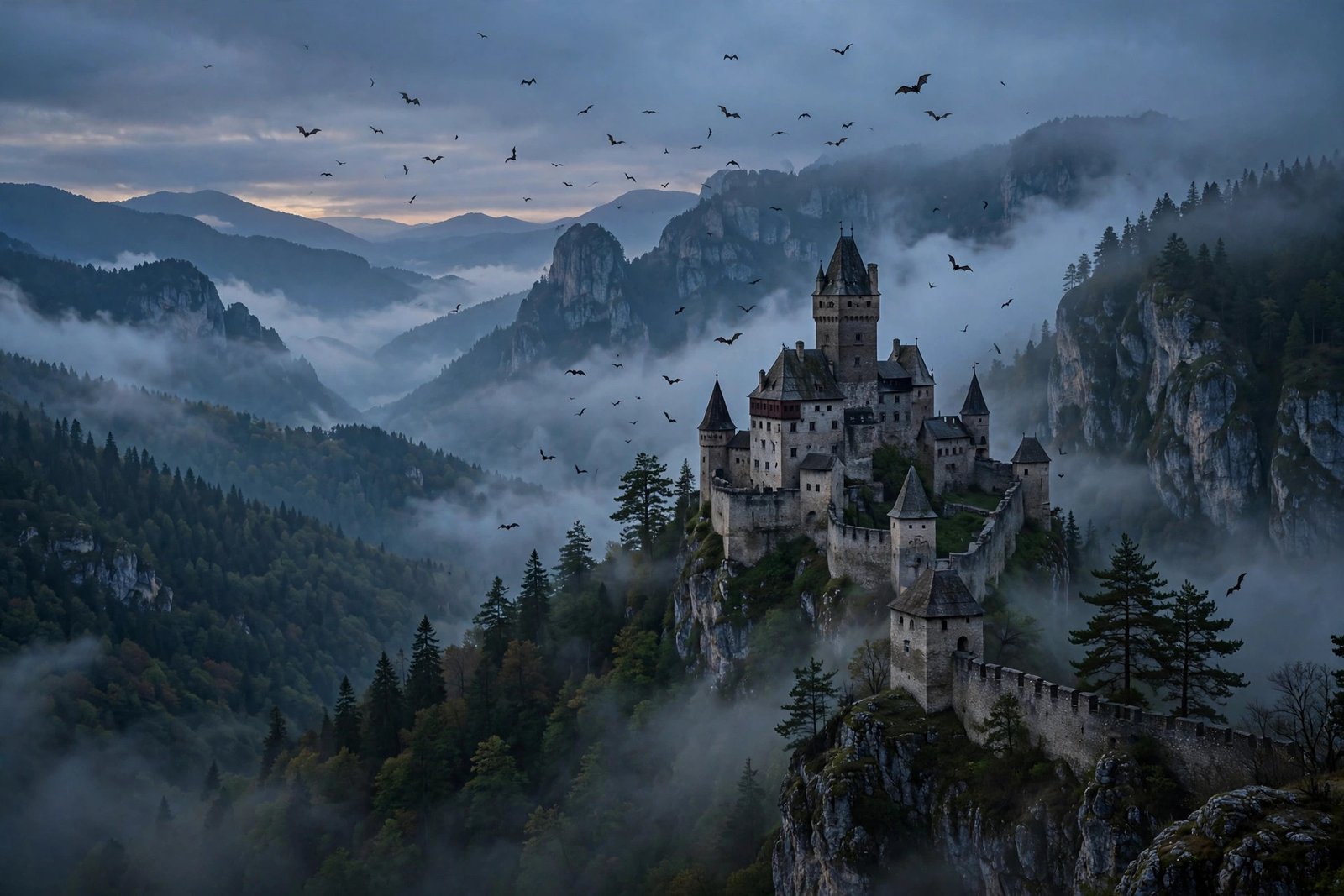
Long before Count Dracula ever stalked the pages of a novel, there was a real prince whose reputation was terrifying enough to inspire one of the most famous monsters in fiction. Vlad the Impaler was not a vampire, he did not sleep in a coffin, and he never drank blood — but the stories told about his cruelty travelled across Europe and survived for centuries, long enough for a Victorian novelist to borrow his name and turn him into a legend.
So who was the real man behind the myth? He was a 15th-century ruler of a small principality called Wallachia, in what is now Romania, caught between powerful neighbours and fighting for survival in a brutal age. His life was full of war, imprisonment, betrayal, and revenge — the kind of story that almost sounds fictional on its own. Yet separating the documented history from the horror stories that grew up around him is where things get truly fascinating.
In this article, we look at what historians actually know about Vlad III, why he earned such a fearsome nickname, how he clashed with the mighty Ottoman Empire, and how Bram Stoker later transformed a Wallachian prince into the world’s most famous vampire. Some of what you think you know about Dracula is true. Much of it is not — and the real story is stranger than the fiction.
Who Was Vlad the Impaler?
Vlad III was born into the House of Draculesti, a branch of Wallachia’s ruling family. His father, Vlad II, was known as Vlad Dracul — a name linked to his membership in the Order of the Dragon, a chivalric order founded to defend Christianity in eastern Europe. The word “Dracul” could mean dragon or devil, depending on context, and his son later became known as Dracula, meaning “son of Dracul.” That family name, not a taste for blood, is the true origin of the Dracula connection.
Wallachia in the 1400s was not a large or wealthy kingdom. It sat between the Kingdom of Hungary to the north and west and the expanding Ottoman Empire to the south, and its rulers constantly had to choose sides, pay tribute, or fight to stay independent. Vlad III ruled Wallachia in three separate periods during this turbulent century, and each reign was shaped by conflict — with rival claimants to his own throne, with Hungarian nobles, and above all with the Ottomans.
As a young man, Vlad spent years as a hostage at the Ottoman court, along with his younger brother Radu. Hostage-taking was a common diplomatic practice of the time: rulers sent their sons to a stronger power as a guarantee of loyalty. Historians generally agree that this experience shaped Vlad deeply. He learned Ottoman military tactics and court politics from the inside, and he also developed a lasting hostility toward the empire that had held him captive. When he later returned to Wallachia to claim power, he brought that knowledge — and that resentment — with him.
Life at the top in Wallachia was never secure. Boyars, the powerful local nobles, frequently plotted against their princes, and rival families competed for the throne. Vlad III dealt with these threats ruthlessly, and it is that ruthlessness, recorded by both his enemies and his supporters, that built his enduring reputation. To his supporters, he was a harsh but just ruler who punished crime and corruption without favour. To his enemies, he was a tyrant whose punishments were designed to terrify.
Why Was He Called Vlad the Impaler?
The nickname comes from his preferred method of execution: impalement. Victims were impaled on long wooden stakes, a slow and public form of execution that was intended to be seen. In an age when public punishment was itself a form of communication, a forest of stakes outside a town sent a message no one could miss: cross this ruler, and this is what happens.
It is important to be honest about what we know here. Impalement was not invented by Vlad III, and it was used elsewhere in Europe and the Ottoman world at the time. What made Vlad stand out, according to contemporary accounts, was the scale and theatricality with which he used it. German pamphlets printed in his lifetime described him impaling merchants, criminals, and captured enemies in large numbers, and those pamphlets — essentially the tabloid press of the 1400s — spread his fearsome image across Europe. Ottoman and Slavic accounts told a different story, sometimes praising his justice and military skill while still describing his severity.
Modern historians treat the most sensational stories with caution. Tales that he dined among impaled victims, drank blood, or committed supernatural acts are not supported by reliable evidence and belong to folklore and propaganda rather than documented history. What is well documented is that he used extreme public punishment as a tool of rule and warfare, in a century when rulers across Europe did the same in different forms. The nickname stuck because his enemies made sure it did — and because it was, in its basic form, true.
There is also a cultural reason the name endured. In Romanian folk tradition, Vlad III is remembered very differently from the vampire of Western fiction. In Romania, he is often remembered as a national hero: a defender of his land against Ottoman invasion and a ruler who punished corrupt nobles and thieves. That contrast — hero at home, monster abroad — is one of the most interesting parts of his story, and it shows how the same life can produce two completely different legends depending on who is telling it.
Vlad the Impaler vs. the Ottoman Empire
The defining conflict of Vlad III’s career was his war against the Ottoman Empire. For years, Wallachia had paid tribute to the sultan to keep the peace. Vlad stopped paying that tribute and launched raids across the Danube into Ottoman territory, a direct challenge to one of the most powerful empires in the world. The response was a major Ottoman invasion aimed at removing him from power.
Vlad’s forces were far smaller than the Ottoman army, so he relied on the tactics of a guerrilla war: scorched earth, night attacks, ambushes, and retreats into forests and mountains. His most famous campaign came when he attacked the Ottoman camp at night, hoping to kill or capture the sultan himself. The attack caused chaos and heavy losses, but it did not end the war. The Ottoman army continued its advance, and Vlad was eventually forced to retreat and seek support from Hungary — support that did not arrive in the way he hoped.
One of the most repeated stories from this campaign is the so-called “forest of the impaled,” in which the advancing Ottoman army supposedly came upon a vast field of impaled prisoners outside the Wallachian capital. Whether the scene was exactly as described in later accounts is debated, but the story captures the essence of Vlad’s strategy: psychological warfare. He wanted an invading army to believe that advancing further would be a nightmare. In a war he could not win by numbers alone, terror was a weapon.
Ultimately, Vlad lost his throne to a rival backed by Ottoman power, and his later years were marked by imprisonment in Hungary and a final, brief return to power before his death. The exact circumstances of his death remain uncertain, and historians do not agree on every detail — which is fitting, perhaps, for a man whose life was already half legend before it ended. What is clear is that his resistance became part of Romanian national memory, and his name became a byword for merciless determination.
How Bram Stoker Turned Vlad Into Dracula
More than four centuries after Vlad III lived, an Irish writer named Bram Stoker published a novel called Dracula in 1897. The book was an epistolary novel — told through letters, diary entries, and newspaper clippings — and it introduced Count Dracula, a Transylvanian nobleman who travels to England and preys on the living. The novel was not an instant blockbuster, but over the following century, through stage plays and films, Dracula became one of the most famous characters in world literature.
Stoker borrowed the name Dracula from Vlad III, and he gave his count a backstory as a warrior who had fought the Ottoman Turks. Beyond that, however, the fictional count owes far more to European vampire folklore, Gothic literature, and Stoker’s own imagination than to the historical prince. The historical Vlad did not live in a remote Transylvanian castle, did not transform into a bat, and did not live for centuries. Stoker’s Transylvania setting also adds to the confusion: Vlad ruled Wallachia, not Transylvania, although the two regions are both part of modern Romania.
So why did Stoker choose that name at all? Scholars believe he came across references to Vlad III while researching Eastern European history and was struck by the name and its dark associations. The name “Dracula” already carried a hint of the devil and the dragon, and the historical reputation for cruelty gave the fictional vampire an aura of real menace. It was a brilliant piece of borrowing: a real historical name, attached to an invented monster, made the monster feel older and more believable.
It is worth noting that Stoker’s novel also drew on much older vampire beliefs from Slavic and Balkan folklore — stories of the restless dead returning to harm the living. Those folk beliefs existed long before Vlad III and had nothing to do with him personally. The novel fused folklore, Gothic horror, and a borrowed historical name into something entirely new. The result was so powerful that it eventually swallowed the real history: for most people today, the name Dracula means the vampire first and the prince second, if at all.
If you enjoy stories where fiction blurs into real history, you will love our look at the War of the Worlds radio broadcast panic of 1938, another case where a story convinced people it was real. And if you want to see how Dracula became a Halloween icon, read our history of trick-or-treating — the vampire is now as much a costume as a character.
What Is Fact and What Is Legend?
Separating fact from legend is the most useful way to understand Vlad III. Here is a simple guide:
- Fact: Vlad III was a real 15th-century ruler of Wallachia who fought the Ottoman Empire and used impalement as a public punishment.
- Fact: His father was called Vlad Dracul, and the name Dracula originally meant “son of Dracul.”
- Fact: Bram Stoker borrowed the name Dracula for his 1897 novel, giving his vampire a backstory as a warrior against the Turks.
- Legend: Vlad III was not a vampire, did not drink blood, and did not live for centuries.
- Legend: The most gruesome anecdotes — dining among corpses, supernatural powers, and vast death tolls quoted in sensational pamphlets — come from propaganda and folklore, not reliable records.
- Debated: The exact details of his death, the size of his armies, and the numbers in some battle accounts remain uncertain, because sources from the period disagree.
The lesson here applies far beyond one prince. History is often written by enemies, printers chasing sales, and storytellers chasing a good tale. Vlad III was a harsh ruler in a harsh century — that much is solid. Everything beyond that needs to be weighed, compared across sources, and treated with healthy scepticism. The real man is impressive enough without the supernatural extras.
Why Vlad the Impaler Still Fascinates Us
More than five hundred years after his death, Vlad III still appears in books, films, video games, and tourist trails across Romania. Part of the fascination is the Dracula connection itself: once a name enters popular culture, it never really leaves. But there is something deeper too. Vlad’s life raises questions that still feel modern — how far should a leader go to defend a small country against a great empire, when does justice become cruelty, and who gets to decide whether a ruler is a hero or a villain?
Romania itself embodies that tension. Visitors can tour castles linked to the Dracula story, while historians point out that the most famous castle of all, Bran Castle, has only a loose connection to Vlad III himself. The tourism is fun, but it also shows how fiction can reshape a place’s history. The real Wallachian prince deserves to be remembered on his own terms: not as a monster, but as a complicated, ruthless, and determined ruler of a dangerous age.
Key Takeaways
- Vlad III was a real 15th-century prince of Wallachia, not a fictional vampire.
- His name Dracula came from his father, Vlad Dracul, and the Order of the Dragon.
- His nickname came from impalement, a public punishment used as a tool of terror and control.
- He fought a guerrilla war against the far larger Ottoman Empire to defend Wallachian independence.
- Bram Stoker borrowed his name and warrior backstory for Dracula in 1897 — the vampire himself is folklore and invention.
- In Romania, Vlad III is often remembered as a national hero, a reminder that history looks different depending on who tells it.
For further reading from reliable sources, see the Britannica biography of Vlad III and the overview of Vlad III, which both separate documented history from later legend.
In the end, the real story of the Wallachian prince is more interesting than the vampire myth because it is true — or at least, as true as 500-year-old history allows. A small country’s ruler, caught between empires, fighting with every weapon he had, including fear itself. Bram Stoker gave the world a monster. History gave us something rarer: a man whose reputation was so fearsome that it outlived him by centuries and still haunts our imagination today. For more curiosity-driven history, explore the stories behind modern Halloween trends and the rest of BolanPost’s history section.
Was Vlad III a real person?
Yes. Vlad III was a real 15th-century ruler of Wallachia, in what is now Romania. He ruled during three separate periods and is documented in contemporary chronicles, diplomatic records, and printed pamphlets from his lifetime.
Did Vlad III drink blood?
No. There is no reliable historical evidence that Vlad III drank blood. That idea comes from vampire folklore and later fiction, especially Bram Stoker’s Dracula, not from documented history.
Why is he called Dracula?
His father was known as Vlad Dracul, linked to the Order of the Dragon. Dracula meant “son of Dracul.” Bram Stoker later borrowed the name for his fictional vampire, which is how it became associated with horror.
Did Vlad III fight the Ottoman Empire?
Yes. He stopped paying tribute to the Ottoman Empire, raided across the Danube, and fought a guerrilla campaign against a much larger Ottoman invasion force, using night attacks, scorched earth, and psychological warfare.
Is Bran Castle Dracula’s castle?
Not really. Bran Castle is marketed as Dracula’s Castle for tourism, but its connection to Vlad III is loose. The fictional Count Dracula’s castle was invented by Bram Stoker, and Vlad ruled Wallachia rather than living in a Transylvanian castle.