
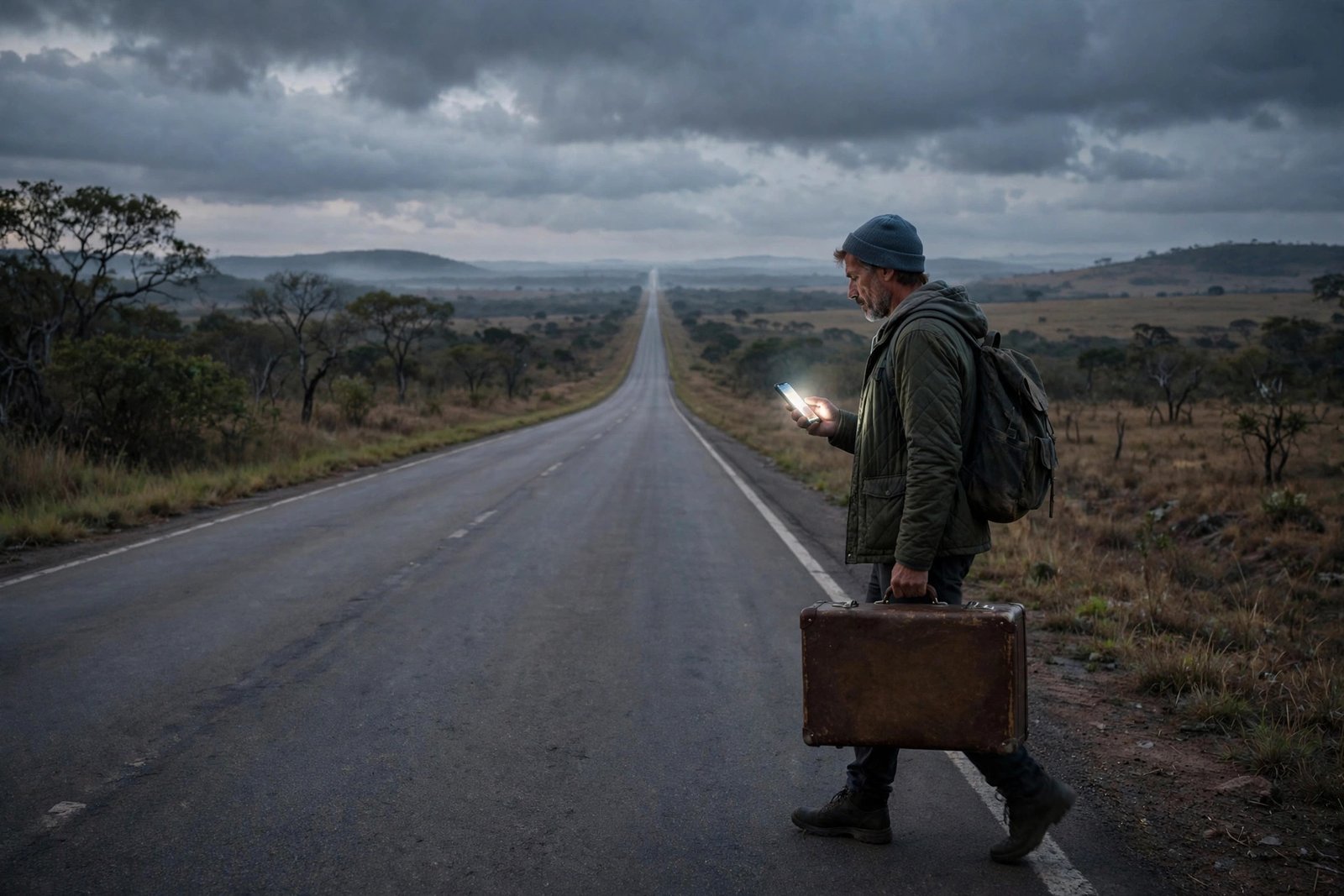
Imagine falling so deeply in love with someone that you sell every single thing you own — your furniture, your tools, the little comforts of home — and then ride a bus for more than 36 hours across an entire country to finally hold them in your arms. Now imagine stepping off that bus and discovering the woman you loved never existed at all. Not in the way romance scams of the past invented excuses. She was never born, never breathed, never lived. She was made of code.
That is exactly what happened to 49-year-old Brazilian bricklayer Edimar Rocha Martins, whose heartbreaking journey became one of the most talked-about viral stories of October 2026. According to reporting by the Economic Times, Martins sold his belongings and travelled nearly 2,000 kilometres from his home in the northeastern state of Maranhão to the southeastern city of Belo Horizonte, convinced he was about to meet the woman he would marry. Instead, he learned that his online girlfriend was an artificial intelligence-generated character — the victim of what experts would call a devastating AI girlfriend scam.
This story is not just about one lonely man. It is about how far artificial intelligence has come, how easily a polished social media persona can feel real, and how a technology designed for entertainment can quietly turn into an emotional trap for the vulnerable. And Martins is far from alone.
Who Is Edimar Martins? The Man Behind the Journey
Edimar Martins is a 49-year-old bricklayer — a mason by trade — from Imperatriz, a city in the northeastern Brazilian state of Maranhão. By every account, he was an ordinary working man living an ordinary, quiet life. The reporting from Brazilian media, including TV Mirante, paints the picture of someone who had simply grown tired of being alone. Loneliness, not gullibility, was the engine of this story. As Martins himself later told reporters, his desire for companionship and the hope of finding a real relationship were what pushed him to take the risk, even though it meant enormous financial sacrifice.
Around 2020, Martins came across a social media profile featuring a woman named Jéssica Oliveira, who also went by the name Jéssica Fazendeira — “fazendeira” roughly meaning a woman from a farm. The account, which went by the TikTok handle @JessicaFazendeira, featured videos of a blonde woman living on a rural property, speaking directly to the camera in a warm, personal tone. In the clips, the character presented herself as a farm owner searching for a companion — a man to share her life with — and promised financial security and a place to live. According to reporting by the Free Press Journal, the account suggested she could support a partner financially, offering love, a home, and a future free of struggle.
Martins believed every word. Over the years, the profile amassed more than 300,000 followers on TikTok, according to multiple reports — a large, engaged audience that made the account look entirely legitimate. If hundreds of thousands of people followed her, how could she not be real? That is the quiet logic that made the AI girlfriend scam work: social proof substituting for actual proof.
One of the most quoted lines from the character’s videos, cited by international outlets, was a promise of devotion: “I want to support you truly, I want you to come to my farm and never have to work again.” For a 49-year-old bricklayer doing hard physical labour for a living, exhausted by solitude, those words landed like a lifeline.
Inside the AI Girlfriend Scam: 2,000 KM of Hope and Heartbreak
On October 9, 2026, Martins made his decision. He sold his personal belongings — everything, by his own emotional account — to finance the trip. “I sold all my things, I got rid of everything,” he told TV Mirante, his voice breaking. “That’s how you get discouraged, who wouldn’t get discouraged?” He packed a suitcase, left his hometown, and boarded a bus bound for Belo Horizonte, the capital of Minas Gerais state in southeastern Brazil.
The journey covered roughly 2,000 to 2,100 kilometres — the distance reports vary slightly between outlets, with some citing 1,900 km and others over 2,100 km — and took more than 36 hours on the road. For over a day and a half, Martins sat on that bus, likely replaying every video, every message, every promise in his mind, rehearsing the moment he would finally meet Jéssica face to face. He arrived in Belo Horizonte on October 11, 2026, full of hope.
But the hope collapsed within hours. He could not find her. He showed her photographs to strangers on the street, and nobody recognised her. In desperation, Martins approached a local radio station — Rádio Itatiaia — hoping they would help announce his arrival so Jéssica could find him. Instead, the reporting team told him the devastating truth. As Martins recalled: “I went to the radio station there, and they said no, that’s fake news, that woman doesn’t exist.”
She did not exist. She had never existed. Every video, every smile, every word of affection was generated by artificial intelligence — a synthetic persona with a human-like face and voice, staged on idyllic rural properties. The discovery that he had been the target of an AI girlfriend scam hit Martins like a physical blow, according to local broadcasters who interviewed him. He was left stranded, his money spent, his possessions sold, in a city more than 2,000 kilometres from home.
When the Dream Collapsed in Belo Horizonte
With almost no money left, Martins turned to Belo Horizonte’s municipal support services for migrants. Staff there gave him food, a shower, basic necessities, and helped arrange onward bus travel. According to News18 and NBG Africa, he was given a bus ticket and initially left on October 13 for Araguatins in the state of Tocantins — a place where he had previously lived — rather than directly back to Imperatriz.
The return journey was its own ordeal. Martins fell ill during the journey and received medical care along the way. After more than 50 additional hours on buses, he finally reached Imperatriz on October 15, where he is now staying with his sister. Despite everything, he has reportedly said he hopes to return to Belo Horizonte in 2027 to thank the people who helped him — a grace note of gratitude in a story that otherwise reads like a tragedy.
Meanwhile, the story exploded across Brazilian national media and then internationally. After the case drew widespread attention, the operator behind the TikTok account posted a video in which the virtual character stated: “I am made of artificial intelligence. I have never spoken to anyone on this profile.” The person running the account acknowledged that Jéssica was AI-generated and said the page existed to generate engagement and drive sales — it reportedly promoted clothing and supplements. Critically, however, the operator denied ever speaking privately with Martins or inviting him to Belo Horizonte.
That denial is where the story gets legally and morally complicated. Was this an AI girlfriend scam in the criminal sense — a deliberate attempt to defraud — or a case of an entertainment-style AI influencer account that a lonely man tragically mistook for a real relationship? The account’s operator claims the former never happened: no private conversations, no invitations, no money requested from Martins. If that is true, then Martins was not “scammed” out of his money in the classic sense — he scammed himself, in a way, by projecting a relationship onto content that was never addressed to him personally. But either way, he was the victim of an AI girlfriend scam in the broader sense: a synthetic persona so convincing that a real human being sold his life and crossed a country for it.
The account subsequently deleted the video featuring the invitation that had drawn so many men in, according to News18. The damage, for Martins, was already done.
He Wasn’t the First: A Pattern of AI Romance Traps
Perhaps the most chilling detail in this story is that Edimar Martins was not the first man to make this exact pilgrimage — and the account in question was reportedly at the centre of all of them. According to Rádio Itatiaia, Martins’s case is the third of its kind in Belo Horizonte in under six months.
The earlier cases followed an eerily similar script. In June 2026, a 72-year-old man named Walter da Silva travelled from the state of Roraima to Belo Horizonte after watching a similar video. In August 2026, a 71-year-old named Alberto da Costa travelled from Manaus and reportedly spent nearly R$3,000 on his journey. Both men were chasing the same AI-generated mirage. Both went home empty-handed.
The pattern reveals something important about how an AI girlfriend scam operates at scale. The account does not need to target anyone individually. It simply broadcasts the fantasy — a beautiful, wealthy, loving woman who wants to take care of you — to hundreds of thousands of followers, and waits for the lonely to self-select. It is a numbers game played with human hearts. And because the content is framed as entertainment or influencer marketing, the operators can claim they never deceived anyone in particular. The harm is diffuse, deniable, and very real.
This is a new frontier for romance fraud. Classic romance scams involved a scammer actively grooming a victim, professing love, and eventually asking for money. The new model barely requires the scammer to lift a finger. The AI does the performing; the victim does the dreaming; and the money flows not through wire transfers to a criminal but through engagement metrics, product sales, and the victim’s own self-destructive decisions.
AI Girlfriend Scams by the Numbers: A Billion-Dollar Heartbreak Industry
To understand why Martins’s story matters beyond its viral shock value, it helps to look at the scale of romance fraud in the age of AI. According to the U.S. Federal Trade Commission, nearly 70,000 Americans reported romance scams in 2022, with total reported losses of $1.3 billion — an average of about $4,400 per victim, as reported by Experian’s analysis of the data. Security researchers consistently warn that the true figure is far higher, because the majority of victims never report what happened out of shame.
More recent figures are even grimmer. The FBI’s Internet Crime Complaint Center estimated romance and confidence scam losses at over $929 million in 2025 alone, ranking romance fraud among the costliest forms of cybercrime in America — above data breaches, phishing, and ransomware in some tallies. In the United Kingdom, Action Fraud estimated £106 million lost to romance fraud in 2024–25. And the FBI has now begun separately tracking AI-enabled romance scams: in 2025, victims lost over $19 million to catfish-style scams with a likely AI connection — fake profiles built with AI image synthesis, AI-scripted conversations, and voice-cloned audio — a figure analysts say is almost certainly an undercount.
What makes the AI girlfriend scam particularly dangerous is that the two traditional ways people verified an online romance — reverse image search and a quick video call — no longer reliably work. A reverse image search on an AI-generated face returns nothing, which perversely makes the person seem more authentic. And deepfake video technology can now generate a convincing live “video call” with a synthetic person. The old rules of verification have been quietly rewritten, and most people have not read the new ones.
Consider how Martins’s case maps onto the classic anatomy of a romance scam. The scammer — or in this case, the content — built emotional intimacy quickly. The persona offered a dream: love, a farm, financial security, an end to loneliness and hard labour. Urgency did the rest. And while no one directly asked Martins for money, the account profited from the engagement of hundreds of thousands of followers, some of whom, like Martins, converted fantasy into real-world action with devastating financial consequences.
How to Spot an AI Girlfriend Scam Before It Costs You Everything
Martins’s story is heartbreaking, but it is also a warning. Cybersecurity experts and consumer advocates point to a set of red flags that can help anyone — or anyone who loves someone vulnerable — spot an AI girlfriend scam before it goes too far:
- They never meet in person — ever. The single biggest red flag in any online romance is a persistent refusal or inability to meet face to face. If years pass and every meeting falls through, something is wrong. Martins followed Jéssica since 2020 and never once met her — six years of one-sided devotion.
- The photos are too perfect. AI-generated faces tend to be symmetrical, flawless, and oddly consistent — but they often have subtle tells: strange backgrounds, inconsistent earrings or teeth, hands that look slightly wrong. Roughly one in five online daters has encountered a fake profile or AI bot, according to recent fraud research.
- The story is too good to be true. A wealthy, beautiful stranger who falls for you from videos alone and promises to support you forever is a fantasy, not a relationship. Real love is mutual, gradual, and inconvenient. Scams are instant, one-directional, and effortless.
- They isolate you. Scammers — and parasocial fantasies — thrive when the victim does not check the story with friends or family. If someone you love is planning a life-altering trip for an online romance, ask gentle questions and offer to help verify.
- Money moves before meetings. Any request for money, gift cards, crypto, or “travel expenses” before you have ever met in person is a blazing red flag. Martins’s money went to his own travel — but the principle holds: never make irreversible financial decisions for someone you have never met.
- Do a video call — a real one. Ask for an unscripted live video call with interaction: wave, hold up three fingers, say a specific word. AI video can be faked, but spontaneous interaction raises the bar considerably.
If you suspect you or someone you love is caught in an AI girlfriend scam, the standard advice from experts is clear: stop communication, do not send money, run reverse image searches on their photos, and report the profile to the platform and to the FBI’s Internet Crime Complaint Center (IC3) in the U.S. — or the equivalent fraud authority in your country.
Key Takeaways
- Edimar Martins, a 49-year-old Brazilian bricklayer, sold his belongings and travelled ~2,000 km by bus to Belo Horizonte to meet a woman he believed he would marry — only to learn she was an AI-generated TikTok character.
- The account (@JessicaFazendeira, “Jéssica Oliveira”) had over 300,000 followers; its operator admitted the character was AI-made for engagement and sales, but denied ever speaking to Martins or inviting him.
- Martins is reportedly the third man in under six months to travel to Belo Horizonte chasing the same AI persona — a pattern, not an isolated incident.
- Romance scams cost Americans a reported $1.3 billion (FTC, 2022 figures), and the FBI now tracks AI-enabled romance fraud as a distinct, growing category.
- The old verification tricks — reverse image search, a quick video call — no longer reliably expose synthetic personas. Behavioural red flags matter more than ever.
Conclusion
There is a temptation to treat Edimar Martins’s story as a punchline — the man who fell in love with a robot. But that would be cruel, and it would miss the point entirely. Martins was not foolish; he was lonely. And loneliness, in the age of artificial intelligence, has become one of the most exploitable vulnerabilities on earth.
The uncomfortable truth is that the technology worked exactly as designed. The AI-generated Jéssica was engaging, consistent, and emotionally resonant enough to hold 300,000 followers and to convince at least three men to cross a country. The line between “content” and “companion” has dissolved, and the people falling through the crack are not tech experts stress-testing chatbots — they are bricklayers, retirees, and ordinary people looking for someone to love.
An AI girlfriend scam does not need to steal your money directly to ruin your life. It only needs to steal your judgment. Martins lost his possessions, his savings, and weeks of his life — and very nearly his health — to a woman made of pixels. His story is a mirror held up to all of us: in a world where anyone can be generated, the most radical act of self-protection is also the oldest one. Verify before you trust. Talk to real people about your online romances. And remember that if a love story seems too perfect to be true — a beautiful stranger, a farm, a future with no more work — it probably is.
For more stories about how artificial intelligence is reshaping real lives, check out how AI did 10 days of work in 3 hours and what Reddit says about entry-level jobs, and read about Disney’s Character.AI bankruptcy saga and the $20 million bid. And if the darker side of social media fascinates you, don’t miss why X suspended 13,000 accounts over foreign influence ahead of the 2026 midterms.
Frequently Asked Questions
What is an AI girlfriend scam?
An AI girlfriend scam is a form of romance fraud in which a scammer — or sometimes an engagement-driven content account — uses an AI-generated persona (synthetic photos, videos, and voice) to create the illusion of a real romantic partner. Victims develop genuine emotional attachments to someone who does not exist, and may lose money, make life-altering decisions, or suffer serious emotional harm. Unlike classic romance scams, the “person” may never directly ask for money; the damage comes from the victim acting on a false reality.
Who is Edimar Martins?
Edimar Rocha Martins is a 49-year-old Brazilian bricklayer from Imperatriz, in the state of Maranhão, Brazil. In October 2026, he sold his belongings and travelled roughly 2,000 km by bus to Belo Horizonte to meet a woman he had followed on TikTok since 2020, believing they would marry. On arrival, he learned through local radio station Rádio Itatiaia that the woman — known as Jéssica Oliveira or Jéssica Fazendeira — was an AI-generated character. He later received help returning home and is now staying with his sister.
Was the TikTok account operator charged with a crime?
Based on reporting available as of October 2026, there have been no confirmed reports of criminal charges against the account operator. The person behind the account acknowledged that Jéssica was AI-generated and said the page existed to generate engagement and drive product sales, while denying any private communication with Martins or any invitation for him to travel. The legal line between deceptive content and criminal fraud in cases like this remains murky.
How common are AI romance scams?
Very common and growing fast. The FTC reported nearly 70,000 Americans reported romance scams in 2022 with $1.3 billion in losses, and researchers say most victims never report. The FBI estimated over $929 million in romance and confidence scam losses in 2025, and now separately tracks AI-enabled romance fraud — with over $19 million in likely AI-connected catfish losses in 2025, a figure considered a significant undercount. Experts warn that generative AI has made fake personas far more convincing than ever before.
How can I protect myself or a loved one from an AI girlfriend scam?
Insist on meeting in person before making any major life or financial decisions; be sceptical of anyone whose photos look flawless and who never video-calls spontaneously; never send money or sell possessions for someone you have not met; discuss online romances openly with trusted friends or family; run reverse image searches on profile photos; and report suspicious profiles to the platform and to fraud authorities like the FBI’s IC3 in the United States.