
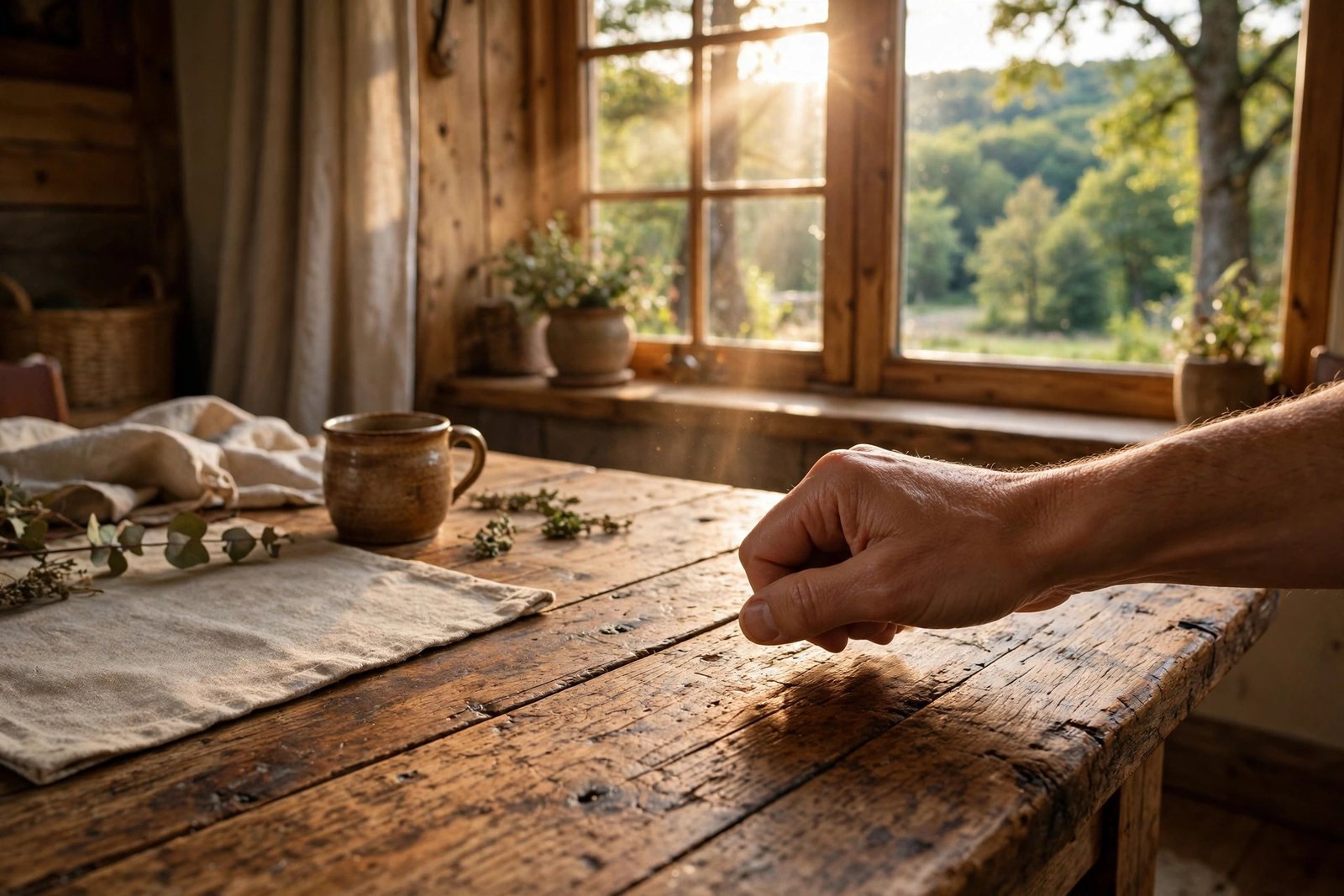
You have just said something good out loud. Maybe you mentioned a holiday going perfectly, a car that has never broken down, or a run of good health. Before the sentence is even finished, your knuckles are already rapping on the nearest table. You do not really believe the table is listening, and yet you do it anyway. The question is simple and strangely stubborn: why do we knock on wood when we want good luck to last?
Knocking on wood, also called touching wood in Britain, is one of those habits almost everyone recognizes instantly. Children learn it from adults, adults do it without thinking, and even self-described skeptics catch themselves doing it mid-sentence. It costs nothing, takes one second, and feels oddly reassuring. Its origin, however, is not a single neat story. It is a tangle of old beliefs about trees, spirits, luck, and games, none of which can be proven as the one true source. That uncertainty is part of the fun, and it tells us a lot about how superstitions survive.
What Exactly Are We Doing When We Knock?
The gesture itself is simple. After saying something hopeful, or after mentioning a fear you want to avoid, you knock on a wooden surface, usually twice or three times, with your knuckles. Sometimes people knock before they finish the sentence, as if to lock the luck in place. Sometimes they knock after, as a kind of insurance policy. If no wood is nearby, people will joke about knocking on their own head, or they will search the room for a wooden door frame, a table, or a chair.
Notice what the habit is not. It is not a prayer with fixed words, and it is not a formal ritual with rules everyone agrees on. Different families do it slightly differently, and that looseness is a clue. Habits that survive for centuries tend to be flexible. They bend to fit new homes, new furniture, and new jokes, while keeping the same core feeling: I have said something tempting to fate, and I want to take it back, just a little.
The phrase itself gives another clue. In American English we usually say knock on wood. In British English, touch wood is just as common. Both versions point to the same idea: wood itself, not just any surface, is supposed to matter. A plastic table does not quite count in the joke, even though most people will happily knock on it if it is all that is available. That detail keeps pointing historians back to trees.
Why Do We Knock on Wood? The Tree Spirit Theory
The most popular theory starts in ancient forests, long before modern cities. In many early European belief systems, trees were not just plants. They were homes for spirits, gods, or protective forces. Oaks in particular were linked with thunder gods and strength, while other trees were seen as sacred or lucky in their own right. Touching the tree, in this theory, was a way to call on the spirit inside for protection, or to thank it for good fortune.
A related version of the theory says the knock was a way to wake the spirit, or to let it know you were there. Another version flips it around: knocking chased away evil spirits that might overhear your good news and spoil it out of jealousy. In both versions, the wood is a kind of telephone line to the unseen world. You knock, something on the other side hears, and your luck is guarded.
It is a beautiful story, and it fits the way people talk about old forests, sacred groves, and tree worship in folklore. But it is important to say clearly that this is a theory, not a proven chain of evidence. We do not have a diary from an ancient tree-worshipper explaining that they invented the modern knock. What we have is a plausible connection between old tree beliefs and a later habit, passed down through storytelling and folklore collections. The theory is popular because it feels right, not because historians have found a smoking gun.
The Pagan and Celtic Connection
A second theory overlaps with the first but leans on Celtic and pagan traditions in Britain and Ireland. In these traditions, trees held a special place in religion and daily life, with certain species linked to protection, healing, or the turning of the seasons. Touching wood may have started as a respectful gesture toward those beliefs, a small acknowledgment that nature had power humans did not control.
Over time, as Christianity spread, older customs did not simply vanish. They blended, softened, and survived as folk habits. A gesture that once meant something solemn could become a joke, a reflex, or a family tradition, while keeping a faint echo of its older meaning. That blending is common in folklore. Christmas trees, lucky charms, and harvest customs all carry layers of older beliefs under newer meanings, and knocking on wood may be one more example.
Again, treat this as a theory. Folklorists can point to tree symbolism in Celtic culture, but they cannot draw a straight, documented line from a specific pagan ritual to the exact knock people do today. The gap between ancient belief and modern habit is centuries wide, and many steps in between are simply lost. This is one reason the question of why do we knock on wood remains so debated among folklorists. What we can say with confidence is that trees mattered deeply in early European cultures, and that makes a tree-based origin plausible, even if it remains unproven.
Did the Christian Cross Play a Role?
A third theory points to Christianity. In this version, knocking on wood refers to touching the wood of the cross, a symbol of protection and divine help. Early Christians, the theory goes, would touch wooden crosses or church woodwork when seeking safety or giving thanks, and the gesture gradually became a general good-luck habit detached from its religious roots.
This theory has a certain neatness to it. Wood plus faith plus protection is an easy story to remember, and it explains why the habit feels vaguely reverent even when people use it as a joke. It also fits a pattern seen in other superstitions, where a religious gesture slowly turns into a secular reflex. People may keep the action long after they forget, or never knew, the original meaning.
But this theory has the same problem as the others: it is a plausible reconstruction, not a documented origin. There is no single early text that says, in so many words, that Christians invented knocking on wood by touching the cross, and that everyone else copied it. Historians who study superstitions often warn that many popular origin stories were invented much later, by writers trying to give a fun explanation to a habit that already existed. The cross theory may be part of the story, or it may be a later explanation pasted onto an older habit. We simply do not know for sure, and that is another reason the question of why do we knock on wood has no single settled answer.
The Children’s Game Theory, and a Surprising Twist
A fourth theory is less mystical and, for many readers, more surprising. Some researchers have suggested that the modern habit may owe something to a children’s chasing game sometimes called Knock on Wood or Tiggy Touchwood, played in Britain in the 1800s. In versions of the game, touching wood made a player safe from being caught. Wood was a base, a safe zone, a place where the rules paused.
If that sounds familiar, it should. Children still play versions of this idea today, where touching a certain object means you cannot be tagged. The theory suggests that a game rule about safety may have fed into adult language about safety and luck, or that both the game and the superstition grew from the same older idea that wood equals protection. Either way, the game theory reminds us that not every superstition starts in a temple or a forest. Some start in a playground.
When people ask why do we knock on wood today, the game theory offers a useful reality check. Habits do not need a single ancient origin to feel ancient. A habit can pick up meanings as it travels through childhood games, family jokes, books, films, and everyday conversation, until it feels like it has always existed. The knock may be old, but our current version of it could be much newer than the legends suggest.
Why Do We Knock on Wood Still Today?
So why has knocking on wood survived into an age of smartphones and science? The answer is probably less about trees and more about human psychology. First, the habit is harmless and free. It does not require belief, money, or effort, so there is no reason to stop doing it. Second, it gives people a tiny sense of control at a moment of uncertainty. Saying something good out loud can feel like tempting fate, and a knock feels like doing something about that feeling, even if you know, rationally, that it changes nothing.
Third, the habit is social. We learn it by watching others, and we repeat it because others recognize it. A knock after a hopeful sentence is a shared joke, a signal that you know the rules of the conversation. Even skeptics often play along, because refusing to knock can feel like ruining the joke or inviting a teasing argument about luck. In that sense, knocking on wood is less about magic and more about belonging.
There is also a simple psychological effect at work. When good things happen after you knock, you remember it. When bad things happen, you forget the knock or explain it away. That selective memory keeps superstitions alive without anyone deliberately lying about them. Our brains are pattern-hunting machines, and a one-second ritual is an easy pattern to notice.
For more delightful puzzles about everyday life, BolanPost readers often enjoy viral human body facts from online threads and facts from Reddit threads that feel fake but are completely real. Like knocking on wood, many of those facts survive because they are simple, surprising, and easy to pass on.
Knock on Wood Around the World
Knocking on wood is not just an English-speaking habit. Variations exist in many cultures, sometimes with different materials or gestures. In some places people knock on iron, in others they touch their own head, spit lightly, or say a protective phrase. The details change, but the structure is often the same: say something hopeful, then perform a small protective action to guard it.
That variety is another reason to be cautious about a single origin story. If many cultures have similar protective gestures, they may have developed independently, or borrowed from each other over centuries of trade, migration, and storytelling. A habit that feels uniquely yours may have cousins all over the world, each with its own local explanation. The universal part is not the wood. It is the human urge to protect good news.
Modern media keeps the habit alive in a new way. Films, television shows, songs, and memes use knocking on wood as a quick visual joke that needs no explanation. A character knocks, the audience laughs, and a new generation learns the gesture without ever hearing a theory about tree spirits. Culture, in other words, is now doing the work that folklore once did, passing the habit on through entertainment.
What Should You Believe About the Origin?
Here is the honest summary. The tree spirit theory is the most popular and the most poetic. The pagan and Celtic connection adds cultural depth. The Christian cross theory adds a religious layer. The children’s game theory adds a playful, more recent twist. Each theory captures something true about how humans think about trees, safety, and luck, but none of them can be proven as the sole origin.
The most likely truth is that knocking on wood has multiple roots, not one, so when someone asks why do we knock on wood, the honest answer is that several old ideas may all have contributed. Old tree beliefs, religious gestures, children’s games, and everyday jokes may all have fed into the same habit at different times, like streams joining into one river. By the time writers started recording the phrase in the 1800s and 1900s, the habit was already widespread, and its earliest steps were lost.
That may feel unsatisfying if you wanted one clean answer, but it is actually the more interesting story. Superstitions are not museum pieces with a single inventor and a date stamp. They are living habits, shaped by everyone who uses them. Every time you knock, you are not just repeating an ancient ritual. You are keeping a small, strange, human tradition alive, and adding your own joke to its history.
If you want to dig deeper into how these explanations are debated, start with the overview of knocking on wood and the history of the phrase knock on wood. Both lay out the competing theories without pretending the mystery is solved, which is exactly the right attitude for a habit this old and this cheerful.
Frequently Asked Questions
Where does knocking on wood come from?
No single origin is proven. The leading theories involve tree spirits in ancient belief systems, pagan and Celtic tree symbolism, touching the wood of the cross in Christian tradition, and a children’s game where wood meant safety. The habit likely has multiple roots.
Is touching wood the same as knocking on wood?
Yes, in most cases they refer to the same habit. Touch wood is the more common British phrasing, while knock on wood is more common in American English. Both involve touching a wooden surface for good luck.
Do people really believe knocking on wood works?
Many people do it as a joke or a reflex rather than a firm belief. It can feel reassuring because it gives a small sense of control, and because it is a shared social habit. Belief varies widely from person to person.
Does it have to be real wood?
Traditionally, yes, which is why the habit points back to trees. In practice, people often knock on whatever is nearby, including tables, doors, and even their own heads as a joke, because the gesture matters more than the material.
Is knocking on wood found in other cultures?
Yes, variations exist around the world, sometimes using iron, a protective phrase, or a different gesture. The common thread is a small action after hopeful words, meant to guard good fortune.