
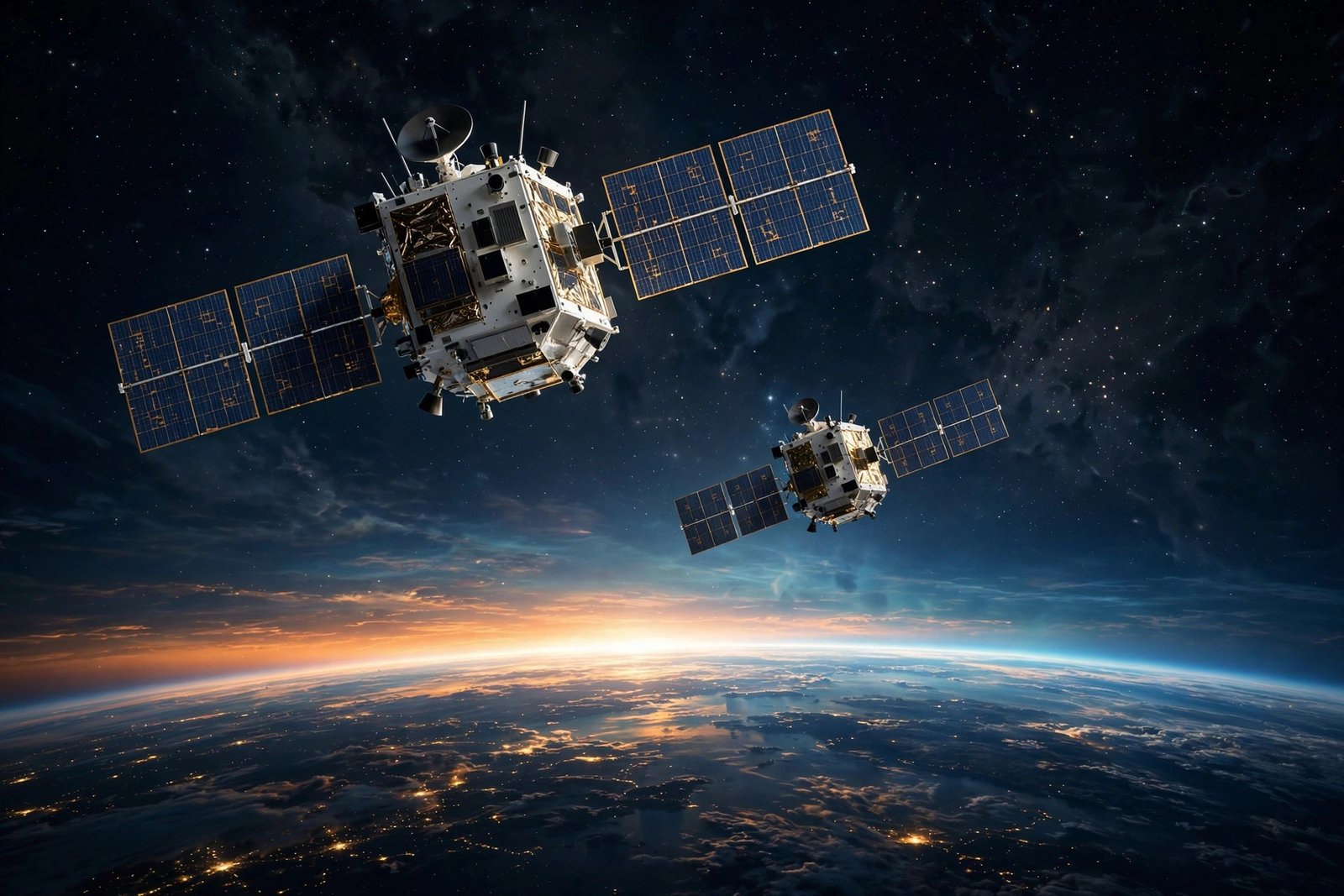
High above your head right now, hundreds of miles over the Earth, a real-life game of cat and mouse is playing out — and the world’s space experts are watching with alarm. This past weekend, a Russian satellite stalks US spacecraft in low Earth orbit, closing in so tightly that analysts described the two machines as flying “bumper-to-bumper” at 17,000 miles per hour. Tracking data suggests it is the closest known deliberate and uninvited encounter between two active satellites in history — and it has raised genuine fears of an attack in space.
The story reads like the opening scene of a spy thriller. A secretive Russian military satellite called Kosmos-2612, launched in April 2026 with almost no public explanation of its mission, spent the weekend of October 17-18 chasing a commercial American imaging satellite known as ICEYE-X36 — a spacecraft whose powerful radar eyes have been helping Ukraine in its war against Russia. According to Scientific American, which reviewed the tracking data, the two satellites came within a few hundred meters of each other, with some estimates putting the distance at just 30 meters. At orbital speeds of roughly 17,000 miles per hour, that is not a near-miss. That is a haircut.
Nobody outside the control rooms — and possibly not even the public spokespeople — knows for certain what Russia intends. As of now, neither Russian officials, the U.S. Department of Defense, nor ICEYE has publicly commented on the encounter. But space security experts agree on one thing: this was not a routine flyby, and it may be a preview of a new and dangerous kind of conflict playing out silently above us all.
What Does It Mean When a Russian Satellite Stalks US Spacecraft?
The word “stalking” sounds dramatic, but it describes something very real and very difficult in orbital mechanics. In spaceflight circles, the maneuver is called a rendezvous and proximity operation — RPO for short. It is not like walking up to someone on the street. To get close to another object in orbit, a spacecraft must first shift itself into the same orbital plane, then adjust its speed until it is moving at almost exactly the same velocity as its target. Otherwise, the two simply zoom past each other at thousands of miles per hour and never meet.
That makes stalking in space extraordinarily hard. Every course correction burns propellant — fuel that cannot be refilled once a satellite is in orbit. Satellite operators therefore treat propellant like a retirement fund: once it runs out, the mission ends. So when a Russian satellite stalks US spacecraft with a series of deliberate, carefully calculated burns, experts pay attention, because nobody spends that kind of nonrenewable resource without a compelling reason.
LeoLabs, the space intelligence company that tracked the encounter, said Kosmos-2612’s path “appears to be a deliberate approach toward” ICEYE-X36. The company described such close-approach behavior as “relatively uncommon” in low Earth orbit and said the activity “warrants continued monitoring.” In plain language: this does not happen by accident.
The Cat-and-Mouse Chase Over South America
The timeline of the chase is what makes it so unsettling. On Friday, October 16, the two satellites were more than 200 miles apart — comfortably distant in orbital terms. Then Kosmos-2612 began a deliberate series of maneuvers. By Saturday, it had closed to about three miles of ICEYE-X36, according to reporting based on LeoLabs data.
A stunning time-lapse image captured the Russian satellite Kosmos-2612 — a fainter dot — chasing the Finnish-American satellite ICEYE-X36, the brighter dot, over South America on the morning of October 18, 2026. At the moment the image was taken, the separation was less than five kilometers, and it later dropped to as little as tens of meters. Clayton Swope, a senior fellow at the Center for Strategic and International Studies, said the proximity was comparable to two automobiles traveling bumper-to-bumper. Astrophysicist Jonathan McDowell called it the first known rendezvous in low Earth orbit between two active satellites conducted without the consent of one of the operators.
And the story did not end with a single close pass. According to LeoLabs, Kosmos-2612 “maneuvered around ICEYE-X36, remained nearby for an extended period, and then began moving away.” This was not a drive-by. It lingered — which raises an obvious and uncomfortable question: what was it doing while it stayed?
Why the Russian Satellite Stalks US Spacecraft Now
To understand the timing, you have to look down at Earth, not up at the sky. ICEYE-X36 is no ordinary commercial satellite. It is a synthetic aperture radar imaging satellite — meaning its sensors can see through clouds, smoke, and darkness to track and guide activity on the ground below. That is the kind of capability that matters enormously in a war. ICEYE, the Finnish company behind the satellite, is owned through a U.S. subsidiary, and earlier this year it announced a collaborative agreement with Ukraine’s defense ministry. A Ukrainian official confirmed to Axios that the country’s military works with the Finnish satellite company.
ICEYE-X36 launched in 2024, two years after Russia’s full-scale invasion of Ukraine. Russian officials have been openly unhappy about Ukraine’s use of Western commercial satellite imagery — Moscow has previously asserted that commercial Western satellites supporting Ukraine in the war could be considered legitimate military targets. Viewed against that backdrop, the moment a Russian satellite stalks US spacecraft like ICEYE-X36, the message reads as part of the same war being fought on the ground.
Victoria Samson, head of space policy at the Secure World Foundation, put it this way: “You’re looking at what Russia is doing here, not in terms, specifically, of what’s happening in space but as part of a larger examination of what’s happening on Earth. Russia and Ukraine are literally at war with each other. And so it’s kind of tinting how you view Russia’s activities here.” The maneuver also arrives as Ukraine has faced broader interference with space-based support: Ukrainian fighters and President Volodymyr Zelensky have reported widespread throttling of SpaceX’s satellite-based Starlink and Starshield services on the battlefield.
What Could a Stalking Satellite Actually Do?
This is the question that keeps space security analysts up at night. During a rendezvous and proximity operation, an aggressor satellite can do any number of things to its target — and most of them are invisible from the ground. It can take close-up photographs to learn the target’s design and vulnerabilities. It can jam communications, block sensors, or even physically disable the other spacecraft. In the most extreme scenario, it can push the target out of orbit entirely.
Even without any hostile act, the stalking itself is a weapon of sorts. Under pressure, the operators of ICEYE-X36 could decide the spacecraft must burn its own precious propellant to escape or dodge Kosmos-2612 or other threatening satellites — shortening the mission’s working life. Simply forcing an opponent to spend fuel is a form of degradation. As Maj. Gen. Michael Traut, head of German Space Command, warned, similar close-approach tactics directed against large commercial constellations such as SpaceX’s Starlink could degrade satellite operational lifespans and trigger broad disruptions.
And there is the legal gray zone. While no formal laws specify how close is too close in orbit, satellite operators generally maintain a separation of at least six miles to avoid steep increases in collision risk, according to space law scholar Aaron Brynildson of the University of Mississippi. Conducting a nonconsensual RPO breaks norms and crosses ill-defined lines for mutual safe operations in orbit, Samson says. Unsolicited close approaches might be interpreted as aggressive — or even as an act of war.
A Short History of Space Stalking
Believe it or not, this weekend’s chase is not the first time satellites have played this game — it is just the closest and boldest. The most famous previous incident came in 2020, when two Russian satellites, Kosmos-2542 and its subsatellite Kosmos-2543, were caught shadowing USA-245, a classified American reconnaissance satellite operated by the National Reconnaissance Office.
Back then, the alarm was public. Gen. John “Jay” Raymond, the first chief of space operations of the U.S. Space Force, told Time magazine that the Russian behavior was “unusual and disturbing” and had “the potential to create a dangerous situation in space,” as SpaceWar reported. Then, in July 2020, the U.S. military said Kosmos-2543 had fired a high-speed projectile in orbit — described as a test of a space-based anti-satellite weapon.
Russia has an even darker entry on its record. In November 2021, it destroyed the Soviet-era satellite Kosmos-1408 with a direct-ascent anti-satellite missile, creating more than 1,500 trackable pieces of orbital debris and drawing international condemnation. The debris from that single test threatened the International Space Station and will menace everything in orbit for years.
The technology, meanwhile, keeps improving. China, the United States, Russia, and several private companies have all been independently testing their RPO capabilities for years. Radar tracking data show that since May 2026, other Kosmos satellites have been maneuvering around ICEYE-X36 in provocative maneuvers that were explicitly called out by the U.S. Space Force. This weekend’s event was the dramatic climax of a campaign that had been building for months. For more mind-bending facts about what floats above us, check out our roundup of 8 space facts that sound fake but are 100% real — some of them are stranger than this chase.
What Happens Next in This Orbital Drama?
Honestly? Nobody knows — and the experts are refreshingly honest about that. “We’re going to wait and see what happens,” Samson told Scientific American. “This kind of thing can change quickly, but I would hold off hysterical speculation until we know more about it.”
What is clear is that the guardrails of space are being tested in real time. There are few official international regulations covering these maneuvers, and the norms that do exist are being stretched by every uninvited close approach. Last month, the U.S. Space Force announced that it had placed weapons in space — it disclosed few details, but some experts believe they are communication jammers with RPO capabilities of their own. The high frontier, as Samson notes, is where “already high tensions now seem set to soar.”
For the rest of us on the ground, the lesson is strangely reassuring and deeply unsettling at the same time. The satellites we depend on — for GPS, weather forecasts, banking, and internet — fly through a domain with no traffic cops, no speed limits, and no 911. Watching a Russian satellite stalk a US spacecraft this closely is a reminder that the next frontier of conflict may not announce itself with explosions. It may just drift silently closer, one deliberate burn at a time. If you are curious how modern spacecraft pull off their own orbital feats, our story on SpaceX’s Dragon missions to the ISS shows the peaceful side of the same technology — and the deformed exoplanet WASP-17b proves space still has stranger sights than any satellite chase.
Key Takeaways
- Russia’s Kosmos-2612 satellite deliberately closed in on the U.S.-owned imaging satellite ICEYE-X36 over the weekend of October 17-18, 2026, coming within a few hundred meters — possibly as close as 30 meters.
- The maneuver is called a rendezvous and proximity operation (RPO) — a difficult, fuel-expensive feat that experts say is never done without a compelling reason.
- ICEYE-X36 carries synthetic aperture radar that can see through clouds and darkness, and ICEYE has a collaboration agreement with Ukraine’s defense ministry — which is likely why Moscow cares about it.
- Experts call it the closest known deliberate, uninvited encounter between two active satellites in low Earth orbit, and warn it could be interpreted as aggressive or even an act of war.
- This is part of a pattern: Russian satellites have shadowed U.S. spacecraft before, including the 2020 Kosmos-2542/2543 incident, and other Kosmos satellites have been circling ICEYE spacecraft since May.
Frequently Asked Questions
What is Kosmos-2612?
Kosmos-2612 is a Russian military satellite launched in April 2026 from a spaceport in northern Russia aboard a Soyuz rocket. Russian authorities disclosed almost no details about its mission, which is typical for military spacecraft. Independent tracking soon showed it maneuvering toward the commercial imaging satellite ICEYE-X36.
What is ICEYE-X36?
ICEYE-X36 is a synthetic aperture radar imaging satellite built by the Finnish company ICEYE and owned through its U.S. subsidiary. Unlike optical cameras, its radar can see through clouds, smoke, and darkness. ICEYE signed a collaborative agreement with Ukraine’s defense ministry earlier in 2026, and Ukrainian officials have confirmed the military works with the company — which is why Russia views the satellite network with hostility.
How close did the two satellites actually get?
Tracking data reviewed by multiple analysts shows the satellites came within a few hundred meters of each other on October 18, 2026, with some estimates as close as 30 meters — after being more than 200 miles apart the day before. Astrophysicist Jonathan McDowell described it as the first known nonconsensual close rendezvous between two active satellites in low Earth orbit.
Could the Russian satellite attack the American one?
Possibly, but there is no public evidence that it did. During such maneuvers, a satellite could photograph its target, jam its communications, block its sensors, or even push it out of orbit. Experts say the maneuver could also be chiefly a warning meant to signal capability. Neither Russia nor the U.S. has explained what happened, so the intent remains unclear.
Is this the first time satellites have stalked each other?
No. In 2020, Russia’s Kosmos-2542 and Kosmos-2543 shadowed the classified U.S. reconnaissance satellite USA-245, prompting public complaints from the U.S. Space Force. Russia also tested an anti-satellite weapon in orbit in 2020 and destroyed its own Kosmos-1408 satellite with a missile in 2021. However, the October 2026 encounter with ICEYE-X36 is the closest and most deliberate uninvited approach recorded in low Earth orbit.