
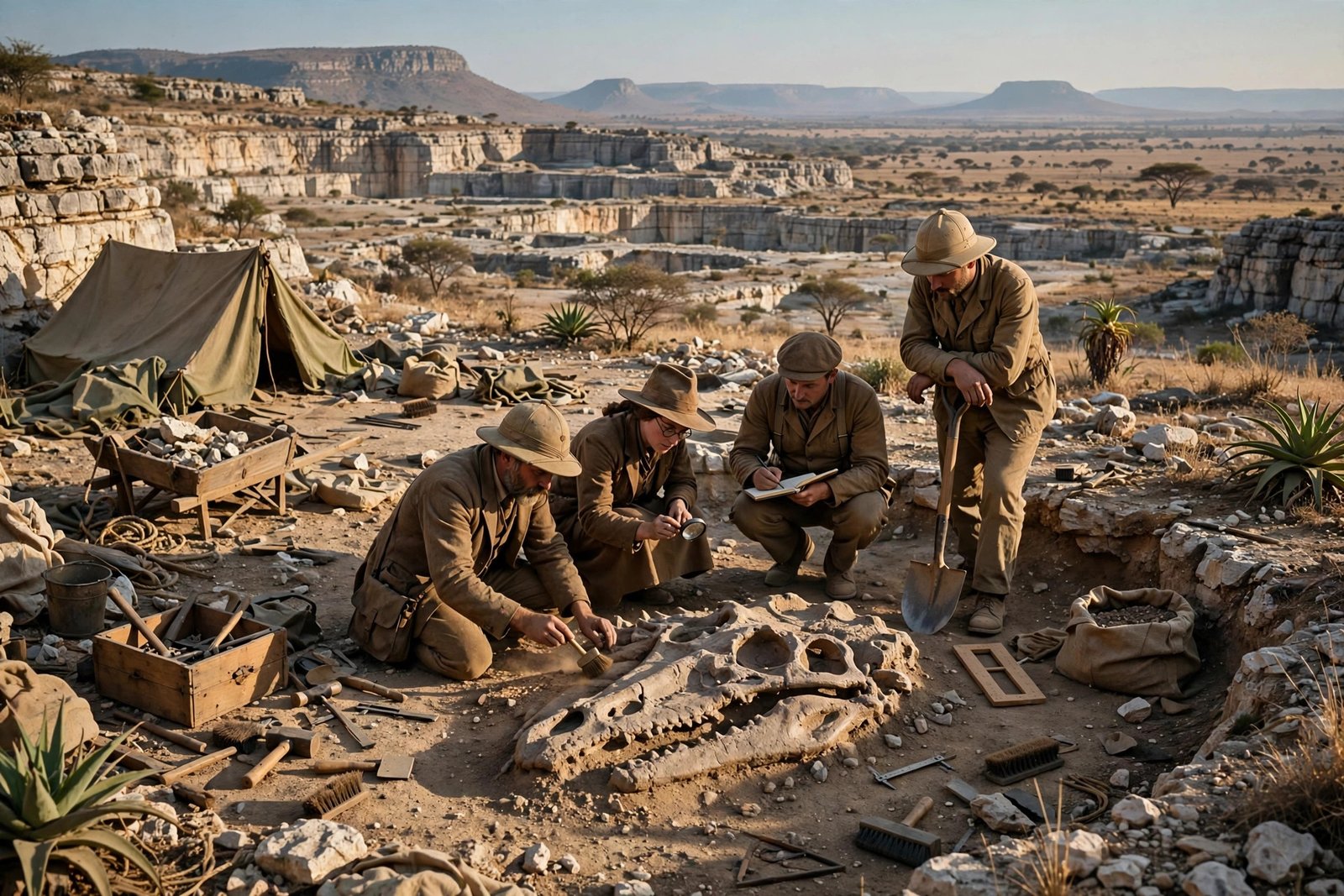
Some discoveries change a single field of study. A rare few change how humanity sees itself. The Taung Child fossil discovery belongs firmly in the second group. In 1924, a small fossil skull found in a lime quarry in Taung, South Africa, forced scientists to rethink where humans came from, when our ancestors first walked upright, and whether Africa — rather than Europe or Asia — was the cradle of humankind. It was a tiny skull, belonging to a young child who lived millions of years ago, and it carried an enormous message.
Today, the Taung Child is one of the most famous fossils in the world. It is also one of the most important, because it was the first fossil of its kind ever recognised: the first early human ancestor identified as belonging to a new genus, Australopithecus, and the first strong evidence that human evolution had deep African roots. Yet when it was first found, it was almost overlooked, and when it was first announced, many leading scientists refused to believe it. The story of how a quarry find became a revolution is as fascinating as the fossil itself.
The Quarry Find That Started It All
The story begins, as many great discoveries do, not in a laboratory but in a workplace. In 1924, miner M. de Bruin was working at a lime quarry in Taung, in what is now South Africa’s North West province. Lime quarries of the time blasted and dug into ancient limestone deposits, and workers sometimes came across bones and other strange objects embedded in the rock. De Bruin noticed a fossil skull and recognised that it was unusual enough to be worth keeping.
That simple act of curiosity mattered enormously. Countless fossils have been lost to blasting, crushing, and indifference over the years. De Bruin, instead, passed the skull on, and it eventually reached Raymond Dart, a young Australian-born anatomist who was then professor of anatomy at the University of the Witwatersrand in Johannesburg. Dart understood at once that he was looking at something extraordinary — but he could not have known just how long it would take for the rest of the scientific world to agree with him.
What Dart received was not a complete skeleton. It was the fossilised skull of a young child, preserved with remarkable detail, including a natural cast of the inside of the braincase. That cast, known as an endocast, preserved the shape of the brain itself. For a scientist in 1924, that was a treasure: it offered clues not just about the shape of the head, but about the brain within it, and about how this ancient child might have grown, moved, and lived.
How the Taung Child Fossil Discovery Challenged Science
Dart studied the skull carefully and reached a bold conclusion. The Taung Child fossil discovery, in his reading, was not simply another ape fossil. The skull combined ape-like features with distinctly human-like ones. Its teeth, in particular, looked more human than ape-like, and the position of the opening at the base of the skull, where the spinal cord passes through, suggested that the creature had held its head upright — a sign of walking on two legs rather than on all fours.
In 1925, Dart announced his findings and gave the creature a new name: Australopithecus africanus, meaning roughly the southern ape of Africa. The name itself was a statement. It claimed that this was a new kind of being, neither a modern ape nor a modern human, but something in between — an early step on the long road toward humanity. For Dart, the Taung Child was evidence that human ancestors had evolved in Africa, and that bipedalism, walking upright, had come before the large brains that later defined our genus.
That idea ran directly against the scientific consensus of the time. In the 1920s, many leading anthropologists expected the earliest human ancestors to be found in Europe or Asia, and they expected those ancestors to have large brains. A small-brained, upright-walking creature from Africa did not fit that picture. Some critics dismissed the Taung Child as nothing more than a young ape, perhaps a chimpanzee or gorilla, whose human-like features were simply the result of its youth. Others argued that a single child skull was not enough evidence to rewrite human origins.
Dart was, by many accounts, deeply frustrated by the reception. He had a fossil of exceptional quality, with anatomical details that pointed clearly in one direction, yet the establishment was slow to move. The Taung Child sat at the centre of a debate that was as much about geography, pride, and old assumptions as it was about bones. It would take decades, and many more fossil finds, before Dart’s interpretation was widely accepted.
What the Skull Itself Tells Us
So what exactly does the Taung Child skull show? First, its age. The child was very young when it died — estimates commonly place it at around three to four years old, based on the development of its teeth. That youth is part of what makes the fossil so valuable and, at the time, so contested: young apes can look more human-like than adults, so critics argued that the human-like features might fade with age. Later research, comparing the Taung Child with other Australopithecus fossils of different ages, helped confirm that its key features were not simply childhood traits.
Second, its brain. The endocast preserved inside the skull allowed scientists to study the shape and size of the brain. It was small by modern human standards — far smaller than an adult human brain — yet its organisation showed features that interested researchers for decades. The debate over exactly what the endocast proved has continued, but its preservation alone made the Taung Child an unusually informative fossil.
Third, its posture. The foramen magnum, the hole at the base of the skull through which the spinal cord exits, sits in a more forward position in the Taung Child than in a quadrupedal ape. That position is consistent with an upright posture and a head balanced on top of the spine, as in humans, rather than a head carried forward as in a knuckle-walking ape. Combined with the teeth and the shape of the face, it pointed to a creature that spent significant time on two legs.
Fourth, its teeth. The Taung Child’s dental pattern, including its canines and molars, was more human-like than that of living apes. Its canine teeth were relatively small, and its molars showed a pattern closer to later human ancestors. Teeth are among the most durable and informative parts of a fossil, and they have always been central to identifying early hominins.
- The Taung Child was a young child, only a few years old at death.
- Its skull preserved a natural endocast, a cast of the brain’s shape.
- Its foramen magnum position suggests upright posture and bipedalism.
- Its teeth were more human-like than those of living apes.
- Its brain was small, suggesting bipedalism evolved before large brains.
The Long Wait for Acceptance
For many years after Dart’s announcement, the Taung Child remained controversial. The fossil record in the 1920s and 1930s was far thinner than it is today, and a single skull, however detailed, was easy for sceptics to dismiss. Some scientists clung to famous finds from elsewhere, including the Piltdown remains from England, which appeared to show a large-brained early human and therefore seemed to support a European origin story. That find was later exposed as a forgery, but at the time it cast a long shadow over Dart’s African evidence.
The turning point came gradually, as more Australopithecus fossils were found in South Africa and elsewhere in Africa. In the late 1930s and 1940s, palaeontologist Robert Broom found additional Australopithecus specimens, including adult skulls, which made it much harder to dismiss the group as merely juvenile apes. Later discoveries in East Africa, including the famous Lucy skeleton of Australopithecus afarensis and the Laetoli footprints, which preserved the tracks of bipedal walkers millions of years old, confirmed the central insight that Dart had drawn from a single child: our ancestors walked upright long before they developed large brains.
By the middle of the twentieth century, the scientific consensus had shifted decisively. Africa was recognised as central to human origins, Australopithecus was accepted as a genuine early hominin, and the Taung Child was recognised as the first specimen of Australopithecus africanus. Dart, who lived long enough to see that vindication, had been right about the big picture, even if some details of his original interpretation were later refined.
Why the Taung Child Fossil Discovery Still Matters
The Taung Child fossil discovery matters today for several reasons. The first is scientific. It established a pattern that has been confirmed again and again: human evolution was not a straight line from ape to human, but a branching tree with many experiments, dead ends, and overlapping species. Australopithecus was one of the most successful early branches, lasting for millions of years and giving rise, eventually, to our own genus, Homo. Understanding that branch helps scientists understand the steps — upright walking, changes in teeth and diet, tool use, and eventually brain expansion — that led to us.
The second reason is historical. The Taung Child story is a reminder of how science actually works. It does not move forward in a single leap; it moves through discovery, argument, scepticism, and, eventually, the slow accumulation of evidence. Dart’s experience shows that being right is not always enough in the short term. A new idea needs supporting finds, patient argument, and a willingness on the part of the scientific community to re-examine its assumptions. That lesson applies far beyond palaeontology.
The third reason is human. The Taung Child was a child. When we look at that small skull, we are looking at an individual who lived, grew, and died millions of years ago — a child of a species that no longer exists, yet one whose story is part of our own family history. That sense of connection, across an almost unimaginable span of time, is what makes fossils more than just old bones. They are evidence that we belong to a long, shared story.
Modern research continues to study the Taung Child with new tools, from high-resolution scanning to comparative studies with other fossils. Each new technique adds detail, refines estimates of age and growth, and places the child more precisely within the Australopithecus family. The fossil that once sat at the centre of a bitter debate is now a cornerstone of museum displays and textbooks around the world.
The Mystery That Remains
For all that we know, mysteries remain. How exactly did the Taung Child die? What was its daily life like? What did it eat, where did it sleep, and what dangers did it face? Scientists have proposed ideas based on the fossil record and on comparisons with living primates, but many details of an individual life millions of years ago will always remain beyond reach. That uncertainty is not a failure of science; it is an honest recognition of its limits.
One widely discussed idea, based on marks on the skull, is that the child may have been preyed upon by a large bird of prey. That hypothesis has been debated, and it remains a hypothesis rather than a proven fact. What is certain is that life for early hominins was dangerous, and that childhood in the ancient African landscape carried risks that modern humans can barely imagine. The Taung Child’s short life is a reminder of how fragile, and how precious, survival was for our distant ancestors.
That fragility makes the preservation of the fossil all the more remarkable. For a small, delicate skull to survive for millions of years, to be buried, mineralised, discovered in a quarry, and recognised as important, required an extraordinary chain of luck. Break any link in that chain — if the quarry had blasted a little differently, if the skull had been discarded, if Dart had not recognised its significance — and one of the most important chapters in human history might have remained unknown.
Lessons From a Small Skull
There are lessons here for anyone interested in curiosity, discovery, and the history of ideas. First, pay attention to the overlooked. A quarry worker, not a professor, first noticed the skull. Great discoveries often begin with someone who stops and asks, “What is this?” rather than walking past. Second, be willing to challenge consensus. Dart’s claim was unpopular, but it was grounded in careful observation, and it survived because the evidence, over time, supported it. Third, accept that answers take time. The Taung Child was announced in 1925, but its full vindication took decades.
For readers who love fossil stories, BolanPost has explored other remarkable finds, including a dinosaur fossil preserved with its last meal, an ancient Egyptian mummy and its surprising secret, and the identification of a skeleton in a Roman coffin beneath Westminster Abbey. Each of those discoveries, like the Taung Child, began with someone noticing something strange in the ground — and refusing to ignore it.
To explore the background further, readers can start with the overview of the Taung Child, the species Australopithecus africanus, and the scientist who identified it, Raymond Dart. Those sources provide the established facts behind this story, and they show how a single fossil can reshape a whole field.
Key Takeaways
- In 1924, miner M. de Bruin discovered the Taung Child skull in a lime quarry in Taung, South Africa.
- Raymond Dart identified it as a new species, Australopithecus africanus.
- The skull combined ape-like and human-like features, including signs of upright walking.
- Many scientists initially rejected Dart’s claim, expecting human origins in Europe or Asia with large brains.
- Later fossil finds confirmed that bipedalism came before large brains, and that Africa was central to human origins.
- The Taung Child remains one of the most important fossils ever found.
Conclusion
The Taung Child is small enough to hold in two hands, yet it changed the story of humanity. It showed that our ancestors walked upright in Africa millions of years ago, that they did so with small brains, and that the path to modern humans was longer, stranger, and more African than the science of the 1920s had imagined. It took a miner’s curiosity, a young professor’s courage, and decades of patient fossil hunting to prove it.
That is why the Taung Child still fascinates us a century later. It is not just a fossil; it is a reminder that history is not fixed, that new evidence can rewrite old certainties, and that the most important discoveries sometimes begin with the smallest, most easily overlooked objects. A child who lived millions of years ago left us a message in stone — and we are still learning how to read it.
Frequently Asked Questions
What is the Taung Child?
The Taung Child is the fossilised skull of a young Australopithecus africanus child, discovered in 1924 in Taung, South Africa. It was the first fossil recognised as belonging to the genus Australopithecus.
Who discovered the Taung Child?
Miner M. de Bruin discovered the skull in a lime quarry in Taung in 1924. It was later studied and identified by anatomist Raymond Dart at the University of the Witwatersrand.
Why was the Taung Child controversial?
Many scientists in the 1920s expected human ancestors to have large brains and to come from Europe or Asia. The small-brained, African Taung Child challenged both assumptions, and some critics dismissed it as a young ape.
What did the Taung Child prove about human evolution?
It provided early evidence that upright walking evolved before large brains, and that Africa was central to human origins — ideas later confirmed by many additional fossil discoveries.
Where is the Taung Child fossil now?
The Taung Child fossil is held in South Africa and is one of the most studied early hominin fossils in the world, frequently featured in museum displays and scientific research.