
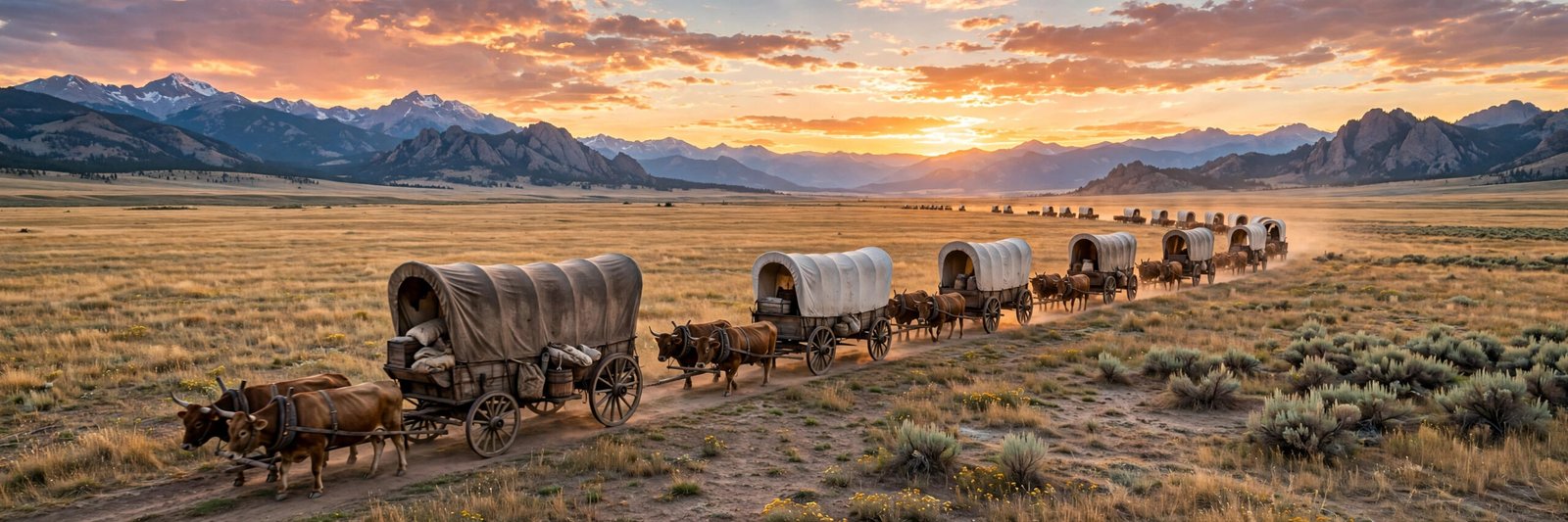
Picture this: after nearly six months on the trail, hungry, ragged, and almost out of hope, a small band of travellers stumbles out of the Sierra Nevada mountains and into a California ranch yard on November 4, 1841. They had started out in Missouri with wagons, livestock, and a dream — and they arrived with almost nothing left but their lives. That ragged arrival was the first wagon train California had ever seen, and it changed the future of America forever.
Before that day, no group of emigrants had ever completed an overland journey to California. Plenty of people had talked about it. Fur trappers had wandered the West for decades. But nobody had proved that ordinary families, with wagons and children in tow, could actually make it all the way from the Missouri frontier to the Pacific side of the continent. The Bidwell-Bartleson party proved it — barely.
What makes their story so gripping is not just that they succeeded, but how close they came to failing. They lost their wagons in the desert. They nearly starved. They crossed mountains with no reliable map and no guide for much of the way. And yet, on this very date in history, they walked into California and opened the door for the hundreds of thousands who would follow.
How the First Wagon Train California Expedition Began
The story starts in the spring of 1841 at Sapling Grove, near Westport, Missouri — then the jumping-off point for the western frontier. A 21-year-old schoolteacher named John Bidwell, originally from New York, had helped organise the Western Emigration Society, a group of restless Americans determined to reach California overland. Captain John Bartleson, a seasoned trader, was elected to lead them, with Bidwell serving as secretary and keeping a daily diary of the journey.
Historical accounts differ slightly on the exact details — some say the party numbered around 69 adults plus children, others put it at just over 60 men, women, and children — but the broad picture is consistent: a large, hopeful company set out west in May 1841, travelling in Conestoga-style wagons drawn by oxen, horses, and mules, at roughly 12 to 15 miles a day. None of them, including Bidwell and Bartleson, had ever been to California.
For the first stretch, fortune smiled on them. They joined forces with a Jesuit missionary group led by Father Pierre-Jean De Smet, guided by the famous mountain man Thomas “Broken Hand” Fitzpatrick. Together, they followed the emerging Oregon Trail westward, passing landmarks that would become legendary to later pioneers: Courthouse and Jail Rocks, Chimney Rock, Scotts Bluff, Fort Laramie, and Independence Rock, then over South Pass through the Rocky Mountains.
But the partnership could not last. The missionaries were bound for their own destinations, and at Soda Springs, in present-day Idaho, the emigrants parted ways with Fitzpatrick on August 11, 1841. From that point on, the California-bound travellers were largely on their own — and the hardest part of the journey had not even begun.
The Great Split at Soda Springs
At Soda Springs, the party faced its first great test of resolve. The Oregon Trail to the Willamette Valley was, by 1841, a known route with at least some precedent. California, by contrast, was a leap into the unknown. Roughly half the company chose the safer path and headed for Oregon under Bartleson. The rest — the more resolute members, as historians describe them — held to their original destination.
The California group that pressed on was small: accounts generally put it at 32 to 34 people, including 32 men, one woman, and one infant, according to the Johnson County Post’s account of the expedition. That one woman was Nancy Kelsey, barely eighteen years old, travelling with her husband Benjamin and carrying her baby daughter in one arm while leading a horse with the other. She would later be remembered for her heroism, patience, and kindness — and as the first woman to make this crossing.
With only nine wagons, no guide, no compass, and, in the words of one historical account, “nothing but the sun to direct them,” the little company turned south down the Bear River toward present-day Utah. Their track never became a trail, and it has long since disappeared. But the journals kept by Bidwell and others allow historians to trace their route with remarkable precision.
Abandoning the Wagons in the Nevada Desert
Crossing into Utah on August 16, 1841, the party became the first emigrants to cross the state with wagons — six years before the Mormon pioneers arrived. They skirted the northern end of the Great Salt Lake, where Nancy Kelsey became the first white woman ever to see that vast inland sea, and pushed on toward what they hoped would be a river leading to California.
That river was the Humboldt (then called Mary’s River), and reaching it brought real relief after the punishing desert. But the relief was temporary. The party crossed Promontory Mountain — along the route the transcontinental railroad would later follow — and pressed on through the arid ranges of present-day Nevada. Water was scarce, the animals were weakening, and the wagons, which had carried them so far, were becoming a burden rather than a help.
At Owl Spring, just north of Lucin in present-day Utah, Benjamin Kelsey abandoned his wagons and put his wife and baby on horseback. Days later, at Pilot Peak on the Utah-Nevada border, the travellers found freshwater springs at the mountain’s base — a moment of salvation. But the end of wagon travel was near. Crossing Silver Zone Pass, the party abandoned its remaining wagons at Relief Springs in Gosiute Valley, east of present-day Wells, Nevada. Those wagons sat there for years; emigrants travelling the Hastings Cutoff in 1846 would later find them.
From here on, everything the party owned was packed onto oxen, mules, and horses. The first wagon train California ever received had, in a very real sense, stopped being a wagon train at all — it had become a desperate pack train racing starvation across the desert.
The Desperate Crossing of the Sierra Nevada
The final leg of the journey was the worst. Food ran low, then lower. The travellers were, in the words of multiple historical accounts, destitute and almost naked by the time they reached the foothills of the Sierra Nevada. The mountains still stood between them and the California they had dreamed about for six months.
How exactly they crossed the Sierra remains one of the hazier parts of the story — the journals give us the broad strokes rather than a turn-by-turn route, and historians still debate some details. What is certain is that they made it through, descending into the San Joaquin Valley and pushing on to the ranch of John Marsh at the foot of Mount Diablo, in present-day Contra Costa County.
On November 4, 1841 — exactly 185 years ago today — the Bidwell-Bartleson party arrived at Marsh’s Los Medanos Rancho. The journey had lasted roughly five and a half to six months. Estimates of the distance travelled vary with how the winding route is measured, from around 1,730 miles to just over 2,000 miles, but by any measure it was an extraordinary feat of endurance. Arriving at the cusp of winter, the party spent time at the ranch recovering their strength and restocking supplies before splitting up to their various final destinations in California.
Consider what they had walked into: at the time, California was still Mexican territory, and only around 100 Americans were estimated to be living there at all. The Bidwell-Bartleson party increased that tiny population by roughly a third in a single day.
Why the First Wagon Train California Arrival Mattered
The Bidwell-Bartleson party did not establish a smooth, ready-made wagon road — their own route was so rough that later travellers needed better paths, and it took several more years before the California Trail became a practical highway. But what they did was arguably more important: they proved it could be done.
Before 1841, the overland journey to California was a theory. After November 4, 1841, it was a fact. As historian Doyce Nunis Jr. wrote, the party had “successfully made the first planned overland emigrant journey to California, bearing with courage and great fortitude the vicissitudes of their ordeal.” Their journals and reports filtered back east, giving later emigrants precious knowledge about water sources, passes, and dangers.
The flood that followed is now legendary. When gold was discovered in January 1848, tens of thousands of people poured over the California Trail — one historical account puts the figure at some 130,000 people in the years after the gold strike. The great migration that transformed California, and ultimately the United States, began with the small, starving band that arrived in 1841. Without their proof that the journey was survivable, the Gold Rush migration might have looked very different.
The party’s members went on to shape California themselves. John Bidwell, hailed by his biographer as the “Prince of California Pioneers,” worked for John Sutter, founded the city of Chico, and spent six decades contributing to his adopted state. Joseph B. Chiles became a noted trails captain who guided later emigrants. Nancy Kelsey lived on in California memory as a symbol of pioneer courage. The first wagon train California welcomed was not just a footnote — it was the seed of the state itself.
Takeaways From America’s First Wagon Train to California
- Preparation matters, but grit matters more. The party had no reliable maps and lost its guide midway — yet determination carried them through.
- Small decisions change history. The split at Soda Springs decided who would become California’s first overland emigrants and who would head to Oregon instead.
- Ordinary people make history. A 21-year-old teacher, a teenage mother, and a handful of farmers did what no expedition had done before.
- Failure along the way is not failure overall. Abandoning the wagons looked like defeat — but it was the decision that saved their lives and let them finish the journey.
- History is often approximate. Party sizes, departure dates, and mileages differ between sources, which is why historians rely on the surviving journals rather than any single retelling.
For more mind-bending true stories from history, check out the shortest war in history, which lasted just 38 minutes, and the mysterious Wow! signal from deep space that scientists still cannot explain. And if you love stories of endurance, do not miss the history of Veterans Day and the generations it honours.
Conclusion
On November 4, 1841, a starving, ragged band of travellers walked into a California ranch yard and changed the map of American ambition. The first wagon train California ever saw did not arrive in triumph — it arrived in tatters. But it arrived. And in arriving, it proved that the continent could be crossed by ordinary people with extraordinary resolve, opening the way for the great westward migration that would define the nation. The next time you drive across the American West in a few comfortable days, spare a thought for the Bidwell-Bartleson party, who did it on foot, in six months, with nothing but the sun to guide them.
Sources and Further Reading
Want to dig deeper? These sources cover the facts behind this story:
- Legends of America: Bidwell-Bartleson Party
- Trail Research Archive: California Trail (Bidwell-Bartleson) 1841
- Johnson County Post: First party to make overland journey to California
Frequently Asked Questions
When did the first wagon train reach California?
On November 4, 1841, the Bidwell-Bartleson party arrived at John Marsh’s Los Medanos Rancho at the foot of Mount Diablo, in present-day Contra Costa County, California, completing the first planned overland emigrant journey to the state.
Who led the first wagon train to California?
Captain John Bartleson was elected captain of the expedition, while 21-year-old John Bidwell was its most active organiser and secretary, keeping a daily diary of the journey. After the party split at Soda Springs, Idaho, Bidwell led the California-bound group.
How long did the Bidwell-Bartleson journey take?
The journey lasted roughly five and a half to six months, from May 1841, when the party set out from Sapling Grove near Westport, Missouri, until its arrival in California on November 4, 1841. Estimates of the distance range from about 1,730 miles to just over 2,000 miles depending on how the route is measured.
Did the first wagon train keep its wagons all the way to California?
No. The party was forced to abandon its remaining wagons at Relief Springs in Nevada’s Gosiute Valley after crossing Silver Zone Pass, continuing the rest of the journey with pack animals. The abandoned wagons were later found by emigrants travelling the Hastings Cutoff in 1846.
Why is the Bidwell-Bartleson party important today?
The party proved that an overland emigrant journey to California was possible, paving the way for the California Trail and the massive Gold Rush migration that followed. Its members, including John Bidwell, founder of Chico, went on to shape the early history of the state.