
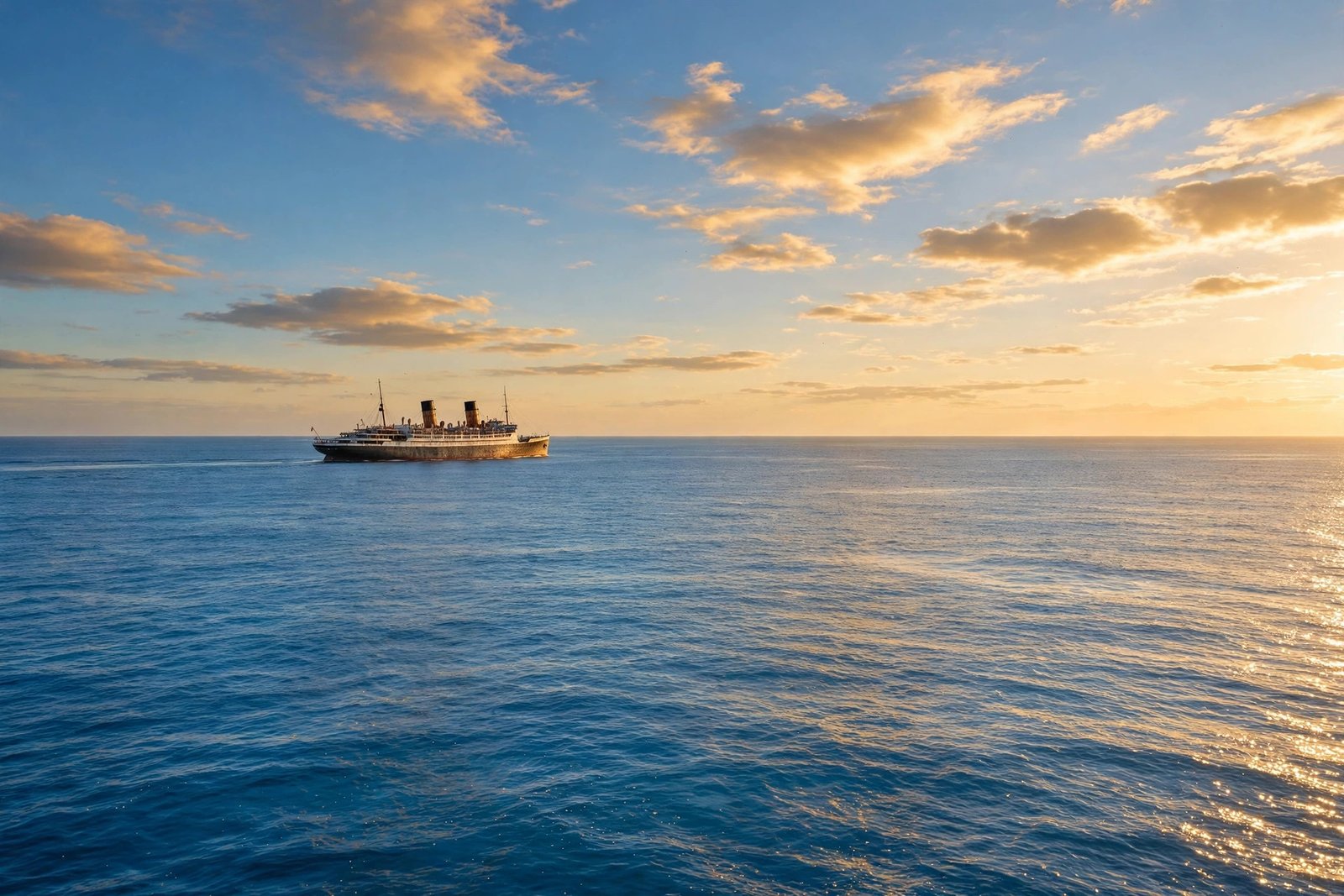
Imagine a ship so fast that no passenger liner has ever beaten her record, so grand that presidents and movie stars crossed the Atlantic aboard her, and so beloved that fans fought for decades to save her from the scrapyard. Now imagine that same ship, nearly 1,000 feet long, deliberately sunk to the bottom of the sea. That is exactly what is about to happen to the SS United States, and the SS United States artificial reef project is set to become one of the most extraordinary second acts in maritime history.
In the second week of November 2026, weather permitting, Okaloosa County, Florida, plans to sink the retired ocean liner about 22 nautical miles southwest of Destin-Fort Walton Beach in the Gulf of Mexico. When she settles on the seabed, she will become the world’s largest artificial reef, a new underwater world for fish, coral, and divers. It is a jaw-dropping ending for a ship that once symbolized American speed, luxury, and ambition. But how did the fastest ship on the Atlantic end up here, and what happens when a floating legend becomes a reef?
The Fastest Ship Ever Built
To understand why this sinking matters, you have to understand what the SS United States was. Built in the early 1950s at the Newport News Shipbuilding and Drydock Company in Virginia, she was the largest ocean liner ever constructed entirely in the United States. She was also designed with a secret mission in mind: in an emergency, she could be converted into a troopship capable of carrying thousands of soldiers. That dual purpose shaped everything about her, from her powerful engines to her fireproof design.
Her designer was William Francis Gibbs, a naval architect who had dreamed of building the fastest ocean liner in the world for decades. Gibbs was obsessed with speed and safety. He banned wood from the ship’s interiors wherever possible, used aluminum extensively to cut weight, and gave her a sleek, narrow hull built to slice through the Atlantic. The result was a ship that looked like a greyhound and moved like one too.
On her maiden voyage in July 1952, the SS United States shattered the transatlantic speed record held by the Queen Mary. She crossed from New York to Cornwall, England, in just 3 days, 10 hours, and 40 minutes, averaging about 35.59 knots, or roughly 41 miles per hour. She then broke the westbound record on the return trip, completing the crossing in 3 days, 12 hours, and 12 minutes. With both records in hand, she claimed the Blue Riband, the honor given to the fastest passenger liner on the Atlantic route. According to the Hemmings account of the ship’s record-breaking career, those speeds remain the record for a passenger ship crossing the Atlantic, and the Blue Riband has never been taken from her.
For 17 years, the Big U, as fans affectionately called her, carried passengers in style. Four decks of lounges, restaurants, and staterooms hosted celebrities, dignitaries, and everyday travelers. She made around 400 transatlantic crossings between 1952 and 1969, a golden era when crossing the ocean by ship was still the most glamorous way to travel. But the jet age was coming, and airplanes would soon make even the fastest ship seem slow.
Decades Adrift: The Fight to Save Her
The SS United States was withdrawn from service in 1969. What followed was a long, sad limbo. She passed through a series of owners, each with a grand plan to restore her as a hotel, casino, or museum, and each plan falling apart. Her interiors were stripped and sold off. By 1996, she was docked at Pier 82 in Philadelphia, where she sat rusting for nearly three decades, a ghost of her former glory visible from the Delaware River.
Yet she never lost her fans. The SS United States Conservancy, a nonprofit led by Susan Gibbs, the granddaughter of the ship’s designer, fought to preserve her. Supporters saw the ship as a piece of American history, a symbol of postwar optimism and engineering genius. As detailed in the story of America’s fastest liner, the ship held the Blue Riband from Great Britain for the highest average speed since her maiden voyage in 1952, even beating the mighty Queen Mary. That record, still unbeaten by any passenger liner, is a big reason people refused to let her go quietly.
The endgame came in 2024, when a court ordered the Conservancy to remove the ship from her Philadelphia berth. With scrapping looming as a real possibility, Okaloosa County, Florida, stepped in and purchased the vessel for $1 million. The county’s plan was bold: instead of letting the ship be cut apart for scrap metal, it would give her a new life underwater, as the centerpiece of a reef and dive tourism destination, alongside a land-based museum celebrating her history.
How the SS United States Artificial Reef Plan Began
Okaloosa County is no stranger to artificial reefs. The county manages more than 500 artificial reefs in the region, and it already has a famous neighbor for the Big U: the USS Oriskany, a former aircraft carrier sunk off Pensacola in 2006, which held the title of largest ship intentionally sunk as a reef. The SS United States artificial reef will surpass it, taking that crown by a wide margin.
The project is funded largely with tourism bed tax revenue collected from short-term rentals in Okaloosa County, plus contributions from local partners. County commissioners allocated $13 million for the whole project, covering the purchase, towing, environmental remediation, and support for the Conservancy’s land-based museum. Partners have chipped in too, including $1.5 million from Visit Pensacola and $500,000 from the Coastal Conservation Association Florida, its largest donation in four decades.
In February 2025, the ship left Philadelphia for the last time, towed more than 1,600 miles to Mobile, Alabama, at an average speed of about 6 miles per hour. In Mobile, crews spent months preparing her for deployment: emptying and cleaning her 128 fuel and lubricant tanks, removing wiring, and stripping out hazardous materials. The goal was to make sure that when she goes down, she goes down clean.
The Sinking: How Do You Sink a 990-Foot Ship?
Sinking a ship this size is not a matter of pushing a button. The plan calls for controlled flooding, not explosives, to settle the vessel upright on the seabed in about 180 feet of water, with her upper decks roughly 55 to 60 feet below the surface. That depth matters: it puts the top of the wreck within reach of recreational divers, while the deeper sections will challenge technical divers.
Here is what the operation looks like in broad strokes:
- The ship is towed to the approved reef site, about 22 nautical miles southwest of Destin-Fort Walton Beach.
- Crews open a carefully planned series of valves and flood points to let seawater in evenly, so she sinks upright rather than rolling over.
- Once she settles, survey teams will map the wreck and confirm her position and orientation before divers are allowed near.
- Researchers will begin monitoring marine life, water quality, and the underwater soundscape around the site.
The county has said the operation is weather-dependent, and the date could shift. According to The Scuba News report on the sinking schedule, officials confirmed in an October 15, 2026 announcement that the ship is scheduled to be deployed during the second week of November 2026, with the precise day depending on conditions at sea.
What the SS United States Artificial Reef Will Mean for Divers and Marine Life
Artificial reefs work because the open Gulf floor is mostly flat sand, with few places for sea life to anchor. A giant steel structure changes that overnight. Algae and small organisms colonize the surface first, then come the small fish seeking shelter, then the bigger predators that hunt them. Over months and years, coral and sponges take hold, and a wreck can become a thriving neighborhood of marine life.
For divers, the appeal is obvious. The SS United States artificial reef will be one of the largest diveable wrecks on Earth, a ship longer than three football fields, with decks, corridors, and open spaces to explore. Dive operators in the Destin-Fort Walton Beach area expect visitors from around the world, and local officials hope the reef becomes a long-term tourism draw, much like the Oriskany has been for Pensacola.
Researchers are taking the science seriously. The Dauphin Island Sea Lab is set to compare the underwater soundscape before and after deployment, Louisiana State University will track tagged fish around the vessel, and the Woods Hole Oceanographic Institution is lined up for biological, chemical, and physical monitoring over ten years. That means the sinking is not just a spectacle; it is a long-running experiment in how a massive structure reshapes an ocean ecosystem.
Florida has its share of dramatic stories, from the skies to the sea. If you enjoy unbelievable-but-true tales from the Sunshine State, you might also like our story about the Florida jet crash in Palm Beach, a very different kind of Florida tragedy that stunned the nation.
The Debate: Is Sinking Her the Right Call?
Not everyone is cheering. Preservation advocates argue that sinking the ship destroys a historic artifact that could have been saved as a museum. Some environmental scientists have raised concerns about coatings on the ship, including a zinc chromate primer, and whether chemicals could leach into the marine environment. In February 2026, PhillyVoice reported that University of Florida biogeochemist Todd Osborne warned about the potential risks of such coatings, while Okaloosa County has maintained that the project is being prepared in accordance with applicable environmental requirements.
A lawsuit filed to stop the sinking over contamination concerns was dismissed by a court, and the county says required environmental remediation has been completed. Still, the debate captures a genuine tension: is it better to preserve a ship as a museum piece that few people may ever visit, or to give it a new purpose that millions of fish, and thousands of divers, will experience? There is no answer that satisfies everyone, and that disagreement is part of why this story has captured so much attention.
As reported by Marine Insight’s coverage of the reef plan, the vessel will be placed at a depth of about 55 metres, with her upper decks 17 to 18 metres below the surface, making her accessible to both recreational and technical divers. And according to The Economic Times report on the project, the initiative carries a budget of $10.1 million for the reef deployment itself and aims to boost marine habitats and draw diving enthusiasts to Florida’s Gulf Coast.
Key Takeaways
- The SS United States was the fastest passenger liner ever, crossing the Atlantic in 3 days, 10 hours, and 40 minutes in 1952, a record no passenger ship has beaten.
- After decades docked in Philadelphia, Okaloosa County bought her in 2024 for $1 million to save her from scrapping.
- She is scheduled to be sunk about 22 nautical miles southwest of Destin-Fort Walton Beach in the second week of November 2026, weather permitting.
- At 990 feet, she will become the world’s largest artificial reef, surpassing the USS Oriskany off Pensacola.
- Controlled flooding, not explosives, will settle her upright in about 180 feet of water, with upper decks reachable by recreational divers.
- Scientists will monitor the site for a decade, tracking fish, coral growth, water quality, and sound.
- A land-based museum in the Destin-Fort Walton Beach area will preserve her history above the waves.
Conclusion
The SS United States was built to conquer the Atlantic, and in a strange way, she still is. Her final voyage is not to a scrapyard but to the seafloor, where she will spend her next chapter sheltering the very ocean she once raced across. Fans who fought for decades to save her may mourn the ship they knew, but her story is not ending. It is transforming, from a liner that carried people across the sea into a reef that carries life beneath it. When the water closes over her funnels for the last time, the fastest ship in history will begin the slowest, quietest voyage of all, and the SS United States artificial reef will be there for generations of divers to discover.
History is full of record-breakers who refused to fade away. For another tale of a daredevil who made history against impossible odds, read about Annie Taylor, the first person to survive going over Niagara Falls in a barrel. And if you love stories where time itself seems to bend, check out the shortest war in history, which lasted just 38 minutes.
Frequently Asked Questions
When will the SS United States be sunk as an artificial reef?
Okaloosa County has scheduled the deployment for the second week of November 2026, about 22 nautical miles southwest of Destin-Fort Walton Beach, Florida. The operation is weather-dependent, so the exact date could change, and county officials have said more details would be released closer to the event.
Why is the SS United States famous?
The SS United States is famous as the fastest ocean liner ever built. On her maiden voyage in July 1952, she crossed the Atlantic in 3 days, 10 hours, and 40 minutes, breaking the Queen Mary’s record by more than 10 hours and winning the Blue Riband, an honor she still holds among passenger liners.
How big is the SS United States artificial reef?
At 990 feet long, the SS United States will be the world’s largest artificial reef, larger than the USS Oriskany, the former aircraft carrier sunk off Pensacola in 2006. She will rest in about 180 feet of water, with her upper decks roughly 55 to 60 feet below the surface.
Can recreational divers visit the wreck?
Yes. The upper decks are planned to sit at depths reachable by recreational divers, while deeper sections will be suited to technical divers. After the sinking, survey teams will map the wreck and confirm safe access before dive operators begin running trips to the site.
What will happen to the ship’s history above water?
Okaloosa County’s plan includes support for a land-based museum in the Destin-Fort Walton Beach area, developed with the SS United States Conservancy. The museum will preserve artifacts, photographs, and stories from the ship’s career, so her history survives even as her hull becomes a reef.