
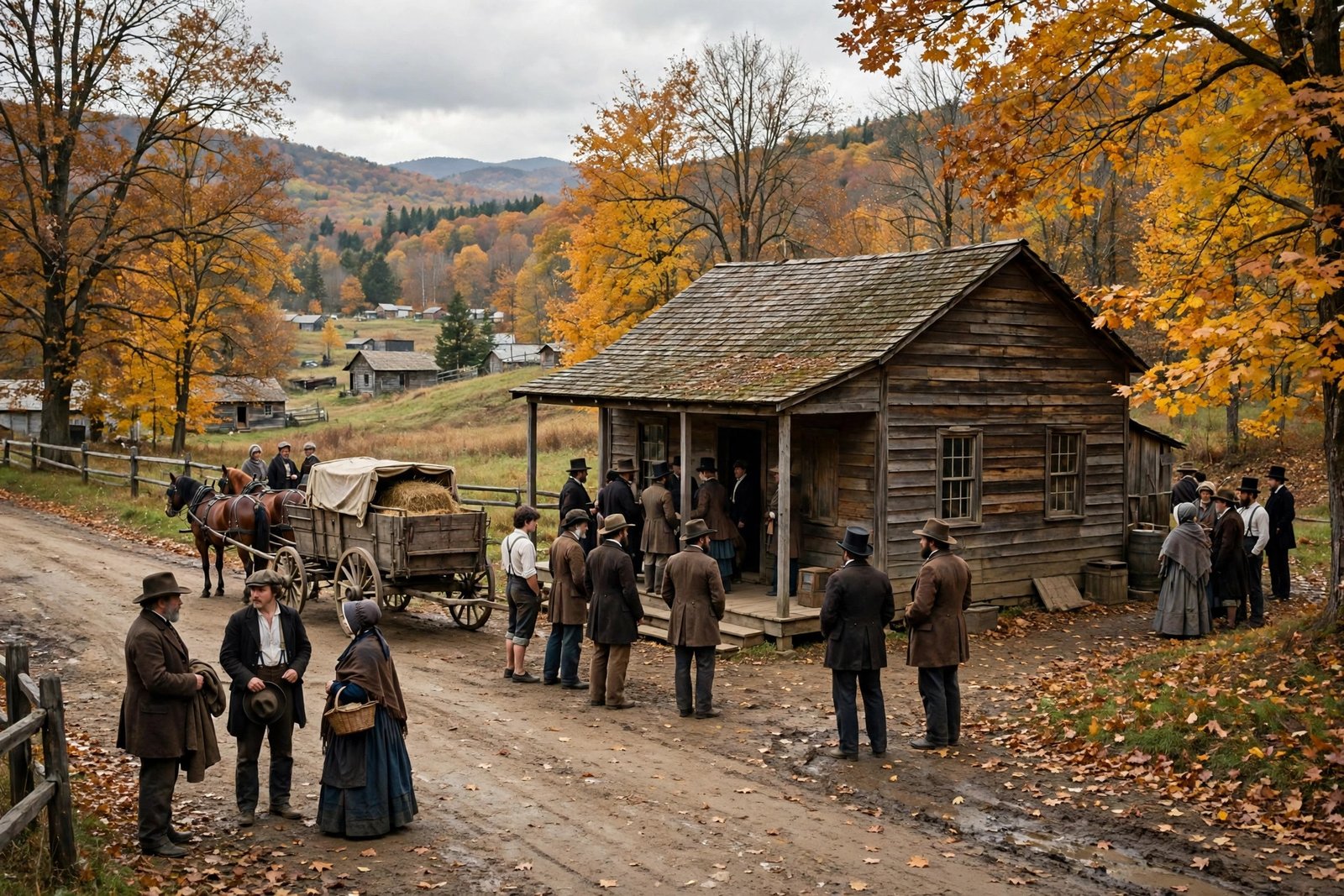
Every four years, millions of Americans line up to vote on a weekday when most of them are supposed to be at work. It feels strange, almost backwards, especially when so many other countries vote on a weekend. Yet there is a reason for it, and that reason is nearly 200 years old. So why Americans vote Tuesday? The answer takes us back to horse-drawn wagons, harvest fields, Sunday church services, and a one-paragraph law passed by Congress in 1845.
This is not a rule someone invented recently and forgot to update. It is a deliberate choice made for a country that looked nothing like modern America. Farmers made up most of the workforce, travel took days rather than minutes, and the calendar revolved around planting, harvesting, worship, and market day. Once you understand that world, Tuesday suddenly makes perfect sense.
And yes, the debate is still alive today. Critics argue that a Tuesday in November is a poor fit for office workers, parents, students, and shift workers. Supporters say the tradition works, especially now that early voting and mail ballots give people more options. Either way, the story behind the date is one of the most surprising pieces of American history hiding in plain sight.
Before 1845, There Was No Single Election Day
For the first half-century of the republic, America did not really have one Election Day. Under an early federal law from 1792, states had to choose their presidential electors within a 34-day window before the Electoral College met in early December. That meant each state picked its own date inside that window.
In practice, voting stretched out for weeks. In 1844, for example, the presidential election played out over roughly a month, from early November into early December. A voter in one state might cast a ballot long before a voter in another state had even heard the latest campaign news.
That staggered system created obvious problems. Results from states that voted early could leak out and influence voters in states that voted later. A candidate who looked like a winner in an early state might pick up momentum elsewhere, not because voters changed their minds on the issues, but because they had seen the early returns. Critics also worried about fairness and about people potentially voting in more than one state.
Then technology changed the game. Congress funded Samuel Morse’s telegraph in 1843, and it was demonstrated in 1844. Suddenly, news could travel from city to city in minutes instead of days. A staggered election calendar that had once been merely untidy now looked risky. If results could race across the country instantly, holding votes on different days seemed even harder to defend.
Congress decided the country needed one national day for choosing presidential electors, and it needed it before the next presidential cycle. The result was a short, practical law that has shaped American life ever since.
Why Americans Vote Tuesday: The 1845 Law in Plain English
On January 23, 1845, Congress passed the Presidential Election Day Act, formally titled “An Act to Establish a Uniform Time for Holding Elections for Electors of President and Vice President in all the States of the Union.” President John Tyler signed it. From then on, presidential elections would be held, in the law’s words, “on the Tuesday next after the first Monday in the month of November.”
That wording sounds fussy today, but every word was doing a job. It was not simply “the first Tuesday in November.” The phrase “after the first Monday” was added on purpose, and it is the reason Election Day always falls between November 2 and November 8, never on November 1.
November 1 is All Saints’ Day on the church calendar, a holy day of obligation for Catholics. Lawmakers wanted to avoid holding an election on a religious holiday. November 1 was also traditionally a day when merchants settled their monthly accounts and did their bookkeeping. Pushing the election past November 1 avoided both clashes at once.
At first, the rule covered only presidential elections. Congress later extended the same Tuesday date to elections for the U.S. House of Representatives in 1872. Senators were originally chosen by state legislatures, not by voters directly, so the change for Senate races came with the 17th Amendment, ratified in 1913, which established direct election of senators. Over time, the Tuesday date became the standard rhythm of American federal elections.
If you want a quick sense of how long this tradition has lasted, consider this: the first presidential election held under the new law was on November 7, 1848, when Whig candidate Zachary Taylor defeated Lewis Cass and former President Martin Van Buren, who was running as the Free Soil Party candidate. Americans have followed the same calendar rule ever since.
Why November? Harvest, Weather, and the Farming Calendar
November was not chosen at random. In an agrarian society, the time of year mattered enormously. Spring and summer were for planting and tending crops. Late summer and early autumn were for the harvest, when every available hand was needed in the fields. Holding an election in the middle of harvest would have asked farmers to abandon urgent work.
By early November, the harvest was usually in. At the same time, the harshest winter weather had generally not yet arrived. Roads were still passable, at least by 19th-century standards, and a journey to the county seat was difficult but doable. November sat in a narrow sweet spot: after the harvest, before winter shut things down.
There was also a legal reason November worked. The Electoral College was scheduled to meet in early December, and the 1792 law required state elections to happen within 34 days before that meeting. Early November fit neatly inside that window, leaving enough time to count votes and send electors on their way.
Today, only a small share of Americans work in agriculture, so the harvest argument feels distant. But in the 1840s, farming was not a niche job. It was the backbone of the economy and the daily reality for most families. A national election date that ignored the farming calendar would have been unworkable.
Why Tuesday and Not Monday, Wednesday, or Sunday?
The choice of Tuesday comes down to a process of elimination shaped by religion, travel, and market day. Picture a farmer in the 1840s who lived a full day’s wagon ride from the county seat, where votes were cast. Getting there was not a quick errand. It was a journey.
Sunday was out of the question. For most Americans of the era, Sunday was for church and rest, and traveling on the Sabbath was widely frowned upon. That ruled out Sunday as an election day, and it also ruled out Monday for many rural voters, because they would have had to travel on Sunday to arrive in time.
Wednesday was also a problem. In many towns, Wednesday was market day, when farmers sold produce and bought supplies. Asking farmers to choose between voting and selling their goods would have been unfair and impractical. That ruled out Wednesday, and by the same travel logic, it made Thursday awkward too, since voters would have needed to travel on market day.
Tuesday solved the puzzle. A voter could leave home on Monday morning, travel during the day, stay overnight in town, vote on Tuesday, and still be home in time for Wednesday market. It was, in the words of historians, the kindest day available to a country full of farmers. Tuesday sat neatly between the Sabbath and market day, with a travel day on either side.
This is why the horse-and-buggy explanation still gets repeated in almost every account of Election Day. It sounds quaint, but it was serious logistics. Without cars, trains for most rural voters, or paved highways, a day’s travel was a real cost, and the calendar had to respect it.
The Modern Debate: Should America Still Vote on a Tuesday?
Fast-forward to today, and the farming calendar no longer runs American life. Most voters are office workers, service workers, parents juggling school runs, students, nurses, drivers, and shift workers. A Tuesday election can mean asking for time off, rearranging childcare, or squeezing a trip to the polls between shifts.
That mismatch is at the heart of the modern debate, and it is why asking why Americans vote Tuesday still sparks arguments every election cycle. Critics argue that a weekday election suppresses turnout because it competes directly with work and school. Research on nonvoting has repeatedly found scheduling conflicts among the top reasons people give for not voting. Supporters of reform point out that many other democracies vote on weekends or make Election Day a public holiday.
Several proposals have been floated over the years. Some advocates want to move federal elections to a weekend, for example the first Saturday and Sunday after the first Friday in November. Others propose making Election Day a national holiday so workers do not have to choose between a paycheck and a ballot. The organization Why Tuesday, founded in 2005, has campaigned for changing the date, arguing that the current system is out of step with modern life.
None of those proposals has succeeded at the federal level so far. Changing the date would require Congress to act, and any change would have to work across a patchwork of state and local election laws, polling-place logistics, and ballot-counting rules. Some critics of reform also worry that a holiday election day could simply become a long weekend for travel rather than a day focused on voting, while others argue that weekend voting brings its own complications.
One political scientist quoted in discussions of the issue, Norman J. Ornstein, has explained that the 1845 law was written for a primarily agrarian society, and he co-founded Why Tuesday to push for a schedule better suited to modern Americans. The debate, in other words, is not really about whether 1845 made sense. It is about whether 1845 should still decide 2026.
Why Americans Vote Tuesday Still Matters in the Age of Early Voting
Here is an important twist: even though the Tuesday rule remains on the books, Election Day itself is no longer the only day most Americans can vote. Many states now offer early in-person voting, no-excuse absentee voting, or mail-in ballots. That flexibility has softened the impact of the Tuesday date without changing the law itself.
Millions of Americans now cast their ballots days or weeks before the official Tuesday. For them, the old calendar is more of a deadline than a single-day event. Election officials still use that Tuesday as the anchor date for counting, reporting, and certifying results, but the voting window around it has widened considerably.
That is also why election results sometimes take days to finalize, a topic that confuses many voters. Mail ballots, close races, and state-by-state counting rules all affect how quickly a winner can be called. If you have ever wondered about that delay, our look at why election results can take days breaks down the counting process in plain language.
The Tuesday tradition also survives because it is familiar. Campaigns, newsrooms, schools, and local governments all plan around it. Changing it would mean rewriting calendars, contracts, and habits built up over generations. Familiarity is not a great argument on its own, but it is a powerful force in any system as large as American elections.
Takeaways: What to Remember About Election Day
- Before 1845, states voted on different days within a 34-day window, and early results could influence later voters.
- Congress set a single national date on January 23, 1845: the Tuesday after the first Monday in November.
- November followed the harvest and came before harsh winter weather, making travel to the polls feasible.
- Tuesday allowed rural voters to travel on Monday, vote on Tuesday, and return home for Wednesday market day.
- The “after the first Monday” wording keeps Election Day off November 1, All Saints’ Day and a traditional bookkeeping day.
- The first election under the new law was held on November 7, 1848, and Zachary Taylor won.
- Reformers today propose weekend voting or a national holiday, but Congress has not changed the federal date.
- Early voting and mail ballots now give many Americans alternatives to voting on the Tuesday itself.
History also has a habit of producing dates that stick around long after their original reasons fade. Veterans Day, for example, is fixed to November 11 for reasons rooted in the end of World War I, and our story on the history of Veterans Day on November 11 shows how another November date became a permanent part of the American calendar.
Conclusion: A Horse-and-Buggy Calendar in a Smartphone World
So why Americans vote Tuesday? Because in 1845, Tuesday was the one day that respected the Sabbath, the harvest, market day, and a day-long wagon ride to the county seat. November was the one month that respected the farming year. And “after the first Monday” was the clever wording that kept the election off a religious holiday and a bookkeeping day.
It was smart, practical lawmaking for its time. The fact that it still governs American elections today tells you two things: how durable a simple rule can be, and how hard it is to change a national habit once millions of people have built their lives around it.
Whether you think Tuesday should stay or go, the story is a reminder that the details of democracy are not always grand or dramatic. Sometimes they are about wagons, wheat, and Wednesdays. And sometimes a small scheduling choice made in 1845 ends up shaping how a superpower votes nearly two centuries later.
Sources and further reading: ThoughtCo on why Election Day falls on a Tuesday, HowStuffWorks on the Tuesday tradition, Al Jazeera’s explainer on the Tuesday vote, and UNC-Chapel Hill on rethinking election traditions. For a curiosity break after all that civic history, check out the loudest sound ever recorded, from Krakatoa in 1883.
Frequently Asked Questions
Why do Americans vote on a Tuesday?
Americans vote on a Tuesday because of a law passed by Congress in 1845 that set presidential elections for the Tuesday after the first Monday in November. Tuesday worked best for a farming society: voters could travel on Monday without breaking the Sunday Sabbath, vote on Tuesday, and return home in time for Wednesday market day.
Why is Election Day in November?
November was chosen because it came after the harvest and before harsh winter weather, making travel to polling places manageable. It also fit the legal timetable for the Electoral College, which met in early December, leaving enough time to count votes and choose electors.
Why does Election Day never fall on November 1?
The law says the Tuesday after the first Monday in November, which always pushes Election Day to between November 2 and November 8. That wording avoids November 1, which is All Saints’ Day on the church calendar and was traditionally a day when merchants settled their monthly accounts.
When was the first election held under the 1845 law?
The first presidential election held under the new law was on November 7, 1848. Whig candidate Zachary Taylor won, defeating Lewis Cass of the Democratic Party and former President Martin Van Buren, who was running as the Free Soil Party candidate.
Could Congress move Election Day to a weekend?
Yes, in principle Congress could change the federal election date, since the Tuesday rule comes from a federal law, not from the Constitution itself. Proposals for weekend voting or a national Election Day holiday have been discussed for years, but none has passed, and many states have instead expanded early voting and mail ballots to give voters more flexibility.