
There is a sound that can stop a bad day in its tracks. You sit down, a cat climbs onto your lap, and within seconds the room fills with a soft, steady rumble. It feels like happiness made audible. But if you have ever wondered why cats purr, the honest answer is more interesting than the simple one: purring is not just a happiness signal. It is a whole communication system, and scientists are still piecing together exactly how it works.
Cats purr when they are relaxed, yes. They also purr when they are frightened, injured, or giving birth. Kittens purr within days of being born. Mother cats purr back. Some cats even purr at the veterinarian’s office, which is hardly their favorite place on earth. So what is going on? To understand why cats purr, we need to look at what a purr actually is, what it does for cats, and what researchers have and have not proven.
Why Cats Purr: What Is Actually Happening
A purr is not a voice sound in the way a meow is. It is produced when the muscles around a cat’s voice box, or larynx, twitch rapidly. As the cat breathes in and out, air passes over these twitching muscles and the vocal cords, creating the familiar vibrating rumble. Because the sound happens on both the inhale and the exhale, a cat can keep purring for a long time without pausing for breath.
That mechanism is part of what makes purring unusual. Most cat sounds are short bursts. Purring is continuous, rhythmic, and low effort. Researchers describe it as a kind of built-in vibration, one that a cat can switch on almost like a reflex. In fact, the neural signal that drives purring appears to come from the brain, which sends rhythmic pulses to the laryngeal muscles. The cat does not have to think about it any more than you think about breathing.
One of the most surprising things about purring is how early it starts. Kittens are born blind and deaf, and they cannot meow loudly enough to reliably guide their mother. But they can purr, and they do, within their first few days of life. The vibration helps their mother locate them, and it likely helps the kittens find her to nurse. In that sense, purring may be one of the very first tools a cat ever uses to communicate.
Why Cats Purr When They Are Happy
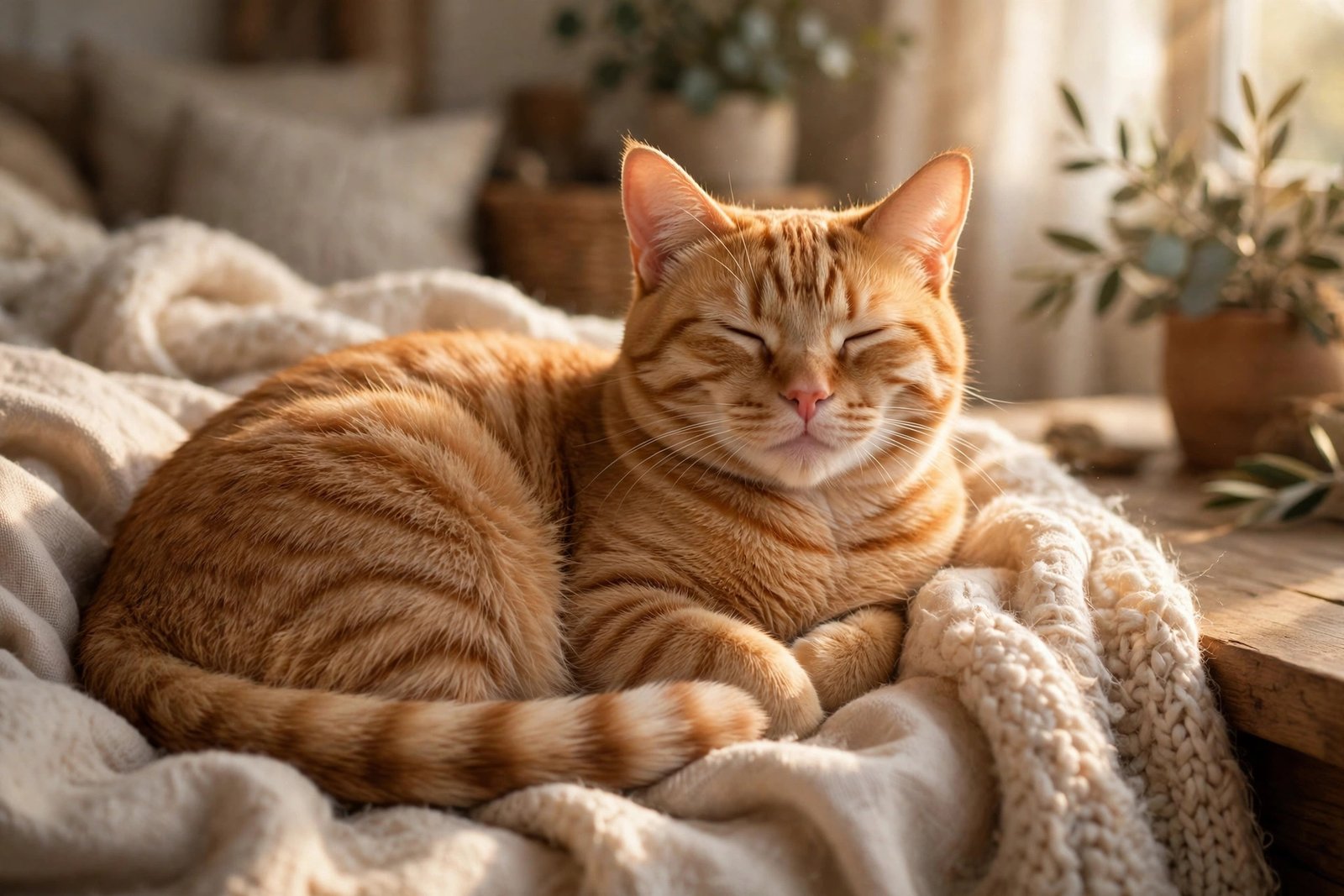
Let us start with the version everyone knows, because it is real. A relaxed cat on a warm lap, eyes half closed, kneading softly, is usually purring because it feels safe and content. In this context, purring is a social signal. It tells nearby cats, and nearby humans, that there is no threat here and that the cat is comfortable.
Mother cats purr while nursing, and their kittens purr in return. Adult cats often purr when greeting a familiar person or another cat they trust. Behaviour specialists sometimes call this a kind of social glue: a sound that says, in effect, I am friendly, stay close, everything is fine. It is one reason purring feels so soothing to us. Our brains seem wired to read that steady rhythm as a sign of calm, and many cat owners say their own stress drops when their cat starts purring.
There is also a clever twist. Researchers have found that some cats produce a special kind of purr when they want something, usually food. This so-called solicitation purr mixes the normal low rumble with a higher-pitched cry, similar in frequency to a human baby’s cry. People tend to find it hard to ignore, even if they do not own cats. It is a reminder that purring is not a single message. It is a flexible signal, and cats adjust it depending on who is listening.
Why Cats Purr When They Are Stressed or in Pain
Here is where the simple happiness story breaks down. Cats also purr at the vet, after a fall, during labor, and when they are frightened. If purring only meant happiness, none of that would make sense. So scientists believe purring also works as a self-soothing mechanism, something like the way a person might hum quietly or rock back and forth when anxious.
Think of it this way: a cat that is hurt or scared cannot always run away or fight. A kitten cannot explain that it is frightened. But a steady, rhythmic vibration may help calm the cat’s own nervous system. Some animal behaviourists compare it to a child sucking their thumb or an adult taking slow, deep breaths. The purr may be the cat’s way of comforting itself, and possibly of asking for comfort from others at the same time.
This dual role matters for cat owners. A purring cat is usually relaxed, but purring alone does not guarantee a cat is fine. Context is everything. A cat that is purring while hiding, refusing food, breathing quickly, or holding its body tense may be stressed or unwell rather than happy. The rest of the body tells the real story: ears, posture, eyes, appetite, and whether the cat is seeking company or trying to disappear. If a cat’s behaviour changes suddenly, that is worth a vet visit, purr or no purr.
Can Purring Help Cats Heal?
One of the most fascinating ideas in purr research is that the vibration itself might help the cat’s body. Domestic cats purr at frequencies often reported in the range of roughly 25 to 150 hertz. Researchers have noted that vibrations in similar frequency ranges have been studied in connection with bone density and tissue healing in other contexts, which led to an appealing hypothesis: perhaps purring helps cats maintain strong bones and recover from injuries.
It is a wonderful idea, and it would help explain a long-standing puzzle. Cats are famously good at recovering from injuries that would keep other animals down for much longer, and they are known for healing quickly from bone fractures. Some researchers have suggested that a cat’s constant low-level purring acts like a built-in, low-cost form of physical therapy, keeping bones and muscles stimulated even while the cat rests.
But honesty matters here. This healing idea is a hypothesis, not a proven medical fact. The frequency observations are real, and the link between vibration and bone health is a genuine area of research, but scientists have not proven that a cat’s purr directly heals its own injuries. What we can say is that purring may be linked to healing, that the idea is plausible, and that more research is needed before anyone calls it a cure. The best science writing leaves room for that uncertainty rather than dressing a guess up as a discovery.
For a fuller picture of how scientists study animal sounds, it is worth reading Scientific American’s explanation of why cats purr, which walks through the larynx mechanism and the self-soothing theory. And if you love stories where animals surprise us, BolanPost’s tale of a dog that survived 34 days in Yellowstone is a reminder of just how tough and resourceful animals can be.
Do Big Cats Purr Too?
Not all cats purr in the same way, and the differences are revealing. Domestic cats, cheetahs, and cougars can purr continuously. Lions, tigers, leopards, and jaguars generally cannot produce a true continuous purr. Instead, they roar, thanks to differences in the structure of their voice box and the bones that support it.
This trade-off is one of nature’s neat compromises. The anatomy that lets a lion roar with enormous power is different from the anatomy that lets a house cat purr nonstop. Some big cats can make purr-like sounds on the exhale only, a kind of chuffing or partial purr, but the full in-and-out rumble belongs mostly to smaller cats. That is part of why your house cat’s purr feels so intimate: it is a sound that big, wild cats largely gave up in exchange for a roar.
There is also a fun middle ground. Cheetahs, despite being large and fast, purr like house cats, and they purr loudly. Cougars purr and chirp. If you ever visit a wildlife sanctuary and hear a cheetah purring, you will notice it sounds remarkably like a very large house cat that is extremely pleased with itself.
What Your Cat’s Purr Might Be Telling You
Since purring can mean several things, how do you read it? Look at the whole cat, not just the sound. Here are the clues that matter most:
- Relaxed body, slow blinks, kneading: this is the classic contented purr. Your cat feels safe and is enjoying the moment.
- Purring plus rubbing and head-butting: a social greeting. Your cat is saying hello and marking you as part of its trusted circle.
- Purring while hiding or crouched low: this may be self-soothing. Give the cat space and check whether something has frightened it.
- Purring with a higher, insistent cry mixed in: your cat may be asking for something, most often food or attention.
- Purring combined with not eating, limping, or unusual lethargy: do not assume contentment. A vet check is the safe move.
The key takeaway is simple: purring is communication, not a single emotion. Cats use it the way people use tone of voice. The same words can mean different things depending on how they are said, and the same purr can mean different things depending on when it happens.
The Takeaways Worth Remembering
If you only remember a few things about why cats purr, make it these. First, purring is produced by rapid twitching of the muscles around the voice box, and it happens on both the inhale and the exhale, which is why it can go on so long. Second, it starts almost at birth and works as a kitten-to-mother signal before cats can see or hear properly. Third, it is a social and self-soothing tool, used when cats are happy, stressed, frightened, or in pain. Fourth, the healing hypothesis is exciting but unproven, and honest science keeps it in the maybe column. And fifth, context beats sound: read the body, not just the rumble.
There is something quietly remarkable about all of this. A cat cannot explain itself in words, yet it carries around a built-in instrument that calms itself, bonds it to its kittens, greets its friends, and asks its humans for dinner. Whether purring evolved mainly for communication, for comfort, or for healing, it clearly does a lot of work for such a small sound.
It also explains why purring is so powerful for us. Humans did not evolve to hear cats purr, but we respond to it anyway. Studies of the human-animal bond often note that stroking a purring cat can lower stress for the person too, and many owners describe the sound as genuinely calming. That may be one reason cats have lived alongside humans for thousands of years so successfully. They do not just tolerate us. They rumble at us, and we cannot help but feel a little better for it.
For more animal facts that sound too strange to be true, check out BolanPost’s collection of facts from a Reddit thread that feel fake but are 100 percent real. And the next time your cat starts purring, pause for a second before you assume you know what it means. Look at the ears, the posture, and the eyes. The rumble is only half the message. The rest is written all over the cat.
Frequently Asked Questions
Do cats only purr when they are happy?
No. Cats purr when content, but they also purr when stressed, frightened, injured, or giving birth. Scientists believe purring works both as a social signal and as a self-soothing mechanism, so the meaning depends on the situation and the cat’s body language.
How do cats make the purring sound?
Purring is made by rapid twitching of the muscles around the cat’s voice box. As the cat breathes in and out, air moves over these muscles and the vocal cords, producing the steady vibration. Because it happens on both inhale and exhale, cats can purr continuously for a long time.
Can purring really help a cat heal?
This is a popular hypothesis but not a proven fact. Cats purr at frequencies often reported between roughly 25 and 150 hertz, and vibration in similar ranges has been studied for bone and tissue health. Researchers have not yet proven that purring directly heals injuries, so it is best described as plausible, not confirmed.
Why do kittens purr so soon after birth?
Kittens are born blind and deaf, and purring gives them an early way to communicate with their mother. The vibration helps the mother locate them and helps the kittens find her to nurse. Mother cats purr back, creating a two-way signal before the kittens can see or hear properly.
Should I worry if my cat purrs at the vet?
Not necessarily. Many cats purr at the vet as a way to soothe themselves when stressed. It does not mean they are enjoying the visit. Watch the whole picture: tense posture, hiding, flattened ears, or changes in appetite are better warning signs than the purr itself, and a vet can advise if anything seems wrong.