
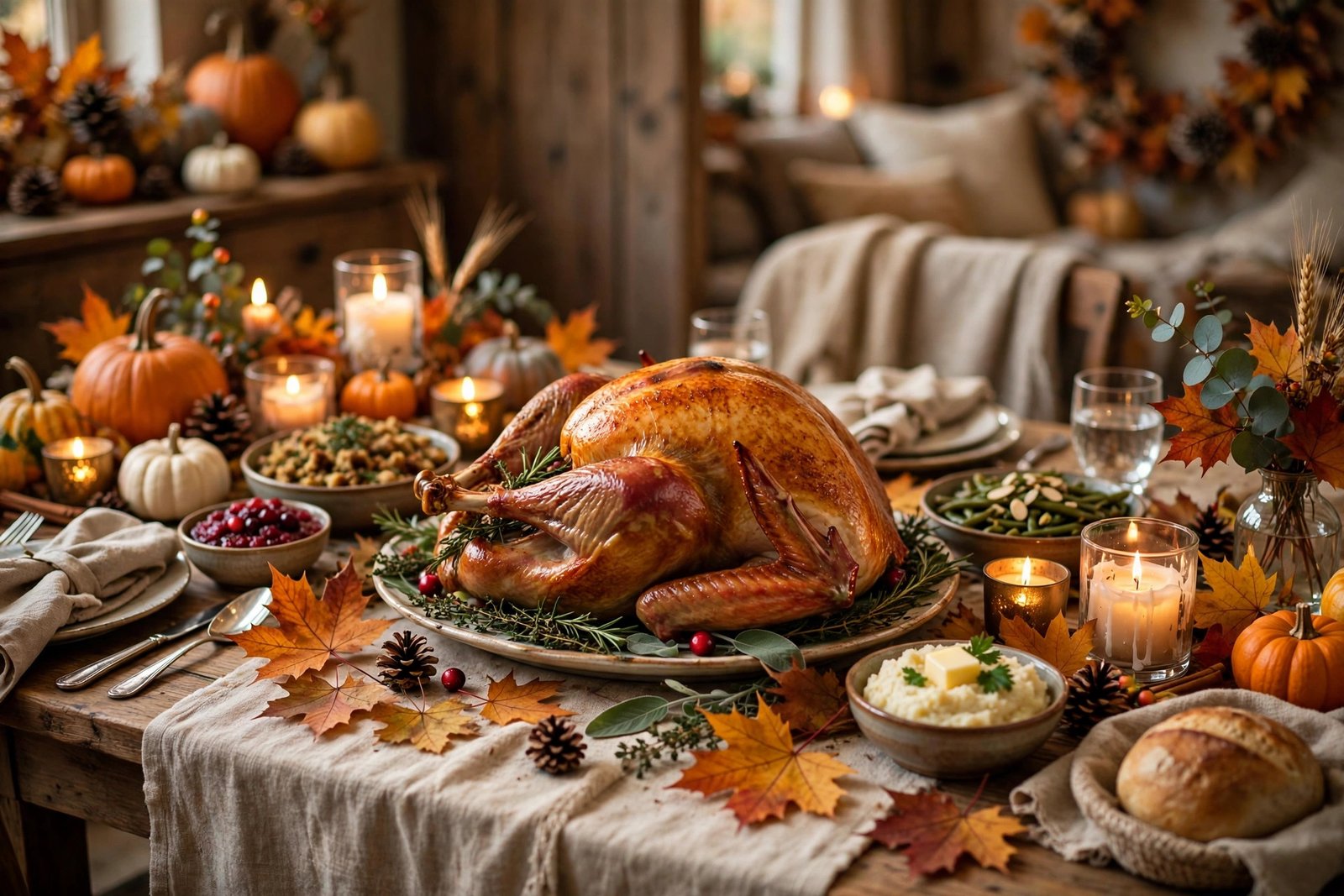
Picture a Thanksgiving table in America, and one image appears almost instantly: a large roasted bird, golden and gleaming, carried proudly to the center of the table while everyone gathers around. But have you ever stopped to ask why turkey on Thanksgiving became such an unshakable tradition? The answer is far more surprising than most people expect, because the bird we now treat as the star of the holiday was not necessarily the star of the first Thanksgiving at all. The real story winds through colonial harvest feasts, practical farm economics, a determined magazine editor, a president leading a nation at war, and more than a century of cookbooks, magazines, and family habit.
The question of why turkey on Thanksgiving matters is not just about food. It is about how traditions are made. Some customs are handed down unchanged for centuries, but Thanksgiving turkey is different. It grew slowly, gained champions, survived competing menus, and eventually became so familiar that we now assume it was always there. Tracing that journey reveals a lot about American history itself, from the early colonies to the Civil War and into the modern age of grocery stores, parades, and football.
What Really Happened at the First Thanksgiving in 1621
Most Americans grow up with a tidy picture of the first Thanksgiving: Pilgrims and Wampanoag people sitting together in 1621 in Plymouth, Massachusetts, sharing a turkey dinner. The real event was both simpler and more interesting. In the autumn of 1621, English settlers celebrated a successful harvest, and members of the Wampanoag people joined them for a feast that lasted about three days. That much is supported by historical records, including a letter written by colonist Edward Winslow to a friend in England.
What Winslow described was plentiful fowl and deer, along with local produce, but he did not name turkey specifically. The word fowl could have covered several kinds of wild birds common in the region, including ducks, geese, and possibly wild turkeys. Historians therefore treat turkey at the 1621 feast as plausible, not proven. The menu likely reflected what was available in season: wild birds, venison brought by Wampanoag hunters, shellfish, eel, beans, squash, corn, and other local foods. There was no cranberry sauce from a can, no sweet potato casserole, and no pumpkin pie as we know it today.
That uncertainty is part of the charm of the story. We love to imagine a single founding meal that explains everything that followed, but early Thanksgiving celebrations were harvest festivals, not a fixed national menu. Different communities ate different foods, and the idea of one official Thanksgiving dinner took a very long time to form. If you enjoy untangling popular history from documented fact, you will also enjoy our look at another famous November anniversary, the discovery of Tutankhamun’s tomb, where legend and evidence also diverge in fascinating ways.
Why Turkey on Thanksgiving Made Practical Sense
So if turkey was not certainly on the table in 1621, why turkey on Thanksgiving in the centuries that followed? The first answer is wonderfully practical. Turkeys were native to North America, plentiful in the wild, and later easy to raise on farms. They were also big. A single turkey could feed a large family gathering in a way that a chicken simply could not, and it cost less per serving than a goose, which remained an expensive luxury for many households.
Farm logic helped too. Chickens and cows gave farmers eggs and milk all year, so killing them for a feast meant losing a steady food source. Turkeys, by contrast, were raised mainly for meat. Slaughtering one in late autumn made sense: the bird had fattened through the summer, the weather was cool enough to keep meat fresh, and the harvest season was ending. For a holiday built around gratitude for the harvest, a large bird that fed everyone at once was the perfect centerpiece, both visually and economically.
Wild turkeys were also part of the landscape of colonial America in a way that feels almost hard to believe today. Early accounts describe them as abundant, and they appeared at many kinds of large gatherings, not only Thanksgiving. In other words, turkey did not start as a Thanksgiving invention. It started as a sensible feast bird, and Thanksgiving eventually claimed it. As Real Simple explains, turkey was indigenous, plentiful, and larger than chickens, ducks, and geese, making it economical to serve to a crowd.
The Woman Who Put Turkey at the Head of the Table
The single most important person in the turkey story may be someone many Americans have never heard of: Sarah Josepha Hale. Hale was a writer and magazine editor who spent decades campaigning to make Thanksgiving a fixed national holiday. In her 1827 novel Northwood: A Tale of New England, she described an idealized New England Thanksgiving in loving detail, and the roasted turkey took pride of place.
Hale wrote that the roasted turkey took precedence on the occasion, placed at the head of the table, sending forth the rich odor of its savory stuffing. That image stuck. As editor of Godey’s Lady’s Book, one of the most popular magazines of its day, Hale published Thanksgiving menus, recipes, and stories year after year. Readers across the country absorbed her version of the holiday, complete with turkey, gravy, vegetables, and pies. Long before Thanksgiving was a national holiday, Hale was already teaching America what Thanksgiving dinner should look like.
Her campaign was about more than food. Hale believed a shared national Thanksgiving could help unite a divided country, and she wrote to governors and presidents urging them to proclaim the holiday on the same day each year. She was persistent for decades, and her timing finally aligned with a president who was looking for a moment of national unity in the middle of a civil war. That persistence is a reminder that traditions often have authors, even when we forget their names.
Lincoln, the Civil War, and the National Holiday
In 1863, in the middle of the American Civil War, President Abraham Lincoln issued a proclamation setting aside the last Thursday of November as a national day of thanksgiving. The proclamation itself did not prescribe a menu, and it did not permanently legislate an annual holiday in one stroke. It designated a specific day that year, and later presidential proclamations established the durable yearly practice. But the effect was enormous: for the first time, Americans across the country were invited to mark the same day of thanks at the same time.
The wartime context mattered. Families were separated, soldiers were far from home, and a shared holiday offered a sense of connection. Aid societies organized Thanksgiving meals for troops, and records show that some of those feasts included roast turkey, though supplies and location meant that not every soldier enjoyed a full feast. The holiday language of home, reunion, and gratitude gained special force during wartime separation, and turkey, already associated with New England Thanksgiving tables through Hale’s writing, rode that wave into national life.
There is also a charming White House story from this era. According to popular accounts, a live turkey sent to the Lincoln family was spared after the president’s young son Tad adopted it as a pet, an early ancestor of the modern presidential turkey pardon tradition. Historians treat some details of the pardon legend cautiously, but the story captures something real: by the 1860s, the turkey had become so linked to Thanksgiving in the public imagination that even the White House could not escape it. The history of the tradition shows how Hale’s lobbying, Lincoln’s proclamation, and simple practicality combined to fix the bird in place.
How Cookbooks, Magazines, and the 20th Century Sealed the Deal
Once Thanksgiving became a national holiday, the turkey’s position only grew stronger. Cookbooks from the late 1700s onward already included roast turkey recipes; Amelia Simmons’s American Cookery, published in 1796, gave detailed instructions for stuffing and roasting the bird. As printing became cheaper and magazines reached more homes, Thanksgiving menus became more standardized. Families in different states began to cook remarkably similar meals, and children learned in school that Thanksgiving meant turkey.
Several other forces helped. Charles Dickens’s A Christmas Carol, published in 1843, popularized the festive roast turkey for Christmas in Britain and America, reinforcing the bird’s association with large holiday gatherings generally. As Thanksgiving spread beyond New England, turkey remained the most practical and affordable large bird, and the growing food industry made it easier to buy. By the twentieth century, frozen turkeys, grocery advertising, and later the televised Macy’s Thanksgiving Day Parade and football games turned the meal into a national ritual with a familiar script.
That script is powerful. Today, tens of millions of turkeys are eaten around Thanksgiving in the United States each year, according to figures commonly cited from the U.S. Department of Agriculture. Not every household eats turkey, and many families add or substitute other dishes, from ham and roast beef to vegetarian mains and dishes reflecting their own heritage. But the roasted turkey remains the default image of the holiday, appearing on greeting cards, advertisements, and dinner tables from coast to coast. Like the curious origins of everyday habits, it rewards a closer look, just as our article on why we say cheese when taking photos shows how a small habit can carry a surprisingly long history.
Why Turkey on Thanksgiving Still Matters Today
So why turkey on Thanksgiving today, when we could easily choose any main dish? Part of the answer is nostalgia. For many families, the smell of a roasting turkey is tied to childhood memories, grandparents’ kitchens, and the one day a year when everyone tries to be in the same room. Food traditions work because they repeat, and repetition turns a meal into a memory. Changing the main dish can feel like changing the holiday itself, even when the spirit of gratitude stays exactly the same.
Another part of the answer is spectacle. A whole roasted turkey looks like a celebration in a way that individual portions never quite do. Carving at the table is a small ceremony, a moment when the cook becomes the host in full view of the family. The bird’s size also solves a real problem: Thanksgiving gatherings are often large, multigenerational, and hungry, and one big bird, plus sides, feeds them all without a complicated cooking schedule.
There is also a modern conversation worth having. As Americans learn more about the fuller history of Thanksgiving, including the experiences of Native peoples and the complicated legacy of colonization, some families are rethinking how they mark the day. That does not have to mean abandoning turkey. It can mean learning the fuller story, acknowledging whose land and harvest traditions shaped the holiday, and making room at the table for gratitude that is honest about the past. Traditions survive best when we understand them, not when we repeat them blindly.
Takeaways: What the Turkey Really Teaches Us
- Turkey was not proven to be on the menu at the 1621 Plymouth harvest feast; records mention fowl and deer, but not turkey by name.
- Turkey won because it was practical: native, plentiful, affordable, and large enough to feed a crowd.
- Sarah Josepha Hale’s novel and magazine menus made roast turkey the idealized Thanksgiving centerpiece decades before the national holiday.
- Lincoln’s 1863 proclamation gave Thanksgiving a shared national date during the Civil War, and turkey rode that national moment.
- Cookbooks, magazines, schools, and later television standardized the menu until turkey felt inevitable.
- Traditions are not always ancient; sometimes they are created by writers, presidents, and ordinary families repeating a good idea.
The next time you sit down to Thanksgiving dinner, you can enjoy the turkey with a better story to tell. It is not simply the bird from the first Thanksgiving. It is the bird that a writer championed, a president’s proclamation helped nationalize, and generations of cooks kept choosing because it fed everyone, looked magnificent, and tasted like home. That is a richer tradition than a simple myth, and it is one worth passing on.
Conclusion
The real history of Thanksgiving turkey is a story of slow choices, not a single founding feast. A native bird, a practical farm economy, a tireless editor, a wartime proclamation, and a century of family habit all played a part. The turkey earned its place at the table the old-fashioned way: by being available, affordable, generous, and delicious at exactly the moment America needed a shared celebration. And like other great historical puzzles, from November anniversaries to famous survivors, it reminds us that the stories we inherit are often more interesting once we check the evidence, as in our piece on the history of Guy Fawkes and Bonfire Night. So this Thanksgiving, when the bird comes out of the oven, raise a toast to the long, surprising journey that put it there.
Frequently Asked Questions
Did the Pilgrims eat turkey at the first Thanksgiving?
Not certainly. The surviving account by Edward Winslow mentions plentiful fowl and deer, but it does not name turkey specifically. Wild turkey was present in the region and may have been eaten, but historians treat it as plausible rather than proven, and the 1621 menu was shaped by seasonal availability rather than a fixed tradition.
When did turkey become the standard Thanksgiving dish?
Turkey rose gradually through the 1700s and 1800s as a practical feast bird, gained a major boost from Sarah Josepha Hale’s 1827 novel Northwood and her magazine menus, and became firmly national after Lincoln’s 1863 Thanksgiving proclamation and the spread of standardized cookbooks and magazines in the late 1800s.
Why is turkey better than goose or chicken for Thanksgiving?
Turkey is larger than a chicken, so one bird feeds a crowd, and it was historically cheaper and more plentiful in America than goose. Unlike chickens and cows, turkeys were raised mainly for meat rather than eggs or milk, so serving one at harvest time did not sacrifice a year-round food source.
Did Lincoln invent the Thanksgiving turkey tradition?
No. Lincoln’s 1863 proclamation created a shared national day of thanksgiving during the Civil War, but it did not prescribe a menu. Turkey was already associated with New England Thanksgiving tables through Hale’s writing and regional custom, and the proclamation helped spread that association nationally.
Do all Americans eat turkey on Thanksgiving today?
No. While turkey remains the most iconic Thanksgiving main dish, many families serve ham, roast beef, seafood, vegetarian mains, or dishes from their own cultural traditions. The holiday’s core is gratitude and gathering, and the menu continues to evolve with each generation.