
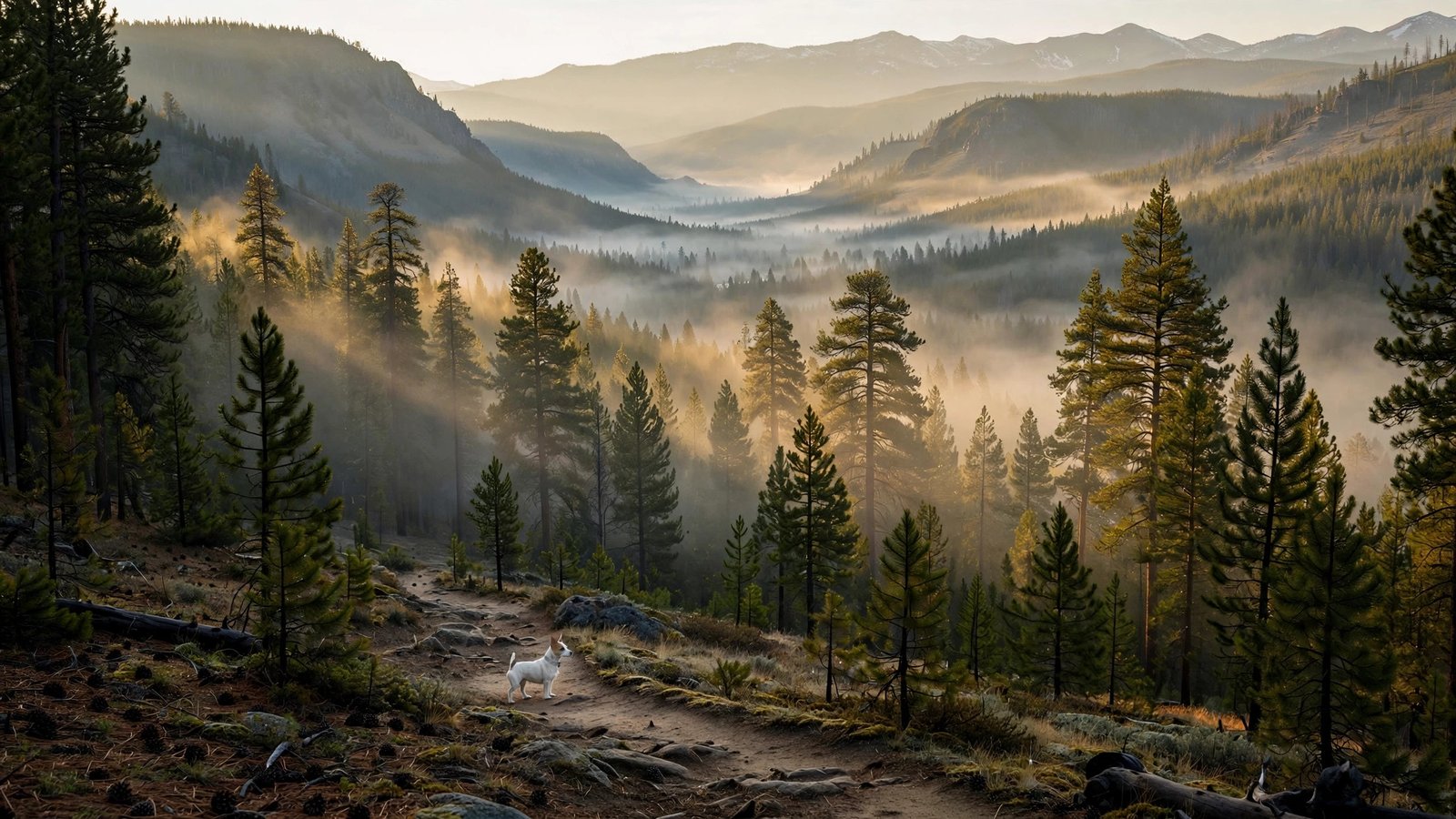
Picture a dog the size of a loaf of bread, white with pointy ears, standing alone in a wilderness the size of a small country. Around her: grizzly bears, wolves, coyotes, cold nights, and a winter storm rolling in. She is ten years old, she weighs less than most backpacks, and she has no one. That was Luna’s life for 34 days in Yellowstone National Park — and the ending of her story is the part nobody saw coming.
Luna did not run away because she was unhappy. She did not slip her leash on a trail or bolt after a squirrel. She escaped from a cabin while her family was out sightseeing, through a door that was never supposed to open. Then she did something that still surprises the people who study lost dogs: she survived, alone, for more than a month, in one of the wildest places in America. And when she was finally caught, she was not cornered, chased down, or trapped mid-flight. She was asleep.
This is the story of how a small pet outlasted a national park — and of the rescue effort that finally brought her home.
The afternoon everything went wrong
Luna’s family had come to Yellowstone from California for a vacation, the kind of trip people plan for years. Luna, a ten-year-old Jack Russell terrier who is part chihuahua, came along. On September 10, 2026, the family left her inside their cabin with a Do Not Disturb sign on the door while they went out to explore the park. It was a sensible plan. It fell apart because of an ordinary mistake.
A housekeeping staffer opened the cabin door by accident, and Luna slipped out. What followed was two hours of chaos. Staff chased her around that part of the park, and by the time the owners came back, their dog was gone. Think about that moment for a second: you return from a day of sightseeing to discover that your dog, a member of your family, has vanished into 3,500 square miles of wilderness. Yellowstone was the first national park in the United States, and it is enormous — it stretches across Wyoming, Montana, and Idaho, and it holds some of the most dangerous wildlife on the continent.
The family searched. They were told, bluntly, that Luna was probably already dead — possibly killed by a coyote. For a family on vacation, that is a devastating thing to hear. They eventually had to leave the area. They stayed in the Yellowstone region until September 22, but as lodging filled up and seasonal accommodations began to close, they ran out of places they could legally stay. The park does not allow visitors to simply sleep in a vehicle or camp outside designated areas. So they went home to California, without their dog.
And then, days after they left, word reached them that Luna had been spotted. She was alive.
A park that swallows dogs
To understand what Luna survived, you have to understand what Yellowstone is. It is not a tidy suburban park with fences and paths. It is a living wilderness, home to grizzly bears, wolves, coyotes, and weather that can turn in an afternoon. A dog loose in Yellowstone is not just lost. It is prey, competition, and a stranger in an ecosystem that does not make exceptions for pets.
Luna had almost nothing going for her on paper. She was ten, which is senior for a small dog. She was a house pet. She had never lived in the wild. And yet she lasted 34 days — through cold nights, scarce food, and encounters with animals that could have killed her in seconds.
How? Part of the answer is something the rescuers discovered from her sightings. Luna was not wandering randomly. She was following a map only she could read.
The ghost dog of Yellowstone
Over the following weeks, Luna became something of a legend inside the park. People kept seeing her, and the reports formed a strange pattern. She was spotted crossing intersections, strolling through employee housing, and walking into lodges through automatic doors as if she belonged there. She turned up near buildings and parking lots again and again — the very places where humans, food, and shelter concentrate.
But the most remarkable detail came from the rescue team. Based on the sightings, Luna appeared to be retracing her family’s steps from the day before she was lost. She sneaked into eateries and lodges they had visited. She sought shelter in employee residences and businesses in areas the family had been. Think about what that means. A dog who had been in Yellowstone for a single day before disappearing was, weeks later, still following the trail of a vacation she had barely started. She was not just surviving. She was looking for her people, using the only clues she had: memory and scent.
That pattern also explains why she kept showing up around people without ever letting them catch her. She was drawn to human places because her family was human. But she was too frightened to be approached. Every time someone tried to help, the help itself became the problem.
Why chasing made it worse
Here is the part of Luna’s story that rescuers want everyone to remember, because it is the part that almost cost her life. When locals and tourists spotted her, their first instinct was to call her name or run after her. It is a completely natural reaction. You see a small lost dog, you want to grab it. But for a frightened animal in survival mode, a person running toward it does not look like a rescuer. It looks like a predator.
Katie Boucher, the volunteer who led the rescue effort, has said that the chasing triggered Luna’s fight-or-flight response and pushed her further into the park. Each well-meaning pursuit made the search harder. Marie Jaskula, a local resident who runs one of the park’s general stores, saw this happening and tried to change it. She posted signs at every park entrance urging visitors to be on the lookout — and her core message was simple: do not chase.
This is one of the quiet lessons of Luna’s rescue. The most helpful thing a stranger could do for a lost dog in a place like Yellowstone was also the hardest thing to do: nothing. Do not run. Do not shout. Report the sighting, and let the people with the equipment and the plan handle it. Luna survived in part because she learned to avoid people. The rescue succeeded when people finally learned to let her come to them.
The woman who hunts lost dogs
When the family learned Luna had been seen, they contacted Katie Boucher, president of the Norris Ark Training and Recovery Center in Norris, Montana, just north of the park. Boucher does this kind of work professionally: finding and recovering frightened, hard-to-catch animals. Luna’s case, she has said, demanded more than most.
Yellowstone is what Boucher has described as an urban-wilderness environment. That phrase sounds contradictory until you picture it: a rescue that has to deal with wildlife, weather, tourists, roads, seasonal closures, contractors, and federal rules all at once. The National Park Service granted Norris Ark special permission and a trapping permit for the effort. Construction crews working inside the park allowed the team into restricted areas normally closed to visitors and even to other workers. The people who developed the trapping equipment consulted with the recovery team throughout the effort, sometimes several times a day.
And time was running out. The permits for the operation were set to expire on October 31. A storm had dropped a light dusting of snow on parts of Yellowstone, and colder weather was on the way. Boucher put it plainly: “She’s a California dog. She’s never seen snow before.”
There was one more deadline nobody talked about much. This was, by Boucher’s own account, the last week she would have been able to keep searching. She had been sleeping at an RV park for seasonal employees — and it was closing the following Monday. The search had rallied locals and tourists alike, but the window was closing fast.
The first year that saved her life
One of the strangest twists in Luna’s story is that her hardest year may have been the one that saved her. Before she became a house dog, Luna spent roughly the first year of her life surviving on the streets before she was adopted. According to Outside, she was eventually picked up by the SPCA. Boucher believes that the survival skills Luna developed as a stray resurfaced in Yellowstone. Luna knew how to hide, how to find food, and how to keep herself away from things she perceived as dangerous.
Boucher summed it up in a line that tells you everything about this dog: “She does not need people and she knows it.”
That is the paradox of Luna. The same independence that made her almost impossible to catch is what kept her alive. A dog that depended on humans would have starved, or walked up to the wrong animal, or frozen waiting for help. Luna did none of those things. She went quiet, she went careful, and she went her own way — the way she had learned as a puppy on the streets of California, long before she ever had a family or a cabin or a collar.
The trap that wasn’t a trap
By mid-October, the rescue team had a plan built around patience rather than pursuit. They were using a device called a Missy Trap: a large enclosure designed for recovering frightened or hard-to-catch animals. Instead of a pressure plate that slams the door automatically, the version authorized for Luna’s recovery used a remote trigger, letting someone watching from a distance decide exactly when to close it. The National Park Service had issued a special permit specifically for the Missy Trap and its remote trigger.
But the final days of the rescue played out differently than a typical trap story. Before a storm hit the Yellowstone area on October 11 and 12, Boucher removed the remote-trigger equipment that allows rescuers to close the trap from a distance, leaving the enclosure open. Then she placed a small doghouse filled with grass inside it, hoping Luna might use it as shelter while the storm passed. The trap was set near the Canyon Village water treatment center.
Accounts of the capture differ slightly in their details, and it is worth presenting both, because together they tell a fuller story. The Associated Press reported that Luna was found in a live trap baited with scent scraps from a T-shirt and pillowcase belonging to the family — the familiar smell of home, used as a lure. Outside reported the doghouse-inside-the-Missy-Trap version, with Luna discovered asleep in the little shelter on the morning of October 14. These are not contradictions so much as two angles on the same patient strategy: give a terrified dog a safe, familiar-smelling place to hide, and wait.
On October 13, a volunteer spotted Luna circling the trap and lying down nearby. The next morning, Boucher returned — and Luna had moved in.
The morning she walked in and went to sleep
One of Luna’s owners had come back to Yellowstone and accompanied Boucher to the trap that morning. Boucher sent the owner in first. Then she approached. Luna, she said, was just barely sticking her nose out of the doghouse, thinking about coming out. The owner got a private reunification first. After 34 days, a month of wilderness, and a search that had stretched across an entire national park, a family got its dog back in a quiet moment nobody else saw.
Boucher and the owner took Luna to a veterinarian in Bozeman. The vet found her underweight, which was no surprise after more than a month in the wild, but alert and in good spirits. Boucher told Outside that Luna had lost around 10 pounds during her 34 days in the wild. She was, by all accounts, remarkably intact: no major injuries, bright, and happy to see her family. Boucher said she cried during the drive from Yellowstone to Bozeman. She called it an emotional day — and said this kind of reunion never gets old.
Stop and think about the image at the center of this story, because it is the image that made it travel around the world. A dog who had outsmarted an entire park for 34 days — who had dodged bears, wolves, storms, and hundreds of well-meaning humans — was finally caught because she walked into a little doghouse, curled up, and went to sleep. She did not surrender. She just, finally, felt safe enough to rest.
Why a Jack Russell?
Part of Luna’s story is about one dog. Part of it is about a whole breed. Jack Russell terriers were originally bred to hunt underground, chasing animals into dens where their handlers could not reach them. Without a person there to give directions, the dogs had to figure things out on their own. That history left the breed with strong hunting instincts, high persistence, and a notable independent streak.
Alison Cook Cilliers, a longtime breeder who runs Kimberlite Jack Russell Terriers in California, told Outside that Luna’s survival is a textbook example of those traits. The dogs work independently of people, she said. They are tenacious, and they really do not want to give up.
Cilliers also offered a comparison that puts Luna’s feat in perspective. In 2024, a Jack Russell named Finney survived 72 days in the Colorado mountains after his owner died on a hike. But Finney stayed with his owner after the accident, giving him what Cilliers described as a familiar anchor in an otherwise dangerous environment. Luna, by contrast, lost her family almost immediately in a place she did not know. That difference, Cilliers suggested, may explain why Luna evaded capture for so long. Once a frightened dog slides into full survival mode, an approaching stranger may no longer register as someone offering help. The dog is protecting itself, and wanting to be safe, and no amount of calling changes that.
In other words: Luna was not being stubborn. She was being a Jack Russell, in the deepest sense — a dog bred to think for itself, doing exactly what centuries of breeding prepared her to do, in the worst possible circumstances.
What this rescue shows
Luna’s story has a happy ending, but the people who lived it are hoping it leaves behind something more useful than a feel-good headline. The rescue shows a few things worth remembering the next time a pet goes missing in a wild place.
First, scent matters. The rescue team used the family’s own scent — scraps from a T-shirt and pillowcase — to lure Luna toward a safe place. Familiar smells can do what shouting cannot: tell a frightened animal that home is nearby.
Second, sightings matter more than captures. Every report of Luna helped the team map where she was going and what she was doing. The pattern of her movements — retracing the family’s steps, sticking near buildings and food — was the intelligence that made the final trap placement possible. A single phone call from a tourist who saw a small white dog near a lodge was, in its own way, as valuable as any piece of equipment.
Third, not chasing matters most of all. The single most repeated piece of advice from the people who actually recovered Luna was the simplest: if you see a lost dog in a place like this, do not run after it. Report it. Let the trained team handle it. The urge to help is real, but in a frightened animal’s mind, pursuit is a threat.
None of this is official park guidance — it is what this one rescue showed, in practice, under extraordinary conditions. But it is the kind of practical wisdom that could matter the next time someone’s pet slips out a door in the wrong place.
The dog who came home
Luna is home now, with the family she spent 34 days trying to find. She is a ten-year-old house pet who lived, for a month, as a wild animal — and then, on a cold October morning, walked into a doghouse and went to sleep, as if the whole ordeal had simply been a long nap she needed.
Stories like Luna’s travel so far because they tap into something simple: the bond between people and their animals, and the almost unreasonable hope that a lost pet is still out there, still looking. Luna was. She crossed intersections, slipped through automatic doors, hid from bears, waited out a snowstorm, and retraced the steps of a vacation that had barely begun — all to stay alive long enough to be found.
The next time you hear about a lost dog, remember her. Somewhere out there, a small white terrier with pointy ears is proof that survival does not always belong to the biggest or the strongest. Sometimes it belongs to the one who refuses to give up — and to the people who refuse to stop looking.
Frequently asked questions
How long was Luna missing in Yellowstone?
Luna escaped on September 10, 2026, and was found on the morning of October 14 — 34 days later.
How did Luna escape?
Her family left her in their cabin with a Do Not Disturb sign while they went sightseeing. A housekeeping staffer accidentally opened the door, and Luna slipped out. Staff chased her for about two hours before the owners returned to find her missing.
How did Luna survive 34 days in Yellowstone?
Rescuers believe a mix of factors kept her alive: street-survival skills from roughly her first year of life before adoption, Jack Russell traits like independence and persistence, and a pattern of staying near buildings, eateries, and employee housing where food and shelter were easier to find. She was also retracing her family’s steps from the day before she was lost.
How was Luna finally caught?
Rescuers placed a small doghouse filled with grass inside a large humane enclosure called a Missy Trap near the Canyon Village water treatment center. The Associated Press also reported the trap was baited with scent scraps from a family T-shirt and pillowcase. On the morning of October 14, rescuers found Luna sleeping in the doghouse. One of her owners was there and got a private reunification first.
Was Luna hurt?
A veterinarian in Bozeman found her underweight but alert and in good spirits, with no major injuries reported. Boucher told Outside that Luna had lost around 10 pounds during her 34 days in the wild.
Why did rescuers tell people not to chase Luna?
Because chasing triggered her fight-or-flight response and drove her further into the park. For a frightened dog in survival mode, a pursuing person can look like a predator rather than a rescuer. Reporting sightings instead of chasing helped the team track her movements.
What should you do if you see a lost pet in a national park?
This rescue suggests three things: do not chase the animal, report the sighting to park staff or the recovery team, and remember that familiar scents from the owner can help lure a frightened pet toward safety. This reflects what worked in Luna’s case, not official park policy.
Sources
- Associated Press via WVLT: Luna, a small dog missing for over a month in Yellowstone, is reunited with her owners
- Outside Online: Yellowstone Rescuers Saved a Dog Missing for 34 Days
[…] that led to Bili’s seizure. If you love stories of animals beating the odds, don’t miss Luna, the dog who survived 34 days alone in Yellowstone — another tale of astonishing animal […]