
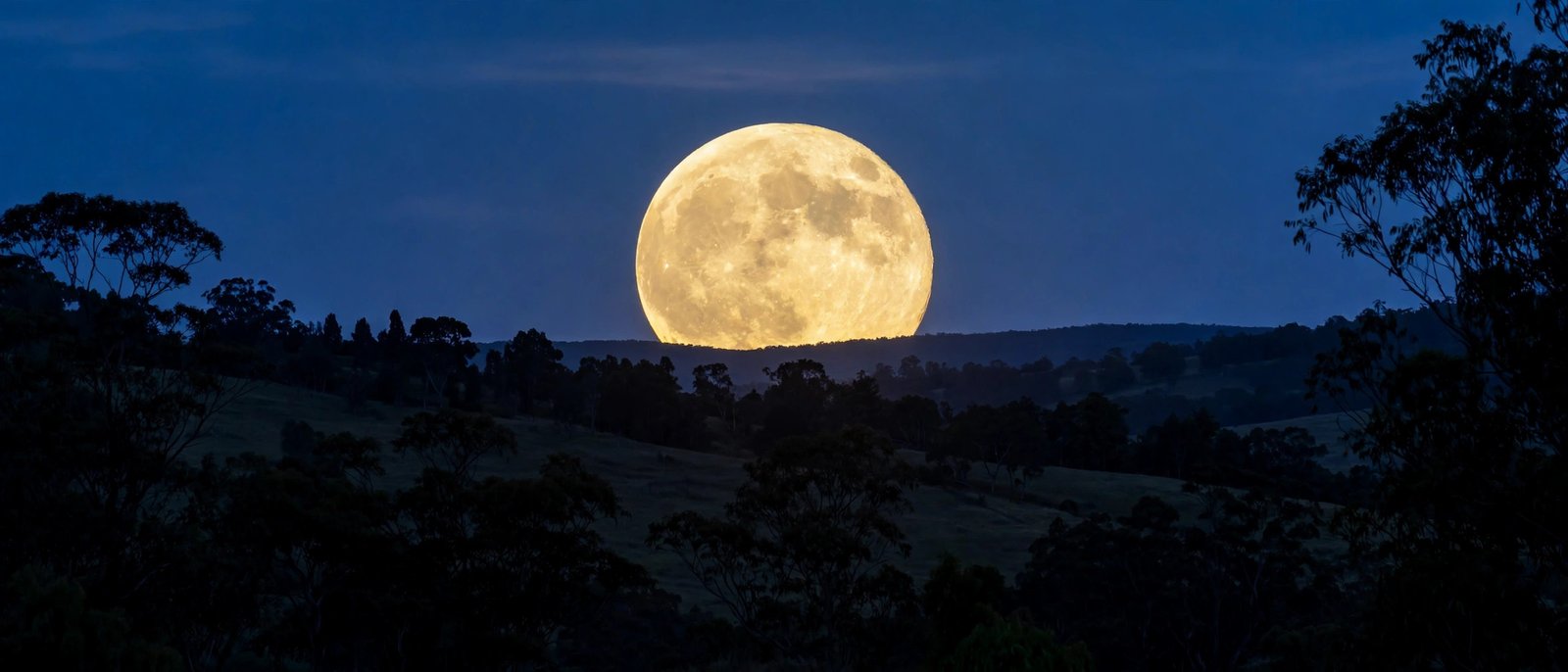
Stand outside on a clear evening when the Moon is just rising, and it can look enormous, like a glowing disc balanced on the rooftops. Wait a few hours until it climbs high into the sky, and it seems to shrink back to normal size. Nothing about the Moon itself has changed. So why does the Moon look bigger at the horizon? Scientists call it the moon illusion horizon effect, and the answer is one of the oldest and most delightful tricks your brain plays on you, and scientists have been arguing about its exact cause for centuries.
The phenomenon has a name: the moon illusion horizon effect. It has been noticed by people all over the world for thousands of years, and it works on almost everyone. It also works on the Sun at sunrise and sunset, and on constellations near the horizon. That alone is a clue. Whatever is happening is not special to the Moon. It is something about how your mind judges size when objects sit low in the sky.
The Moon Illusion Horizon Effect: The Key Fact
Here is the single most important fact about the moon illusion puzzle: the Moon is not actually bigger near the horizon. In fact, careful measurements show the opposite. When the Moon is low, it is slightly farther from you than when it is overhead, because you are seeing it across the radius of the Earth as well as up into space. Its image on your retina is essentially the same size, or even a tiny bit smaller, at the horizon than at its highest point.
You can prove this to yourself with a simple test. Hold a coin at arm’s length and compare it to the Moon when it is rising, then do the same test later when the Moon is high. The coin covers about the same amount of the Moon in both cases. Photographs tell the same story. A camera, which has no brain to fool, records the Moon at the same size at the horizon and overhead. The difference is entirely in your head, which is what makes the moon illusion horizon mystery so fascinating. Your eyes are reporting honestly. Your brain is adding a story on top.
Why the Atmosphere Is Not a Magnifying Glass
The most common explanation people offer is that the atmosphere magnifies the Moon near the horizon, like a lens. It sounds sensible, but it is wrong, and the evidence against it is strong. The atmosphere does bend light, a process called refraction, and it does make the rising Moon look slightly squashed, wider than it is tall, like an oval. But refraction does not make the Moon look bigger overall. If anything, it flattens it.
Think about the geometry. If the atmosphere were magnifying the Moon, a camera would record a bigger Moon at the horizon, and it does not. If the air were acting as a lens, the effect would also change with humidity, pollution, and weather in dramatic ways, and it would work differently for everyone depending on local conditions. Instead, the illusion is remarkably consistent across climates and centuries. That consistency points away from the air and toward the brain.
There is another problem with the lens idea. The illusion still happens when the Moon is viewed over a flat, empty ocean or a desert, where there are no buildings or trees to compare it with, though the effect can be weaker there. And it can be reduced or even removed by simple tricks, like viewing the Moon upside down between your legs or through a tube that blocks out the surrounding landscape. If a lens in the sky were responsible, bending over would not change anything. But it does, which tells us the surroundings and the brain’s interpretation matter enormously.
How Your Brain Judges Size
To understand the moon illusion horizon effect, you need to know how your brain figures out how big things are. Your eyes do not measure size directly. They measure the angle an object takes up in your field of view. Your brain then combines that angle with a guess about distance. A small angle could mean a small object nearby or a huge object far away, and your brain has to decide which.
That distance guess is where the trouble starts. When the Moon sits near the horizon, your brain sees it against a landscape full of distance cues: fields, roads, houses, trees, mountains. Those cues tell your brain that the horizon is far away. When the Moon is high overhead, there are no such cues, just empty sky, so your brain treats the zenith as closer. If your brain believes two objects take up the same angle but one is farther away, it concludes the farther one must be bigger. That is the heart of the apparent distance theory, one of the leading explanations for the illusion.
A related idea involves the shape of the sky itself. Most people do not perceive the sky as a perfect dome. They experience it as a flattened bowl, with the horizon feeling much farther away than the point directly overhead. If the Moon appears to sit on that distant horizon while taking up the same angle as the overhead Moon, your brain inflates its size to match the imagined distance. In other words, the Moon looks bigger because your mental map of the sky is squashed, not because the Moon changed.
Another strong candidate is the relative size effect, sometimes illustrated with the Ponzo illusion. In the classic Ponzo drawing, two identical lines are placed across converging railway tracks, and the upper line looks longer because the brain reads the converging lines as depth. At the horizon, trees, buildings, and terrain may act like those converging lines, making the Moon seem larger by comparison. When the Moon is high, there is nothing to compare it with, so it looks its normal size. Researchers still debate how much each of these mechanisms contributes, and the honest answer is that no single theory has explained every experiment perfectly. The moon illusion horizon effect may involve several of these processes working together.
Moon Illusion Horizon Experiments: What They Actually Show
Scientists have tested the illusion in clever ways. In one kind of experiment, people view an artificial Moon projected inside a planetarium or on a screen, and researchers change the surroundings while keeping the Moon image identical. When the surroundings suggest a distant horizon, people report the Moon as larger. When the surroundings are removed or the image is viewed through a narrow tube, the illusion shrinks or vanishes. That pattern supports the brain-based explanations over any atmospheric one.
Other experiments have tested the flattened-sky idea by asking people to judge distances in the sky. People consistently judge the horizon as farther than the zenith, matching the flattened bowl model. Researchers have also found that the illusion can be weakened by turning your head upside down to look at the Moon, which disrupts the brain’s usual depth cues. None of this proves one theory completely, but taken together, the evidence points firmly in one direction: the Moon illusion is a perceptual phenomenon, a quirk of how the mind builds a model of the world from limited information.
For a clear, authoritative overview, the Library of Congress explains why the Moon appears larger near the horizon, and you can explore the Moon itself through NASA’s Moon science pages. A general reference on the effect is also available in the Moon illusion article on Wikipedia, which summarizes the main theories and their history.
Try the Illusion Yourself
The best way to appreciate the illusion is to test it on the next clear evening. You do not need special equipment, just a little patience:
- The coin test: hold a small coin at arm’s length next to the rising Moon, note how much of the Moon it covers, then repeat when the Moon is high. The coverage will be nearly the same.
- The photo test: take a photo of the rising Moon with the same zoom setting you use later for the high Moon. Compare the two images side by side.
- The tube test: roll a piece of paper into a tube and look at the rising Moon through it, blocking out the landscape. Many people find the Moon suddenly looks normal sized.
- The upside-down test: bend over and look at the rising Moon between your legs. This disrupts your brain’s depth cues, and the illusion often weakens dramatically.
- The finger test: hold your thumb up at arm’s length beside the Moon at moonrise and again later. Your thumb is a surprisingly consistent measuring tool.
These tests are fun, but they also teach something deeper. Your senses are not cameras. They are interpreters, constantly guessing, filling in gaps, and building a useful picture of the world rather than a perfectly accurate one. Most of the time those guesses are excellent. Sometimes, as with the Moon at the horizon, they produce a beautiful mistake.
The Takeaways Worth Remembering
First, the Moon does not change size as it rises. Its image on your retina stays essentially the same, and cameras confirm it. Second, the atmosphere is not magnifying it; refraction actually flattens the rising Moon slightly rather than enlarging it. Third, the leading explanations are psychological: your brain judges the horizon as farther away than the overhead sky, compares the Moon with landscape objects, and inflates its apparent size to match. Fourth, no single theory explains everything yet, so the moon illusion horizon effect remains an active scientific puzzle, not a closed case. And fifth, you can break the illusion yourself with a tube, a coin, or a photograph, which is the surest sign that the trick lives in your mind, not in the sky.
There is a poetic side to all this. The Moon has inspired calendars, myths, tides, and poetry for all of human history, and part of its power may come from this very illusion. A huge Moon on the horizon feels closer, more dramatic, more personal than a small disc high above. Our ancestors did not know it was a trick of perception, but they felt its magic anyway. Now we know the secret, and somehow it does not spoil the wonder at all.
If you enjoy sky wonders that feel almost unreal, BolanPost has more for you: 8 space facts that sound fake but are real, and a guide to the Leonid meteor shower in November 2026. The next time a giant Moon rises over your street, you will know exactly what is happening, and you will probably still stop and stare. That is the best kind of science fact: one that explains the magic without removing it.
Frequently Asked Questions
Is the Moon actually bigger when it is near the horizon?
No. The Moon’s apparent size stays essentially the same, and measurements show it is slightly farther from you at the horizon than overhead. Cameras record it at the same size in both positions. The enlargement is an illusion created by your brain, not a change in the Moon.
Does the atmosphere magnify the Moon like a lens?
No. The atmosphere bends light and can make the rising Moon look slightly flattened, but it does not magnify it. If magnification were the cause, cameras would record a larger Moon at the horizon, and they do not. The illusion also weakens when you block out the surrounding landscape, which a lens effect would not do.
What is the leading explanation for the Moon illusion?
The leading explanations are psychological. The apparent distance theory says your brain treats the horizon as farther away than the overhead sky, so it inflates the Moon’s size to match. Relative size cues from trees and buildings may add to the effect. Researchers still debate the exact mix, so no single theory is fully settled.
Why does the Moon look smaller when it is high in the sky?
When the Moon is overhead, there are no landscape cues to suggest great distance, so your brain treats the sky above as closer. With the same retinal image but a shorter perceived distance, your brain concludes the Moon is smaller. It is the same Moon, judged against a different mental backdrop.
Can I make the illusion disappear?
Often, yes. Looking at the Moon through a tube that blocks the landscape, viewing it upside down, or comparing it with a coin at arm’s length can weaken or remove the effect. These tricks work because they remove or disrupt the depth cues your brain uses to inflate the Moon’s apparent size.