
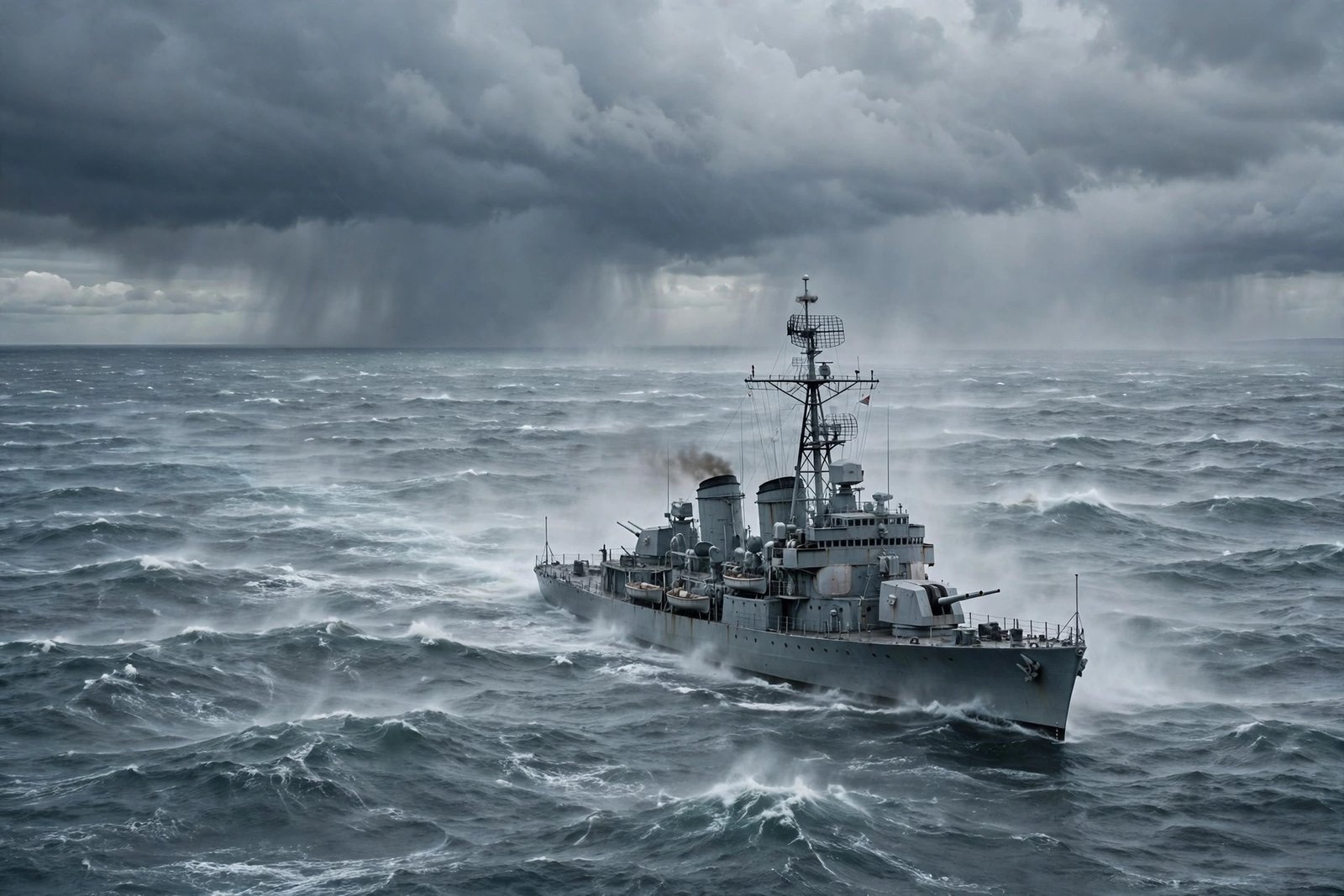
On October 27, 1962, the world came closer to nuclear war than on any other day in history. Historians call it Black Saturday, and the name is no exaggeration. In a single day, an American spy plane was shot down over Cuba, a Soviet submarine nearly launched a nuclear torpedo, and another American spy plane wandered into Soviet airspace by accident, nearly triggering a shooting war in the sky. In Washington and Moscow, leaders who had spent nearly two weeks staring each other down suddenly faced a terrifying truth: events were slipping out of their control. This is the story of the Black Saturday Cuban Missile Crisis, the day the fate of humanity hung on a handful of individual decisions.
That Saturday did not come out of nowhere. It was the climax of thirteen days of confrontation that began when American U-2 spy planes photographed Soviet nuclear missile sites under construction in Cuba, just 90 miles from Florida. President John F. Kennedy imposed a naval quarantine around the island, Soviet ships steamed toward the line, and the world held its breath. By October 27, both sides were exhausted, frightened, and heavily armed. What happened next would decide whether the Cold War stayed cold.
Black Saturday Cuban Missile Crisis: How the Day Began
The morning of Saturday, October 27, 1962, opened with confusion in both capitals. The night before, Soviet leader Nikita Khrushchev had sent Kennedy a long, emotional letter offering a deal: the Soviet Union would remove its missiles from Cuba if the United States promised never to invade the island. It sounded like a way out. But on the morning of Black Saturday, a second, much more formal and demanding letter arrived from Moscow. This one insisted that the United States also dismantle its Jupiter missiles in Turkey as part of any deal.
Kennedy and his advisers, known as EXCOMM, were left wondering which letter to believe. Was the first offer still on the table, or had hardliners in Moscow taken over? While they debated, events on the ground began to move faster than diplomacy could follow. That Saturday was about to be defined not by letters, but by soldiers, sailors, and pilots acting under extreme pressure, sometimes without orders from their leaders at all.
The U-2 Shot Down: The Only Combat Death of the Crisis
At around noon Eastern time, USAF Major Rudolf Anderson Jr. was flying his sixth mission over Cuba in a U-2 spy plane, photographing the missile sites. As his aircraft crossed eastern Cuba near Banes, a Soviet-operated S-75 surface-to-air missile battery fired two missiles at him. The decision to fire had been made by Soviet commanders on the island, not by Moscow, which had not authorized shooting down American aircraft. Anderson was killed, and his plane crashed in Cuba.
Anderson became the only person killed by enemy fire during the entire Cuban Missile Crisis. The news reached Washington during an EXCOMM meeting, and the pressure to retaliate was enormous. American contingency plans had envisioned immediate airstrikes against Cuban air defenses if a reconnaissance plane were shot down, and the Joint Chiefs of Staff demanded action. Kennedy, however, refused to retaliate immediately. He decided not to strike unless another attack followed, a decision that may have prevented the crisis from tipping into war. That restraint, in the face of an American death, is one of the most remarkable acts of leadership in that crisis.
The Submarine That Almost Started World War III
While Washington absorbed the news of Anderson’s death, an even more dangerous drama was unfolding beneath the waves. In the Sargasso Sea, the American destroyer USS Beale was dropping signaling depth charges on the Soviet submarine B-59, trying to force it to the surface for identification. The charges were not meant to destroy the submarine, but the crew of B-59, deep underwater and out of contact with Moscow for days, could not know that.
What the Americans did not know was that B-59 carried a tactical nuclear torpedo, and that its captain, Valentin Savitsky, believed war might already have begun. Under Soviet protocol, launching the torpedo required the agreement of three officers: the captain, the political officer, and the brigade chief of staff, Vasily Arkhipov. Savitsky reportedly gave the order to prepare the weapon. Arkhipov refused to agree. His single refusal blocked the launch, and the submarine eventually surfaced instead of firing. Historians now credit Arkhipov with saving the world, because a nuclear torpedo launched at an American destroyer would almost certainly have triggered a full-scale nuclear exchange. If you want another story of one person standing between humanity and catastrophe, read the man who survived two atomic bombs, a tale of almost unbelievable luck in the nuclear age.
A Second U-2 Wanders Into Soviet Airspace
As if one shootdown and one near-launch were not enough, Black Saturday produced a third terrifying incident. Another American U-2, on a routine air-sampling mission over Alaska, strayed off course due to a navigational error and wandered into Soviet airspace over Siberia. Soviet fighter jets scrambled to intercept it, and American fighters armed with nuclear air-to-air missiles scrambled to escort it back to safety.
For a few heart-stopping minutes, American and Soviet fighter planes were in the same sky, in a region where any miscalculation could have started a shooting war. The U-2 eventually made it back to American airspace without a shot being fired, but the incident showed how easily an accident could have ignited the conflict. On the Black Saturday Cuban Missile Crisis, the world was not just threatened by deliberate decisions. It was threatened by mistakes, miscommunication, and machines operating at the edge of human control.
Why Historians Call It the Closest the World Came to Nuclear War
Historians use strong language about October 27, 1962, and for good reason. Never before or since have so many separate incidents, each capable of starting a war, happened on a single day while two nuclear-armed superpowers were already in a direct confrontation. The United States had placed its Strategic Air Command on DEFCON 2, the highest alert level ever reached in American history, meaning forces were ready for full-scale war within hours.
What makes Black Saturday so frightening in hindsight is how little control the leaders actually had. Khrushchev had not ordered the shootdown of Anderson’s plane. Kennedy had not ordered the depth charges to be interpreted as an attack. Nobody in Washington or Moscow had ordered a U-2 to fly over Siberia. These were accidents, local decisions, and the fog of a military standoff, and any one of them could have produced the war that both leaders were desperately trying to avoid. Black Saturday is studied today in military academies and history courses precisely because it shows how wars can start even when nobody wants one.
Disasters born of small errors are a recurring theme in history, as we explored in the Great Molasses Flood of 1919, when an ordinary industrial accident turned into a deadly wave through the streets of Boston.
How the Black Saturday Cuban Missile Crisis Ended
By the evening of October 27, both Kennedy and Khrushchev understood that they had to find a way out, and fast. That night, Attorney General Robert Kennedy met secretly with Soviet Ambassador Anatoly Dobrynin in Washington. The message was clear: the United States would accept Khrushchev’s first offer, promising not to invade Cuba, and would also secretly remove its Jupiter missiles from Turkey, but the Turkey part could never be admitted publicly.
Kennedy then sent a formal reply accepting the first letter and ignoring the second, giving Khrushchev a face-saving way to back down. The gamble worked. On October 28, Khrushchev announced that the Soviet Union would dismantle the missiles in Cuba and return them home. The crisis was over. The world exhaled, though the public would not learn about the secret Turkey deal for years. For a collection of history’s strangest true coincidences, see historical coincidences that feel completely made up.
October 27 in Other Years: Constantine’s Vision and Pinckney’s Treaty
October 27 has a habit of producing turning points. On the evening of October 27, 312, according to tradition, the Roman emperor Constantine had a vision of a cross of light in the sky before the Battle of the Milvian Bridge, accompanied by the words “In this sign, conquer.” Lactantius describes a dream in which Constantine was told to mark his soldiers’ shields with the Christian sign, while the historian Eusebius, who claimed to have heard the story from Constantine himself, describes a cross of light seen while marching. Constantine won the battle the next day, and his embrace of Christianity helped transform the Roman Empire and the course of European history.
Centuries later, on October 27, 1795, the United States and Spain signed Pinckney’s Treaty, also known as the Treaty of San Lorenzo. The agreement settled the disputed boundary between the United States and Spanish Florida, and, crucially, gave Americans the right to navigate the Mississippi River and to deposit goods at New Orleans. For a young nation expanding westward, it was a diplomatic triumph that opened the continent’s great waterway to American trade. Two very different Octobers 27, one ancient and one early American, each reshaped the world in its own way, just as Black Saturday did in 1962.
Key Takeaways From Black Saturday
- The Black Saturday Cuban Missile Crisis, October 27, 1962, was the most dangerous day of the thirteen-day confrontation, combining a shootdown, a near nuclear launch, and an accidental airspace violation.
- Major Rudolf Anderson Jr. was shot down over Cuba and became the only combat death of the crisis; President Kennedy refused immediate retaliation, preventing escalation.
- Soviet submarine B-59 nearly launched a nuclear torpedo at an American destroyer, and was stopped only by Vasily Arkhipov’s refusal to authorize the launch.
- A second U-2 strayed into Soviet airspace over Siberia, bringing American and Soviet fighter jets into a tense standoff that ended without shots fired.
- The crisis ended the next day, October 28, when Khrushchev agreed to remove the missiles from Cuba in exchange for a public no-invasion pledge and a secret US promise to remove Jupiter missiles from Turkey.
- October 27 also marks Constantine’s vision in 312 and Pinckney’s Treaty in 1795, making it one of history’s most consequential calendar dates.
Conclusion: The Day the World Got Lucky
The Black Saturday Cuban Missile Crisis ended without nuclear war, but not because the situation was under control. It ended because a handful of people, Kennedy refusing retaliation, Arkhipov refusing to launch, and fighter pilots on both sides holding their fire, chose restraint in moments when aggression would have been easier. The lesson of October 27, 1962, is both reassuring and unsettling: humanity survived its closest brush with annihilation thanks to individual judgment, not just grand strategy. As we mark another October 27, it is worth remembering how thin the line was, and how much depended on the calm of a few people on the worst Saturday in modern history.
Sources: Cuban Missile Crisis overview; Black Saturday: the U-2 over Cuba; Constantine’s vision before the Battle of the Milvian Bridge.
What was Black Saturday in the Cuban Missile Crisis?
Black Saturday was October 27, 1962, the most dangerous day of the crisis, when a US U-2 was shot down over Cuba, a Soviet submarine nearly launched a nuclear torpedo, and another U-2 strayed into Soviet airspace.
Who was killed on Black Saturday?
USAF Major Rudolf Anderson Jr., whose U-2 spy plane was shot down over Cuba, was killed and became the only person to die by enemy fire during the Cuban Missile Crisis.
Who stopped the Soviet submarine from launching a nuclear torpedo?
Vasily Arkhipov, the brigade chief of staff aboard submarine B-59, refused to agree to the launch, blocking the captain’s order and preventing a nuclear attack on an American destroyer.
How did the Cuban Missile Crisis end?
On October 28, 1962, Khrushchev agreed to remove Soviet missiles from Cuba in exchange for a US pledge not to invade Cuba and a secret promise to remove American Jupiter missiles from Turkey.
What else happened on October 27 in history?
On October 27, 312, Constantine traditionally had his vision of the cross before the Battle of the Milvian Bridge, and on October 27, 1795, the United States and Spain signed Pinckney’s Treaty, opening the Mississippi River to American navigation.