
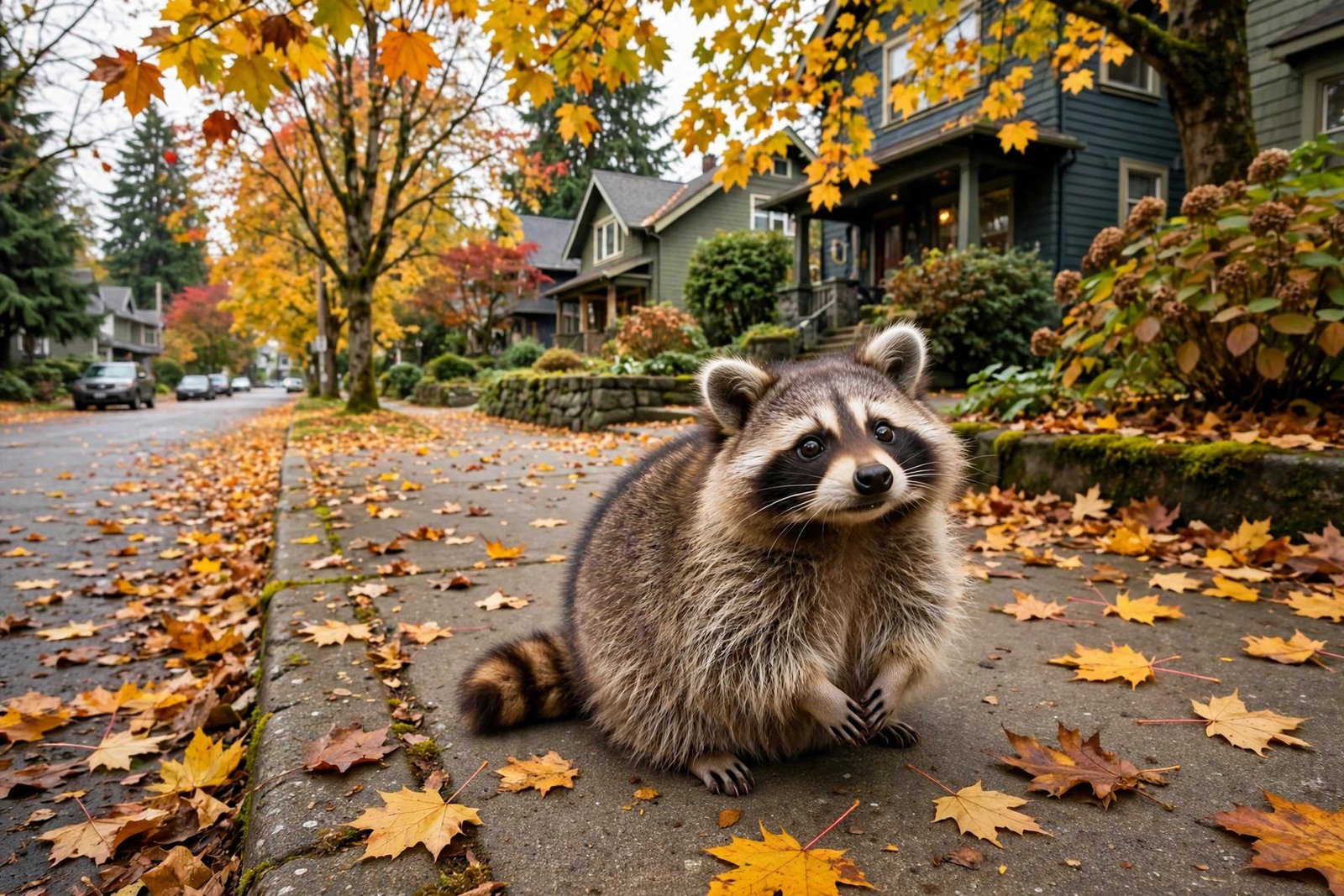
Scroll through your feed on a quiet evening in Seattle and you might spot him: a small, round raccoon trotting along a fence line like a furry loaf of bread on legs. That is Jimothy the Raccoon, the wild animal from the city’s Ballard neighborhood who turned an ordinary backyard sighting into one of the most wholesome viral stories of 2026. He did not audition for fame. He did not have a manager, a merch line, or a plan. He simply walked across a yard, looking unlike any raccoon most people had ever seen, and the internet did the rest.
Jimothy’s story is funny on the surface and surprisingly tender underneath. It is about a wild animal living his life, a neighborhood that adopted him as a local celebrity, and millions of strangers who saw something familiar in his determined little waddle. It is also a reminder that viral fame can land on creatures who never asked for it, which is why wildlife officials have been just as quick as fans to share an important message: enjoy Jimothy from a distance, and leave him wild.
In this article, we trace how a five-second clip became a citywide phenomenon, what experts believe explains Jimothy’s unusual shape, why his story struck such a chord, and what his fame tells us about the internet’s enduring love for animal stars. Along the way, we separate what is actually known from what is still uncertain, because with a wild animal, the honest answer is often the most interesting one.
Who Is Jimothy the Raccoon?
Jimothy is a wild raccoon living in Seattle, Washington, in the Ballard neighborhood. He is not a pet, he has no owner, and he does not live in a sanctuary or a zoo. He lives outdoors, as raccoons do, finding food, shelter, and routes through yards, fences, and rooftops in the area where residents have spotted him again and again.
What sets Jimothy apart is his shape. Compared with a typical raccoon, his body looks much shorter and rounder, with a rounded back and legs that seem long in proportion to his compact frame. In videos, he trots, climbs, and scrambles over fences with the same unbothered confidence as any other raccoon. That contrast, a body that looks unusual paired with behavior that looks completely normal, is a big part of why the first clips stopped people mid-scroll.
Reports describe Jimothy as a young animal, likely born in 2026, although an exact age cannot be confirmed for a wild raccoon seen only in passing. His sex has not been determined either, even though most coverage and fans refer to him as “he.” Residents of Ballard have said the raccoon had been seen in the area for months, and some wondered whether more than one short-bodied raccoon had lived there over the years, since wild raccoons typically live only a few years. That question remains open, and it is a good example of how a viral story can outgrow the facts available about a single wild animal.
His name, by the way, came from the person who filmed him. Seattle resident Kiana Hall, who posted the original video on Instagram, said he simply looked like a Jimothy. It was not a scientific name or a brand decision. It was a joke that stuck, and it fit the internet’s affectionate, slightly absurd sense of humor perfectly.
What Is Short Spine Syndrome?
Veterinarians who reviewed videos of Jimothy believe his unusual shape is likely the result of a spinal deformity resembling short spine syndrome, a rare congenital condition in which vertebrae are compressed or fused during development. In animals with the condition, the spine does not lengthen normally, which can produce a short, rounded body. The condition is best known in dogs, where a small number of famous cases have helped researchers understand it, but it has also been reported in other mammals.
Here is the important caveat, and it matters: Jimothy has not been formally diagnosed. A diagnosis would require a hands-on veterinary examination, and Jimothy is a wild animal who has not been captured or examined in that way. What experts have offered is an assessment based on video footage, not a confirmed medical finding. Reporting that distinction honestly is not a footnote; it is the story. The internet loves a tidy explanation, but wildlife biology rarely offers one from a five-second clip alone.
What experts have also noted is reassuring. Despite his shape, Jimothy appears to move well. Videos show him walking, climbing fences, and settling on rooftops, and wildlife officials have described him as appearing healthy and able to find food without human help. One veterinarian who reviewed footage noted that his spine does not appear to limit him, a point echoed in wider coverage of the case. His survival, some observers have suggested, also reflects the care a mother raccoon gives her young, helping a kit with an unusual body grow into an animal capable of fending for itself.
Short spine syndrome itself is not contagious, and it is not something a raccoon catches from another animal. It is a developmental condition, present from birth, linked to how the spine forms. That is why Jimothy’s case fascinates animal lovers and science-curious readers alike: it is a rare glimpse of how much variation nature can produce, and how resilient an animal can be within that variation.
How Jimothy the Raccoon Went Viral
The story began in July 2026, when Kiana Hall filmed Jimothy in her Ballard backyard and posted the clip to Instagram. The video was short, just a few seconds of a compact raccoon running through the yard, but it had everything a viral clip needs: surprise, charm, and a question viewers could not resist asking, which was essentially, “What am I looking at?”
The clip spread quickly. According to reporting on the original post, it attracted millions of views, with some accounts putting the figure at more than five million. Within days, other sightings followed. A video shared on X in mid-July gathered tens of thousands of likes and reposts in just a few days, and local news stations picked up the story. Soon, national outlets were covering a raccoon from a Seattle neighborhood, and Jimothy had gone from a backyard curiosity to a national talking point.
The coverage then took on a life of its own. As new sightings appeared, each clip restarted the cycle: a fence climb here, a rooftop pause there, another round of delighted comments. By late July, Seattle City Councilmembers Alexis Mercedes Rinck and Dan Strauss had proclaimed a season called “Jimothy Summer,” a playful civic nod to the local interest surrounding the Ballard raccoon. It was the kind of honor usually reserved for sports teams and festivals, now bestowed on a wild raccoon who had no idea it was happening.
That official recognition did not change Jimothy’s daily life, of course. He kept doing raccoon things. But it marked a turning point in the story: Jimothy was no longer just a viral video. He was a neighborhood mascot, a city in-joke, and a symbol of Seattle’s ability to embrace something delightfully weird.
Why the Internet Fell for Him
Why Jimothy, and why now? Part of the answer is visual. His shape is instantly readable even on a small phone screen. You do not need context, a caption, or a backstory to understand why the clip is funny and endearing. He looks like a raccoon, but shorter, rounder, and somehow more determined. That instant readability is gold on platforms built for split-second attention.
Part of the answer is emotional. Jimothy’s walk reads as unbothered confidence. He is not performing, begging, or posing. He is simply getting on with his day, fences and all, in a body that was not built to textbook specifications. People projected their own stories onto that walk: getting through a long week, showing up anyway, doing your best with what you have. Meme captions soon cast him as a coworker, a Monday mood, a small business owner refusing to give up, or simply themselves at the end of a hard day.
Another part is safety. In an online landscape full of arguments and controversies, Jimothy was, as one trends roundup put it, about as brand-safe as a viral moment gets. There was no controversy attached, no in-joke to get wrong, and no villain in the story. The format was simply an affectionate caption over a widely loved animal. That made him easy to share across ages, audiences, and platforms, from neighborhood groups to national news.
Finally, there is the local pride factor. Ballard residents were not just watching a viral animal; they were watching their neighbor. Sightings became community events, shared with the excitement of spotting a local celebrity. That neighborhood ownership kept the story alive long after the first clip’s peak, because every new sighting felt like a fresh episode rather than a rerun.
Jimothy Summer, Murals, and a Costco Toy
Jimothy’s fame did not stop at memes. According to coverage in The Guardian, his popularity inspired murals, artwork, and merchandise in Seattle, turning a wild raccoon into a piece of local folk culture. Fans made art, shops sold themed items, and the Seattle Mariners even gave him recognition, a sign that the city had fully embraced its shortest celebrity.
The merch wave reached a new level in late October 2026, when Costco began selling a Jimothy the Raccoon dog toy, a jumbo plush made by Delca and priced at $19.99, complete with squeakers, crinkle material, and a hidden ball. It was a surreal milestone: a wild raccoon from Ballard, now available in the toy aisle. The toy’s appeal was obvious, but it also raised the same question that runs through the whole story. How do you celebrate a wild animal without turning him into a product or a pet in people’s minds?
That tension is worth sitting with. Merchandise can be harmless fun, and it can also blur the line between admiring wildlife and treating it as entertainment to be owned. Jimothy himself, of course, receives no royalties and has no opinion on plush toys. The responsibility sits with us: to enjoy the joke while remembering the animal at the center of it is real, wild, and better off unbothered.
The Wider Trend: Why Viral Animal Stars Never Go Away
Jimothy is part of a long line of viral animal stars, from grumpy cats to skateboarding dogs to unexpected backyard visitors who became overnight celebrities. The pattern repeats because animals offer something the internet craves: authenticity without agenda. An animal is not selling a product, running for office, or chasing clout. It is just being itself, and audiences reward that honesty with attention.
What has changed is speed. A backyard clip can now travel from a neighborhood to national news in days, and from national news to a city proclamation in weeks. That speed amplifies both the joy and the risk. Joy, because millions of people can share a laugh over something genuinely wholesome. Risk, because attention can bring crowds, feeding attempts, and well-meaning interference that stress the very animal people love.
The best viral animal stories, and Jimothy’s is one of them, end up teaching something. They teach viewers about a rare condition, about raccoon behavior, about a neighborhood, and about the difference between watching wildlife and interfering with it. If Jimothy’s legacy is a few more people who know what short spine syndrome is, and a few more who leave wild raccoons alone, that is a pretty good outcome for a five-second video.
What Experts Want You to Know
Wildlife officials have been consistent in their advice throughout Jimothy’s fame, and it is worth repeating clearly:
- Do not approach Jimothy. The Washington Department of Fish and Wildlife has urged people not to approach the raccoon, which appears healthy without human intervention.
- Do not feed him. Feeding wild raccoons can make them dependent on people, bring them into conflict with humans and pets, and expose them to foods that are not good for them.
- Do not try to capture or rescue him. He is not injured, stranded, or in need of rescue. He is a wild animal living his life.
- Keep your distance when filming. If you are lucky enough to spot him, enjoy the moment from afar and let him pass.
- Remember raccoons can carry bacteria and parasites. Seattle and King County health departments have cautioned that wild raccoons can carry organisms transmissible to humans, another good reason to admire from a distance.
If you see a wild animal that genuinely appears injured or in distress, the right move is to contact local wildlife authorities rather than intervening yourself. They can assess the situation safely. Jimothy, by all available evidence, does not fall into that category, and the kindest thing fans can do is let him stay wild.
Key Takeaways
- Jimothy is a wild raccoon in Seattle’s Ballard neighborhood whose short, round body likely reflects a congenital spinal condition resembling short spine syndrome, though he has not been formally diagnosed.
- He went viral in July 2026 after a short Instagram video filmed by Ballard resident Kiana Hall spread to millions of viewers and national news coverage.
- Seattle embraced him with a “Jimothy Summer” proclamation, murals, artwork, merchandise, and even a Costco plush toy.
- His appeal lies in instant visual charm, unbothered confidence, and a controversy-free story that anyone can enjoy and share.
- Wildlife officials urge the public to observe from a distance, never approach or feed him, and let him remain wild.
Jimothy’s story is, at heart, a small story that got big. A raccoon walked through a yard. A neighbor filmed him. Millions of people smiled. A city declared a season in his honor. And somewhere in Ballard, a short, round raccoon is still climbing fences, completely unaware that he became a symbol of resilience, humor, and the internet at its most wholesome. That is probably exactly how he would want it.
For more on what is capturing attention online right now, check out our roundup of TikTok trends for the first week of November 2026, and if you love stories of unexpected fame, do not miss how another viral moment took over TikTok. You can also explore the monarch butterfly migration for another reminder of how extraordinary ordinary wildlife can be.
Frequently Asked Questions
Is Jimothy the Raccoon a pet?
No. Jimothy the Raccoon is a wild animal living in Seattle’s Ballard neighborhood. He has no owner, and wildlife officials advise against approaching, feeding, or attempting to capture him.
What condition does Jimothy have?
Veterinarians who reviewed video footage believe he likely has a condition resembling short spine syndrome, a rare congenital disorder in which vertebrae are compressed or fused during development. He has not received a formal diagnosis through a hands-on examination.
How did Jimothy become famous?
He became famous in July 2026 after Ballard resident Kiana Hall posted a short Instagram video of him running through her backyard. The clip attracted millions of views, was shared widely on other platforms, and was picked up by local and national news outlets.
Is Jimothy healthy?
By all available evidence, yes. Experts who reviewed the footage saw no signs of pain or trouble moving, and wildlife officials have described him as appearing healthy and able to walk, climb, and find food on his own.
Can I go see Jimothy in Ballard?
Wildlife officials advise against seeking him out. If you happen to spot him, enjoy the sighting from a distance, do not approach or feed him, and let him continue on his way undisturbed.
Sources: Wikipedia: Jimothy, Know Your Meme: Jimothy the Raccoon, ViralMeme.ai trending memes, November 2, 2026, PetHelpful: Costco Jimothy dog toy, NapoleonCat: Trending memes.