
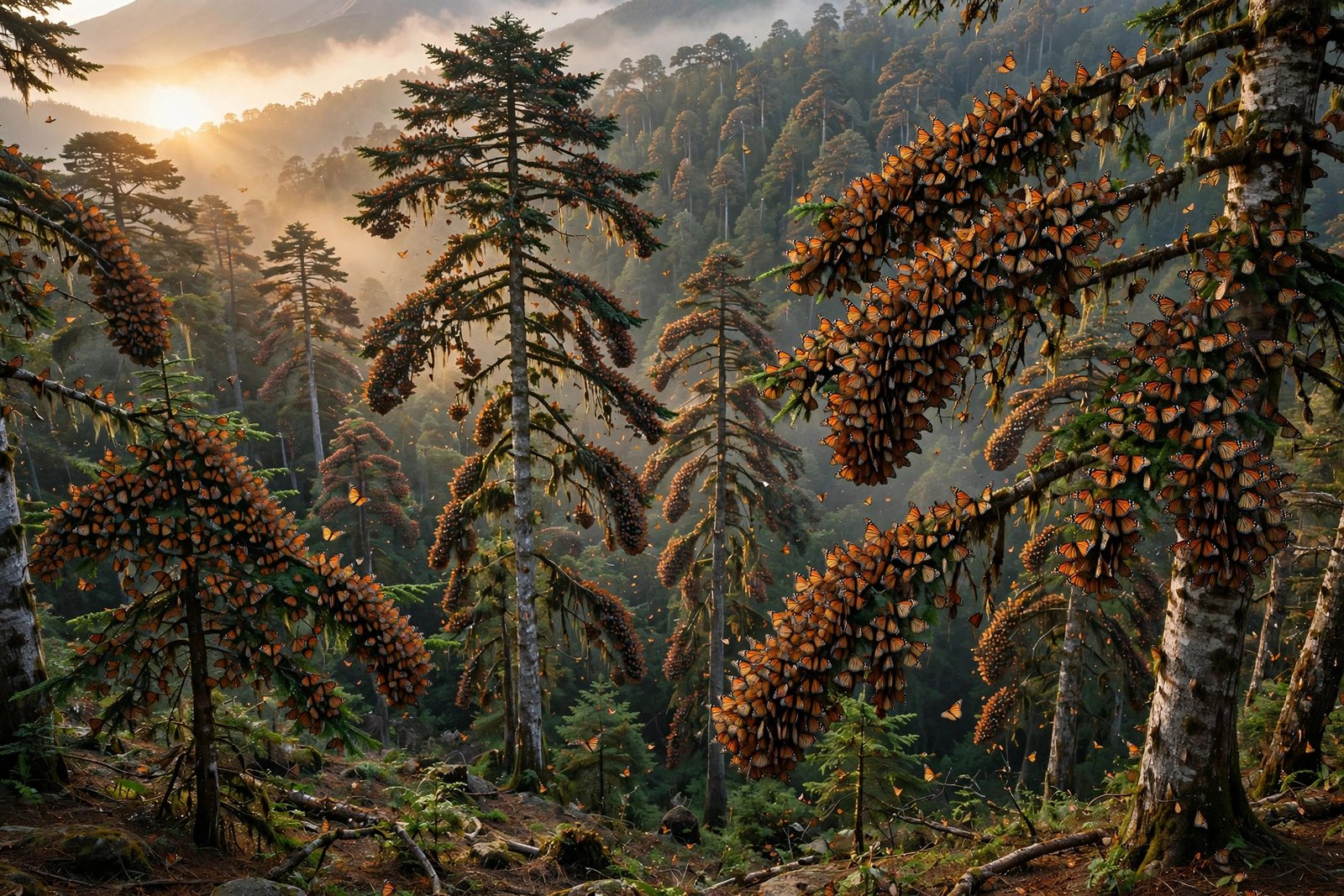
Every November, something extraordinary happens in the mountains of central Mexico. Millions of orange-and-black wings fill the air, cluster on fir trees, and turn whole forests into living colour. These are monarch butterflies, and their arrival in early November is one of nature’s most astonishing journeys. The monarch butterfly migration is not a single flight by a single butterfly. It is a relay race across generations, a journey so long that no one butterfly makes the whole round trip, yet the species finds its way back to the same forests year after year.
That timing is part of why the migration feels almost magical. The butterflies arrive around the same time as Dia de los Muertos, Mexico’s Day of the Dead on November 1 and 2, and tradition links them to returning spirits. National Geographic notes that monarchs are celebrated during Day of the Dead as a symbol of life and death, and that a young woman dressed as a monarch butterfly in a Michoacan parade captures that connection in a single image. Science and tradition meet in that moment: a real natural event, arriving at exactly the season when families welcome back the memory of loved ones.
What Is the Monarch Butterfly Migration?
The monarch butterfly migration is the seasonal movement of monarch butterflies between breeding grounds in the United States and Canada and overwintering grounds in central Mexico. In spring and summer, monarchs breed and spread across North America, laying eggs on milkweed plants. Their caterpillars feed on milkweed, grow, form a chrysalis, and emerge as butterflies. That cycle repeats through the warmer months, with each summer generation living only a few weeks.
The autumn generation is different. These are the butterflies that make the long journey south. They are sometimes called the migratory generation, and they live far longer than their summer relatives, surviving through the winter before heading north again in spring. When they finally begin the return journey, they lay eggs along the way, and it is their children and grandchildren who complete the northward journey. In other words, the migration is a story told across four generations, not a single heroic flight.
That multi-generational pattern is one of the most curious facts in all of nature. How does a butterfly that has never been to Mexico find its way to a specific mountain forest? Scientists believe monarchs use a combination of cues, including the position of the sun, Earth’s magnetic field, and inherited instincts shaped by evolution. The exact details are still being studied, which makes the migration both a scientific wonder and a reminder of how much we still have to learn about the natural world.
Why Monarch Butterfly Migration Arrives in November
Monarchs leave their summer breeding grounds as days shorten and temperatures fall. They travel south in autumn, riding air currents and stopping to feed on nectar along the way. By early November, many have reached central Mexico, just as Day of the Dead celebrations begin. National Geographic states plainly that the butterflies, which migrate through Mexico, arrive around the same time as the November 1 and 2 holiday, and that they drink from streams at the El Rosario butterfly sanctuary in Michoacan.
That overlap is not a coincidence of the calendar alone. It is a meeting of two seasonal rhythms: the natural rhythm of migration and the cultural rhythm of remembrance. In Michoacan, where many monarchs overwinter, the butterflies are woven into Day of the Dead imagery, costumes, and parades. A butterfly that appears after a long journey, transforms from caterpillar to winged adult, and returns to the same place each year is a powerful symbol for a holiday about life, death, and return.
National Geographic also shares a moving local story that shows how deep that symbolism runs. When Day of the Dead approaches, Estela Romero, an educator from Angangueo in Michoacan, celebrates the monarch butterflies that died in a snowstorm in 2002. She picked up several dead monarchs from the sanctuaries, buried them in her town’s graveyard, and added a memorial plate. It is a small, personal act, but it captures something large: for people who live beside the overwintering forests, monarchs are not just visitors. They are neighbours, guests, and symbols.
The Oyamel Fir Forests of Michoacan
The overwintering monarchs do not spread evenly across Mexico. They gather in high-altitude oyamel fir forests in Michoacan and neighbouring areas, where the cool, moist mountain climate helps them conserve energy through winter. The trees provide shelter from wind, rain, and temperature swings, and the butterflies cluster together on branches and trunks in dense groups that can look, from a distance, like leaves or flowers.
Clustering is a survival strategy. By gathering together, monarchs help regulate temperature and protect each other from the cold. On sunny days, they may flutter, drink from streams, and bask in the light. On cold or cloudy days, they stay clustered and still, saving energy until conditions improve. It is a quiet, patient way to spend winter, very different from the busy feeding and breeding of summer, and it is one reason the forests feel so special to visitors: the air can suddenly fill with wings when the sun breaks through.
The El Rosario sanctuary in Michoacan, mentioned by National Geographic, is one of the best-known places where visitors can see this spectacle. Sanctuaries in the region offer guided visits and a chance to witness the overwintering colonies up close. Responsible visits matter here, because the colonies are sensitive to disturbance, noise, and habitat damage. The best way to enjoy the migration is quietly, respectfully, and with a guide who understands the forest.
Threats to the Migration
Despite its wonder, the migration faces serious threats, and conservationists have warned for years that the journey is fragile. One major threat is habitat loss. Monarchs depend on milkweed for breeding, because it is the only plant their caterpillars eat. When milkweed disappears from fields, roadsides, and gardens due to farming, development, or weed control, breeding habitat shrinks and fewer caterpillars survive to become butterflies.
A second threat is the loss and disturbance of overwintering habitat. Logging, forest thinning, and land-use change in and around the Mexican overwintering forests can reduce the shelter monarchs need to survive winter. Storms and extreme cold can also harm colonies, especially when forests are degraded and offer less protection. Climate change adds further pressure by shifting temperatures, rainfall patterns, and the timing of seasons, which can affect both migration and the plants monarchs depend on.
A third threat is the use of pesticides and herbicides. Chemicals that kill milkweed or harm insects can reduce food for caterpillars and adults alike. Because monarchs travel across farms, gardens, towns, and wild areas, they pass through many different landscapes, and each one can help or harm them. That is why conservation is not just a job for protected reserves. It is a job for everyone whose land lies along the migration route.
What Conservation Efforts Exist
The good news is that monarch conservation is a shared effort across three countries, and it includes scientists, governments, farmers, gardeners, and local communities. In Mexico, protected areas and sanctuaries help safeguard overwintering forests, while local guides and communities earn livelihoods from responsible butterfly tourism. That link between protection and livelihood matters, because people who benefit from healthy forests have a strong reason to defend them.
In the United States and Canada, conservation focuses heavily on habitat. Planting native milkweed and nectar plants in gardens, parks, schoolyards, and along roadsides gives monarchs food and breeding sites. Farmers and land managers are also encouraged to leave milkweed patches, reduce unnecessary herbicide use, and create pollinator-friendly areas. Even a small garden can help, because migrating monarchs need nectar stops along the way, and every flower counts on a long journey.
Citizen science plays a role too. Volunteers track monarch sightings, tag butterflies, count overwintering colonies, and report milkweed and monarch observations. That data helps scientists understand population trends, migration timing, and where habitat work is most needed. If you have ever reported a monarch sighting, you have contributed to that picture. It is a rare case where a casual nature walk can become real research.
How You Can Help Monarchs
- Plant native milkweed and nectar flowers in your garden, if they are suitable for your region.
- Avoid spraying pesticides and herbicides where butterflies feed and breed.
- Leave some wild areas in your yard, with flowers that bloom at different times of the season.
- Support sanctuaries and conservation groups through responsible visits and donations.
- Report monarch sightings to citizen-science projects, and teach children why milkweed matters.
If you visit an overwintering sanctuary, follow the rules: stay on paths, keep your voice low, do not touch butterflies or branches, and do not use flash photography near clusters. The goal is to witness the migration without disturbing it. The same respect applies at home. A garden that is a little wilder, with milkweed and nectar plants, can be a rest stop for a butterfly that has travelled farther than most people ever will.
Teachers and families can also use November as a teaching moment. The migration arrives at a season of remembrance, change, and preparation for winter, which makes it a natural topic for lessons about life cycles, geography, and ecology. A child who learns that a butterfly’s great-grandparents began a journey it will finish is learning something profound about generations, patience, and connection across time.
Takeaways
- The monarch butterfly migration is a multi-generational journey between North America and central Mexico, completed across several generations.
- Migrating monarchs arrive in early November, around the same time as Dia de los Muertos, and are celebrated in Mexico as a symbol of life and death.
- Overwintering monarchs cluster in oyamel fir forests in Michoacan, including the El Rosario sanctuary, where cool mountain conditions help them survive winter.
- Threats include milkweed loss, overwintering habitat disturbance, pesticides, and climate pressures along the route.
- Conservation depends on protected forests, milkweed and nectar habitat, responsible tourism, and citizen science across Mexico, the United States, and Canada.
In the end, the monarch migration is a story about return. Butterflies that have never seen a mountain forest find their way back to it. Families who gather for Day of the Dead find a living symbol of return in the same season. And a species that weighs less than a paperclip completes a journey that spans a continent, simply by passing the task from one generation to the next. That is why November in Michoacan feels so magical, and why protecting the migration matters far beyond one forest. For more amazing animal stories, see the baby gorilla rescued from traffickers given a second chance, the fin whale, the second-largest animal, feeding off Wales, and the elephant calf reunited with its mother after seven hours in Kurseong. You can read National Geographic’s Day of the Dead facts, including the monarch connection, at National Geographic.
If you remember only one thing about monarchs this November, remember this: their journey is not finished by one butterfly, but by a family. Protecting milkweed, protecting forests, and giving migrating butterflies a safe place to rest is how we help that family keep arriving, year after year, right on time for November.
When do monarch butterflies arrive in Mexico?
Monarchs arrive in early November, around the same time as Dia de los Muertos on November 1 and 2, according to National Geographic.
What is the monarch butterfly migration?
The monarch butterfly migration is the seasonal, multi-generational movement of monarchs between breeding grounds in the United States and Canada and overwintering forests in central Mexico.
Where do monarchs spend winter in Mexico?
They cluster in oyamel fir forests in Michoacan, including the El Rosario butterfly sanctuary, where cool, moist mountain conditions help them survive winter.
Why are monarchs linked to Day of the Dead?
Because they arrive in early November at the same time as Dia de los Muertos, monarchs are celebrated in Mexico as a symbol of life and death, and appear in parades and costumes in Michoacan.
How can I help monarch butterflies?
Plant native milkweed and nectar flowers where suitable, avoid pesticides where butterflies feed, support sanctuaries through responsible visits, and report sightings to citizen-science projects.