
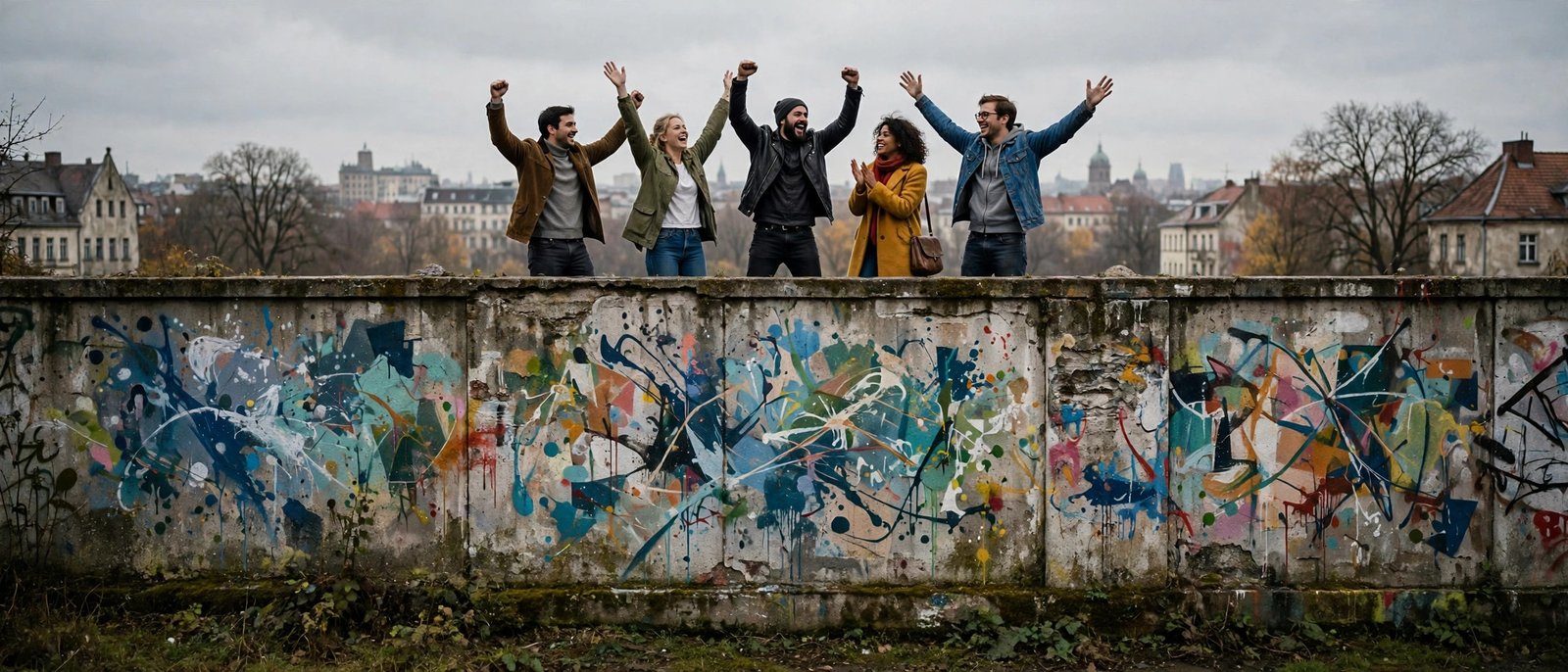
On the night of November 9, 1989, something extraordinary happened in Berlin: a wall that had divided a city for 28 years suddenly stopped working. East Berliners streamed through checkpoints into the West, strangers embraced on top of the concrete barrier, and people began chipping pieces off it with hammers. The night the Berlin Wall fell became one of the defining moments of the twentieth century, and it happened almost by accident.
The Berlin Wall fell because of a confused announcement at a press conference, a bureaucracy that moved too slowly, and ordinary people who decided to test whether the border was really open. Within a year, Germany was reunified, and within two years, the Soviet Union itself had dissolved. Here is how a wall built to keep people in came down in a single night.
Why the Wall Was Built in 1961
After World War II, Germany was divided into four occupation zones controlled by the United States, Britain, France, and the Soviet Union. Berlin, deep inside the Soviet zone, was divided the same way. The western sectors became West Berlin, a capitalist enclave, while the eastern sector became the capital of East Germany, a communist state officially called the German Democratic Republic.
The problem for East Germany was that its citizens kept leaving. The border between East and West Berlin was relatively easy to cross in the early years, and hundreds of thousands of East Germans, many of them young and skilled workers, moved to the West through Berlin. The East German government was losing the very people it needed to build its economy, and the exodus was an embarrassment to the communist bloc.
On the night of August 12-13, 1961, East German troops and workers sealed off West Berlin with barbed wire, and over the following weeks and years the makeshift barrier was replaced with a formidable concrete wall. The wall ran for around 155 kilometres around West Berlin, with guard towers, a cleared “death strip,” floodlights, and patrols. It was officially described by East Germany as an “anti-fascist protection rampart,” but its real purpose was obvious: to stop East Germans from escaping to the West.
The wall became the most visible symbol of the Cold War, the decades-long standoff between the communist East and the capitalist West. It split streets, neighbourhoods, and families overnight. People woke up to find that the road to a relative’s house now ended at a concrete barrier patrolled by armed guards.
Life in a Divided Berlin
For 28 years, Berlin lived as two cities in one. West Berlin, though surrounded by East German territory, thrived as a showcase of Western life, subsidised by West Germany and connected to the outside world by air corridors and a single transit autobahn. East Berlin was the capital of a communist state, with grey apartment blocks, shortages of consumer goods, and the ever-present surveillance of the Stasi, East Germany’s secret police.
Crossing from one side to the other was possible only at a handful of checkpoints, the most famous being Checkpoint Charlie, the crossing point for foreigners and diplomats on Friedrichstrasse. Ordinary East Germans were generally not allowed to travel to the West at all, and those who tried to escape across the wall risked their lives. More than 100 people are known to have died trying to cross the Berlin Wall, shot by border guards, drowned, or killed in other ways during escape attempts.
Yet the two Berlins were never completely separate. West Berliners could see the wall from their side and, at places like the Brandenburg Gate, could look across into the East. Families separated by the wall waved at each other across it, and on some holidays, limited visits were allowed. The wall was a daily, visible reminder of a divided world, and it featured in speeches by world leaders. In 1963, US President John F. Kennedy declared “Ich bin ein Berliner” in a show of solidarity with West Berliners, and in 1987, President Ronald Reagan stood at the Brandenburg Gate and urged Soviet leader Mikhail Gorbachev to “tear down this wall.”
The Night the Berlin Wall Fell: The Press Conference
By 1989, the communist world was changing fast. Gorbachev’s reforms of glasnost (openness) and perestroika (restructuring) had loosened Moscow’s grip on Eastern Europe, and in countries like Poland and Hungary, communist governments were giving way to reform. In East Germany, protests were growing, and thousands of East Germans had fled to the West through Hungary after it opened its border with Austria that summer.
Under pressure, the East German government decided to relax its travel rules. On the evening of November 9, 1989, government spokesman Gunter Schabowski held a televised press conference to announce the new regulations. Reading from a note he had not fully studied, he said that East Germans would be allowed to travel abroad, and when a journalist asked when the rules would take effect, Schabowski replied, apparently improvising, that they would apply “immediately, without delay.”
In fact, the new regulations were not meant to take effect that night, and the details were far from settled. But television carried Schabowski’s words across both Berlins within minutes, and East Berliners heard a simple message: the border was open. Crowds began gathering at the crossing points to find out for themselves.
Crowds at the Checkpoints After the Berlin Wall Fell
At the Bornholmer Strasse crossing, the first checkpoint to open, crowds grew through the evening as East Berliners demanded to be let through. The border guards on duty had received no clear orders, and as the crowds swelled, the officer in charge eventually decided to open the gates rather than risk a dangerous confrontation. Similar scenes played out at other crossings, and by late evening, East and West Berliners were pouring through the checkpoints in both directions, celebrating together in streets that had been closed to them for decades.
People climbed onto the wall itself, standing on top of the concrete slabs that had dominated their city, singing, cheering, and embracing strangers. Others began hacking at the wall with hammers and chisels, taking home pieces as souvenirs. The images of that night, Berliners dancing on the wall, families reunited, champagne corks popping, were broadcast around the world and became the defining pictures of the end of the Cold War.
It is important to be clear about what happened that night: the wall did not physically disappear on November 9. The concrete barrier remained standing, and its formal demolition took place over the following months. What fell that night was the wall’s power. Once the border guards had opened the gates and the crowds had crossed, there was no going back. East Germany’s leaders could not reimpose a closed border on a population that had just tasted freedom.
The Road to German Reunification
The night the Berlin Wall fell set off a chain of events that moved astonishingly fast. Within weeks, the East German government had collapsed, and negotiations began for the reunification of Germany. The process, often called the “Two Plus Four” talks, involved East and West Germany plus the four wartime Allied powers, the United States, Britain, France, and the Soviet Union, who still held formal rights over Germany.
On October 3, 1990, less than a year after the wall came down, Germany was formally reunified. The date is now celebrated as German Unity Day. The Brandenburg Gate, which had stood in the shadow of the wall, became a symbol of the reunited country, and Berlin once again became the capital of a single German state.
The wider effects were just as dramatic. The fall of the wall emboldened reform movements across Eastern Europe, and by the end of 1991, the Soviet Union itself had dissolved. The Cold War, which had shaped global politics for more than four decades, was over. The night the Berlin Wall fell did not cause all of this on its own, but it was the moment when the change became visible, irreversible, and impossible to ignore.
Key Takeaways
- The Berlin Wall was built in August 1961 to stop East Germans fleeing to the West through Berlin.
- It divided the city for 28 years, with guard towers, a death strip, and checkpoints like Checkpoint Charlie.
- On November 9, 1989, spokesman Gunter Schabowski mistakenly announced that new travel rules applied immediately.
- Crowds gathered at the checkpoints, guards opened the gates, and Berliners celebrated on top of the wall.
- Germany was formally reunified on October 3, 1990, and the Cold War soon came to an end.
Conclusion
The fall of the Berlin Wall is a reminder that history can turn on a single evening, and sometimes on a single misread note. A wall built with concrete, barbed wire, and armed guards was undone not by an army but by a press conference, a crowd, and a decision by border guards not to use force. The wall’s physical demolition took months, but its meaning changed in one night: a barrier became a bridge. Today, fragments of the wall remain as memorials, and pieces of it sit in museums and collections around the world, reminders of a divided city and the night it came back together.
For more Cold War history, read our account of Black Saturday and the Cuban Missile Crisis of 1962, the panic caused by the War of the Worlds radio broadcast of 1938, and Muhammad Ali’s first professional fight in 1960. The Encyclopaedia Britannica entry on the Berlin Wall offers further background on the wall’s construction and fall.
When did the Berlin Wall fall?
The Berlin Wall fell on November 9, 1989, when East German border guards opened the checkpoints after a confusing press conference announcement, allowing crowds of East Berliners to cross into West Berlin.
Why was the Berlin Wall built?
The wall was built in August 1961 to stop East Germans from fleeing to West Berlin and on to West Germany. Before the wall, hundreds of thousands of East Germans had left through Berlin, draining the country’s workforce.
How long did the Berlin Wall stand?
The Berlin Wall stood for 28 years, from August 1961 until November 1989. Its formal demolition took place over the following months, though its power as a barrier ended on the night of November 9, 1989.
What happened at the Bornholmer Strasse checkpoint?
Bornholmer Strasse was the first checkpoint to open on November 9, 1989. As crowds of East Berliners gathered demanding to cross, the guards, lacking clear orders, opened the gates, and similar openings followed at other crossings that night.
When was Germany reunified?
Germany was formally reunified on October 3, 1990, less than a year after the Berlin Wall fell. October 3 is now celebrated as German Unity Day.