
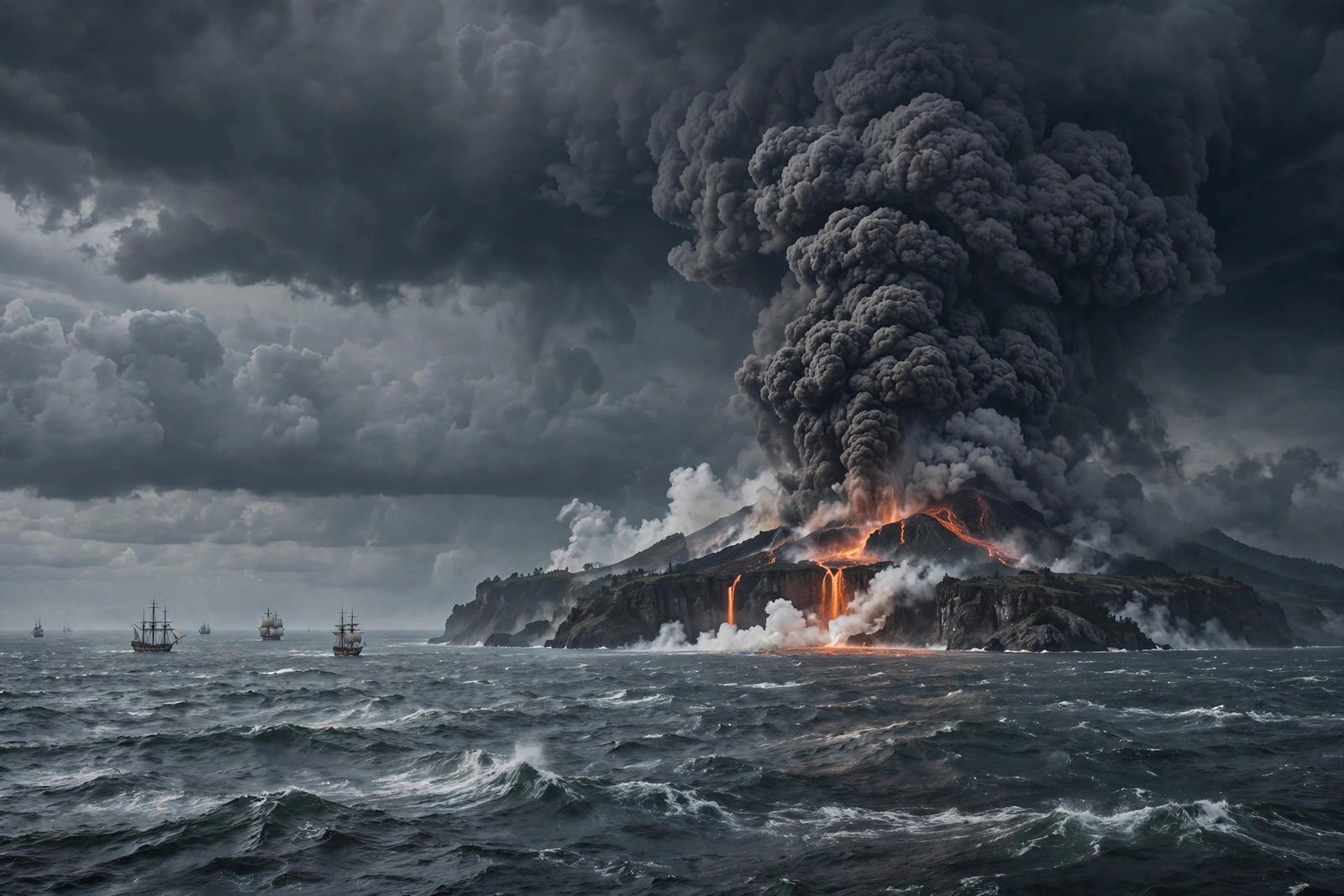
Imagine a sound so powerful that people standing on an island nearly 3,000 miles away thought a cannon was firing right next to them. That is not the opening of a disaster movie. It is the true story of the loudest sound ever Krakatoa produced, when a volcanic island in Indonesia exploded on August 27, 1883, and sent a pressure wave rolling around the entire planet. The blast was heard across an eighth of the Earth’s surface, recorded on instruments all over the world, and followed by sunsets so strange that people wrote about them in diaries for years afterward.
What makes this story so fascinating is not just the noise. It is everything the noise reveals about how our planet works. The eruption of Krakatoa, also spelled Krakatau, turned a quiet stretch of sea between Java and Sumatra into the site of one of the deadliest and most destructive volcanic events in recorded history. Tens of thousands of people lost their lives, mostly to the tsunamis that followed. And yet the sound itself became a scientific gift, because it gave researchers in the 1880s their first truly global measurement of a single event.
The Morning the Sky Exploded
Krakatoa was not a stranger to rumbling. The volcano had been restless for months before the catastrophe, with steam, ash, and smaller explosions warning anyone who was paying attention that something big was building. The eruption began in earnest on August 26, 1883, and grew steadily more violent through the night. Then, on the morning of August 27, a series of enormous explosions tore the island apart.
The most powerful explosion came at 10:02 a.m. local time on August 27. It destroyed much of the island itself, collapsing the volcanic cone into the sea and hurling ash and rock high into the atmosphere. Contemporary accounts describe a column of ash rising tens of kilometres into the sky and a roar that seemed to come from everywhere at once. Ships in the Sunda Strait reported darkness at midday as ash blotted out the sun, and sailors described a rain of pumice falling onto their decks.
For the people living on the coasts of Java and Sumatra, the sound was only the beginning of the horror. The collapse of the island displaced an enormous volume of seawater, generating tsunamis that raced across the strait and struck coastal towns with waves reported to reach tens of metres in height. Entire villages were swept away. At least 36,417 deaths are attributed to the eruption and the tsunamis it created, according to the historical record summarized on Wikipedia’s account of the 1883 eruption of Krakatoa. That number alone makes Krakatoa one of the deadliest volcanic disasters ever documented.
Heard 3,000 Miles Away: How the Loudest Sound Ever Krakatoa Traveled
Here is the detail that still stops readers in their tracks. The explosion was heard 3,110 kilometres (1,930 miles) away in Perth, Western Australia, and on Rodrigues Island near Mauritius, about 4,800 kilometres (3,000 miles) away, where people reportedly mistook the sound for distant cannon fire. To put that in perspective, 3,000 miles is roughly the distance from New York to Los Angeles. Imagine standing in California and clearly hearing an explosion that happened in New York, and you start to grasp the scale of what happened in the Sunda Strait.
How could sound travel that far? Normal sounds fade quickly because their energy spreads out and gets absorbed by the air. But Krakatoa’s blast was not a normal sound. It was a shock wave of extraordinary energy, and part of that energy became trapped in channels of the atmosphere that carried it over vast distances with less loss than usual. The result was a roar that crossed oceans, skipped over continents, and arrived hours after the explosion in places where no one had any idea a volcano had erupted.
People on Rodrigues Island had no way of knowing what they were hearing. There were no telephones, no radio broadcasts, and no news alerts in 1883. When residents heard what sounded like heavy guns firing at sea, they reasonably assumed a ship was in distress nearby. Only much later, when reports from Indonesia finally reached them, did the mystery resolve itself into something far stranger than a naval battle. If you love stories where the truth turns out to be weirder than the first guess, you will enjoy our roundup of facts that feel fake but are 100 percent real on BolanPost.
The Pressure Wave That Circled the Globe
Hearing the blast thousands of miles away was astonishing enough. What scientists measured afterward was even more remarkable. The eruption sent an acoustic pressure wave around the Earth, and barographs, instruments that record changes in air pressure over time, picked it up on every continent. Several barographs recorded the wave seven times over five days, as it traveled away from the volcano, reached the far side of the planet, and came back again. In other words, the wave rounded the globe three and a half times before it finally faded.
This was the first time in history that a single event had been tracked all the way around the world by instruments. Weather stations from London to Washington and beyond all showed the same strange ripples in their pressure records, arriving at times that matched the speed of sound circling the globe. The Royal Society later collected these records into a famous report, and scientists still cite Krakatoa as a landmark in the study of atmospheric waves. Modern researchers got a smaller-scale reminder of this phenomenon in January 2022, when the Hunga Tonga-Hunga Ha’apai eruption in the South Pacific also sent a pressure wave around the world, though nothing since 1883 has matched the loudest sound ever Krakatoa unleashed.
Think about what that means for a moment. A single explosion on a small Indonesian island shook the air above the entire planet, repeatedly, for five days. Every breath of air on Earth carried a faint echo of that morning. It is one of the rare moments when the whole planet can be said to have felt the same event at once, and it happened more than a century before satellites or the internet existed.
Why 310 Decibels Needs an Asterisk
You will often see Krakatoa’s blast described as reaching about 310 decibels. That number deserves an honest explanation, because it is an estimate, not a direct measurement. No one was standing next to the volcano with a modern sound meter in 1883, and no instrument could have survived there anyway. Scientists worked backward from how strong the pressure wave still was when it reached distant barographs, and calculated how powerful it must have been at the source. The figure of roughly 310 decibels is the result of that reconstruction.
There is another wrinkle worth knowing. In ordinary air, a sustained sound wave reaches a physical limit around 194 decibels, beyond which the wave stops behaving like normal sound and becomes a shock wave instead. That does not mean the 310-decibel estimate is wrong. It means the blast is better understood as an explosive shock, a wall of pressure, rather than as a sound in the everyday sense, like thunder or music. When writers call Krakatoa the loudest sound in history, they are using the word sound loosely, and the honest version of the story keeps that caveat in view.
Even with the caveat, the numbers closer to the volcano are staggering. Roughly 100 miles away, the blast has been calculated at around 180 decibels, far beyond the threshold of pain and well past the level that can rupture eardrums. Sailors on ships tens of miles from the island reportedly suffered burst eardrums from the concussion. The scale of the energy involved is commonly estimated at around 200 megatons of TNT, several times more powerful than the largest nuclear weapon ever tested. Those are estimates, but every version of the math points to the same conclusion: nothing humans have ever built has produced a louder bang.
The World Turned Red: Sunsets, Skies, and a Colder Year
After the noise faded, the sky itself changed. Krakatoa hurled enormous quantities of fine ash and sulfur gases into the upper atmosphere, where they spread around the globe and stayed aloft for years. Sunlight filtering through that haze produced sunsets of extraordinary color, vivid reds, oranges, and purples that were reported from Europe, the Americas, and Asia. People who had never seen anything like it filled newspapers and letters with descriptions of a sky that seemed to be on fire night after night.
Some art historians have even suggested that the famously blood-red sky in Edvard Munch’s painting The Scream, painted a decade later in Norway, may have been influenced by these strange post-Krakatoa sunsets. That connection is debated and should not be stated as settled fact, but it shows how deeply the eruption lodged itself in the culture of its time. For months, the whole world seemed to be watching the same sunset, tinted by dust from a volcano most people had never heard of.
The haze had a cooler side effect as well. By reflecting some sunlight back into space, the volcanic particles slightly cooled the planet. The U.S. National Oceanic and Atmospheric Administration reports that global temperatures dropped by as much as 0.9 degrees Fahrenheit in the year following the eruption. Crops suffered in some regions, and the year after Krakatoa is remembered in some histories as a year of poor harvests and strange weather. A single island’s explosion had, in effect, dimmed the sun for the entire Earth.
The Human Cost No One Should Forget
It is easy to get swept up in the record-breaking numbers and forget what they cost. The tsunamis that followed the eruption devastated the coasts of Java and Sumatra, destroying towns, ships, and farmland. The official death toll of more than 36,000 makes Krakatoa one of the deadliest eruptions in recorded history, and the true number may have been higher, since record-keeping in the region at the time was incomplete. Many victims were never counted, and many communities took years to rebuild.
There is a lesson in that grim balance. The same energy that made the loudest sound ever Krakatoa famous also made it a human catastrophe. Modern volcano monitoring exists in large part because of disasters like this one. Today, Anak Krakatau, the Child of Krakatoa, a new volcanic island that has grown from the submerged remains of the old volcano, is closely watched by Indonesian scientists. When it erupted in 2018, it triggered a deadly tsunami in the Sunda Strait, a reminder that the region is still dangerous and that early-warning systems save lives. The story of Krakatoa is thrilling, but it is also a warning.
What the Loudest Sound Ever Krakatoa Teaches Us Today
Why does a 140-year-old explosion still matter? First, because it taught scientists that the atmosphere is a connected system. Before Krakatoa, it was possible to think of weather and air pressure as local phenomena. Afterward, no one could doubt that an event on one side of the planet could be measured on the other. That insight underpins modern atmospheric science, from weather forecasting to the study of how volcanic eruptions affect climate.
Second, Krakatoa remains the benchmark against which every other loud event is measured. Rocket launches, nuclear tests, and even the 2022 Tonga eruption are all described in relation to it. When scientists say Tonga’s pressure wave circled the globe, they are invoking a comparison that only Krakatoa makes meaningful. Records like this one give us a sense of scale, a way to understand just how far nature can go beyond anything humans can produce.
Finally, Krakatoa is a reminder of humility. The people of 1883 were not foolish for failing to predict the disaster. They simply did not yet have the tools. Today we have seismometers, satellites, and tsunami warning systems, but the Earth can still surprise us. The loudest sound ever Krakatoa produced is a story about power, distance, and connection, and it ends with a simple truth: the planet is smaller, and more tightly linked, than it ever feels from the ground. For another mystery that shows how strange the universe can be, read the story of the Wow! signal from deep space on BolanPost.
Key Takeaways
- The loudest sound ever Krakatoa produced came from the August 27, 1883 eruption, with the largest explosion at 10:02 a.m. local time.
- The blast was heard about 3,000 miles away on Rodrigues Island, and about 1,930 miles away in Perth, Australia.
- The pressure wave circled the globe three and a half times and was recorded on barographs worldwide over five days.
- The often-quoted figure of 310 decibels is an estimate reconstructed from distant measurements, not a direct reading.
- Volcanic haze from the eruption produced spectacular red sunsets worldwide and slightly cooled the planet the following year.
- At least 36,417 people died, mostly from tsunamis, making Krakatoa one of history’s deadliest eruptions.
Frequently Asked Questions
What was the loudest sound ever recorded in history?
The loudest sound ever recorded is widely considered to be the explosion of Krakatoa on August 27, 1883. It was heard roughly 3,000 miles away, and its pressure wave was measured circling the globe multiple times by barographs around the world.
How far away was the Krakatoa eruption heard?
The eruption was heard on Rodrigues Island near Mauritius, about 4,800 kilometres (3,000 miles) away, and in Perth, Western Australia, about 3,110 kilometres (1,930 miles) away. People on Rodrigues reportedly mistook the sound for nearby cannon fire.
How loud was Krakatoa in decibels?
Krakatoa is commonly estimated at about 310 decibels at the source, but this is a reconstruction based on distant pressure readings, not a direct measurement. Because sustained sound in air has a physical limit near 194 decibels, the blast is more accurately described as a shock wave.
Did Krakatoa really change sunsets around the world?
Yes. Fine ash and sulfur particles from the eruption spread through the upper atmosphere and scattered sunlight, producing vividly red and orange sunsets that were reported across Europe, the Americas, and Asia for months afterward.
Is Krakatoa still active today?
The original island was largely destroyed in 1883, but a new volcanic island called Anak Krakatau, meaning Child of Krakatoa, has grown from the same site and remains active. It is monitored by scientists because the region is still at risk from eruptions and tsunamis.