
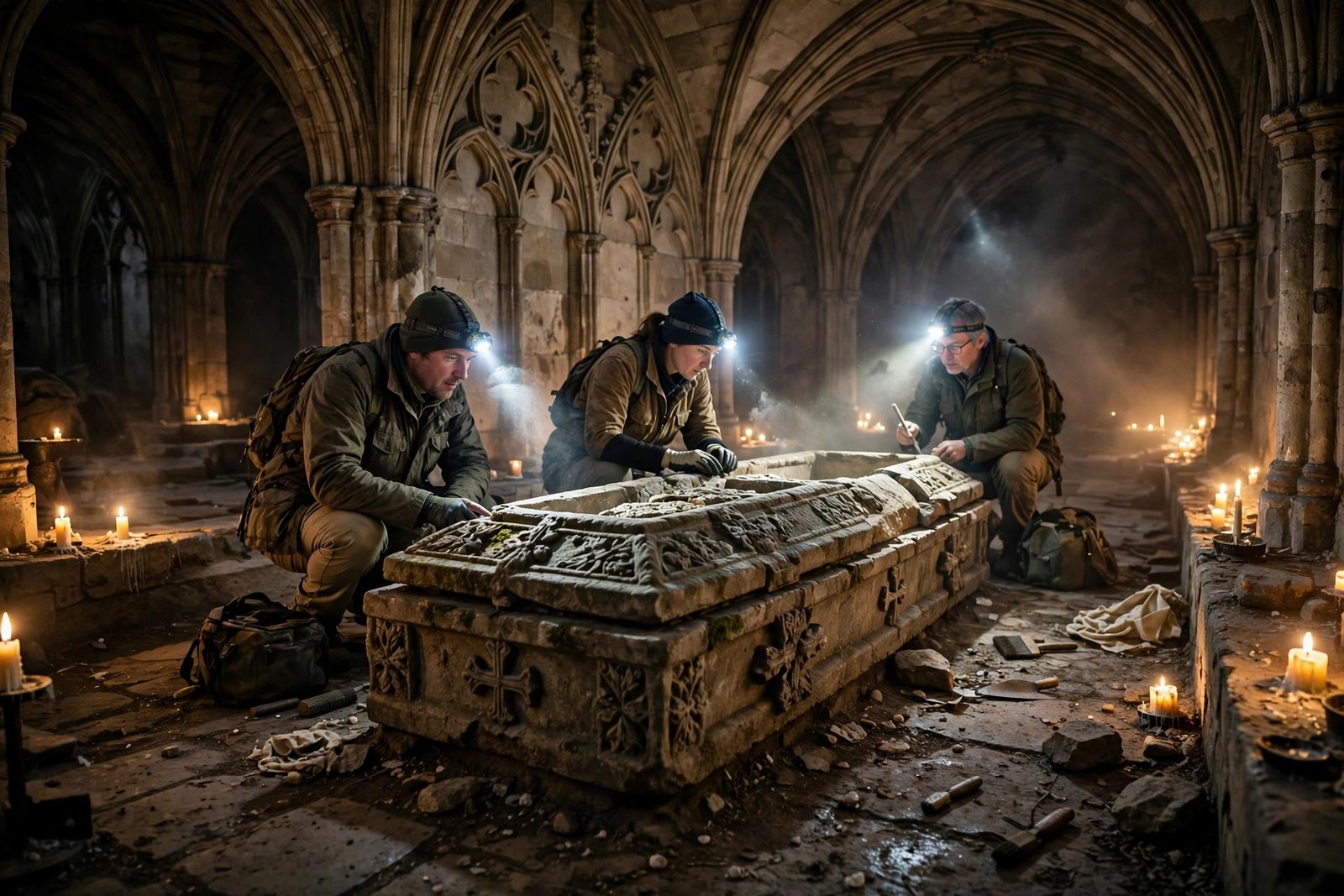
Imagine this: deep inside London’s Westminster Abbey, one of the most famous churches on Earth, sits a stone coffin carved for a wealthy Roman who lived 1,600 years ago. For more than 150 years, everyone assumed the bones inside it had vanished long ago. But the Westminster Abbey Roman coffin was still guarding a secret — and this week, scientists finally cracked it. The skeleton inside has been identified as a medieval church leader who died roughly a thousand years ago, a man who was laid to rest inside a Roman’s coffin seven centuries after it was made.
It is one of the strangest burial stories in British archaeology: two eras, one grave. And the answer only emerged after a 2016 cleaning session, radiocarbon dating, and a new study in the Journal of the British Archaeological Association.
The Westminster Abbey Roman Coffin: A 150-Year Mystery
The story begins in 1869, when workers uncovered a limestone sarcophagus in the triforium of Westminster Abbey. The find immediately baffled the antiquarians of Victorian England. An inscription on the coffin named a wealthy Roman called Valerius Amandinus, whose sons had commissioned the tomb sometime between AD 300 and 400. But the bones inside told a completely different story: they were roughly 700 years too young to have belonged to a Roman-era Londoner.
The lid only deepened the puzzle. Carved into the top was a large Latin cross — a style dated to the 10th or 11th century. So the container was Roman, the carving was medieval, and the bones matched neither the name on the stone nor the church they lay under. Researchers spent generations arguing about how a medieval skeleton ended up inside an ancient Roman coffin.
The saga had even earlier chapters. Workers had first stumbled upon the limestone sarcophagus in 1820 while digging on the north side of the abbey — and smashed its lid into six pieces by accident. It was repaired, formally recorded in 1869, and put on a long path toward modern analysis.
The Skeleton That Was Supposed to Be Gone
In 1873, the abbey’s architect declared the skeleton “unquestionably lost” in a letter, and researchers took his word for it — for the next 143 years. The bones became a ghost in the abbey’s records: assumed gone, discussed only in old notes.
That assumption collapsed in 2016. Conservators removed the lid while cleaning the sarcophagus in a studio before putting it on display, and archaeologists from Pre-Construct Archaeology (PCA) found the skeleton still lying inside — about 90 percent complete. James Young Langthorne, PCA’s human bone specialist, examined the remains and found a few surprises of his own. The man had been between 35 and 49 years old at death, stood about five feet nine inches (1.75 meters) tall, and was somewhat taller and considerably older than the nineteenth-century researchers had estimated.
His bones also carried the marks of a real, lived-in medieval life: arthritis in the shoulders, spine, right wrist, and left big toe, two healed rib fractures, and an infection in his lower right leg. His teeth were complete and free of decay. Nothing on the bones pointed to a cause of death. And whoever laid the skeleton out knew nothing of anatomy — two shin bones lay where the arms should have been.
Science Cracks the Case: Dated Between AD 987 and 1052
The breakthrough came from radiocarbon dating. Researchers sent a bone sample to the Scottish Universities Environmental Research Centre, and the result was decisive: the man had lived between AD 987 and 1052, in Anglo-Saxon England, roughly seven centuries after the Roman sarcophagus was made.
“The result was conclusive,” Professor Warwick Rodwell, Westminster Abbey’s consulting archaeologist, told Earth.com. He had commissioned the test specifically to confirm the man lived in the early medieval period rather than Roman times — and it did exactly that.
But the investigation turned up one more twist. Cleaning the floor of the sarcophagus revealed a white rectangle with straight edges, three to four inches in from the walls. Victorian observers had noticed the same substance as a paste on the bones. “The biggest surprise was discovering deposits of lime adhering to some of the bones,” Rodwell said. “This immediately told us that the corpse had been surrounded by powdered lime.”
The powder implied a timber coffin: one filled with lime, then sealed inside the stone sarcophagus. The wood had completely decayed over a millennium, but researchers could still trace its outline on the base — the ghost of a coffin inside a coffin.
Westminster Abbey Roman Coffin: Who Was the Dead Man?
With the date range pinned down, Rodwell turned to history. The published analysis in the Journal of the British Archaeological Association concludes the man was a high-ranking monk — most likely an abbot of Westminster Abbey, back when it was a Benedictine monastery. Two names fit the evidence.
- Ælfwig — led the abbey from 993 and died around 1020. He is the stronger candidate because he had already served as a monk at Westminster before becoming abbot.
- Wulfnoth — Ælfwig’s successor, who died in 1049 and was presumed buried at the abbey as well.
Nobody knows when either man was born, but both would match the skeleton if the abbot took office in his early twenties and died close to fifty. The identification is not definitive — Rodwell is careful about that — but the evidence has narrowed a 150-year mystery to two names.
Why Bury a Medieval Abbot in a Roman Coffin?
This is the question that makes the whole story delicious. The coffin was deliberately reused during the Anglo-Saxon period, with its lid modified to accommodate a Christian burial. A wooden coffin was placed inside the much older Roman stone container, while the lid was remodelled with a prominent Latin cross.
The reuse was no accident and no act of poverty. The archaeologists’ report explains that recycling an ancient sarcophagus in this way signals that the medieval occupant was considered important enough to receive an elaborate stone burial rather than an ordinary grave. Reusing Roman monuments was, in a sense, a power move: it connected the medieval abbot to the deep antiquity of the site and to the grandeur of Rome itself.
Westminster Abbey itself is a monument stacked on centuries. The abbey’s official history stretches back to a Benedictine community founded in the 10th century, and the present Gothic church was rebuilt under Henry III in the 13th century. This burial shows that the recycling of the past was happening even a thousand years ago — the medieval monks were curating their history just as the abbey does today. The Westminster Abbey Roman coffin now stands on public display in the Queen’s Diamond Jubilee Galleries, where visitors can see both the Roman inscription and the medieval cross in a single artifact.
What This Discovery Teaches Us
- Absence of evidence is not evidence of absence. For 143 years, everyone believed the bones were lost because one Victorian architect said so. They were there the whole time.
- One object can hold two histories. The Roman inscription naming Valerius Amandinus and the medieval cross tell the story of London itself — Roman city, Anglo-Saxon church, modern capital — layered in a single stone.
- Medieval people recycled prestige. Burying an abbot in a 600-year-old Roman sarcophagus was a statement about status and continuity, not a shortcut.
- Modern science keeps rewriting old museums. Radiocarbon dating, osteology, and careful conservation turned a display piece into a solved cold case.
The story also belongs to a long tradition of archaeology turning up graves that rewrite assumptions — much like the burial cave discovered in Jerusalem that opened a window onto Second Temple–era practices, or the astonishingly preserved fossils like the best-preserved dinosaur with its last meal still visible. Bones keep receipts, and they do not care how long you make them wait.
A 1,000-Year Cold Case, Closed at Last
In the end, the mystery was never really about the Roman named on the coffin. Valerius Amandinus and his sons have their inscription, and they keep their place in the story. But the man who slept inside the stone for a thousand years was a medieval abbot — probably Ælfwig — buried with lime, wood, and a carved cross, inside a tomb six centuries older than he was.
As Rodwell’s study notes, the precise identity may never be established with absolute certainty. But after more than 150 years of confusion, archaeology has narrowed the possibilities from “someone, maybe Roman, maybe not” to two named abbots of a specific monastery in a specific half-century. For a cold case a millennium old, that is as close to solved as it gets.
For more on the official research, see the coverage at Geo News, Earth.com, Arkeonews, and Archaeology News Online Magazine.