
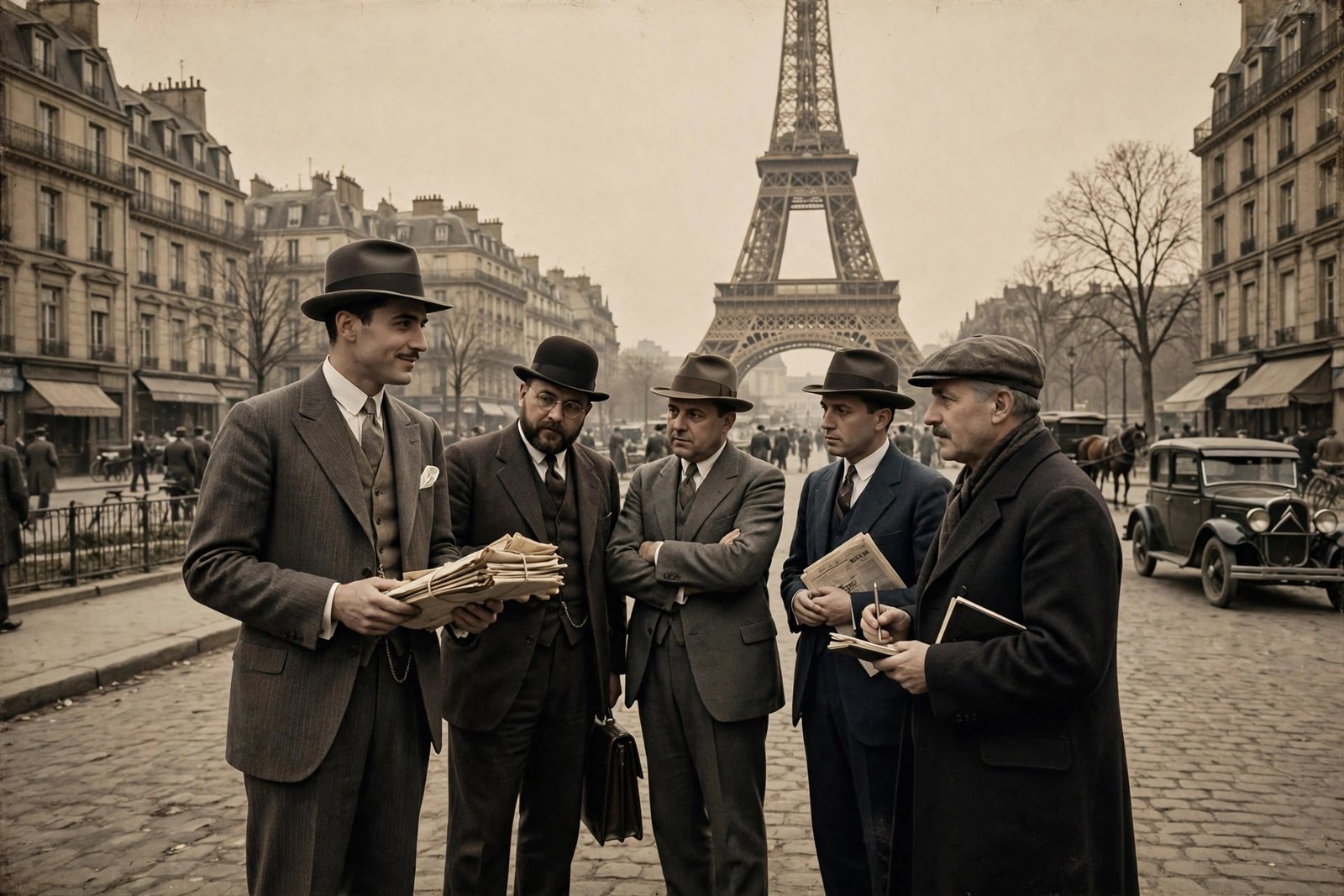
Imagine walking into a grand Paris hotel in 1925, gathering the city’s top scrap-metal dealers, and calmly announcing that the Eiffel Tower is coming down — and that you are the man selling it. Then imagine getting away with it. Then imagine doing it all over again. That is the story of Victor Lustig, the con man behind the most audacious fraud of the twentieth century. The victor lustig eiffel tower scam sounds like a tall tale, and in some details it probably is — but the outline is documented in memoirs, magazine investigations, and Secret Service history, and it remains the gold standard of the confidence trick.
This is the story of how one charming fraudster sold a national monument for scrap, why his victim never called the police, and how the same man went on to forge banknotes so good that they worried the United States government — before ending his life in Alcatraz. Where the record is solid, we say so. Where a detail comes from legend rather than a court record, we flag it as such.
Who Was Victor Lustig?
Victor Lustig was born in 1890 in what was then Austria-Hungary, in the town of Hostinné, in present-day Czechia. According to accounts of his life, he was educated, multilingual — reportedly fluent in several European languages — and gifted with the charm that would define his career. By the time he reached adulthood, he had drifted into a world of gambling, fraud, and high living, collecting aliases the way other men collected stamps. Later profiles would credit him with dozens of them, though the exact count varies by source and should be treated as legend rather than ledger.
Lustig operated in an era thick with confidence men. America in the 1920s was, as Smithsonian magazine has noted, infested with such rackets, run by smooth-talking immigrants who treated their victims as “marks” and themselves as gentlemen rather than thugs. Charles Ponzi, namesake of the Ponzi scheme, was a contemporary. Lustig, though, aimed higher than most: he did not want a mark’s savings. He wanted a mark’s belief — and he wanted it on a monumental scale.
How the Victor Lustig Eiffel Tower Scam Worked
The plan began, according to accounts, with a newspaper article. Lustig was in Paris in May 1925 when he read that the Eiffel Tower — built for the 1889 World’s Fair and then nearly four decades old — was expensive to maintain and in need of costly repairs. The tower had been a controversial structure from the start, and in the 1920s its future was genuinely debated in some circles. Lustig saw not a civic problem but an opportunity.
His first move was presentation. He checked into the luxurious Hôtel de Crillon on the Place de la Concorde and commissioned stationery bearing the French government’s official seal. Then, posing as a deputy director general in the French postal ministry, he wrote to the city’s leading scrap-metal dealers and invited them to a confidential meeting at the hotel. Five dealers, by most accounts, accepted the invitation.
In a quiet hotel room, Lustig told them a secret: because of engineering faults, costly repairs, and political problems he could not discuss, the tearing down of the Eiffel Tower had become mandatory. The government, he said, would sell the tower’s roughly 7,000 tons of metal to the highest bidder, and the dealers were competing for the contract. The pitch was brilliant because it flattered its audience — they were not being robbed, they were being let in on a state secret — and because it exploited a real anxiety about the tower’s upkeep.
Lustig chose his mark carefully. According to Smithsonian magazine, the winning bidder was André Poisson, a newcomer to Paris who was eager to break into the city’s business circles. Lustig then hinted, delicately, that public servants earned meager salaries. Poisson understood: a bribe was expected, and he paid it. Smithsonian reports that Poisson paid $20,000 in cash and $50,000 more to secure the winning bid — $70,000 in all, roughly $1.3 million in today’s money by one consumer-price calculation.
Then Lustig did the simplest thing in the world: he left. He took a train to Vienna with the cash, betting that Poisson would be too embarrassed to report the fraud. According to accounts, he was right. Poisson, who would have had to admit he tried to bribe a government official to buy a national monument, stayed silent, and Paris never learned what had happened. The con worked because of shame — the same silence that protects modern fraudsters, as our look at the Great Emu War shows in a very different way: sometimes the most unbelievable stories are the ones nobody wants to admit.
The Victor Lustig Eiffel Tower Scam, Attempt Two
Success, for a man like Lustig, was an invitation to repeat himself. About six months later, according to accounts, he returned to Paris and ran the same scheme with a new group of scrap dealers. This time, however, the trick failed: one of the dealers went to the police before any money changed hands, and Lustig fled the city in a hurry.
This is where honesty about the record matters. The Eiffel Tower sale was never proven in any court of law. No trial ever established Poisson’s payment, and the details we have come from later memoirs — including that of a U.S. Secret Service agent — and magazine investigations, not from a verdict. The story is widely retold and broadly consistent across sources, but some details, especially the exact sums and the number of dealers, come from retellings rather than documents. The honest summary is this: the scam is one of history’s most famous cons, but its finest details live in the gray zone between record and legend.
That gray zone is part of the fascination. Lustig himself liked to boast about his exploits, and he even circulated a list of rules for con artists — be a patient listener, never look bored, never boast, and so on — that is still quoted today. Whether he truly wrote every line of it is, again, a matter of accounts rather than proof. What is certain is that the man understood his craft: a con works not when the lie is perfect, but when the victim wants to believe it.
From Paris to Counterfeiting and Alcatraz
Lustig’s career did not end in Paris. After fleeing to the United States, he ran a string of other schemes, including the notorious “money box” — a device he claimed could duplicate banknotes, which he would demonstrate with real bills before selling the empty box for a fortune. According to accounts, he even ran a version of the trick on the gangster Al Capone, taking $50,000 and then returning it with an apology, earning Capone’s trust — and, in the legend, a reward for his honesty. That tale, too, should be read as colorful account rather than court record.
His most serious crime, and the one that finally ended his freedom, was counterfeiting. In the 1930s, working with a partner in New York, Lustig produced fake $100 bills so convincing that they became known in Secret Service circles as “Lustig money.” The operation was large enough to worry federal authorities, and in 1935 the Secret Service caught him. He briefly escaped custody — according to accounts, by climbing out of a window on a bedsheet rope — but was recaptured within weeks.
Convicted and sentenced to a long prison term, Lustig was sent to Alcatraz, the island prison in San Francisco Bay. He died there in 1947, reportedly of pneumonia. His death certificate, in a final touch of irony that biographers love to repeat, listed his occupation as “apprentice salesman.” Whether or not every detail of that story is exact, the arc is documented: a man who sold the world’s most famous tower ended his life in America’s most famous prison.
Why the Scam Still Works as a Story
Nearly a century later, the Eiffel Tower scam still gets retold because it exposes a timeless weakness. Consider what made it work:
- Authority. Official stationery, a grand hotel, and a government title made the impossible sound procedural.
- Secrecy. A confidential deal flatters the mark and discourages him from checking with anyone else.
- Greed, politely framed. The dealers were not stealing; they were winning a contract. The bribe was just how business was done.
- Shame. The victim’s embarrassment became the con man’s insurance policy. Fraud victims stay silent today for the same reason.
- A plausible premise. The tower really was expensive to maintain, which made demolition just believable enough.
That is why the victor lustig eiffel tower scam is still taught as a classic confidence trick: it shows how authority, secrecy, and shame can be more powerful than any forged document. Those same levers drive modern scams: the fake government email, the secret investment opportunity, the pressure not to tell anyone. The technology has changed, but the psychology has not. If a deal must stay secret, if it leans on an official-looking letterhead, and if it promises a fortune for acting fast, it is worth a second look — and a call to someone who is not in on the secret.
Conclusion: The Man Who Sold a Monument
Victor Lustig never owned the Eiffel Tower, and no scrap dealer ever dismantled it. What he sold was belief: belief in a secret, in a title, and in a bargain too good to question. The victor lustig eiffel tower scam endures not because it was the biggest fraud in history — it was not — but because it was the most elegant. A monument that still stands, a victim too embarrassed to speak, and a con man who walked away to do it again: it is a story with everything except a courtroom verdict.
That is also the lesson worth keeping. History’s greatest cons are rarely about the thing being sold. They are about the story being told, and the part of us that wants it to be true. Lustig understood that better than anyone, and the tower — still standing over Paris, still visited by millions — is the best possible proof that his greatest sale never actually happened. For another tale of a beautiful object hiding a stranger truth, read our story of the Mona Lisa and the mystery of her missing eyebrows.
Did Victor Lustig really sell the Eiffel Tower?
According to widely retold accounts, Lustig posed as a French government official in Paris in 1925 and took about $70,000 from scrap dealer Andre Poisson for the tower’s supposed demolition. However, the sale was never proven in court, so some details come from memoirs and magazine investigations rather than a legal verdict.
Why didn’t his victim report the scam?
According to accounts, Poisson was too embarrassed to go to the police, since reporting the fraud would mean admitting he had tried to bribe a government official to buy a national monument. Shame is a common reason fraud victims stay silent, then and now.
Did Lustig really sell the tower twice?
According to accounts, he returned to Paris about six months later and tried the same scheme with a new group of dealers, but one of them alerted the police before any money changed hands, and Lustig fled. The second attempt is part of the legend, not a court-proven fact.
What happened to Victor Lustig in the end?
After other schemes, including a ‘money box’ con, Lustig was caught by the U.S. Secret Service in 1935 for a large counterfeiting operation producing fake $100 bills. He was sentenced to prison, sent to Alcatraz, and died there in 1947.
What can the Eiffel Tower scam teach us today?
The scam worked through fake authority, secrecy, flattery, and the victim’s shame. The same levers drive modern frauds: if a deal must stay secret, uses official-looking documents, and promises a fortune for acting fast, it deserves skepticism and a second opinion.