
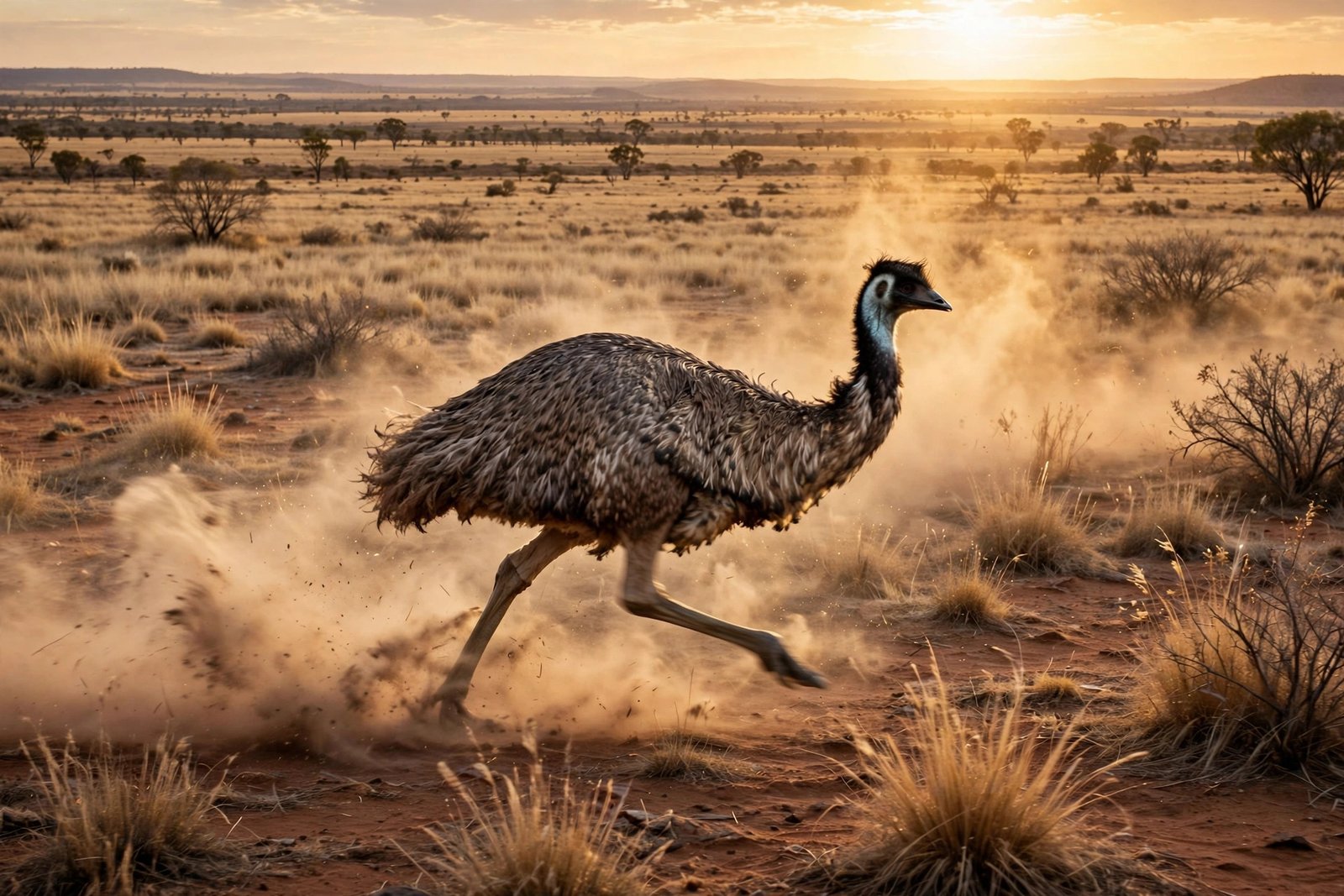
In 1932, the Australian government declared war. The enemy was not a foreign army, not a rebel force, and not a criminal gang. The enemy was a bird. A big, flightless, surprisingly fast bird called the emu. What followed was one of the strangest military operations in modern history: soldiers armed with machine guns were sent into the wheat fields of Western Australia to defeat an army of emus, and the birds won. This is the true story of the Great Emu War Australia still laughs about today.
It sounds like a joke, but every part of it really happened. The military operation lasted from November to December 1932, involved three soldiers and two Lewis machine guns, burned through thousands of rounds of ammunition, and ended with the army withdrawing in defeat while the emus kept eating the crops. How did it come to this? The answer lies in the hardships of the Great Depression, the struggles of soldier-settlers, and one spectacularly underestimated bird.
How the Great Emu War Australia Began: Soldier-Settlers in Trouble
After World War I, the Australian government settled thousands of returning soldiers on farmland in Western Australia, including the Campion district. These soldier-settlers were given land to farm, but much of it was poor quality, and conditions were harsh. When the Great Depression struck in 1929, wheat prices collapsed, and the government urged farmers to grow more wheat while promised subsidies failed to arrive. By October 1932, the farmers were desperate and angry, even threatening to withhold their wheat harvest.
Then the emus arrived. After their breeding season, large numbers of emus migrate across Western Australia in search of food and water. In 1932, a dry period pushed an estimated 20,000 emus into the wheat-growing region around Campion. The birds trampled crops, ate grain, and smashed through fences. Broken fences created a second problem: rabbits could slip through the gaps and damage the fields further.
The farmers had tried ordinary pest control methods, but nothing worked against birds in such numbers. Frustrated, they appealed to the government for military assistance. Their request reached Defence Minister Sir George Pearce, a former soldier-settler supporter, who agreed to send help. The military, it seemed, would solve the emu problem once and for all.
The Army Arrives: Two Machine Guns Against 20,000 Birds
On November 2, 1932, Major G. P. W. Meredith of the Royal Australian Artillery arrived in the Campion district with two other soldiers and two Lewis machine guns. The plan was simple: find the emus, shoot them, and reduce the population enough to save the harvest. The operation was expected to be quick and decisive.
It was neither. The emus refused to cooperate with military doctrine. The birds scattered into small groups when approached, making them difficult targets for machine guns designed to fire at massed formations. Emus can run at remarkable speeds, with reports of birds sprinting at up to 55 miles per hour, and they zigzag unpredictably. Trucks mounted with guns could not keep up with them over rough ground, and at one famous ambush near a dam, a Lewis gun jammed after killing only about a dozen birds from a flock of more than a thousand.
By November 8, after firing roughly 2,500 rounds, the military had killed only a small number of emus. Defence Minister Pearce withdrew the troops. The first campaign of the Great Emu War Australia had ended in failure after barely a week.
The Second Attempt: More Bullets, Same Birds
The farmers, however, were not ready to give up, and neither was Meredith. After lobbying from the settlers, a second military operation began on November 13, 1932. This time the soldiers adapted their tactics, mounting a gun on a truck in an attempt to chase down the birds. The truck, however, could not handle the rough terrain, and it crashed, ending that experiment.
Meredith later claimed that 986 emus had been killed during the operations, a figure that works out to roughly ten rounds per claimed kill. Other estimates put the toll far lower, and even Meredith’s own number was a tiny fraction of the estimated 20,000 birds. The operation finally ended on December 10, 1932. The army went home. The emus stayed.
According to Britannica, the campaign lasted from November to December 1932, and after two months, fewer than 1,000 emus were reported killed. The failure became the subject of national and international ridicule, and newspapers around the world delighted in the story of an army defeated by birds.
Why the Emus Won the Great Emu War Australia
So why did a modern army lose to flightless birds? The reasons reveal a lot about both emus and warfare:
- Speed and agility: Emus are fast runners that zigzag and scatter, making them terrible targets for machine guns built for massed infantry.
- Numbers: With an estimated 20,000 birds spread across a huge area, the army could never concentrate enough firepower in one place.
- Adaptability: The emus quickly learned to split into small groups and keep their distance from the soldiers.
- Toughness: Emus are large, hardy birds, and even wounded birds often kept running.
- Terrain: Rough, uneven farmland wrecked the army’s trucks and limited where guns could be positioned.
- Wrong weapons: Lewis guns were designed for battlefield use against human formations, not for pest control across open wheat fields.
Meredith himself reportedly praised his feathered adversaries, remarking that emus could face machine guns with the invulnerability of tanks. Whether or not he used those exact words, the sentiment was clear: the birds had outmatched the military.
The Aftermath: Bounties, Fences, and a Lasting Legend
After the military withdrawal, the farmers asked for army assistance three more times, and were refused each time. The government turned instead to other solutions: bounty systems that paid for emu kills, and exclusion fences designed to keep the birds out of farming areas. In 1934, about 57,000 emu bounties were claimed in just six months, showing that civilian hunters and farmers had more success than the army, though the emu population endured.
The emus, of course, are still in Australia today. They remain a protected native species in most contexts, and they are the only birds besides the kangaroo to appear on the Australian coat of arms. The Great Emu War Australia has become a beloved piece of national folklore, retold in documentaries, comedy sketches, and countless articles. It is a story Australians tell with a grin: the time their army went to war with birds and lost.
History is full of stranger-than-fiction true stories like this one. If you enjoy them, you may also like BolanPost’s account of the DB Cooper skyjacking mystery, another tale where the official story took an unexpected turn.
Lessons From the Emu War
Beyond the humor, the Emu War carries real lessons. First, it shows how desperate people can become during economic crises: the soldier-settlers were not foolish, they were farmers facing ruin who asked their government for help. Second, it reveals the limits of military solutions to ecological problems. Guns designed for war are poor tools for managing wildlife, and the emus’ behavior simply did not fit the army’s tactics.
Third, the story reminds us that nature is resilient. The emus were not villains; they were wild animals following ancient migration patterns into landscapes humans had recently turned into farms. The conflict was really about humans and wildlife competing for the same land, a story that continues around the world today.
Finally, the Emu War shows the power of a good story. Few people remember the details of Australian wheat policy in 1932, but almost everyone who hears about the Emu War remembers it forever. History’s strangest chapters are often its most memorable.
Takeaways: The War the Birds Won
- The Emu War took place in November and December 1932 in the Campion district of Western Australia.
- Three soldiers with two Lewis machine guns were sent to cull an estimated 20,000 emus damaging wheat crops.
- The emus scattered, outran trucks, and survived: fewer than 1,000 were reported killed after two months.
- The army withdrew twice, and farmers’ later requests for military help were refused.
- Bounties and exclusion fences replaced military action, and emus remain a proud symbol of Australia today.
Conclusion: Salute the Emus
The Great Emu War Australia is funny, but it is also a genuinely remarkable piece of history. It is the story of desperate farmers, an overconfident military plan, and a bird that refused to be beaten. The emus did not know they were at war, and they did not need to. They simply did what emus have always done: run fast, scatter, and survive. Nearly a century later, the birds are still there, still running across the Western Australian wheatbelt, while the machine guns are long silent. If there is a moral to the story, it is this: never underestimate your opponent, especially when your opponent is a six-foot-tall bird that cannot fly but can outrun your truck. For more unbelievable-but-true stories from history, explore BolanPost’s piece on the Amelia Earhart expedition, where another search defied all expectations.
Sources: Britannica: Emu War and Emu War on Simple Wikipedia.
Frequently Asked Questions
What was the Great Emu War Australia?
The Great Emu War Australia was a military operation in late 1932 in which the Australian army tried to cull emus damaging wheat crops in the Campion district of Western Australia. The operation failed, and the emus survived in large numbers.
When did the Great Emu War take place?
The Great Emu War took place from November 2 to December 10, 1932, in two phases: an initial operation in early November and a second attempt from November 13 to December 10.
How many emus were killed in the Great Emu War?
Major Meredith claimed 986 emus were killed, though other estimates are lower. Britannica reports that after two months, fewer than 1,000 emus were reported killed, out of an estimated 20,000 birds.
Why did the army lose the Emu War?
The emus scattered into small groups, ran at high speeds, and zigzagged unpredictably, making them poor targets for machine guns. Rough terrain wrecked the army’s trucks, guns jammed, and the birds’ numbers were simply too large for three soldiers to control.
What happened after the Great Emu War?
After the army withdrew, farmers’ further requests for military help were refused. The government turned to bounties and exclusion fences instead, and emus remain common in Australia today, appearing on the national coat of arms alongside the kangaroo.