
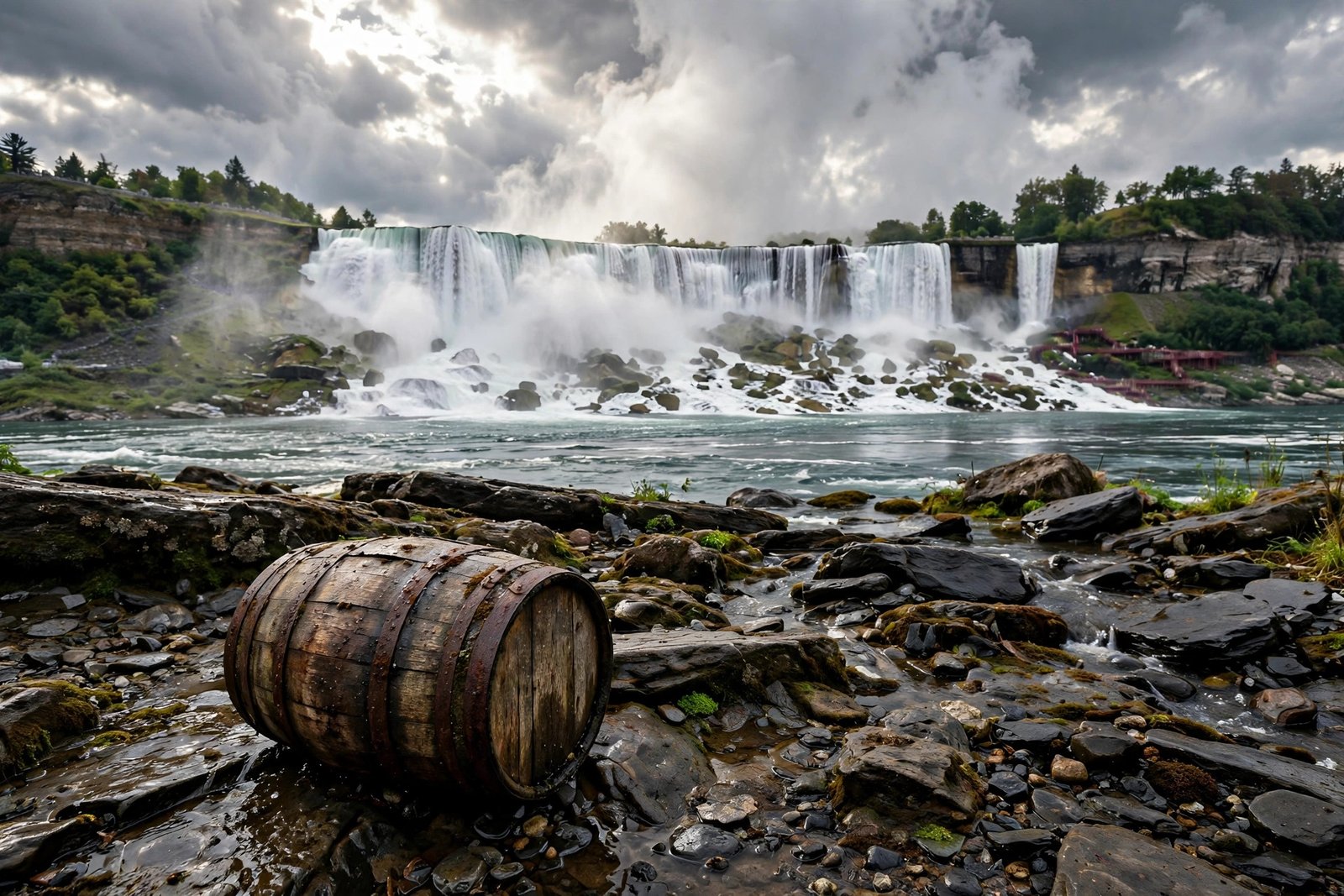
On her 63rd birthday, a widowed schoolteacher climbed into a wooden pickle barrel, had the lid nailed shut, and was pushed into the raging Niagara River. Minutes later she plunged 167 feet over Horseshoe Falls in a Niagara Falls barrel stunt that no one had ever survived before. Her name was Annie Edson Taylor, and when rescuers pried the barrel open, she climbed out alive, bruised and bleeding but very much able to tell the tale. It was one of the boldest, strangest, and most unlikely feats in the history of daredevilry, and it was performed not by a young circus acrobat but by a broke 63-year-old teacher chasing a fortune.
How does a schoolteacher end up going over the most famous waterfall in the world in a barrel? The answer is a mix of desperation, showmanship, and pure stubborn courage. Annie Edson Taylor was not rich, not famous, and not young when she decided to risk everything. She simply believed that one spectacular act could change her life forever. She was right about the fame. The fortune, sadly, never quite arrived.
Who Was Annie Edson Taylor?
Annie Edson Taylor was born in 1838 in Auburn, New York, one of eleven children in a comfortable family in the Finger Lakes region. She trained as a schoolteacher and later taught school and music, and she married a man named David Taylor. Her life changed when she was widowed, leaving her without the financial security marriage had provided in that era. By the turn of the century she was living in Bay City, Michigan, teaching and scraping by, with little money and no prospect of a comfortable retirement.
Like many people facing an uncertain old age, Taylor began thinking hard about how to earn a living. According to her own later account, the idea came to her while reading a newspaper feature about tourists flocking to Niagara Falls. The article got her thinking: thousands of people visited the falls every year, but no one had ever gone over them in a barrel and lived. If she could be the first, she reasoned, the fame would bring money through lectures, photographs, and a book about her adventure. It was a business plan disguised as a death wish.
There was a catch, of course. Going over Niagara Falls was, and still is, extraordinarily dangerous. The Horseshoe Falls drop about 167 feet, and the water crashes into the rocks and churning pool below with terrifying force. Plenty of people had died in the river’s rapids and whirlpools over the years. Taylor knew the risks. She simply decided the potential reward was worth it.
Building the Niagara Falls Barrel
Taylor did not just grab any old barrel off a dock. She had a custom barrel built for the journey: a sturdy oak barrel about five feet high and three feet in diameter, originally designed for pickles. Inside, it was padded with cushions to protect her body, and she was strapped into a leather harness with hand grips so she could brace herself no matter which way the barrel tumbled. An anvil was attached to the bottom of the barrel to keep it upright in the water, a clever piece of engineering that likely saved her life.
Before risking her own life, Taylor tested the barrel’s design. She sent it over the falls with a cat inside, or so later accounts claim, and the cat reportedly survived the trip. Some historians note that this cat story may be more legend than fact, but whether or not a feline test pilot really made the journey, the barrel itself was clearly built with care. Taylor was not reckless in her preparation, only in her ambition.
On the morning of 24 October 1901, her 63rd birthday, Taylor and her two assistants took the barrel to the upper Niagara River above Horseshoe Falls. A crowd of spectators and reporters had gathered to watch. Taylor climbed inside wearing what one account described as an abbreviated skirt, asked her helpers to stand back for the sake of modesty, and the lid was secured. A small boat towed the barrel into the middle of the fast-flowing river and cut it loose. There was no turning back.
The Niagara Falls Barrel Plunge Over Horseshoe Falls
The barrel was swept toward the edge of Horseshoe Falls, the great curved cataract on the Canadian side of the river. According to the New York Times report of the day, Taylor dropped over the falls at 4:23 in the afternoon. In less than a minute the barrel reappeared at the base of the falls and was swept downstream into the churning rapids below. By about 4:40 p.m., a rescue team managed to capture the barrel and open it.
Inside was Annie Edson Taylor, alive. She was bruised, disoriented, and bleeding from a cut to her head, but she was conscious and able to speak. Her own description of the ride was vivid: she later said she felt as though she was being knocked to pieces and churned all over, that she struck rocks three times, and that water seemed to come into the barrel everywhere. She said she knew when she went over the falls and lost her senses for just a minute. It was, by any measure, a horrifying experience, and she had survived it.
The crowd that had gathered erupted in celebration. Taylor had just become the first person ever to go over Niagara Falls in a barrel and survive. Newspapers across America carried the story. Almost overnight, the 63-year-old teacher became a celebrity, known as the “Queen of the Mist” and the “Queen of the Falls.” It was exactly the fame she had hoped for.
Fame Without Fortune
Here is where Taylor’s story turns bittersweet. The fame came, but the fortune did not follow. Taylor spent years trying to turn her celebrity from the first Niagara Falls barrel ride into income. She sold photographs of herself posing beside her barrel, gave lectures about her plunge, and in 1902 published a booklet about the experience called “Over the Falls.” She toured and told her story wherever people would listen. But the money trickled rather than flowed, and she often struggled to make ends meet.
Part of the problem was that Taylor was not a natural show business operator. She also spent years claiming to be in her forties rather than her sixties, believing a younger daredevil would sell better, though genealogical records later confirmed she was 63 on the day of the plunge. Her managers, at various times, took much of what little money her appearances earned. One manager reportedly even ran off with her barrel, leaving her without her most famous prop. By her later years, Taylor’s health was failing, and she attributed her poor eyesight and ill health to the trauma of the plunge twenty years earlier.
Annie Edson Taylor died in poverty on 29 April 1921, aged 82. Her funeral was paid for by public donations, and friends arranged for her burial in Oakwood Cemetery in Niagara Falls, not far from the falls themselves, where she rests among other daredevils who followed her over the edge. It is a sad ending for a woman who risked everything for a better life, but her place in history was secure in a way no amount of money could buy.
The Daredevils Who Followed Her
Taylor’s success inspired a long line of imitators, and their stories show just how dangerous her feat really was. In 1911, ten years after Taylor, a British man named Bobby Leach became the second person to survive going over the falls in a barrel, though he shattered his kneecaps and jaw in the process. Between 1901 and 1995, fifteen people went over the falls in barrels or other devices, and only ten of them survived. The other five died trying to repeat what a 63-year-old teacher had done first.
Over the decades, daredevils have tried the falls in everything from barrels to rubber balls to jet skis, and the results have often been tragic. That is why a Niagara Falls barrel ride is illegal today, and survivors face charges and heavy fines on both the American and Canadian sides of the border. The falls are not a playground. They are a force of nature that has killed many people who underestimated them, which makes Taylor’s survival all the more remarkable.
Today, Taylor is remembered as a pioneer of daredevil culture and a symbol of late-life courage. Her barrel is displayed at museums in the Niagara area, and her story is told to millions of visitors every year. She proved that history’s boldest firsts do not always come from the young, the strong, or the famous. Sometimes they come from an ordinary person with an extraordinary idea and the nerve to follow through.
Key Takeaways
- Annie Edson Taylor became the first person to survive going over Niagara Falls in a barrel on 24 October 1901, which was also her 63rd birthday.
- She was a widowed schoolteacher from Michigan who hoped the stunt would bring her fame and enough money to live comfortably.
- Her custom oak barrel was about five feet high, padded with cushions, fitted with a harness and hand grips, and weighted with an anvil to stay upright.
- She survived the 167-foot plunge over Horseshoe Falls with only bruises and a scalp cut, and became known as the “Queen of the Mist.”
- Despite her fame, she died in poverty in 1921, but she inspired generations of daredevils, only some of whom survived trying to copy her.
- Love unbelievable survival stories? Read about the largest pumpkin in world record history and the astonishing man who survived two atomic bombs.
Conclusion
Annie Edson Taylor’s Niagara Falls barrel ride remains one of the greatest daredevil stories ever told, not because it was the most spectacular stunt in history, but because of who performed it. A 63-year-old widowed teacher, with no fortune and nothing to lose, looked at the most powerful waterfall in North America and decided to ride over it in a wooden barrel. She survived, she became famous, and she never got rich. But more than a century later, we still remember her name, and that may be the one fortune she truly earned. Her own warning to would-be copycats says it best: she later said she would sooner walk up to the mouth of a cannon than make another trip over the falls.
Read more about her feat at HISTORY’s account of the first barrel ride down Niagara Falls, Guinness World Records’ story of the first person to survive the drop, and Britannica’s Today in History entry on Taylor’s plunge.
Frequently Asked Questions
Who was the first person to survive going over Niagara Falls in a barrel?
Annie Edson Taylor, a 63-year-old widowed schoolteacher, was the first person to survive going over Niagara Falls in a barrel. She made the plunge over Horseshoe Falls on 24 October 1901, her 63rd birthday, inside a custom-built padded oak barrel.
How old was Annie Edson Taylor when she went over Niagara Falls?
Taylor was 63 years old on the day of her plunge, 24 October 1901, which was her birthday. She often claimed publicly to be in her forties, but genealogical records later confirmed her true age, making her not only the first but also the oldest person to survive the feat at the time.
How did Annie Edson Taylor survive the fall?
Taylor survived thanks to a carefully designed barrel: a five-foot oak barrel padded with cushions, fitted with a leather harness and hand grips, and weighted with an anvil to keep it upright. The barrel absorbed the impact of the 167-foot drop over Horseshoe Falls, and she emerged with only bruises and a cut to her head.
Did Annie Edson Taylor get rich from her stunt?
No. Despite becoming famous as the “Queen of the Mist,” Taylor never made the fortune she had hoped for. She sold photographs, gave lectures, and published a booklet about her experience, but she struggled financially for the rest of her life and died in poverty in 1921.
Is it legal to go over Niagara Falls in a barrel today?
No. Going over Niagara Falls in a barrel or any other device is illegal, and survivors face charges and stiff fines on both the American and Canadian sides. Since Taylor’s 1901 plunge, only a minority of those who have tried the stunt have survived it.