
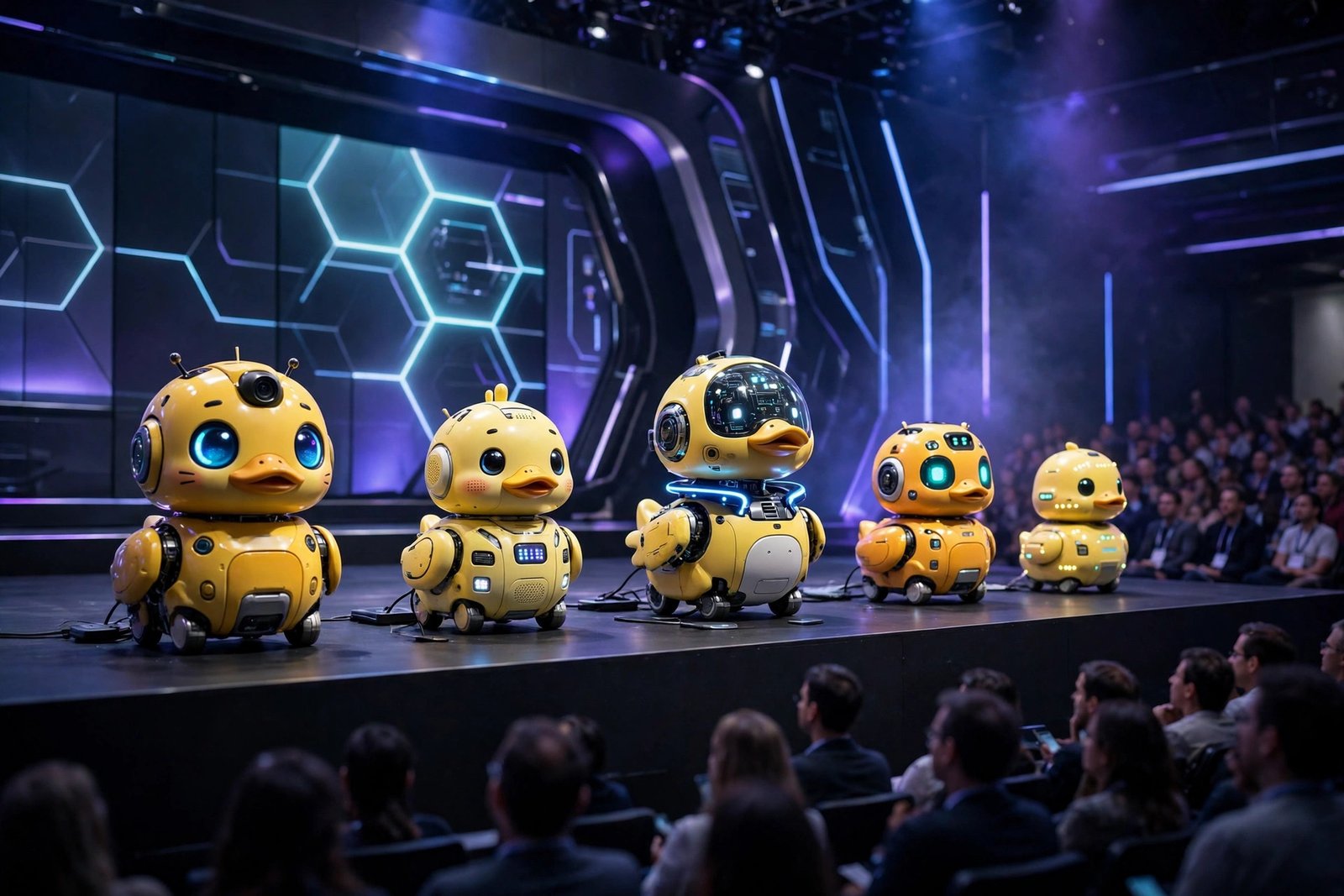
Picture this: one of the most powerful men in artificial intelligence walks onto a stage in Berlin, and the audience does not gasp at a new chip. They gasp at four tiny robot ducks waddling toward him, stomping their little feet and making chirpy, robot-like sounds. That is exactly what happened when NVIDIA Microduck robots stole the show at GTC Berlin 2026, turning a serious technology keynote into one of the most shareable moments of the year.
The clip spread fast, and for good reason. It was funny, it was strange, and it was strangely moving. Here were machines that fell over, got distracted, and needed a pep talk, just like toddlers on their first day at school. Yet behind the cuteness sat a serious idea that could change how robots are built, trained, and sold: teach a robot in a virtual world first, then let it walk in the real one.
By the next day, preorders had passed 20,000 units, according to Hugging Face chief executive Clem Delangue, as reported by TechCrunch. The little ducks, which had been a niche product for developers, were suddenly being talked about as a possible Christmas hit. Whether they become the hottest toy of the season or not, they have already done something remarkable: they made the abstract idea of physical AI feel real, small, and touchable.
NVIDIA Microduck Robots Take the Stage in Berlin
Four Microducks walked onto the stage on their own during NVIDIA chief executive Jensen Huang’s keynote at GTC Berlin on Wednesday evening, October 21, 2026, and gathered in front of him. The moment came near the end of the keynote, and it quickly became the part everyone remembered.
Huang put the robots through a short routine. First, he asked them to sit, then to stand up again. Then came the moment that made the audience laugh: nap time. Three of the robots flopped down almost immediately. The fourth kept walking for a few more steps, as if it had not heard, or had simply decided it was not tired yet, before finally lying down beside the others.
Reuters coverage of the moment, as summarized by Dealroom, captured Huang telling the distracted duck to pay attention and stay focused. It was a joke, but it landed because it felt human. The audience was not watching a perfect machine execute a perfect program. They were watching four small robots try, stumble, and mostly succeed, and that imperfection made the demo feel alive.
Huang laughed, encouraged the group to stand up again, and carried on. The robots, for their part, did what robots in demos rarely do: they behaved like characters, not appliances. That is a big part of why the video traveled so far, so fast.
What Are NVIDIA Microduck Robots?
Microduck is an open-source robot platform built by Pollen Robotics, a Bordeaux-based robotics team owned by Hugging Face. Hugging Face acquired Pollen Robotics in April 2025, and NVIDIA agreed in September 2026 to buy Hugging Face for about $12.9 billion, according to Dealroom. That chain of ownership is part of why a tiny duck ended up on stage with the head of NVIDIA.
Each Microduck stands about 25 centimeters tall, roughly 10 inches, and weighs less than 800 grams, under two pounds. It is a biped, meaning it walks on two legs, and it carries 15 motors spread across its legs, head, and neck. It also has a camera, a depth sensor, and a beak that can pick up small objects.
The robot ships with pre-trained moves learned in simulation, including walking, sitting, standing, kicking, grabbing objects with its beak, roller-skating with attachments, and getting back up after a fall. It also makes its own little creature sounds, with each robot generating its own voice the first time it wakes up, according to coverage of the launch.
Microduck is not quite a toy and not quite a laboratory instrument. It sits in between. Out of the box, it can be driven with a game controller, which makes it fun to play with. Underneath, it is a serious learning tool, built for students, researchers, and developers who want to experiment with how machines learn physical skills. That dual identity is central to its appeal.
How the Robots Learned to Walk, Sit and Nap
Before the robots appeared on stage, Huang showed a video explaining how an AI agent trained a Microduck. The process, as described by NDTV and Moneycontrol, started in a virtual world. An AI agent designed a training course and tested a virtual version of the robot using NVIDIA’s Isaac Sim simulation tool and its Isaac Lab training framework, along with the Newton physics engine.
The heavy training work was then carried out on cloud servers, using NVIDIA supercomputers. After that, the results were checked on an RTX Spark laptop before being transferred to the physical robot. Huang summed it up on stage by telling the robots they were created on RTX Spark, trained in the cloud on NVIDIA supercomputers, and taught their skills using RTX Spark and a digital twin.
This approach is known as sim-to-real transfer, and it matters for a simple reason: training a robot only on real hardware is slow, expensive, and hard on the hardware. Robots fall down. Motors wear out. Every failed attempt costs time and money. In simulation, a virtual robot can fall down thousands of times without breaking anything, and the lessons it learns can then be carried over to the real machine.
For years, that transfer was the hard part for NVIDIA Microduck robots and for larger machines alike. A policy that worked perfectly in a simulation would often fail in the real world, because the real world has friction, wobble, and wear that simulations only approximate. The Microduck demo was presented as evidence that the gap is narrowing, at least for a small, light robot with a well-understood body. A joint tutorial from NVIDIA and Pollen Robotics researchers, reported by Tech Times, described a walking policy trained entirely in simulation that transferred to the physical $399 robot without hardware-specific tuning.
That does not mean every robot problem is solved. It does mean the workflow is becoming accessible. A student or a small team can now train a behavior in simulation, test it, and watch it run on a real robot, without owning a fleet of expensive machines.
Why 20,000 Preorders Matter
Preorders for Microduck opened on August 27, 2026, at an introductory price of $399 before taxes and shipping. TechCrunch reported on October 23, 2026, that preorders had surpassed 20,000 units by the day after the Berlin demo, citing a post on X by Hugging Face’s Clem Delangue. Dealroom reported the same milestone, noting that the surge followed the keynote.
It is worth being precise about what that number means. Preorders are reservations, not final sales, and the figure comes from Hugging Face itself. Shipping tens of thousands of legged robots in about two months is a much harder job than taking orders, as Dealroom itself cautioned. Still, the speed of the surge is striking. A niche robotics platform became a mainstream talking point overnight, largely because of a 30-second nap.
The first deliveries are targeted before Christmas 2026 in North America and Europe, according to Pollen Robotics and multiple reports, including TechRepublic. That timing is no accident. A small, cute, trainable robot is an obvious gift, and TechCrunch openly asked whether Microduck could become the hottest toy for Christmas. Delangue, according to TechCrunch, thought it might end up being the best-selling robot of the year, and possibly not even for kids, since promotional videos show adults playing with them too.
Demand has already pushed later orders back. The Robot Radar reported that new orders placed after the surge should expect a wait of four to six months, which would mean spring 2027 for those buyers. If you are thinking of ordering one as a gift, the honest advice is to check the current delivery estimate before you promise it to anyone.
There is also a business story here. Hugging Face’s earlier consumer robot, Reachy Mini, was a desktop robot. Microduck is its more mobile successor, focused on locomotion and learning. The preorder surge suggests there is a real market for robots that people can program, not just robots that perform a fixed set of tricks.
Open Source, Teachable and Surprisingly Practical
One of the most important details about Microduck is also one of the easiest to misunderstand. Pollen Robotics describes the robot as open source, but the openness applies to software, not hardware. Reports on the launch note that the control software is published under the Apache 2.0 license, while the mechanical and electronic design files are not open. In plain language, you can change how the robot behaves, but you cannot freely manufacture your own copy of its body.
For most buyers, that distinction will not matter much. What matters is the ability to train new tricks and share them with the community. Pollen says owners can train their robots with new behaviors and then share those behaviors with others. That turns each Microduck into a small experiment that can benefit every other owner.
Think about what that means in practice for owners of NVIDIA Microduck robots. A teacher could train a Microduck to walk a simple obstacle course for a classroom demo. A student could teach it to pick up a small object and bring it back. A hobbyist could try to improve its balance on uneven ground. Each success, if shared, becomes a starting point for someone else, rather than a trick locked inside one machine.
The robot’s hardware supports that kind of experimentation. Beyond its 15 motors, it carries a camera, a compact LiDAR-style depth sensor, motion sensors, microphones, a speaker, Wi-Fi, and Bluetooth. It runs on a removable battery reported to last about an hour, depending on use. It is not a powerhouse, and it is not meant to be. Its job is to be cheap enough, tough enough, and open enough that people can afford to experiment with it.
There are limits, of course. A one-hour battery means sessions are short. A small, light body means it cannot carry much or handle rough terrain like a larger robot. And a $399 price, while low for a bipedal robot, is still real money, especially once taxes and shipping are added. None of that takes away from the achievement. It simply sets honest expectations.
What NVIDIA Microduck Robots Mean for Physical AI
Physical AI is the idea that artificial intelligence should not live only in chat windows and image generators. It should also live in machines that move through the real world, see it, touch it, and respond to it. That is a much harder problem than generating text, because the real world does not wait, does not rewind, and does not forgive a bad step.
Huang used the Berlin demo to argue that Europe’s engineering base gives it an edge in physical AI and robotics, according to Dealroom. Pollen Robotics itself was founded in 2016 as a spinout from INRIA, the French national research institute for digital science. The Microduck story, in that telling, is not just about a cute robot. It is about a European robotics team, backed by an AI platform, showing its work on a stage run by the world’s most valuable chip company.
For readers who do not follow robotics, the takeaway is simpler. The same techniques that let a tiny duck learn to walk in simulation are the techniques being explored for warehouse robots, helper robots, and eventually humanoid robots. The duck is a low-stakes, low-cost place to learn those techniques. If the workflow works at $399, it can be adapted, tested, and improved far more quickly than if every experiment required a machine costing tens of thousands of dollars.
That is also why the demo resonated beyond technology circles. People do not need to understand reinforcement learning to understand a robot that tries to nap and gets distracted. They can see, in a few seconds, what learning looks like when it happens in a body. The duck makes an abstract research field feel concrete, and concrete ideas are the ones people remember, share, and talk about at dinner.
Curiosity is, after all, the point of this blog. If you enjoy stories where the strange and the technical collide, you may also like our look at the Pentagon UFO files and the triangular craft mystery, and our piece on the D.B. Cooper ransom money auction. Both start with a small, strange detail and follow it to a much bigger question, just like this one.
Key Takeaways
- Four Microducks walked on stage during Jensen Huang’s GTC Berlin keynote on October 21, 2026, and performed sit, stand, and nap commands on cue, mostly.
- Each robot is about 25 centimeters tall, weighs under 800 grams, has 15 motors, and ships with pre-trained moves learned in simulation.
- Preorders opened August 27, 2026, at $399 before taxes and shipping, and passed 20,000 units the day after the Berlin demo, according to Hugging Face.
- First deliveries are targeted before Christmas 2026 in North America and Europe, but later orders may wait months.
- The software is open source, so owners can train and share new tricks, while the hardware design itself is not open.
- The serious point behind the cute demo is sim-to-real training: learn in a virtual world, then transfer the skill to a real robot.
Conclusion
The NVIDIA Microduck robots did not need to be perfect to be persuasive. In fact, their imperfections were the persuasion. A robot that falls over, wanders off, and needs to be told to pay attention is a robot that feels like it is learning, not just executing. That feeling is what turned a keynote demo into a viral moment, and a viral moment into 20,000 preorders.
Whether Microduck becomes a Christmas bestseller, a classroom staple, or simply a beloved footnote in robotics history, it has already made its point. The future of robots may not arrive as a giant humanoid striding across a stage. It may arrive as something much smaller, much cheaper, and much cuter, waddling toward us one careful step at a time, and occasionally stopping for a nap.
Frequently Asked Questions
What are Microducks?
Microducks are small, two-legged robots made by Pollen Robotics, the Bordeaux robotics team owned by Hugging Face. They are designed as an open-source platform for developers and students who want to teach machines physical skills.
How big is a Microduck?
Each Microduck stands about 25 centimeters tall, roughly 10 inches, and weighs less than 800 grams, or under two pounds. It is small enough to hold in your hands, yet it walks, sits, and gets back up after falling.
How much does a Microduck cost?
Preorders opened on August 27, 2026, at an introductory price of $399 before taxes and shipping. Later orders may face a longer wait, with some reports pointing to a wait of several months for new orders.
Can owners teach a Microduck new tricks?
Yes. That is the central idea. Owners can train new behaviors in simulation and share them with the community, building on the pre-trained moves the robot ships with, such as walking, sitting, and standing.
When will the first Microducks be delivered?
The first deliveries are targeted before Christmas 2026 in North America and Europe. That is a target rather than a guaranteed date, and demand after the Berlin demo has pushed later orders further back.