
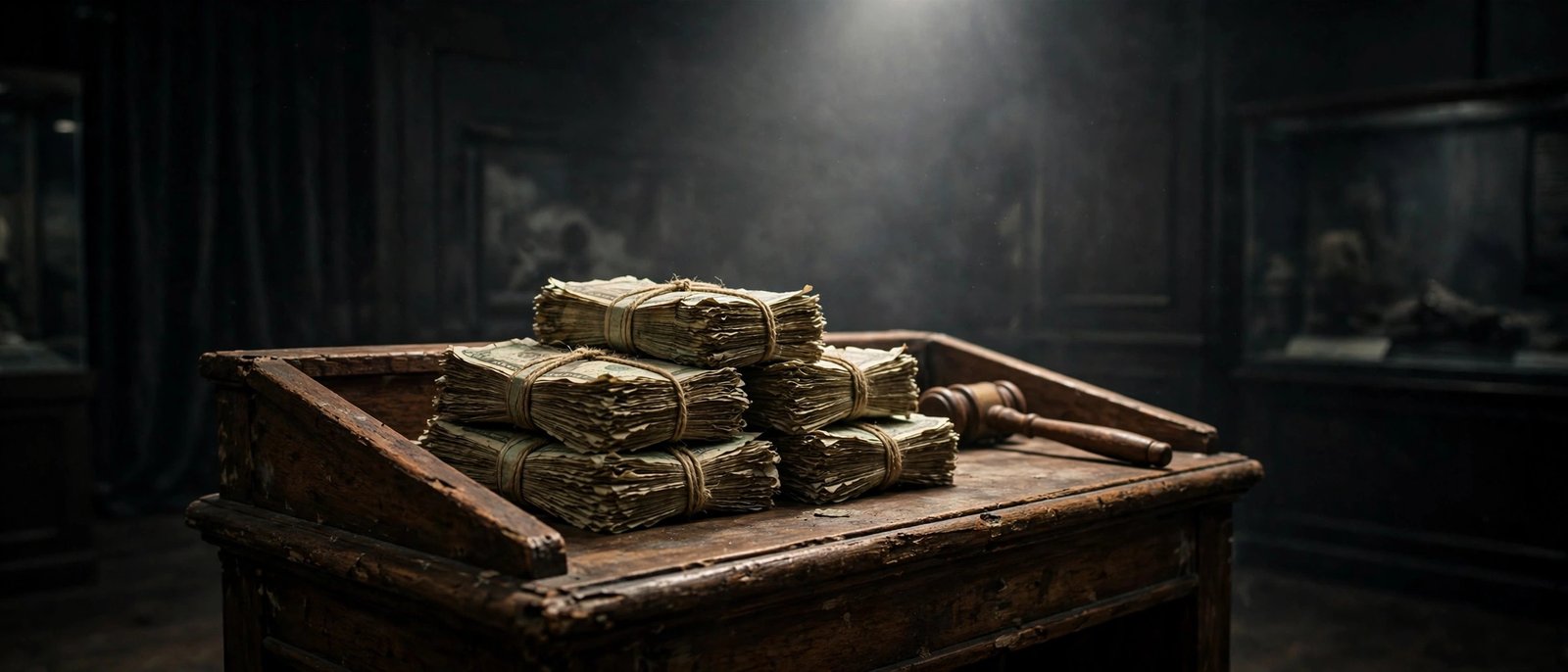
Somebody just paid $134,200 for a torn twenty-dollar bill. Not a crisp collector’s note. Not a rare misprint. A dirty, tattered scrap of currency, fished out of river sand nearly half a century ago, missing pieces, stained by time and water. And yet collectors fought over it like treasure, because this was no ordinary twenty. It was part of the ransom handed to D.B. Cooper, the only skyjacker in American history who was never caught. The D.B. Cooper ransom money auction at Heritage Auctions in October 2026 turned one fragile fragment of that infamous cash into a six-figure artifact, and it tells us something wild about how America’s greatest unsolved hijacking still grips the public imagination.
The Night D.B. Cooper Jumped Into History
On the afternoon of November 24, 1971, the day before Thanksgiving, a calm, middle-aged man in a dark suit and sunglasses bought a one-way ticket at Portland International Airport under the name Dan Cooper. He boarded Northwest Orient Airlines Flight 305, a Boeing 727 bound for Seattle, ordered a bourbon and soda, and settled into seat 18E. Shortly after takeoff, he handed a flight attendant a note claiming he had a bomb in his briefcase.
What followed was the most audacious ransom demand in aviation history. Cooper asked for $200,000 in cash and four parachutes, to be delivered when the plane landed in Seattle. The airline complied. Cooper released the passengers, kept a small crew, and ordered the pilots to fly south toward Mexico at low altitude and low speed, with the landing gear down and the cabin depressurized. Somewhere over the dense, freezing forests of the Pacific Northwest, near Ariel, Washington, he lowered the plane’s rear airstair, strapped on a parachute, and leapt into the rainy night with the money strapped to his body. He was never seen again.
The FBI launched one of the longest investigations in its history. More than 800 suspects were checked. The bureau chased leads for 45 years before closing the active case in 2016, making it the only unsolved air piracy case in American aviation. No body was ever found. No parachute was ever found. And of the $200,000, only one small chunk ever surfaced.
The $200,000 Ransom in Twenties
The ransom Cooper demanded was not a neat briefcase of hundred-dollar bills. It was 10,000 twenty-dollar bills, bundled together, weighing about 21 pounds. The serial numbers were all recorded by the FBI, and the bills were a mix of Series 1969 notes. Because every serial number was catalogued, the money was effectively poisoned: Cooper could not spend large amounts of it without risking detection, and none of the recorded bills ever turned up in circulation. That fact alone has fueled decades of debate about whether Cooper survived the jump at all.
The parachutes came from a local skydiving school. In a twist Cooper researchers still argue about, one of the two front parachutes he was given was sewn shut, a training rig meant for classroom demonstration, not jumping. If Cooper grabbed that one by mistake, the consequences would have been grim. The money bundles were tied to his body or stuffed into a bag, depending on which witness account you trust. Everything about the jump suggested a man with some knowledge of aviation but a shaky understanding of parachuting, a contradiction at the heart of the case.
The Boy on the Beach: Tena Bar, 1980
For nine years, not a single bill from the ransom appeared. Then, in February 1980, eight-year-old Brian Ingram was digging a fire pit on a sandy stretch of the Columbia River called Tena Bar, near Vancouver, Washington, when his fingers brushed something strange in the sand. He had found three bundles of decaying twenty-dollar bills, rubber bands still clinging to them, totaling $5,800. The serial numbers matched the ransom list.
The discovery remains one of the strangest chapters of the case. Tena Bar is miles from where Cooper is believed to have jumped, and investigators have never agreed on how the money got there. Did Cooper lose the bundles during the jump, and did river currents carry them downstream over nine years? Did he land, bury some of the money, and flee? Or did the bills float down from a crash site in the washougal River watershed? The FBI, the Ingram family, Northwest Orient Airlines, and the airline’s insurer all fought over the find in court, and a 1986 settlement divided the battered bills among the parties. Some went to the FBI as evidence. A share went to the Ingram family. And those surviving notes, fragile as wet newspaper, became the most coveted relics in American true-crime collecting.
The bills were in terrible shape. Years in the river had rotted many of them beyond recognition. Yet even fragments carried the magic of the case: serial numbers that matched the FBI’s ransom list, Treasury seals, and the portrait of Andrew Jackson, tangible proof that D.B. Cooper’s money was real and that at least some of it had been out there in the wild all along.
Why the D.B. Cooper Ransom Money Auction Smashed Expectations
Fast-forward to October 2026. Heritage Auctions, one of the world’s premier auction houses, included a piece of the Tena Bar money in its GACC U.S. Currency Signature Auction in Dallas, a sale packed with rare notes and coins. The D.B. Cooper ransom money auction lot was a largely intact $20 fragment from the Ingram discovery, measuring about 4.5 inches wide and 1.5 inches tall, bearing the critical serial-number details confirming its origin along with the Treasury and District seals, Jackson’s portrait, and the signature of then-Treasury Secretary David M. Kennedy.
When the hammer fell, the damaged bill had sold for $134,200. To put that in perspective, a much smaller fragment of Cooper cash, showing only the Federal Reserve District Seal, fetched $4,000 in a similar Heritage sale back in 2024. The 2026 result was more than thirty times higher, a staggering premium that shows just how much the story matters. Heritage’s currency specialists noted that the auction drew strength across many collecting specialties, but the Cooper note stood out as a piece of American history that money alone cannot usually buy.
Why did this fragment command such a price? Rarity is part of it: this is one of the very few pieces of physical evidence ever recovered from the ransom. But the real driver is narrative. Collectors were not bidding on paper and ink. They were bidding on the only unsolved skyjacking in U.S. history, on a rainy night in 1971, on a man who outsmarted the FBI and vanished into legend. The bill’s near-complete state, with so many identifying details intact, made it the crown jewel of Cooper collectibles.
Inside the D.B. Cooper Ransom Money Auction: A Rare Fragment
What exactly did the winning bidder take home? According to Heritage Auctions’ sale records, the note is a Series 1969 $20 Federal Reserve Note from the Tena Bar discovery, the bundle of cash young Brian Ingram pulled from the Columbia River sand in 1980. It survived river, rot, court battles, and decades in private hands to reach the auction block in Dallas, where it became one of the headline lots of the October 6-9, 2026 sale.
The fragment’s condition tells the story of its journey. The edges are irregular, the paper is discolored, and portions are missing entirely, damage consistent with years buried in wet sand. Yet the essential features survived: the seals, the serial number area tying it to the ransom list, the portrait, and the Treasury signatures. For Cooper researchers, those details are everything. Each surviving bill is a forensic artifact, a data point in the decades-long argument about where Cooper landed and how the money traveled. The buyer has not been publicly identified, and given the price, the note is presumably headed for a vault, a museum-grade display, or a very serious private collection.
This was not the first time Tena Bar bills crossed the auction block. Back in September 2008, fifteen of the recovered bills were sold through Heritage Auction Galleries in Dallas for $37,000, a price two to three times higher than expected at the time. Even then, some notes still carried the initials of investigators who had examined them after the discovery. The 2026 sale shows the legend has only grown: a single well-preserved fragment now commands nearly four times what fifteen bills brought eighteen years ago.
The Theories That Never Died
The auction’s frenzy is inseparable from the mystery itself, because nobody knows who D.B. Cooper was or what happened to him. The theories are the stuff of American folklore:
- He died on impact. The jump conditions were brutal: night, rain, freezing wind, wooded terrain, a possibly unfamiliar parachute rig. Many FBI agents believed Cooper never survived the landing, which would explain why the money never circulated.
- He was an insider. Cooper knew about the 727’s rear airstair, knew the plane could fly slow and low with the gear down, and chose parachutes and a flight path with confidence. Some researchers argue he was a former military paratrooper, an airline employee, or a cargo specialist.
- He lived to spend it. A smaller camp insists Cooper survived, buried or stashed the bulk of the money, and lived quietly, perhaps spending the cash slowly far from the Pacific Northwest. The problem: with every serial number recorded, no ransom bill ever appeared in circulation, a fact that haunts this theory.
- The money at Tena Bar tells the tale. The location of the $5,800 find has spawned its own sub-field of Cooper research, with competing models of river hydrology, dredging operations, and flood events used to argue whether the bundles drifted there naturally or were placed there by human hands.
The FBI’s 2016 decision to close the active investigation did not end the theorizing; if anything, it transferred the case to citizen sleuths, who continue to analyze everything from the tie particles found on Cooper’s clip-on tie to the diatom species on the recovered bills. The auction result proves the public is still paying attention, literally.
What the Money Teaches Us
There is a reason a ruined twenty can sell for $134,200 while a pristine one is worth twenty dollars. Value, in the world of historical artifacts, is a story made physical. The D.B. Cooper ransom money auction worked because the object on the block was not currency at all, but evidence: evidence of the boldest crime in aviation history, of a man who beat the system and disappeared, of a mystery the FBI could not solve in 45 years.
It also reminds us how fragile history is. The Tena Bar bills survived by luck, a boy digging in the right patch of sand at the right moment. Had Ingram dug a few feet to the left, or visited a different weekend, the money might have dissolved into the river forever, and the 2026 auction would never have happened. Every artifact is an accident of survival.
Conclusion
Fifty-five years after a man in sunglasses jumped out of a Boeing 727 into a rainy night, his money is still making headlines. The $134,200 sale of a single battered $20 bill shows that D.B. Cooper is not fading into history; he is appreciating like a blue-chip asset. Somewhere, perhaps, the rest of the $200,000 still lies buried in a Pacific Northwest forest, waiting for its own Brian Ingram. Until then, the fragments we have will keep commanding fortunes, because they are the closest anyone will ever get to touching the greatest unsolved skyjacking the world has ever known.
Curious about other history that sounds too strange to be true? Read about the man who survived two atomic bombs, explore historical coincidences that feel made up, and don’t miss facts that feel fake but are 100 percent real.
Sources: Coast to Coast AM: Piece of D.B. Cooper Ransom Money Sells for Massive Sum at Auction; Coast to Coast AM: This Week’s Weird News (10/16/26); Times of India: the 1980 Tena Bar discovery and 2008 auction.
How much did the D.B. Cooper ransom money sell for at auction?
A largely intact $20 fragment from the D.B. Cooper ransom sold for $134,200 at Heritage Auctions’ GACC U.S. Currency Signature Auction in Dallas, held October 6-9, 2026. The bill came from the $5,800 in ransom cash discovered on the Columbia River’s Tena Bar in 1980.
What happened in the D.B. Cooper hijacking?
On November 24, 1971, a man calling himself Dan Cooper hijacked Northwest Orient Flight 305, demanded $200,000 and four parachutes, then parachuted from the plane over the Pacific Northwest with the ransom. He was never seen again, making it the only unsolved air piracy case in U.S. history.
Who found the D.B. Cooper ransom money?
In February 1980, eight-year-old Brian Ingram found three bundles of decaying $20 bills totaling $5,800 while digging on Tena Bar along the Columbia River near Vancouver, Washington. The serial numbers matched the FBI’s ransom list. It remains the only recovered portion of the $200,000.
Why is D.B. Cooper ransom money worth so much?
Only $5,800 of the $200,000 ransom was ever recovered, making surviving bills extraordinarily rare. Combined with the fame of America’s only unsolved skyjacking, fragments with verifiable ransom serial numbers command huge premiums. A smaller fragment sold for $4,000 in 2024, while the 2026 near-complete note reached $134,200.
Did the FBI ever solve the D.B. Cooper case?
No. After investigating for 45 years and checking more than 800 suspects, the FBI closed its active investigation in 2016 without identifying Cooper. Citizen researchers continue to study the case, analyzing evidence like tie particles and the Tena Bar bills.