
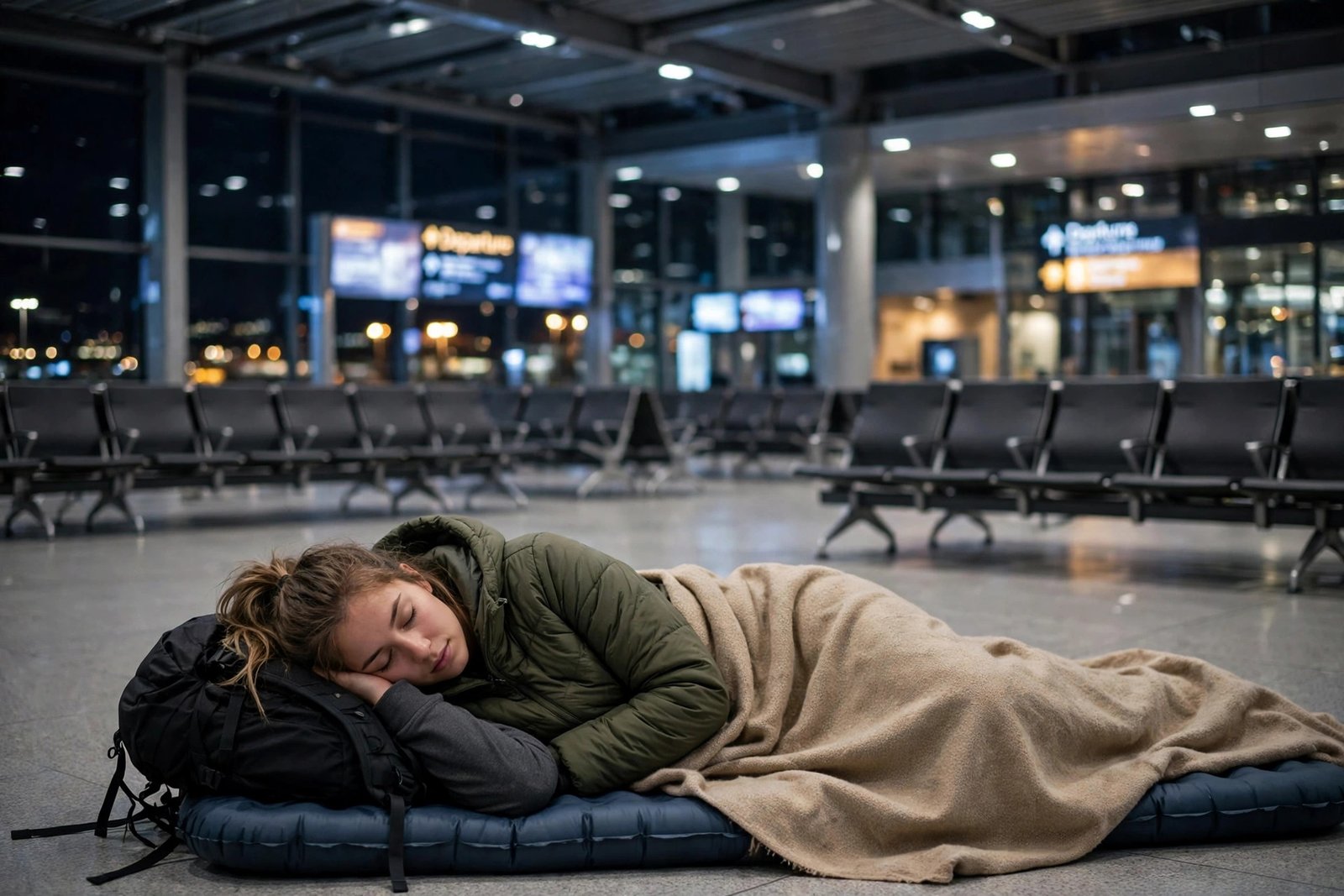
Picture this: your flight lands late at night in a city you did not plan to sleep in. The hotels nearby cost more than your plane ticket. The streets outside are dark and unfamiliar. Most people would sigh, open a booking app, and pay up. Santeon Brown did something else entirely — she unrolled a sleeping pad on the terminal floor, pulled a sheet over herself, put on her bonnet, and went to sleep. On purpose. And then she posted about it on TikTok, where the video of a woman who sleeps on airport floors on purpose has now been watched roughly 725,000 times.
The 29-year-old Los Angeles actor and nanny has become the internet’s most talked-about budget traveler after revealing that she deliberately sleeps on airport floors instead of booking hotels — not because she got stranded, not because she missed a connection, but because she genuinely prefers it. “I didn’t get stuck, I planned it,” she says in the clip, “and it was a good decision and a good time.”
Her story has split the internet in two. Half the comments call her a genius; the other half call her unhinged. But love it or hate it, her viral moment says something fascinating about how a new generation thinks about money, comfort, and what a “vacation” is even supposed to look like. Here is the full story.
Who Is Santeon Brown, the Woman Who Sleeps on Airport Floors?
Santeon Brown is a 29-year-old actor and nanny based in Los Angeles, and by her own account, she is also an avid camper — which turns out to be an important detail. According to the New York Post’s coverage of her story, published on October 21, 2026, Brown has slept in airports multiple times before. This was not a first-time experiment born of desperation. It was a seasoned practitioner doing what she does best.
She is also, notably, not someone who couldn’t afford a hotel. That is what makes the story so interesting. This is not a tale of a stranded traveler with no options. It is the story of a woman who looked at the price of a San Francisco hotel room, looked at the price of her flight, did the math, and decided the math did not make sense.
In an exclusive interview with People, Brown explained her thinking with the kind of calm practicality that has made the video so shareable: “I feel like people sleep in the airport all the time, I just feel what’s crazy about it is that I planned it.” She is right about the first part, at least — stranded travelers doze in terminals every single night. What made her different was the intentionality. Nobody forced her onto that floor. She chose it.
The $20 Flight That Started It All
The whole saga began with the kind of impulse purchase that defines modern travel: a spontaneous, absurdly cheap flight. Brown booked a $20 one-way ticket from Los Angeles to San Francisco — a whim, a deal too good to pass up, the sort of fare that makes you invent a reason to travel.
She arrived at San Francisco International Airport at night, with no concrete plans for where to stay. And here is where the story takes its turn. Rather than scrambling for a last-minute hotel in one of America’s most expensive cities, Brown simply… stayed. She documented the experience on her phone, filming herself inside the terminal for the TikTok video she posted on October 15.
“I just stayed here overnight,” she says in the clip, grinning. “I didn’t get stuck, I planned it, and it was a good decision and a good time.”
The economics of the decision are hard to argue with. A hotel room in San Francisco on short notice can easily run well over a hundred dollars — more than five times what she paid for the flight itself. As a working actor and nanny, Brown is no stranger to stretching a dollar, and the idea of spending that kind of money for a few hours of unconsciousness simply did not add up. As she put it in the video: “We got in at night, so it didn’t make sense to spend money on a hotel just to sleep.”
The fact that she sleeps on airport floors by choice — rather than out of desperation — is exactly what made the video spread. A stranded traveler is a sad story. A traveler who looked at the options and picked the floor on purpose is a story story.
It is the kind of ruthless travel math that would make any budget traveler nod along. Why pay for check-in, a room you will barely see, and an early checkout when all you actually need is a flat surface and a few hours? Her logic is the same logic that powers the entire budget-travel movement — she just took it further than most people are willing to go. It is the travel equivalent of the jaw-dropping journeys people share online, like the man who traveled 2,000 kilometers to meet his AI girlfriend — stories where the extremity of the choice is the whole point.
Why She Sleeps on Airport Floors Instead of Hotels
In her video and in her interview with People, Brown laid out three clear reasons for her decision. They are worth taking seriously, because together they form a surprisingly coherent philosophy of travel.
Reason one: the money. This is the obvious one, and Brown does not dress it up. Arriving late at night for a short stay, a hotel room is mostly a very expensive place to be unconscious for a few hours. “We got in at night, so it didn’t make sense to spend money on a hotel just to sleep,” she said. The flight cost $20. A hotel would have cost many times that. The equation solved itself.
Reason two: safety. This is the reason that surprised the most people — and the one Brown feels strongest about. Staying inside the airport, she argues, is actually safer than venturing out into an unfamiliar city after dark, especially for a woman traveling alone. Her logic: once you are past the TSA checkpoint on the secured side of the airport, “everyone’s been vetted, you know no one has any weapons or anything crazy.” It is an argument that flips the usual assumption on its head. The airport floor, in her telling, is not the sketchy option. The sketchy option is wandering around a strange city at midnight looking for your hotel.
Reason three: it is genuinely fun. Brown described the experience as “kinda fun,” “relaxing,” and “novel.” There is an adventure to it — a small rebellion against the idea that every trip needs a reservation, an itinerary, and a turndown service. For someone who camps for fun, a terminal floor with a sleeping pad is not suffering. It is just camping indoors, with better lighting and free Wi-Fi.
That third reason is the one that separates Brown from the average stranded passenger. She is not enduring the airport; she is enjoying it. And that enjoyment is visible in the video, which is a huge part of why it went viral. Nobody shares a video of someone looking miserable. People share videos of someone having the time of her life in a place where nobody is supposed to have fun.
What the Internet Thought: 725,000 Views and Counting
Brown admitted she was surprised by the response. The video, posted October 15, climbed to around 725,000 views — and the comment section turned into a full-blown debate about money, comfort, aging, and what counts as a reasonable life choice.
On one side: the believers. “Some people thought it was insane or dirty,” Brown told People, “but there were also people that were very excited about it, or like, ‘Oh, I haven’t thought of this.’” For younger travelers, gig workers, and anyone who has winced at a hotel bill lately, the idea of someone who cheerfully sleeps on airport floors to save a buck felt like permission — proof that you can opt out of the expensive default and still have a good time.
On the other side: the skeptics, and they were loud. “As a flight attendant… hell to the naw,” one commenter wrote — a verdict from someone who presumably knows exactly how clean those floors are. “I did this once and it was one of the worst nights of my life,” another shared. And then there was the comment that probably stung the most: “This is all fun until you’re over the age of 35. My back would hurt like hell not having a bed to sleep in.”
That last comment gets at something real. Brown is 29, an avid camper, and physically comfortable sleeping on hard surfaces. The airport floor is not a universal solution — it is a solution for a specific kind of person at a specific stage of life. The debate in her comments is really a debate about that: at what point does saving money stop being clever and start being miserable? Everyone draws the line somewhere. Brown just draws it further out than most.
It is worth noting how the coverage itself became part of the story. The New York Post picked it up on October 21 with the gloriously tabloid headline about a California woman who “prefers sleeping on airport floors to hotel beds,” and People ran an exclusive interview digging into her reasoning. Within a week, a spontaneous TikTok had become a full media cycle — the classic viral pipeline, from phone video to national headlines in under seven days. It is the same pipeline that turns unlikely animal stories into global news, like Luna, the dog who survived 34 days in Yellowstone — an ordinary moment, filmed honestly, that the internet decides it cannot stop thinking about.
Her Airport Sleep Kit: How She Actually Does It
One detail that separates Brown from a truly chaotic traveler: she came prepared. This was not a collapse onto cold tile in despair. According to the New York Post, her kit for the night included a sleeping pad, a sheet, and her bonnet — the essentials for turning a terminal floor into a workable bed.
The sleeping pad is the key piece of equipment. Anyone who has tried to sleep directly on an airport floor knows the problem is not just hardness — it is cold, and it is the kind of hard that finds every bone in your body. A pad solves both. The sheet adds a layer of cleanliness between you and the floor. And the bonnet? That is the detail that makes the whole thing feel human and real — she protected her hair routine even while sleeping in public. Priorities.
Her background as an avid camper explains everything about the kit. Campers already own sleeping pads. They already know how to sleep on the ground. They already have the mindset that a bed is a luxury, not a requirement. Brown did not invent a new skill for this trip; she just applied an old one in a new location. If you have ever wondered what separates people who could sleep in an airport from people who actually do, it is mostly this: owning the gear and having done it before.
For anyone morbidly curious about trying it, Brown’s implicit advice is clear from her description of the night as “relaxing”: preparation is everything. The people who have terrible airport-sleep stories are usually the ones who did not plan for it — no pad, no layers, no eye mask, trying to sleep upright in a chair designed by someone’s enemy. Brown planned it, packed for it, and picked her spot. That is the difference between an adventure and an ordeal — and it explains why she sleeps on airport floors comfortably while unprepared travelers just suffer through the night.
Is Sleeping in an Airport Actually a Thing?
Here is the part of the story that might surprise you: Brown is far from alone. Sleeping in airports is a genuine, long-running subculture among budget travelers — big enough to have its own guidebooks, rankings, and lore.
The website SleepingInAirports.net has been collecting traveler reports for years, ranking airports by how sleep-friendly they are — which terminals have the good benches, where the quiet corners are, which airports will wake you up and shoo you out. Seasoned budget travelers trade tips the way foodies trade restaurant recommendations. Some airports are legendary for it: Singapore’s Changi is practically a resort, while others are, to quote one memorable traveler report, places you should not even think about attempting.
Travel writers have documented the practice for decades. The travel blog Live and Let’s Fly famously chronicled a night spent sleeping on a chair at Helsinki Airport after a 2 a.m. arrival — no hotel reservation, just a coat, headphones, and a few hours to kill before a 5:30 a.m. lounge opening. The author’s verdict? A solid nap, power outlets within reach, and a hundred euros saved. Sound familiar?
The practice even has infrastructure now. Many major airports have added designated rest zones, and sleep pods — rentable by the hour — have been popping up in terminals around the world, with TikTok users reporting on them as recently as mid-2026. The line between “sleeping rough in the terminal” and “paying for a pod” is getting blurrier every year.
That said, there are real caveats, and Brown’s critics are not entirely wrong. Not every airport allows overnight stays — some smaller airports close or clear their terminals at night, and policies vary widely. Floors are genuinely dirty, no matter how you slice it; a sheet helps, but it is not a sterilization chamber. And as that viral commenter noted, age and back pain are real constraints. What works at 29 with a camper’s body might not work at 45 with a herniated disc.
The safety argument deserves a balanced look, too. Brown’s point about the secured side of the airport — that everyone past TSA has been screened — is genuinely reasonable as far as it goes. But airports are still public spaces, your belongings are still vulnerable while you sleep, and “safer than a dark unfamiliar street at midnight” is a low bar, not a guarantee. Common-sense precautions apply: keep valuables on your person, stay in well-lit areas near other people, and set an alarm.
The Takeaway: What Her Viral Night Really Says
Strip away the novelty, and Santeon Brown’s story is about something bigger than one woman’s airport nap. It is about a generation renegotiating what travel — and comfort, and money — is supposed to look like.
For decades, the default travel script was fixed: flight, hotel, rental car, repeat. Deviating from it meant something had gone wrong. Brown’s video proposes a different script, one where the hotel is optional, the terminal is a legitimate venue, and the money you save is the souvenir. It is the same impulse behind the broader “de-influencing” of travel — the growing suspicion that many of the things we are told we need are just things someone is selling us.
Is sleeping on an airport floor for everyone? Obviously not. Will most people who watched her video ever try it? Probably not. But 725,000 views suggest that a lot of people found the idea liberating — the reminder that the rules of travel are, to some extent, made up, and that opting out is always an option if you pack a sleeping pad.
And in a year when a single 4,300-mile underwater internet cable can dominate the tech news cycle, maybe it makes sense that the most relatable viral story of the month is also the simplest: a woman, a $20 flight, and a floor. No bed, no problem — as long as you planned it.