
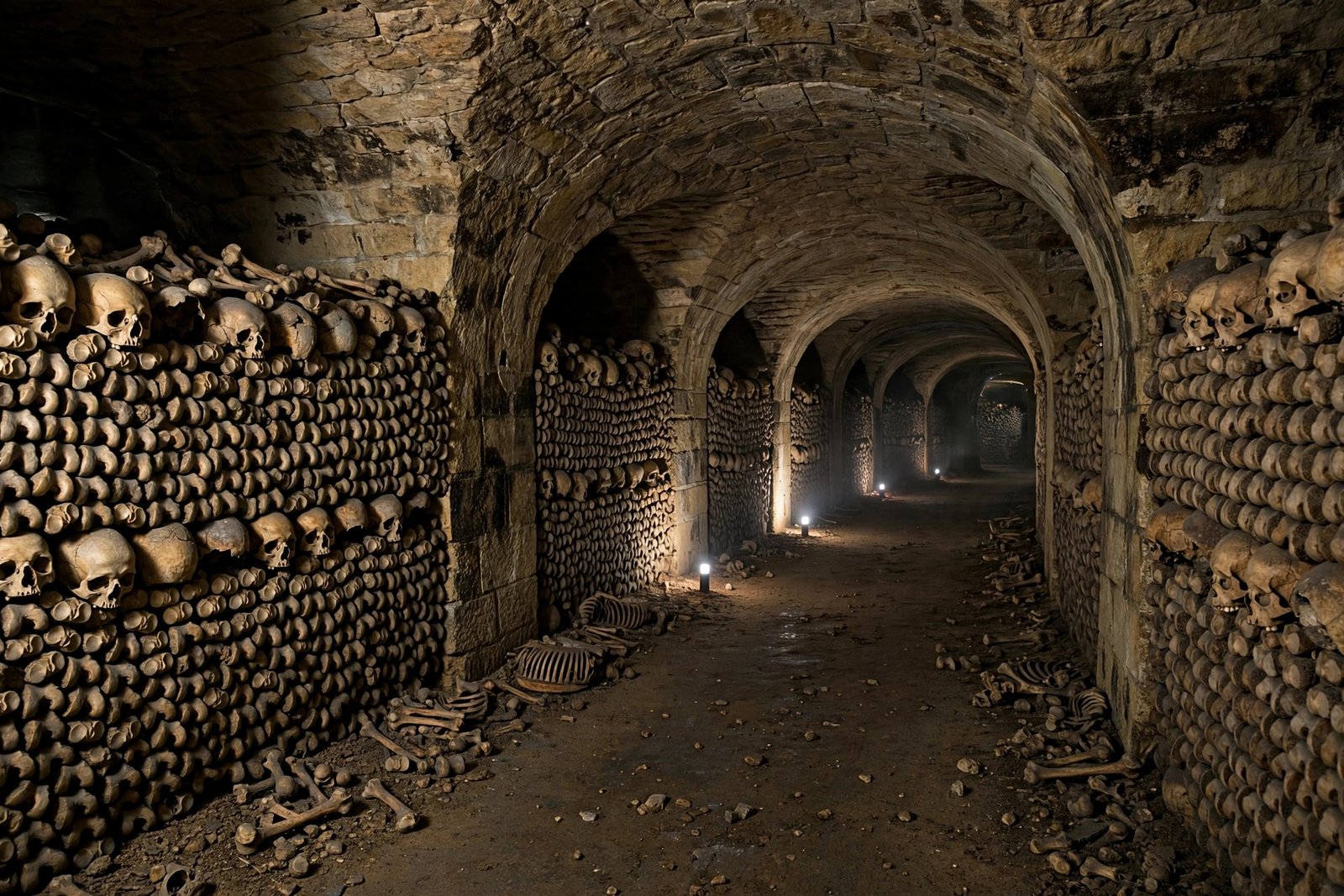
Beneath the romantic streets of Paris, under the cafes, the boutiques, and the cobblestones, lies a city of the dead. It is a place where the walls are built from human bones, where skulls stare out from carefully stacked rows, and where a sign at the entrance delivers a chilling greeting: “Halt! Here is the empire of the dead.” The Paris catacombs underground are one of the strangest attractions on Earth, a shadowy world that holds the remains of more than six million people. How did millions of Parisians end up buried beneath their own city, and why does this eerie underworld still fascinate visitors centuries later?
The answer begins not with death, but with stone. Long before the catacombs existed, the ground beneath Paris was being hollowed out by quarries. Limestone dug from these tunnels built many of the city’s grandest buildings. By the 18th century, those empty tunnels had become a problem of their own, and the city’s overflowing cemeteries were about to collide with them in one of history’s most extraordinary solutions.
Why Paris Needed the Paris Catacombs Underground
For centuries, Parisians buried their dead in cemeteries inside the city walls. The largest and most notorious was the Cemetery of the Innocents, near the bustling Les Halles market district. It had been in use since the Middle Ages, and by the late 1700s it was catastrophically overcrowded. Bodies were stacked in mass graves, and the stench drifted through the neighborhood. Residents complained of foul air and disease, and authorities began to fear a public health disaster.
The crisis came to a head in 1780, when a wall of the Cemetery of the Innocents collapsed after heavy rains, spilling corpses into nearby streets and cellars. It was a horrifying moment, but it finally forced action. The city closed the cemetery that same year and began searching for somewhere to put centuries of accumulated remains.
The solution was hiding right beneath their feet. The abandoned limestone quarries south of the city, outside the old city limits at the time, offered vast empty galleries. In 1786, the Tombe-Issoire quarries were blessed and consecrated as the Paris Municipal Ossuary. That same year, under cover of darkness, the great transfer began.
The Nighttime Processions That Filled the Tunnels
Night after night, covered wagons rolled through the streets of Paris carrying bones. Priests accompanied the convoys, reciting prayers as the remains of the city’s dead were carried to the quarry shafts near what is now Rue de la Tombe-Issoire. The first transfers came from the Cemetery of the Innocents, and over the following decades, remains from most of Paris’s parish cemeteries followed.
At first, the bones were simply piled into the galleries with little ceremony. But in the early 1800s, the ossuary was transformed. Inspector Louis-Etienne Hericart de Thury, who oversaw the quarries, ordered the bones rearranged into the striking patterns visitors see today: walls of femurs and tibias stacked in neat rows, with skulls arranged in decorative motifs, crosses, and hearts. Inscriptions and plaques mark the cemetery each section of bones came from, and poetic warnings about mortality line the walls.
Transfers continued on and off for decades, with the last major deposits arriving during the Haussmann-era rebuilding of Paris around 1860. By then, the ossuary held the remains of an estimated six million people, more than the population of Paris itself at the time.
What Visitors See Underground Today
Today, the publicly accessible route through the Paris catacombs underground covers about 1.5 kilometers of tunnels, roughly 20 meters below street level. Visitors descend 131 steps and eventually climb 112 steps back to daylight. The temperature underground hovers around 14 degrees Celsius all year, so even in summer, the tunnels are cool and damp.
The experience is deliberately unsettling and strangely beautiful. Highlights along the route include:
- The Port-Mahon sculpture, a detailed model of a Mediterranean fortress carved into the quarry stone by a soldier in the late 1700s.
- The Sepulchral Lamp, a carved stone monument in a small rotunda that once held an eternal flame.
- The Crypt of the Passion, also called the Barrel Crypt, where bones are arranged in the shape of a giant barrel.
- The bone galleries themselves, where walls of skulls and long bones stretch into the dark, each section labeled with its original cemetery.
- The Fountain of the Samaritan, a small spring-fed basin deep in the tunnels.
The catacombs have been open to the public in some form since 1809, and they now welcome nearly 550,000 visitors a year, according to the official Paris Catacombs site. Since 2013, they have been managed as one of the City of Paris Museums. If you love stories of real-life mysteries, you may also enjoy reading about another famous unsolved case on BolanPost: the DB Cooper ransom money mystery.
The Secret World Beyond the Tourist Route
Here is the twist most visitors never realize: the tourist route is only a tiny fraction of the underground network. Beneath Paris lies a vast labyrinth of old quarry tunnels, and Parisians often use the word “catacombs” to describe the whole thing. Entering the rest of the network has been illegal since 1955, but that has not stopped urban explorers known as cataphiles from venturing in.
Cataphiles have mapped hidden galleries, discovered underground chambers, and even held secret parties and art installations in the depths. Some tunnels contain graffiti, sculptures, and makeshift meeting rooms. During World War II, the French Resistance used parts of the tunnel network for secret meetings, adding another layer of history to the underground world.
The tunnels are also genuinely dangerous. Collapses, flooding, and getting lost are real risks, and explorers have died underground. The city maintains a special police unit to patrol the quarries. The romance of the secret tunnels is real, but so is the danger, which is why the legal, guided route is the only safe way to experience the underworld.
The Catacombs in Popular Culture
The catacombs have inspired writers, filmmakers, and musicians for two centuries. Victor Hugo referenced the Paris underworld in his novels, and the tunnels appear in countless horror films, thrillers, and documentaries. The idea of a hidden city of bones beneath the City of Light is irresistible to storytellers, and each retelling adds to the legend.
Yet the real story is stranger than any movie. The catacombs were not built as a tourist attraction or a horror set. They were a practical, if macabre, solution to a public health crisis, created by engineers and city officials who needed somewhere to put millions of bones. The beauty of the bone arrangements came later, when 19th-century officials decided the ossuary deserved dignity and order.
That mix of the practical and the poetic is what makes the site so compelling. It is at once a cemetery, a museum, an engineering project, and a work of art. Few places on Earth combine those identities so completely.
Planning a Visit: What You Should Know
If you ever plan to visit, a few practical tips will help. Book tickets online in advance through the official site, because time slots sell out, especially in summer. Wear comfortable shoes and bring a light layer, since the tunnels are cool and the route involves many steps. The route is not accessible for people with limited mobility, and children should be supervised closely. Photography is allowed, but flash is discouraged out of respect for the site.
Most visitors spend about an hour underground. The route is one-way, so once you descend, you follow the path to the exit near Rue Remy Dumoncel. Take your time in the bone galleries, but remember what you are walking through: the remains of real people who lived, worked, and died in Paris centuries ago.
For more jaw-dropping true stories from history and the world around us, check out BolanPost’s look at the Amelia Earhart expedition mystery, another tale where the search for answers took explorers to extraordinary places.
Takeaways: Why the Paris Catacombs Underground Still Amazes Us
- The catacombs hold the remains of more than six million people, making them one of the largest ossuaries in the world.
- They were created to solve a real crisis: overflowing cemeteries that had become a danger to public health in 18th-century Paris.
- The bones were moved at night in covered wagons, accompanied by priests, in processions that lasted for decades.
- The tourist route is only a small part of a much larger tunnel network that explorers still secretly roam today.
- The site is both a cemetery and a museum, a place where engineering, history, and art meet in the dark.
Conclusion: A City Beneath the City
The Paris catacombs underground remind us that every great city has a hidden layer. Above ground, Paris is romance, art, and light. Below ground, it is bone, stone, and silence. The millions of anonymous Parisians resting there never chose this strange afterlife, yet their bones have become one of the world’s most visited wonders. They remind every visitor of a simple truth carved into the tunnel walls: death comes for us all, but the stories we leave behind can last for centuries. If you ever find yourself in Paris, descend those 131 steps. The empire of the dead is waiting, and it has a story worth hearing.
Sources: Paris Catacombs official site history, Catacombs of Paris on Wikipedia, and Lonely Planet: Les Catacombes.
Frequently Asked Questions
What are the Paris catacombs underground?
The Paris catacombs underground are a municipal ossuary beneath Paris, France, created in former limestone quarries. They hold the remains of more than six million people, transferred from the city’s overcrowded cemeteries beginning in the late 18th century.
Why were the Paris catacombs created?
They were created because Paris’s cemeteries, especially the Cemetery of the Innocents, had become dangerously overcrowded and a public health hazard. After a cemetery wall collapsed in 1780, authorities moved the remains into abandoned quarries south of the city.
How many people are buried in the Paris catacombs?
The catacombs hold the remains of more than six million people, transferred from Paris cemeteries between the late 1700s and around 1860.
Can you visit the Paris catacombs underground?
Yes. The official visitor route covers about 1.5 kilometers of tunnels, about 20 meters below street level, and is open to the public. Tickets should be booked in advance through the official Paris Catacombs website, as time slots sell out.
Is it illegal to explore the rest of the Paris tunnels?
Yes. Entering the quarry tunnels beyond the official visitor route has been illegal since 1955. Urban explorers known as cataphiles still enter secretly, but the tunnels are dangerous, with risks of collapse, flooding, and getting lost.