
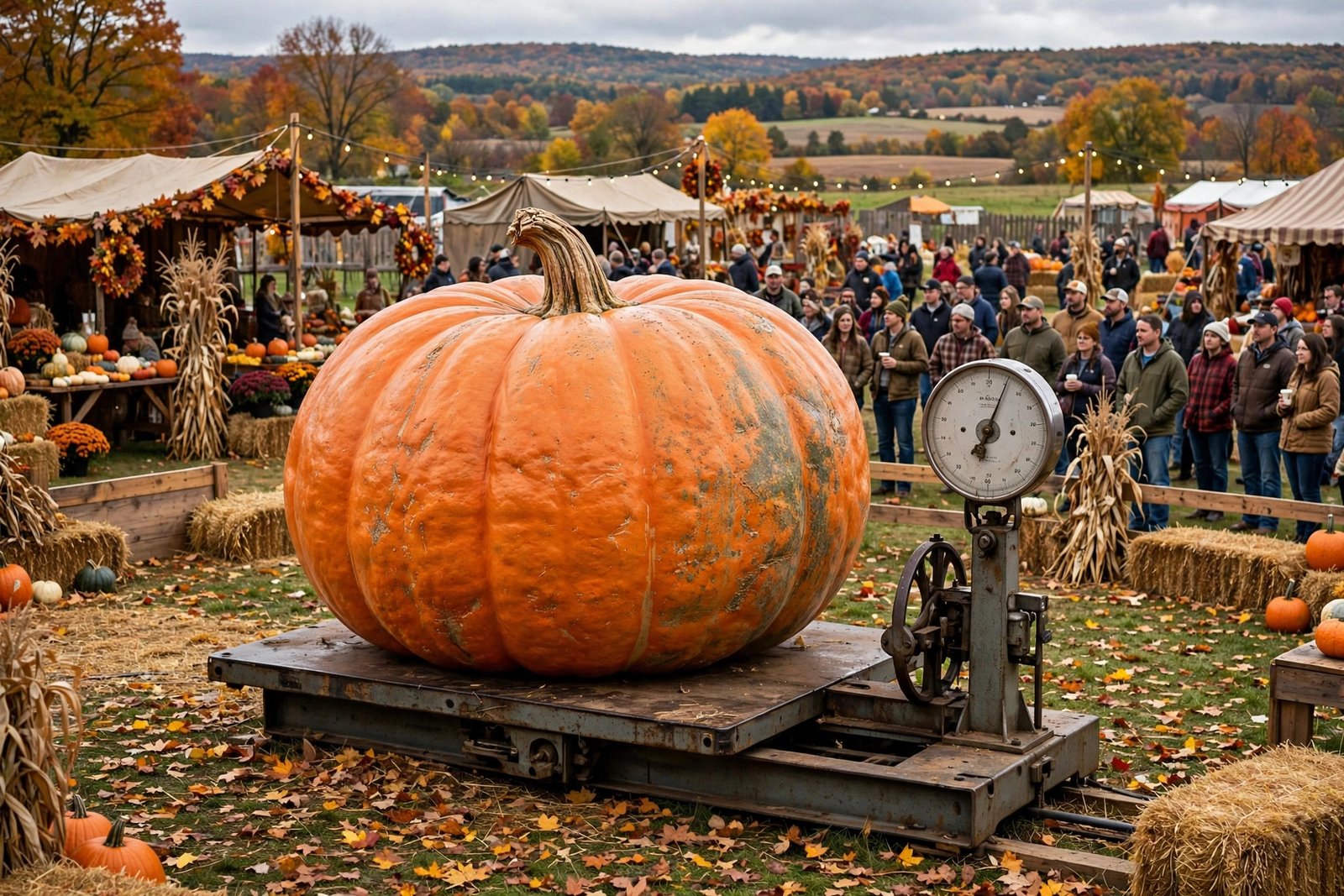
Picture a pumpkin so big that it needs a forklift, a flatbed truck, and a police escort just to get to a county fair. A pumpkin you could climb inside, carve into a boat, or hollow out and sit in like a chair. That is not a cartoon or a fairy tale. It is the real, slightly absurd, completely serious world of giant pumpkin growing — a hobby that has quietly turned into a competitive sport, where growers spend months coaxing a single fruit to a weight that would crush a small car. The story of the largest pumpkin ever grown is really three stories at once: a gardening obsession, a science experiment, and a small-town festival that somehow became a world championship.
Most pumpkins you see at a grocery store weigh somewhere between a few pounds and twenty pounds. The giants are a different species of effort altogether. They start from special seeds, saved from previous champions, and they grow in pampered patches with daily watering, careful feeding, and protection from wind, pests, and even sunburn. By harvest time, a champion can weigh more than a ton — more than a grand piano, more than a dairy cow, and in recent record years, well past two thousand pounds. How does a fruit get that big without splitting apart, and what happens to it once the scales stop moving? The answers are stranger and more fun than you might expect.
This is a tour of that world: the seeds, the soil, the science, the weigh-off drama, and the surprisingly sweet afterlife of a record pumpkin, from parade float to pie filling to a boat floating down a river.
How Growers Turn a Seed Into a Giant
Giant pumpkin growing starts long before spring. Serious growers trade seeds like baseball cards, and the most prized seeds come from previous champions. A seed from a two-thousand-pound pumpkin does not guarantee another giant — genetics help, but weather, soil, and daily care matter just as much — yet growers guard their best lines carefully, because a good genetic starting point is half the battle. Many belong to clubs and online groups where they swap seeds, compare notes, and cheer each other on through the season.
Once planted, a giant pumpkin plant takes over. A single vine can sprawl across hundreds of square feet, with leaves bigger than dinner plates and a stem as thick as your wrist. Growers prune the plant down to one fruit, sometimes two, so that all of the plant’s energy flows into a single pumpkin instead of being spread across many. They water deeply and often, feed the soil with compost and fertilizer, and watch the weather like farmers watching a storm forecast — because a single hard frost, a hailstorm, or a hungry deer can end a season in one night.
The growth itself is astonishing. In peak summer, a giant pumpkin can gain dozens of pounds in a single day, swelling visibly if you check it in the morning and again in the evening. Growers measure the circumference with a tape measure and estimate weight from growth charts, tracking the curve the way a coach tracks an athlete. They shade the fruit with blankets or canopies on hot days, cushion it on soft soil or sand so it does not develop a flat spot or crack, and sometimes even build little shelters around it. It is gardening, but it is also intensive care.
- One fruit per plant: pruning focuses all energy into a single pumpkin.
- Champion seeds: genetics from previous winners give growers a head start.
- Daily care: watering, feeding, shading, and pest protection through the whole season.
- Careful handling: a crack or soft spot can disqualify a pumpkin at a weigh-off.
There is also a quiet, patient side to the sport that surprises newcomers. Giant pumpkin growers are famously generous with advice. Veterans mentor beginners, share soil recipes, and celebrate each other’s personal bests even when they are competing for the same prize. The rivalry is real, but so is the community, and many growers say the friendships are the reason they come back year after year, win or lose.
The Largest Pumpkin Records and the Half Moon Bay Weigh-Off
If giant pumpkin growing has a Super Bowl, it is the Safeway World Championship Pumpkin Weigh-Off in Half Moon Bay, California. The event began in 1974 as a friendly challenge between Half Moon Bay and Circleville, Ohio, to see who could grow the biggest pumpkin, and it has grown into a festival that draws growers from across the country and crowds who come to gawk at pumpkins the size of small cars. The winning pumpkin is lifted by crane onto a giant scale, the crowd holds its breath, and the number flashes up to cheers, gasps, and sometimes disbelief.
The scale of the modern records is hard to grasp until you compare them to everyday things. A champion pumpkin can weigh more than a ton, and recent winners have pushed well past two thousand pounds — heavier than many cars, and far heavier than the 132-pound pumpkin that won that very first Half Moon Bay showdown in 1974. The jump from a hundred pounds to thousands of pounds over fifty years tells the story of better seeds, better soil science, and growers who have simply gotten very, very good at this.
Recent seasons show just how fast the record chase moves. Minnesota horticulture teacher Travis Gienger set a world record at Half Moon Bay in 2023 with a 2,749-pound pumpkin, and he returned to win the 2026 Half Moon Bay title with a 2,389-pound pumpkin named Rocky, earning $9 per pound in prize money. Meanwhile, reporting on the 2025 and 2026 seasons notes that twin brothers Ian and Stuart Paton of England grew a pumpkin listed at 2,819 pounds, 4 ounces in 2025, and that a Rhode Island grower, Ron Wallace, weighed a 3,156-pound squash in October 2026 that was awaiting formal verification by Guinness World Records at the time of reporting. Those fast-moving numbers are a reminder to check the latest verified record before quoting one, because in this sport, last year’s unthinkable weight can become this year’s runner-up.
Coverage of the 2026 Half Moon Bay event, including the New York Post report on Gienger’s win and the Associated Press account of the weigh-off, captures the festival atmosphere: food trucks, music, a prettiest-pumpkin contest, and a parade through town with the champion on display. The weigh-off is part competition, part county fair, and part science fair, and that mix is exactly why families keep coming back.
Not every giant makes it to the scale. Pumpkins split, rot, get damaged in transport, or simply stop growing. Growers have driven for more than a day with a pumpkin strapped to a trailer, only to watch it crack on arrival. Those heartbreaks are part of the lore, and they make the successes feel even bigger. When a grower finally hears the winning weight announced, it is the payoff for months of early mornings, muddy boots, and worrying about the weather.
The Science Behind Growing the Largest Pumpkin
So how does a fruit get to weigh as much as a car without collapsing under its own weight? Part of the answer is the variety. Giant pumpkins are usually Atlantic Giant, a variety bred specifically for size, with thick walls and a sturdy structure. Part of the answer is water: a pumpkin is mostly water, so steady, generous watering directly translates into weight gain, as long as the grower avoids sudden swings that can cause splitting.
Soil is the other secret weapon. Giant pumpkin growers treat soil like a science project, testing it, amending it with compost and minerals, and building raised beds that drain well but hold moisture. Healthy soil grows a healthy root system, and a huge root system can support a huge fruit. Some growers keep detailed journals of what they fed, when they watered, and how the weather behaved, turning each season into an experiment they can learn from the next year.
There is also a simple physics trick at work: a pumpkin grows by expanding its cells, and those cells fill with water and sugars produced by the leaves. More leaf area means more energy, which is why growers let the vine sprawl so wide. It is the same basic biology as a normal pumpkin, just scaled up to an extreme by careful selection, feeding, and protection. That is what makes the sport so fascinating to scientists and kids alike — it is not magic, it is biology pushed to its limit by patience.
For a different kind of everyday science wonder, see our explainer on why honey never expires — another case where a simple natural process turns out to be surprisingly clever.
What Happens to a Record Pumpkin After the Weigh-Off?
A record pumpkin’s fame does not end when the scale stops. In Half Moon Bay, the champion is traditionally showcased in a parade through town, where crowds cheer a vegetable like a sports hero. Some champions are carved into enormous jack-o’-lanterns — a feat in itself, since carving a pumpkin that big requires ladders, large tools, and a team of helpers, and the finished lantern can set its own records for size.
Other giants find a second life as boats. Yes, boats. Hollowed-out giant pumpkins have been paddled down rivers in pumpkin regattas, with brave (and very wet) paddlers sitting inside the shell and racing each other. It sounds like a joke until you see the photos: a person in a life jacket, paddling a pumpkin, grinning like they have won the lottery. The thick walls and round shape actually make a surprisingly seaworthy, if wobbly, vessel for a short, calm-water race.
And then there is pie. A single giant pumpkin can yield an enormous amount of flesh, and festivals often turn champions into pies, soups, or roasted seeds shared with the crowd. It is a fitting end: a fruit grown with months of care becomes food shared with neighbors. Some growers also save seeds from their champions, starting the whole cycle again. A record pumpkin is not just a trophy; it is the parent of next year’s contenders.
Not every pumpkin gets a glamorous ending, of course. Some are composted, some are displayed until they soften, and some simply go back to the garden. But even then, the grower keeps the photos, the measurements, and the story — and in a community built on stories, that counts for a lot.
Could You Grow a Giant Pumpkin Yourself?
The good news is that you do not need a farm to try growing a future largest pumpkin contender. A sunny patch of garden, a packet of Atlantic Giant seeds, and a willingness to water daily will get you started, and many first-time growers are thrilled to harvest a pumpkin of a hundred pounds or more — still many times bigger than a store pumpkin. You will not break a world record in year one, and that is fine. The joy is in watching something grow faster than you thought possible.
- Start with Atlantic Giant seeds from a reputable seed seller or a growers’ club.
- Give one plant plenty of space — a vine can easily cover a large garden bed.
- Water consistently, feed the soil, and protect the young fruit from pests.
- Keep only one or two fruits per plant so energy is not spread thin.
- Measure weekly and enjoy the growth curve, even if the final weight is modest.
Joining a local growers’ club or an online giant pumpkin group is the fastest shortcut. Experienced growers love helping beginners, and they will warn you about the classic rookie mistakes: planting too late, letting the vine dry out in a heatwave, or trying to move a half-grown pumpkin and cracking it. Learn from their mistakes, and your first season will be far more fun.
Halloween is the perfect time to start dreaming about next year’s patch. Visit a weigh-off if one is near you, talk to the growers, and see a giant up close. Standing next to a pumpkin taller than a child changes your sense of what a garden can do — and it might just plant the seed, literally, for your own giant attempt. If you want a Halloween read to pair with it, our history of trick-or-treat explains how the holiday itself grew from old traditions into the celebration we know today.
Takeaways: Why Giant Pumpkins Amaze Us
Strip away the festival crowds and the crane, and the story of the largest pumpkin ever grown is really about human curiosity. How big can this get? What happens if we give a plant everything it needs and then get out of its way? Those are the same questions behind every science experiment and every backyard garden, just asked at a much larger scale.
- Giant pumpkins are a real competitive sport, with clubs, seeds, and weigh-off championships.
- Champions now weigh well over a ton, thanks to genetics, soil science, and daily care.
- Half Moon Bay’s weigh-off, running since 1974, is the sport’s most famous stage.
- Record pumpkins become parade stars, giant jack-o’-lanterns, boats, and pies.
- Anyone with sun, space, and patience can try growing one at home.
Conclusion
The next time you pick up a pumpkin for carving, take a second to imagine its giant cousin: a fruit so heavy it needs a crane, so famous it gets a parade, and so beloved that people drive across the country just to watch it get weighed. That is the magic of giant pumpkin growing. It takes something ordinary, something we walk past in a grocery store every October, and shows us how extraordinary it can become with time, care, and a little competitive spirit. The largest pumpkin in the world is not just a record on a list. It is proof that curiosity, patience, and a good patch of soil can grow something truly amazing — and that sometimes, the biggest stories come from the garden.
So this Halloween, when you see a pumpkin, think bigger. Much, much bigger. And if you ever get the chance to stand next to a giant, take the photo. You will want to show everyone.
How heavy can a giant pumpkin get?
Modern champions weigh more than a ton, and recent record contenders have pushed well past two thousand pounds. Exact verified records change from year to year, so check the latest Guinness-verified figure before quoting a single number.
What variety do giant pumpkin growers use?
Most competitive growers use Atlantic Giant, a variety bred for size, grown from seeds saved from previous champion pumpkins.
Where is the most famous giant pumpkin weigh-off?
The Safeway World Championship Pumpkin Weigh-Off in Half Moon Bay, California, which began in 1974 and is often called the Super Bowl of weigh-offs.
Can I grow a giant pumpkin at home?
Yes, with a sunny spot, Atlantic Giant seeds, consistent watering, good soil, and plenty of space for the vine. First-time growers often reach a hundred pounds or more.
What happens to a champion pumpkin after it wins?
Winners are often paraded through town, carved into giant jack-o’-lanterns, paddled as boats in pumpkin regattas, turned into pies and soups, or composted after their seeds are saved for next season.