
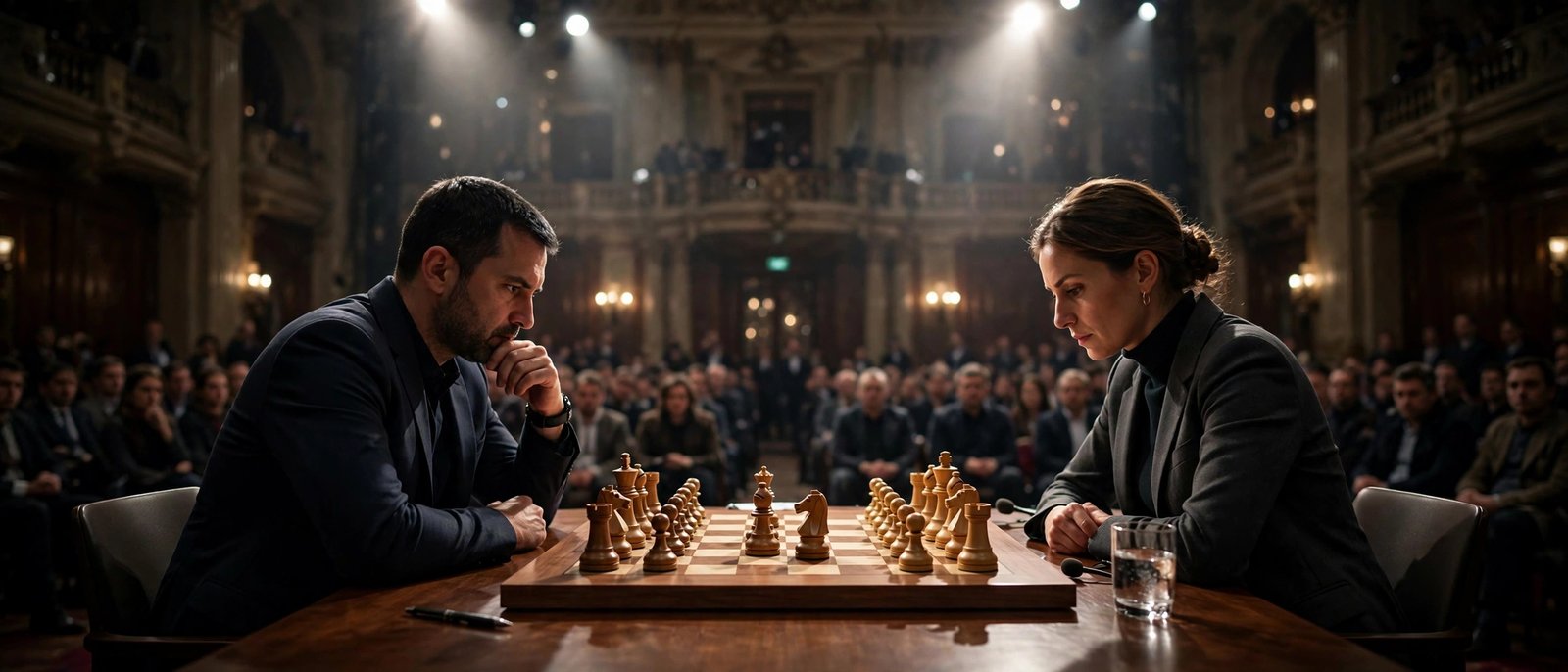
Three games into the World Chess Championship, and nobody has blinked. Gukesh and Sindarov have now played out a marathon draw in Game 3 — described as the longest game of the series so far — and after three games there is still nothing to separate them. The Gukesh Sindarov World Chess Championship is living up to every expectation: tense, gruelling, and balanced on a knife’s edge.
World Championship matches are supposed to be dramatic, but this one is delivering a special kind of drama. There have been no early knockouts, no collapses, no gifts. Instead, two of the best players on the planet are grinding each other down move by move, hour by hour, and Game 3 showed just how far both are willing to go to avoid giving an inch.
The Gukesh Sindarov World Chess Championship So Far
The Gukesh Sindarov World Chess Championship is a contest between the reigning champion and the challenger who earned the right to face him. Gukesh, India’s world champion, is defending the title he won in 2024 when he defeated Ding Liren to become the youngest undisputed world champion in history. Sindarov, the challenger from Uzbekistan, arrives as one of the brightest talents of his generation, a player who has climbed to the very top of world chess at a remarkably young age.
Through three games, the match is dead level. Game 1 ended in a draw. Game 2 ended in a draw. And now Game 3 — the marathon — has ended in a draw too. Nobody leads. Nobody trails. The scoreboard says the match is tied, but the games themselves have been anything but quiet.
That is the strange beauty of a World Championship at this level. A draw does not mean nothing happened. It means both players found the truth of the position, defended with precision, and refused to crack under hours of pressure. Game 3 was the longest game of the match so far, and length matters: the longer a game runs, the more chances there are for a single tired move to lose everything.
Who Are Gukesh and Sindarov?
To understand why this match matters, you need to know the two men at the board.
Gukesh Dommaraju, known simply as Gukesh, is India’s chess superstar. He became world champion in 2024, beating China’s Ding Liren in a match that went down to the final game. His rise was extraordinary: a grandmaster in his early teens, a key player in India’s gold-medal winning team at the 2024 Chess Olympiad, and then world champion while still a teenager. He plays with a calm, almost unshakeable demeanour at the board, but his chess is sharp — he is famous for squeezing wins out of positions that look drawn to everyone else.
His challenger, Javokhir Sindarov of Uzbekistan, is no less remarkable. Sindarov became a grandmaster as a teenager and has been one of the strongest young players in the world for years, part of a golden generation of Uzbek chess that also won team gold at the 2022 Chess Olympiad. He is known for deep preparation and a cool temperament, the kind of player who is extremely hard to beat in a long match. Earning a World Championship challenge is the hardest road in chess — it means surviving the Candidates, the most gruelling tournament in the sport — and Sindarov earned his place at the table.
What makes this match fascinating is the symmetry. Both players are young. Both are already proven at the highest level. Neither is a veteran defending old ground or a newcomer hoping to get lucky. This is a contest between two players at the start of what could be a long rivalry, and the chess world is watching closely.
Why Game 3 Was So Long and So Tense
Game 3 stretched on far longer than a typical World Championship game, and the length itself tells a story. At this level, games are long for two reasons: the positions are complex, and neither player is willing to settle for a safe draw while there is still something to play for.
In a World Championship, the opening phase is a battle of preparation. Both players arrive with teams of seconds — elite grandmasters who spend months analysing openings — and much of the early game is a test of whose homework is better. When the preparation ends and the players are on their own, the real fight begins. That is where Game 3 earned its reputation as a marathon: both players kept finding resources, kept defending accurately, and kept the tension alive deep into the game.
Long games are physically demanding in a way that surprises people who have never played competitive chess. The players sit at the board for five, six or more hours, burning mental energy at a rate that scientists have compared to serious physical exercise. Concentration must not slip for a single move. One moment of fatigue, one second of miscalculation, and a game that was drawn becomes lost. That both players held their nerve for the entire length of Game 3 is a testament to their fitness and focus.
There is also a psychological layer. In a match, a long draw can be a message. It says: I can match you for as long as it takes. I will not break. Neither player wanted to be the one who blinked first in the longest game of the series, and in the end, neither did.
What the Marathon Draw Means for the Gukesh Sindarov World Chess Championship
A draw in Game 3 keeps the match level, but it is not a neutral result in terms of momentum. Long games drain energy, and the player who recovers better between games gains an edge. Rest days and preparation time become almost as important as the games themselves.
History shows that World Championship matches are often decided not by brilliant attacks but by endurance. The player who stays sharpest in the second half of the match, when fatigue accumulates and the pressure peaks, is often the player who lifts the trophy. A marathon draw early in the match is a warning to both camps: this one could go the distance, and preparation for a long, grinding battle matters as much as preparation for the next game.
For the challenger, holding the champion to three straight draws is a solid start. The champion is supposed to be the favourite, and every game that passes without a win for Gukesh keeps the door open for Sindarov. For the champion, the message is different: he has shown he can match the challenger in the longest, toughest game so far, and he has the experience of having won a World Championship match before — an experience Sindarov does not yet have.
What Comes Next
With the match level after three games, everything is still to play for. The coming games will test both players in new ways. As the match wears on, opening surprises become more likely, as each team looks for an edge that breaks the deadlock. The middle games of a World Championship are often where the real drama lives: the preparation starts to run dry, the nerves start to show, and the player with the stronger will can take control.
Fans should expect more long games. Neither player has shown any sign of settling for quick, safe draws, and the pattern so far suggests both are happy to fight for hours when the position demands it. The question is which player will find the first decisive break — a moment when preparation, courage and accuracy combine to produce a win.
There is also the question of how the match is being followed around the world. Chess has never been more popular. The 2024 World Championship drew enormous audiences online, with millions following the games live, and this match is building on that momentum. In India, where Gukesh is a national hero, interest is enormous. In Uzbekistan, Sindarov’s run is a source of national pride. The Gukesh Sindarov World Chess Championship is not just a sporting event — it is a story of two nations, two generations of chess talent, and the oldest game in the world played at its very highest level.
Why This Match Captivates Even Non-Chess Fans
You do not need to know chess to appreciate what is happening here. At its heart, this is a story anyone can understand: two young champions, locked together, neither willing to give ground. Game 3 was a marathon because both players refused to lose — and that refusal, stretched over hours of silent concentration, is genuinely dramatic.
Chess at this level is also a window into how elite minds work. The players are calculating variations most of us could not follow, remembering preparation from months of study, and managing their own emotions under enormous pressure — all while the world watches their every move. It is sport stripped down to pure thought, and that purity is part of its appeal.
Takeaways: Gukesh vs Sindarov, Game 3
- Game 3 of the World Chess Championship ended in a marathon draw — the longest game of the series so far.
- After three games, Gukesh and Sindarov are level, with nothing to separate the champion and the challenger.
- Gukesh, India’s world champion, is defending the title he won in 2024; Sindarov of Uzbekistan earned his challenge as one of the world’s brightest young stars.
- Long games test fitness, focus and nerve — both players held firm for hours without a single decisive slip.
- The match is now a test of endurance as much as chess skill, and the first win could change everything.
Conclusion
Game 3 of the Gukesh Sindarov World Chess Championship will be remembered as the marathon — the longest game of the series so far, and the game that proved neither player is going anywhere. Three games in, the match is level, the tension is rising, and the chess world is settling in for a classic. If the first three games are any guide, this match will be decided by patience, nerve and the ability to keep finding the right move when exhaustion says otherwise. The next game cannot come soon enough.
For more stories that make you think, read about the Great Emu War in Australia, explore the Bermuda Triangle mystery explained with facts, or dive into the Reddit Place pixel war.
Who is playing in the 2026 World Chess Championship?
The match is between Gukesh, India’s reigning world champion, and Javokhir Sindarov of Uzbekistan, the challenger who earned his place by winning through the qualification cycle.
What happened in Game 3 of the Gukesh Sindarov World Chess Championship?
Game 3 ended in a marathon draw, described as the longest game of the series so far. Neither player could break through, and the match remained level after three games.
What is the score after three games?
After three games, there is nothing to separate the two players. All three games have ended in draws, so the match is level heading into the next games.
How did Gukesh become world champion?
Gukesh won the world title in 2024 by defeating China’s Ding Liren, becoming the youngest undisputed world champion in history.
Why are World Championship games so long?
At this level, both players defend with great precision and neither wants to settle early, so games can run for five or six hours or more. Long games test concentration, fitness and nerve as much as chess skill.