
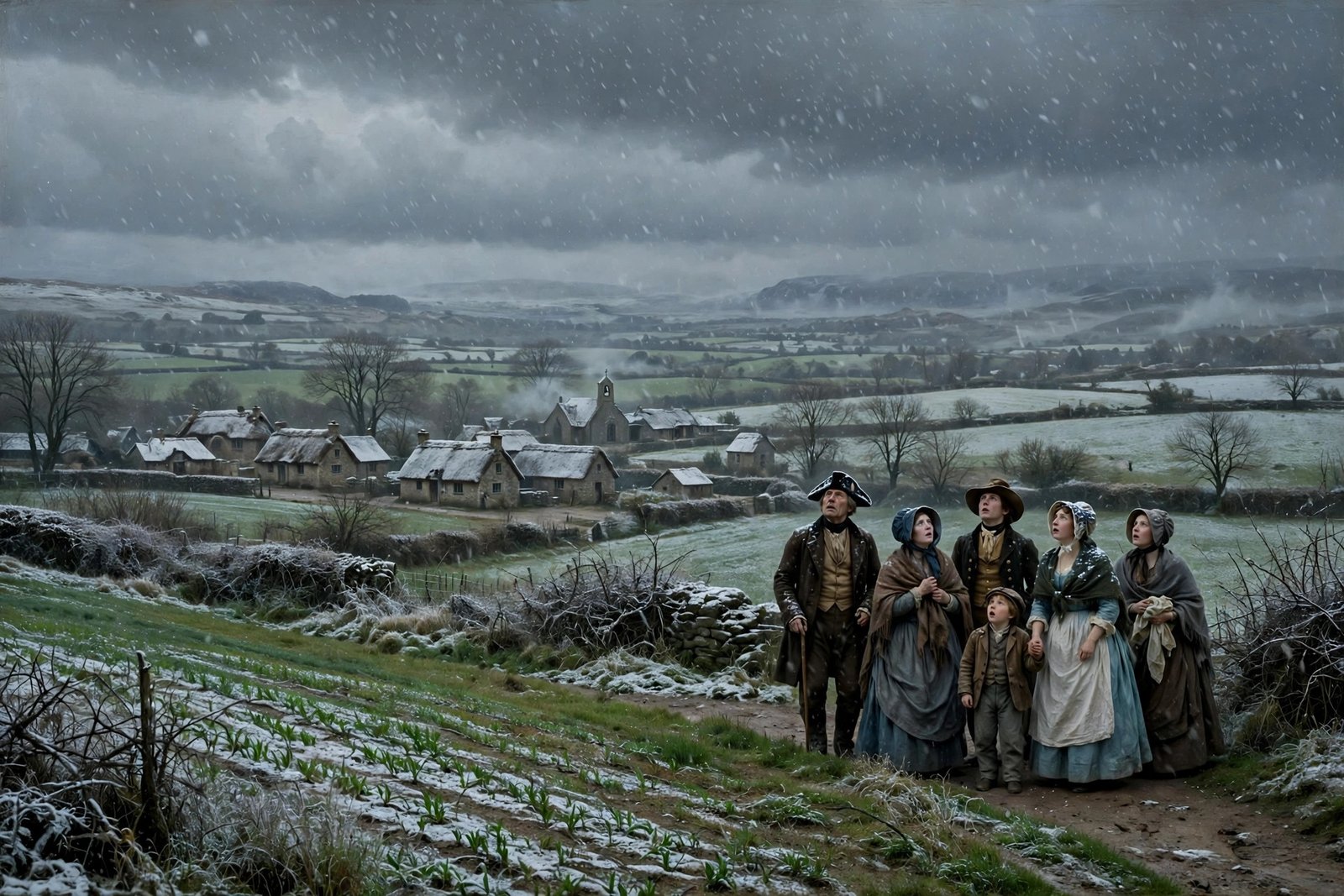
Imagine waking up on a June morning, expecting warm sunshine, and finding snow on the ground instead. That is exactly what happened across New England in 1816, a year so cold and strange that history remembers it as the Year Without a Summer 1816. Crops froze in the fields, rivers stayed iced over in midsummer, and farmers watched their harvests die in the middle of what should have been the growing season. Nobody living through it knew why. The answer lay thousands of miles away, on a small Indonesian island, where a volcano had exploded a year earlier with a force the world had never recorded before. This is the story of the year the summer never came, and how a single mountain changed the weather of an entire planet.
The Year Without a Summer 1816 was not a local cold snap. It was a global climate disaster. From the eastern United States to Western Europe and across Asia, temperatures plunged, frosts struck in every month of the year, and food became so scarce that prices soared and people went hungry. The strange weather also left an unexpected cultural legacy: it trapped a group of young writers indoors during a rainy holiday in Switzerland, and out of that boredom came one of the most famous novels ever written. The year without a summer was a catastrophe, but it was also one of the most fascinating chapters in the history of weather.
The Volcano That Changed the World
The story begins on the island of Sumbawa, in what is now Indonesia. There, a volcano called Mount Tambora had been quiet for centuries. In early April 1815, it began to rumble. On April 5, a large explosion was heard hundreds of miles away. Officials on the nearby island of Java, then under British administration during the Napoleonic Wars, assumed they were hearing distant gunfire. The real climax came on the evening of April 10 and continued into April 11, when Tambora erupted with a violence that dwarfed almost everything else in recorded history.
Mount Tambora ejected an enormous volume of ash and rock into the sky, and its summit collapsed into a wide crater, losing well over a thousand meters of height. Glowing avalanches of hot gas and rock, known as pyroclastic flows, swept down the mountainside to the sea. The small kingdoms of Tambora and Pekat on Sumbawa were destroyed outright. Archaeologists working on the island in the 2000s found the remains of houses, pottery, and people buried under the volcanic deposits, a find that led some to call the site a Pompeii of the East. Around 10,000 people or more are thought to have died directly in the eruption, and modern estimates of the total death toll, including the famine and disease that followed, are commonly in the range of 70,000 to 90,000, with some researchers suggesting higher figures.
Scientists rate the eruption at 7 on the Volcanic Explosivity Index, a level reached by only a handful of eruptions in the past several thousand years. It threw out a far larger volume of ash and pumice than the famous eruption of Krakatoa in 1883, which produced the loudest sound in recorded history. Volcanologists estimate the erupted magma alone at roughly 30 to 50 cubic kilometers. But the most important thing Tambora threw into the sky was not ash. It was sulfur dioxide gas, and that gas would go on to change the climate of the entire world.
How One Eruption Froze the Planet
When a volcano erupts, most of its ash falls back to the ground nearby within days or weeks. Sulfur dioxide behaves differently. High in the stratosphere, it turns into tiny droplets of sulfuric acid, and those droplets can stay aloft for years. Carried around the world by high-altitude winds, Tambora’s aerosol layer acted like a thin veil across the sky, reflecting part of the incoming sunlight back into space before it could warm the Earth. According to the Smithsonian, those aerosol particles stayed in the stratosphere for two years, blocking sunlight and causing havoc with the climate.
The effect was dramatic. Scientists estimate that average global temperatures dropped by around three degrees Celsius in the year after the eruption. That may not sound like much, but for farmers it was the difference between a harvest and a famine. The cooling was worst in the Northern Hemisphere, where most of the world’s people lived, and it hit hardest in the summer, exactly when crops needed warmth and sunshine to grow. The sun itself looked strange: observers described it as dim and hazy, as if seen through a cloud of smoke, and sunsets turned blood red for years afterward. European artists such as J.M.W. Turner painted those strange, vivid skies, and scientists have since been able to use paintings from the years after Tambora to measure the aerosol levels in the atmosphere.
People in 1816 had no idea any of this was happening. The connection between a volcano in Indonesia and cold weather in New England was not established until the 20th century. At the time, people blamed the strange weather on sunspots, the positions of the planets, and even divine punishment. The Earth was also in the concluding decades of the Little Ice Age, and the period from 1790 to 1830 saw relatively low solar activity, known as the Dalton Minimum, which may have made the cooling worse. But Tambora was the trigger, and its fingerprints are all over the weather records of 1816.
Snow in June: The Year Without a Summer 1816 in America
In the United States, which then numbered just 18 states, the summer of 1816 was a season of freak weather. May frosts killed off crops in upstate New York and at higher elevations in Massachusetts, New Hampshire, and Vermont. Then came June. On June 6, snow fell in Albany, New York, and in Dennysville, Maine. In Cape May, New Jersey, frost was reported five nights in a row in late June, causing extensive crop damage. Lake and river ice was observed as far south as Pennsylvania, and some accounts describe people skating on frozen ponds in July.
New Englanders called it “eighteen hundred and froze to death,” and the name stuck. Farmers replanted their corn again and again, only to watch each new planting die in the next frost. By August, many had given up entirely. Food prices soared as grain became scarce, and families that could not afford bread went hungry. The hardship drove a wave of migration westward, as New England farm families abandoned their failing land and headed for the more forgiving climate of the Ohio Valley. In that sense, the cold summer helped reshape the map of the young United States.
The weather was just as strange in other parts of the world. In Europe, the summer was cold, wet, and gloomy, with rain falling for weeks at a time. In Switzerland, snow fell in the valleys in summer. In China, the monsoon rains failed, and the province of Yunnan suffered a devastating famine. Historian Gillen D’Arcy Wood, author of “Tambora: The Eruption That Changed the World,” describes scenes of starvation there in harrowing terms. The Year Without a Summer 1816 was a worldwide event, and its worst effects fell on the people who could least afford them.
Famine and Food Riots in Europe
Europe was still recovering from the Napoleonic Wars when the cold summer struck, and the failed harvests pushed many communities over the edge. Grain shortages and famine occurred across the continent, and food prices climbed so high that bread became unaffordable for the poor. In France, Switzerland, and Germany, hungry crowds rioted, demanding bread and blaming merchants and officials for hoarding grain. Governments struggled to respond, and in some places, the unrest fed into the political upheavals of the years that followed.
The suffering was not limited to hunger. The unusual cold and the disruption of food supplies were followed by epidemics of cholera and other diseases, and the hardship lingered for years. Historians now see the years after 1816 as a period of genuine global crisis, one of the worst short-term climate shocks of the last thousand years. It is a reminder that the weather is not just a topic for small talk: when the climate shifts suddenly, the effects ripple through food, prices, politics, and public health, just as they did in the strange summer of 1816.
There is a curious detail in the story that still surprises people. Because oats became so expensive, feeding horses cost far more than usual, and horses were the main form of transport at the time. According to the University Corporation for Atmospheric Research, the high price of oats may have been one of the factors that inspired a German inventor named Karl Drais to build a machine that could move without a horse. His wooden running machine, the draisine, is now regarded as an early ancestor of the bicycle. The year without a summer may, indirectly, have helped invent the bike.
The Summer That Gave Us Frankenstein
The most famous cultural legacy of 1816 began on the shores of Lake Geneva in Switzerland. There, a group of young writers had gathered for a summer holiday: Mary Shelley, her husband, the poet Percy Bysshe Shelley, and their friend Lord Byron. They had expected a warm, pleasant summer by the lake. Instead, they got weeks of cold rain and gloom, the direct result of Tambora’s veil of dust in the stratosphere. Trapped indoors for days on end, the group grew bored, and Byron suggested a contest: each of them would write a ghost story.
Mary Shelley was just 18 years old. In the dreary atmosphere of that endless rainy summer, she began a story about a young scientist who creates a living creature from dead body parts, only to be horrified by what he has made. That story became “Frankenstein,” published in 1818, one of the most influential novels ever written. Its stormy, gloomy setting owes a great deal to the weather outside the windows at Lake Geneva that summer. The creature’s world is a world of cold, rain, and darkness, because that was the world Mary Shelley was living in while she wrote it.
Byron, too, was changed by the experience. He wrote the poem “Darkness,” which opens with the line, “I had a dream, which was not all a dream. The bright sun was extinguish’d.” The poem imagines a world where the sun has gone out and humanity descends into chaos, a vision that reads today like a description of the volcanic winter itself. Percy Shelley also wrote during that summer, and the group later scattered across Europe, carrying the dark mood of 1816 with them into some of the most famous works of the Romantic era. If you enjoy strange true stories from history, you will also like the tale of the dancing plague of 1518, when crowds danced for days and could not stop.
Why the Year Without a Summer Still Matters
Scientists study 1816 today for a serious reason: it is the best-documented example of what happens when a huge volcanic eruption cools the planet. The lessons matter because it could happen again. A Tambora-scale eruption in the modern world would disrupt harvests, food prices, and supply chains on a scale that would make 1816 look simple by comparison, because far more people depend on global food trade today. Climate scientists use the records of 1816 to test their models of how volcanic aerosols affect the atmosphere, and to prepare for the next big eruption, whenever it comes.
The year also reminds us how connected the world is. A mountain on a small island in Indonesia changed the weather in New England, the price of bread in Paris, the harvest in China, and the books on the shelves of readers two centuries later. Nobody in 1816 could have imagined that connection, and yet it was real. In a world that still argues about climate, 1816 is a vivid piece of evidence that the atmosphere does not respect borders, and that a single event on one side of the planet can reshape life on the other.
There are even stranger echoes. The cold, dark summer of 1816 inspired some of the most enduring horror and poetry in the English language, and it may have helped give the world the bicycle. It pushed families across America westward, and it gave historians one of their clearest windows into how climate shapes history. The Tunguska event of 1908 is another reminder that the sky can change history in a single day, but Tambora changed it for years.
Takeaways: What the Year Without a Summer 1816 Teaches Us
- Mount Tambora erupted in April 1815 in Indonesia, the largest volcanic eruption in recorded history, rated 7 on the Volcanic Explosivity Index.
- Sulfur dioxide from the eruption formed a veil of aerosols in the stratosphere that reflected sunlight and cooled the planet for about two years.
- In the Year Without a Summer 1816, snow fell in New England in June, frosts struck in every month, and crops failed across Europe and North America.
- Food prices soared, famines and food riots spread, and the hardship drove migration westward in the United States.
- Trapped indoors by the rainy summer at Lake Geneva, Mary Shelley began writing Frankenstein, while Lord Byron wrote his poem Darkness.
- The cold summer may have indirectly inspired Karl Drais to invent an early bicycle, because expensive oats made horse transport costly.
Conclusion
The Year Without a Summer 1816 was one of the strangest years in human history. A volcano that most people had never heard of, erupting on an island most people could not find on a map, stole the summer from an entire hemisphere. It froze crops, starved villages, emptied farms, and filled the skies with red sunsets. It was a disaster for millions of people, and it is remembered as one of the worst climate shocks of the last thousand years.
And yet the story of 1816 is not only a story of suffering. It is also the story of how a rainy summer gave the world Frankenstein, how a shortage of oats may have helped invent the bicycle, and how a single eruption taught scientists that the climate of the whole planet can turn on a single event. Two centuries later, the year without a summer still has something to teach us: that the world is smaller and more connected than it looks, and that the weather, when it changes suddenly, changes everything. The next time a summer feels too cold or too strange, remember 1816, and remember the mountain in Indonesia that once switched the summer off.
To learn more, see the Smithsonian’s account of Tambora’s lasting effects, the Old Farmer’s Almanac on the Year Without a Summer, the University Corporation for Atmospheric Research explainer, and Historian’s overview of Mount Tambora and 1816.
What was the Year Without a Summer 1816?
The Year Without a Summer 1816 was a year of extreme cold and failed harvests across the Northern Hemisphere, caused by the eruption of Mount Tambora in Indonesia in April 1815. Snow fell in New England in June, frosts struck in every month, and food prices soared as crops failed.
What caused the Year Without a Summer?
Mount Tambora erupted in April 1815, throwing sulfur dioxide high into the stratosphere, where it formed tiny droplets of sulfuric acid. That aerosol veil reflected sunlight back into space, cooling the planet for about two years and producing the cold summer of 1816.
Did it really snow in June 1816?
Yes. On June 6, 1816, snow fell in Albany, New York, and in Dennysville, Maine. Frosts were reported in New England and the Mid-Atlantic through the summer, and lake and river ice was observed as far south as Pennsylvania.
How is Frankenstein connected to the Year Without a Summer?
In the summer of 1816, Mary Shelley was holidaying at Lake Geneva with Percy Bysshe Shelley and Lord Byron. The cold, rainy weather trapped them indoors, and Byron suggested a ghost-story contest. Mary Shelley began Frankenstein during that stay, and Byron wrote his poem Darkness.
How many people died because of the Tambora eruption?
Estimates vary. Around 10,000 people or more are thought to have died directly in the eruption, and modern estimates of the total death toll, including the famine and disease that followed, are commonly in the range of 70,000 to 90,000, with some researchers suggesting higher figures.