
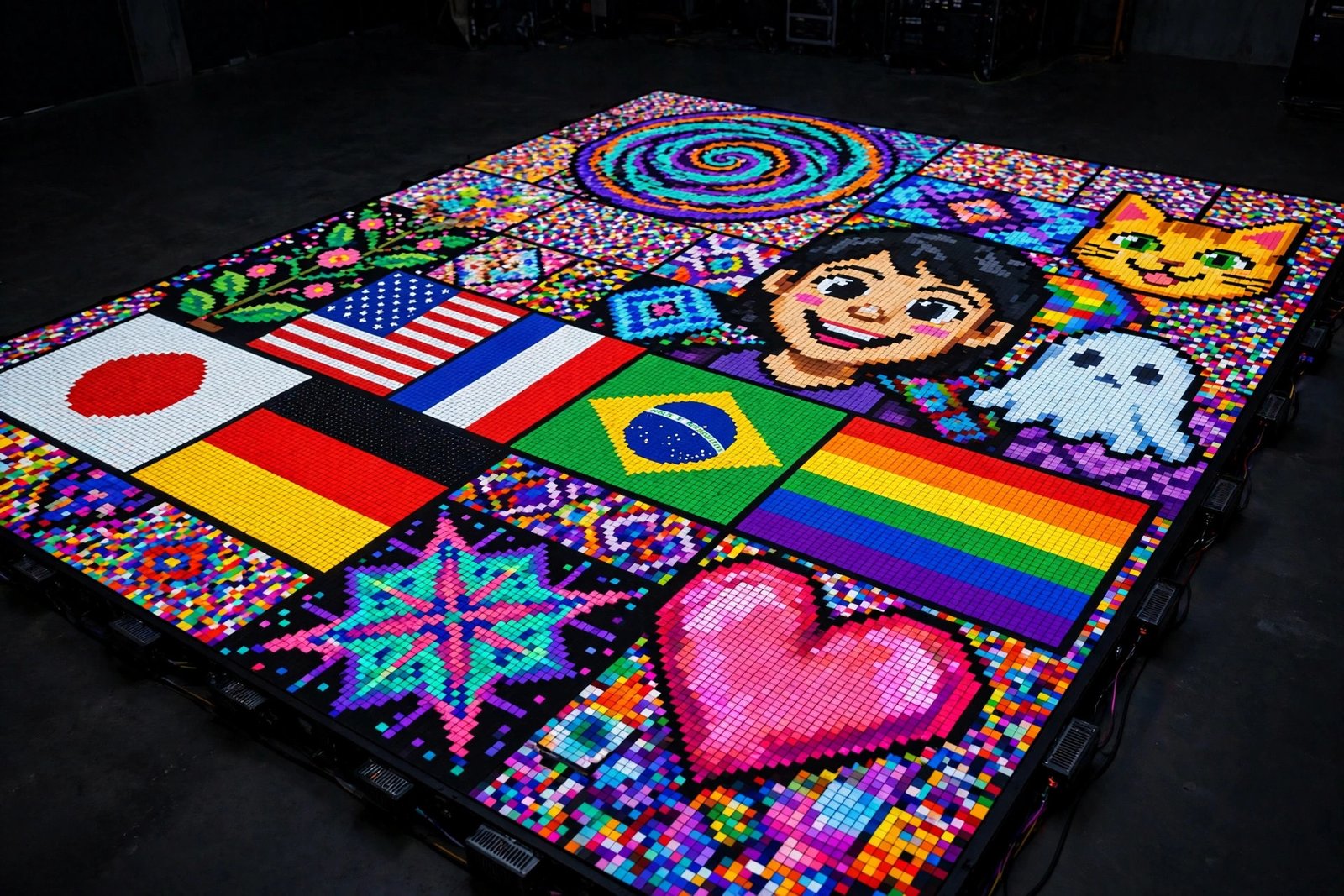
Imagine a blank canvas one million pixels wide, handed to the entire internet at once, with a single rule: you may colour in exactly one pixel, and then you must wait. No one can draw a picture alone. No one can claim a corner for themselves. Yet within three days, that canvas held national flags, a Mona Lisa, cartoon characters, memorials, jokes, protests and wars. That is the strange magic of the Reddit Place pixel war, Reddit’s r/place experiment, which turned millions of strangers into rival armies, unlikely allies and, for a few days at a time, the largest art collective in human history.
It has happened only three times, in 2017, 2022 and 2023, and each time it has been bigger, louder and stranger than the last. Streamers have commanded armies of viewers to conquer territory. Countries have fought pixel-by-pixel battles over their flags. A mysterious black shape called the Void has swallowed whole artworks. And in 2023, the canvas itself became a protest against Reddit. This is the story of how one tiny rule, one pixel per person, created one of the most fascinating social experiments the internet has ever run.
What Is the Reddit Place Pixel War?
The Reddit Place pixel war is the nickname users gave to r/place, a collaborative canvas hosted on Reddit. The idea is simple enough to explain in one sentence, and chaotic enough to fill a history book. Reddit opens a shared canvas, and every logged-in user can change the colour of a single pixel. After placing a pixel, the user must wait out a cooldown timer before placing another. Anyone can overwrite anyone else’s pixel at any time, so nothing on the canvas is ever truly safe.
The event was conceived by Josh Wardle, a Reddit employee who later became famous as the creator of Wordle. It was first launched as an April Fools’ Day experiment in 2017, and it returned on April Fools’ Day 2022 and again in July 2023. Since then it has been dormant, with no new edition since July 2023, but its final canvases are still studied, archived and argued over like historical documents. Fans keep the memory alive through timelapse videos, atlases that map every artwork to its creators, and the many articles and videos that still explain the event to newcomers.
What makes r/place different from any ordinary drawing app is scarcity. In 2017, the canvas was 1,000 by 1,000 pixels, just one million squares, and it had to be shared by more than a million users. There was never enough room for everyone, which meant every artwork existed only because a group of people agreed to build it and defend it together. That scarcity is the whole experiment. Give people unlimited space and they draw alone. Give them one shared wall and they form nations.
The Rules: One Pixel, Then Wait
The rules of r/place have stayed remarkably consistent across all three editions, and the most important rule is the cooldown. In 2017, after placing a pixel, a user had to wait between 5 and 20 minutes before placing another, depending on whether their email address was verified. Later editions kept the same idea but varied the wait times, with newer or unverified accounts waiting longer. A single user, no matter how determined, could therefore place only a handful of pixels per hour.
The colour palette was limited too. In 2017, users chose from just 16 colours, which forced artists to fake shading with dithering and to accept flag colours that were only close to the real thing. In 2022, the palette grew during the event from 16 to 24 and then 32 colours, and each new set of colours started a wave of repainting as communities redrew their art in more accurate shades. The 2023 edition began with only 8 colours before expanding to 32. Reddit also expanded the canvas itself during the later events. In 2022 it grew from 1,000 by 1,000 to 2,000 by 2,000 pixels, and in 2023 it eventually reached 3,000 by 2,000 pixels. Every expansion set off a land grab, as communities that had been squeezed out raced to claim the fresh empty space along the new edges.
Behind the scenes, Reddit administrators could place as many pixels as they wanted, which let them remove offensive content. But for ordinary users, the limit was the point. Because one person alone could do almost nothing, any artwork larger than a few pixels needed hundreds or thousands of people placing pixels in turn, following a shared plan. Communities planned designs on Discord servers, shared pixel-by-pixel templates, and organised shifts to repair damage overnight. The cooldown turned what could have been a free-for-all into a genuine social experiment about cooperation, and it is the reason the rest of r/place happened: factions, alliances, raids and the constant repair of artwork under attack.
2017: The April Fools’ Experiment That Started It All
The first r/place ran for 72 hours, from April 1 to April 3, 2017. More than a million users took part, placing about 16 million pixels in total, and at the moment the experiment ended, over 90,000 users were actively viewing or editing the canvas. For an April Fools’ joke, those are extraordinary numbers. For a social experiment, they were unprecedented.
The 2017 canvas became a dense patchwork of internet culture. National flags took up large blocks, defended fiercely by their countries’ Reddit communities. A pixel Mona Lisa appeared, alongside characters from games, films and anime. Memes and in-jokes from individual subreddits sat side by side with sincere tributes. And through it all ran a rainbow road, a diagonal stripe of colour that crossed the canvas and became one of its most recognisable features.
What surprised even Reddit was how organised the chaos became. Communities that had never cooperated before formed alliances to protect shared borders. Groups appointed defenders who watched their artwork around the clock and called for help when it came under attack. The final canvas was widely praised as a portrait of internet culture itself, messy, funny, earnest and endlessly creative, all at once. Reddit published a timelapse of the whole event, and it remains one of the most satisfying videos on the internet: three days of human cooperation and conflict, compressed into minutes, ending in a finished picture that no single person could have made.
The Void: The Group That Wanted to Destroy Everything
Every great story needs a villain, and r/place had one: the Void. The Void was a group organised through the subreddit r/theblackvoid, whose only goal was to cover other people’s art in black pixels. Its members treated destruction almost as a religion, calling for the Void to swallow the canvas. It had no flag to defend and no picture to build. It existed purely to erase.
And yet the Void worked the same way everyone else did. It took coordination, shared targets and a steady stream of pixels placed by many hands. Its attacks forced other communities to organise defences and alliances and to keep repairing their art, sometimes for hours at a time. Some of the most dramatic moments in r/place history are battles against the Void, as a beloved artwork slowly turned black and its defenders rushed to save it, pixel by pixel. In later editions, the Void came back, joined by copycat groups using black pixels for the same purpose.
The Void is what makes r/place more than a cute art project. Without an enemy, the canvas would have been a polite exhibition. With one, it became a story about what communities do under pressure: whether they fall apart, whether they fight back, and whether strangers will stay up all night to defend a cartoon character they have never met. Time and again, they did.
2022: Streamers, Flag Wars and Four Million Pixels
When r/place returned on April 1, 2022, it was five years later, and the internet had changed. This time more than 10 million users took part, and the event ran for about four days. The canvas started at 1,000 by 1,000 pixels and was expanded twice, eventually reaching 2,000 by 2,000, four million pixels in total. The palette grew to 32 colours. And this time, a new force entered the war: livestreamers.
Streamers such as xQc and Hasan Piker directed their massive Twitch audiences to the canvas, claiming huge chunks of space and launching raids on other communities’ art. A single streamer could mobilise tens of thousands of viewers at once, which made them the most powerful armies on the board. That power created drama of its own, as streamers clashed with each other and with organised subreddit communities who resented being steamrolled. At one point, xQc’s viewers attempted to take over a large section of the canvas, only to be pushed back by a coalition of smaller communities working together. It was, in miniature, a lesson in how organised minorities can beat disorganised majorities.
The 2022 canvas was also defined by flag wars, as national communities fought over borders, and by the return of beloved 2017 artworks, rebuilt by veterans of the first event. The Reddit Place pixel war had become a mainstream spectacle, covered by news outlets around the world. It ended the way the first one had, with Reddit limiting the palette to white in the final hours, so the community gradually painted the entire canvas white. The final image before the whiteout is the one people remember and archive, and Reddit’s official timelapse of the event became an iconic piece of internet history.
2023: The Reddit Place Pixel War Becomes a Protest
The third edition, which ran from July 20 to July 25, 2023, was different from the start. It launched only weeks after thousands of subreddits went dark in protest over Reddit’s API pricing changes, which shut down many beloved third-party apps, and shortly after the removal of older chat messages. Many users were angry at Reddit itself, and that anger spilled straight onto the canvas.
Within hours, the canvas filled with protest art aimed at Reddit’s CEO, Steve Huffman, known on the site as Spez. Messages and images criticising the API changes appeared across the board, alongside the usual flags, pixel art and memes. The event that had once been a celebration of community became, for many participants, a chance to tell the company running it exactly what they thought. Reddit let it run, and the protest art became part of the final canvas, a permanent record of a community in open revolt against its own platform.
The 2023 canvas was the largest yet, eventually growing to 3,000 by 2,000 pixels, six million squares, with a palette that expanded from 8 colours to 32. It ended the same way as 2022, with a greyscale phase and then a white-only phase that gradually erased everything. But the story of 2023 is not really about the art. It is about what happened when a company gave its users a canvas and the users used it to paint a message the company did not want to hear. That, more than any flag or character, is what people remember about the last r/place.
What the Pixel War Revealed About the Internet
Strip away the memes and the drama, and r/place is one of the most revealing experiments ever run on the internet. It showed that strangers will cooperate at an extraordinary scale when the rules make cooperation necessary. No one was paid. No one was ordered. Yet millions of people followed templates, took shifts, defended borders and rebuilt what was destroyed, all for the sake of a picture that would be erased within days.
It also showed how quickly order emerges from chaos. Within hours of each launch, the canvas developed neighbourhoods, borders, treaties and wars. That is not so different from how real communities form, and researchers have studied r/place as a model of how cooperation and conflict work in large groups. The event even produced a lasting resource: the Place Atlas, a community-built map that documents every artwork on the final canvases and the groups that made them.
Perhaps the most hopeful lesson is about repair. In r/place, destruction was always easier than creation. One person could ruin in seconds what a hundred people had spent hours building. And yet, again and again, the builders won. Artworks were defended, rebuilt and finished. That is a reassuring thought for anyone who spends time online: given the choice, most people would rather make something than break it. Reddit has that same instinct for collective problem-solving in quieter corners too, as our story about how Reddit solved the Grateful Doe mystery shows, and the same generosity shows up in everyday life in Reddit strangers paying it forward. The pixel war was the loudest, most colourful version of that instinct. If you enjoy internet rabbit holes that sound too strange to be true, our round-up of 8 space facts that sound fake but are real is a good next stop.
Key Takeaways
- r/place ran three times: April 2017, April 2022 and July 2023, growing from 1 million to 6 million pixels.
- Each user could place just one pixel at a time, then wait out a cooldown of several minutes.
- The Void, a group devoted to painting everything black, became the event’s great villain.
- Streamers turned the 2022 edition into a mainstream spectacle with raids by tens of thousands of viewers.
- The 2023 canvas became a protest against Reddit’s own API pricing changes.
- Every edition ended with a white-only phase that gradually erased the finished canvas.
The canvas is blank now, and it has been for years. No new edition has run since July 2023, and Reddit has said nothing about bringing it back. But the timelapses still get watched, the atlases still get updated, and every April, someone asks whether this is the year r/place returns. The answer, so far, is always no. Maybe that is fitting. The pixel war was never really about the final picture, which was always going to be erased. It was about the three or four days when millions of strangers agreed, pixel by pixel, to make something together. That is a hard thing to repeat, and a wonderful thing to remember. For the documented history of the event, see the Wikipedia overview of r/place, the gHacks explainer on the 2017, 2022 and 2023 editions, and the Know Your Meme guide to r/place. You can also visit the canvas’s home at r/place on Reddit.
What is the Reddit Place pixel war?
The Reddit Place pixel war is the nickname for r/place, Reddit’s shared canvas event where each logged-in user can place one coloured pixel at a time, then wait out a cooldown. Groups cooperate to build art and fight over space, which is why users call it a pixel war.
When did r/place run?
r/place ran three times: April 1 to 3, 2017; April 1 to 4, 2022; and July 20 to 25, 2023. No new edition has run since July 2023, and the event is currently dormant.
How does r/place work?
Each user picks one colour from a fixed palette and places a single pixel on the shared canvas, then waits several minutes before placing another. Any pixel can be overwritten by anyone, so artworks survive only if a community defends and repairs them.
What was the Void in r/place?
The Void was a group organised through r/theblackvoid whose only goal was to cover other people’s artwork in black pixels. It returned in later editions, and its attacks forced communities to organise defences and alliances.
Why was the 2023 r/place a protest?
The 2023 edition launched weeks after subreddit blackouts over Reddit’s API pricing changes, which shut down many third-party apps. Users filled the canvas with protest art criticising Reddit’s CEO, Steve Huffman, known as Spez.