
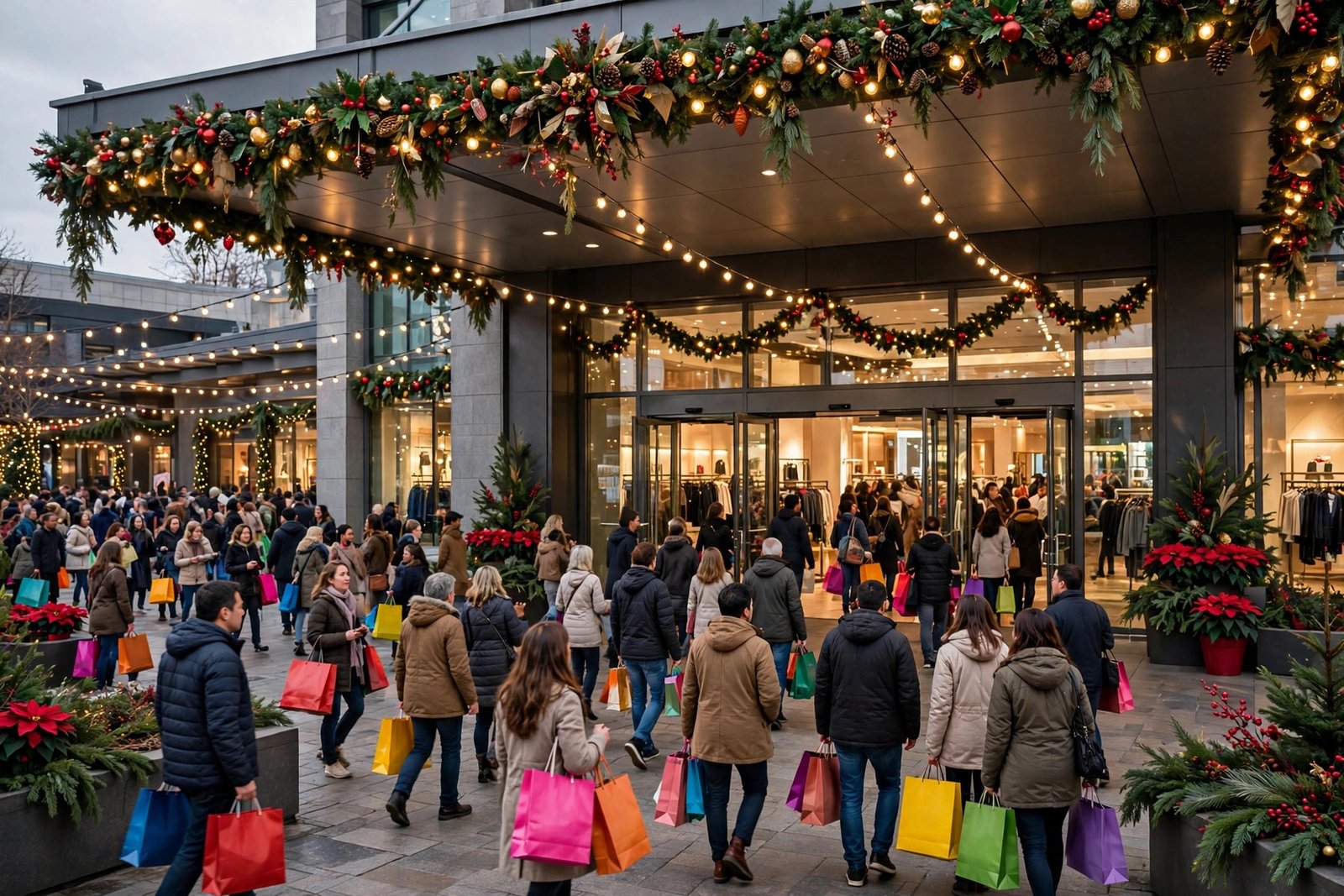
Every November, the same question pops up in search boxes, dinner-table conversations, and news reports: where did the name Black Friday actually come from? Most people have heard an answer. Some say it is the day shops finally go “into the black” and start making a profit. Others repeat a darker story involving slavery. Both explanations sound neat, and both are widely shared. Yet the real Black Friday origin is different, messier, and far more interesting. It begins not in a boardroom or an accounting ledger, but on the crowded, traffic-jammed streets of Philadelphia in the 1950s and 1960s, where police officers used the name as a complaint, not a celebration.
This is a story about how a grumble became a brand. It involves traffic police working twelve-hour shifts, shoppers pouring into a city for a football game, newspaper reporters borrowing police slang, merchants who hated the name, and retailers who, decades later, turned it into the biggest shopping event of the year. It is also a useful lesson in how easily a simple, appealing explanation can replace the real history, even when the evidence for the real history is sitting in old newspapers. For the holiday that starts the whole season, see why Americans eat turkey at Thanksgiving.
Black Friday origin: Philadelphia Police, Not Accountants
If you want the short version, here it is. The modern shopping use of the name Black Friday began in Philadelphia in the late 1950s and early 1960s. Local police officers and transit workers used the term to describe the Friday after Thanksgiving, when tens of thousands of shoppers and visitors flooded into the city centre. It was not a positive label. It was a description of a very bad day at work.
Thanksgiving itself falls on a Thursday, and the Friday after it had long been the start of the Christmas shopping season. In Philadelphia, that Friday was especially chaotic for two reasons. First, shoppers came in from the suburbs to buy Christmas presents in the big downtown department stores. Second, the annual Army-Navy football game was played in Philadelphia on the Saturday after Thanksgiving, which brought in thousands more visitors, many of whom arrived on Friday and stayed for the weekend. The result was gridlock: crowded sidewalks, traffic jams, packed buses and trains, and long, exhausting shifts for everyone who had to keep the city moving.
For the police, that Friday was the worst traffic day of the year. Officers were not allowed to take the day off, and they worked twelve-hour shifts. Even the police band was ordered into the city centre to help direct traffic, a detail that has survived in the memories of the officers and reporters who were there. Bus drivers and cab drivers used the term too, because they were stuck in the same jams. When they said Black Friday, they meant a day of headaches, not a day of bargains. That chaos is at the heart of the Black Friday origin, because the name was a description of a difficult working day, not a marketing slogan.
That is the key point to hold on to. The name started as a complaint from the people who had to manage the crowds. It was only later, when retailers and advertisers got hold of it, that it became a cheerful slogan about sales and savings.
How the Name Got Into Print
Police slang does not usually make it into the history books, so how do we know this story is true? The evidence comes from a combination of newspaper archives, the memories of the reporters who were there, and the work of language researchers who have tracked the term through old publications. Tracing the Black Friday origin through those newspapers is what separates the documented history from the later myths.
One of the most important sources is Joseph P. Barrett, a Philadelphia newspaper reporter. In a piece for the Philadelphia Daily News in November 1994, Barrett recalled that the term came from the Philadelphia Police Department’s traffic squad. He wrote that he had been assigned to cover police administration in 1959, and that he kept hearing officers use the phrase for the Friday after Thanksgiving. In the early 1960s, Barrett and Nathan Kleger, the police reporter who covered the city centre for the Evening Bulletin, put together a front-page story for Thanksgiving and borrowed the police term to describe the terrible traffic conditions.
That story annoyed downtown merchants. They complained to the police commissioner that drawing attention to traffic would put customers off coming downtown. The following year, the commissioner put out a press release describing the day as “Big Friday” instead. Barrett and Kleger ignored the rebrand and kept writing Black Friday, year after year. Big Friday never caught on, and television eventually picked up the police term as well.
Researchers have also found early print references that support the Philadelphia story. Language researcher Bonnie Taylor-Blake and linguist Ben Zimmer have traced the term through old sources, and their findings are summarised in a detailed entry on the history of the phrase. One early reference appeared in Women’s Wear Daily on November 28, 1960, describing sales forecasts and noting that in Philadelphia it had become customary for officers to refer to the post-Thanksgiving days as Black Friday and Black Saturday. A further reference in Public Relations News on December 18, 1961, used the term in its shopping sense and described it as already customary among officers. In January 1966, a column in The American Philatelist by Martin Apfelbaum, a Philadelphia stamp dealer, described the name as the police department’s term for the day and added, “It is not a term of endearment to them.” You can read the researchers’ account of the evidence here: Wordorigins.org, “Black Friday / Cyber Monday”.
That paper trail matters because it shows the name was already in regular use by the early 1960s, and that the people using it were police officers, transit workers, and the reporters who covered them. Merriam-Webster, which is cautious about origins, dates its first known use of the term in this sense to 1961, and notes that the origin is not known for certain. That caution is fair. But the Philadelphia police story has the oldest and most consistent evidence, and it is the explanation accepted by most historians of the language.
An Earlier Black Friday: The Gold Crash of 1869
There is a twist in this story. The Philadelphia police were not the first people to use the phrase Black Friday. Almost a century earlier, on September 24, 1869, the United States suffered a financial panic that became known as Black Friday. On that day, speculators Jay Gould and James Fisk tried to corner the gold market, and when their scheme collapsed, the gold market crashed, ruining many investors and shaking the American economy.
That 1869 crash is the first famous use of the term Black Friday, and it is the reason the phrase was already familiar to Americans when Philadelphia police began using it in a new sense. In the nineteenth and early twentieth centuries, the word “black” was often used to describe a day of disaster or bad news, as in Black Tuesday, the stock market crash of October 29, 1929. The police use of the term fits that older pattern: a black day was a bad day, a day of trouble.
It is important not to confuse the two events. The 1869 gold crash and the shopping day share a name, but they are not the same story. The shopping meaning did not come from the gold crash. It came from Philadelphia traffic, almost a century later. The older crash simply helps explain why the phrase was available, and why it felt natural as a label for a miserable day.
There was also an earlier, lesser-known use of the term in 1951, in a trade magazine called Factory Management and Maintenance, which used “Black Friday” to describe a day when workers called in sick after Thanksgiving. That use is interesting, but it is not the origin of the shopping meaning. It is another example of how the phrase was floating around as a label for a difficult day after a holiday, before the Philadelphia police made it famous.
The “In the Black” Myth: A Cheerful Story Invented Later
So where does the most popular explanation come from, the one that says Black Friday is the day retailers finally go “into the black”? In accounting, a business is said to be “in the red” when it is losing money, because losses were once written in red ink, and “in the black” when it is making a profit, because profits were written in black ink. According to this story, shops lose money for most of the year and only start making a profit on the Friday after Thanksgiving, when Christmas shoppers arrive in force.
It is a tidy story, and it makes retailers look like underdogs who finally get their reward. The problem is that it is not true, at least not as an origin. Language researchers describe it as a later rationalisation, dating to the 1980s, long after the Philadelphia police were already using the term. In other words, the “in the black” explanation was invented to give a negative name a positive spin, once retailers decided they wanted to embrace the day rather than fight it.
Why would retailers want to do that? By the 1970s and 1980s, the day after Thanksgiving had become an important shopping day across the United States, and the name Black Friday had spread beyond Philadelphia. But the name still sounded negative. It suggested crowds, chaos, and trouble, which was exactly what the police had meant by it. Retailers needed a friendlier story, and the accounting explanation provided one. It turned a day of traffic jams into a day of profit, and it gave shoppers a reason to feel good about taking part.
The myth also has a practical problem. It is not true that most retailers lose money until the day after Thanksgiving and only then turn a profit. Retailers make money at many times of the year, and the idea that a whole industry is “in the red” until late November is a simplification. Some shops do make a large share of their annual profit in the Christmas season, and the Friday after Thanksgiving is certainly an important day for sales, but that is not the same as the name coming from accounting. The name came first, from the police. The accounting story came later, as a marketing makeover.
The Slavery Myth: A False Story With No Evidence
There is another story about the name that circulates online, especially on social media, and it is important to address it clearly because it is false. According to this story, Black Friday is named for a day when enslavers in the American South sold enslaved people at a discount after Thanksgiving. This claim has been widely shared, but fact-checkers and historians have found no evidence to support it.
There is no historical record of such a sale day, no newspaper reference, no document, and no credible source that links the name Black Friday to the sale of enslaved people. The claim appears to be a modern invention, spread online, and it does not fit with the documented history of the term. The earliest documented uses of the name in a shopping sense point to Philadelphia in the 1960s, and the earliest famous use of the name at all points to the gold crash of 1869. Neither has anything to do with slavery.
It is worth saying this plainly, because the false story is harmful in two ways. First, it misleads people about the real history of a familiar phrase. Second, it trivialises a real and terrible part of American history by attaching it to a shopping day without evidence. The history of slavery in the United States is serious and well documented, and it deserves to be told accurately, not through invented stories about the names of sales.
When you see the slavery claim online, the safest response is to ask for a source. If a claim about history has no source, no date, and no document behind it, it is probably not history. The Philadelphia police story, by contrast, can be traced through named reporters, named newspapers, and dated publications, which is why historians accept it.
How the Black Friday origin Was Rebranded Into a Celebration
The transformation of Black Friday from a police complaint into a shopping celebration took decades, and it happened in stages. In the 1960s, the term was still largely a Philadelphia word. Local newspapers and stores in the city used it, but it was not yet a national phrase. In the 1970s, it began to spread to other cities, as newspapers and television stations picked it up. By the 1980s, it was becoming a national term, and retailers were starting to use it in advertising.
That was when the “in the black” story took hold. Retailers did not want to advertise a day named for traffic jams, so they promoted a new meaning. The day was no longer about crowds and chaos. It was about bargains, doorbuster deals, and the start of Christmas shopping. Stores began opening earlier, offering bigger discounts, and advertising Black Friday sales as an event in itself, not just a busy day.
The rebrand worked. By the 1990s and 2000s, Black Friday had become the biggest shopping day of the year in the United States, and the name was recognised around the world. Other countries adopted the idea, and online shopping added new events such as Cyber Monday, the Monday after Thanksgiving, when online retailers offer their own deals. The police origins were largely forgotten, and most shoppers who lined up outside a store at dawn had no idea that the name they were celebrating had once been a complaint about their own behaviour.
There is a certain irony in that. The police had hoped the name would put people off. They used a negative label in the hope that shoppers would stay away, or at least that the city would take the traffic problem seriously. Instead, the name stuck, the shoppers kept coming, and the retailers turned the label into a brand worth billions of dollars. It is a reminder that language does not always do what its first users intended.
Black Friday Today: Deals, Crowds, and a Debate
Today, Black Friday is a huge commercial event, and it is also a subject of debate. Supporters say it is a chance to save money on Christmas presents, and that the deals are real, especially for electronics, toys, and household goods. Critics say the deals are often exaggerated, with prices raised before the sale so that the discount looks bigger than it really is, and that the crowds and early opening hours put pressure on shop workers.
Both sides have a point, and shoppers are wise to check prices before they buy, rather than trusting a sale sign on its own. But whatever your view of the deals, the history of the name is a separate question, and it is worth knowing. When you hear the phrase Black Friday, you are hearing a piece of Philadelphia history, a reminder of a time when the day was defined not by bargains, but by the people who had to manage the crowds.
The story also offers a broader lesson about how words change. A term that starts as slang in a police station can end up on billboards around the world. A negative label can become a positive brand. And a simple, appealing explanation, like the “in the black” story, can replace the real history in the public mind, even when the evidence for the real history is available to anyone who looks. That is why it is worth going back to the sources, and to the reporters and researchers who traced the name to its beginnings. For another surprising American history story, see the first person to survive going over Niagara Falls in a barrel.
Key Takeaways
- The real story is Philadelphia in the late 1950s and early 1960s, where police officers used the term for the chaotic Friday after Thanksgiving.
- Officers worked twelve-hour shifts, could not take the day off, and faced gridlock caused by Christmas shoppers and visitors arriving for the Army-Navy football game.
- Reporters Joseph P. Barrett and Nathan Kleger borrowed the police term for a front-page story, and merchants’ attempt to rename the day “Big Friday” failed.
- An earlier Black Friday, on September 24, 1869, was a gold market crash, not a shopping day, and it is a separate story.
- The “in the black” accounting explanation is a later rebranding from the 1980s, not the original meaning of the name.
- The claim that the name comes from the sale of enslaved people has no historical evidence behind it and should not be repeated as fact.
Conclusion
So, what is the Black Friday origin, in short? It came from the streets of Philadelphia, from police officers who dreaded the Friday after Thanksgiving, from reporters who borrowed their slang, and from a city that could not cope with the crowds. It did not come from accountants, and it did not come from the story that circulates on social media. It came from traffic, and from the people who had to manage it.
That is a less cheerful story than the one retailers tell, but it is a more honest one, and it is more interesting too. It reminds us that the words we use every day have histories, and that those histories are often hidden in plain sight, in old newspapers, in the memories of reporters, and in the slang of people doing a difficult job. The next time you hear about Black Friday deals, you will know that the name began as a complaint, and that the shoppers the police were complaining about were, in the end, the very people the retailers wanted most.
Frequently Asked Questions
What is the real Black Friday origin?
The real Black Friday origin is Philadelphia in the late 1950s and early 1960s. Police officers in the city’s traffic division used the term for the Friday after Thanksgiving, when Christmas shoppers and visitors for the Army-Navy football game caused gridlock in the city centre. It was a complaint about a difficult working day, not a sales slogan.
Does Black Friday come from shops going “into the black”?
No, that is a later myth. The “in the black” accounting explanation dates to the 1980s, long after Philadelphia police were already using the term. Retailers promoted it as a friendlier meaning once they decided to embrace the name, but it is not where the name came from.
Was Black Friday named after the sale of enslaved people?
No. There is no historical evidence for that claim. Fact-checkers and historians have found no record of such a sale day, and the documented history of the name points to the 1869 gold crash and, for the shopping meaning, to Philadelphia police in the 1960s.
What was the Black Friday of 1869?
On September 24, 1869, speculators Jay Gould and James Fisk tried to corner the gold market, and when their scheme collapsed, the gold market crashed. That financial panic became known as Black Friday, and it is the first famous use of the term, almost a century before the shopping meaning appeared.
Why did merchants try to rename it “Big Friday”?
After reporters borrowed the police term for a front-page story, downtown merchants complained to the police commissioner that the negative name would put customers off coming downtown. The commissioner issued a press release calling the day “Big Friday,” but reporters kept using Black Friday, and the rebrand never caught on.