
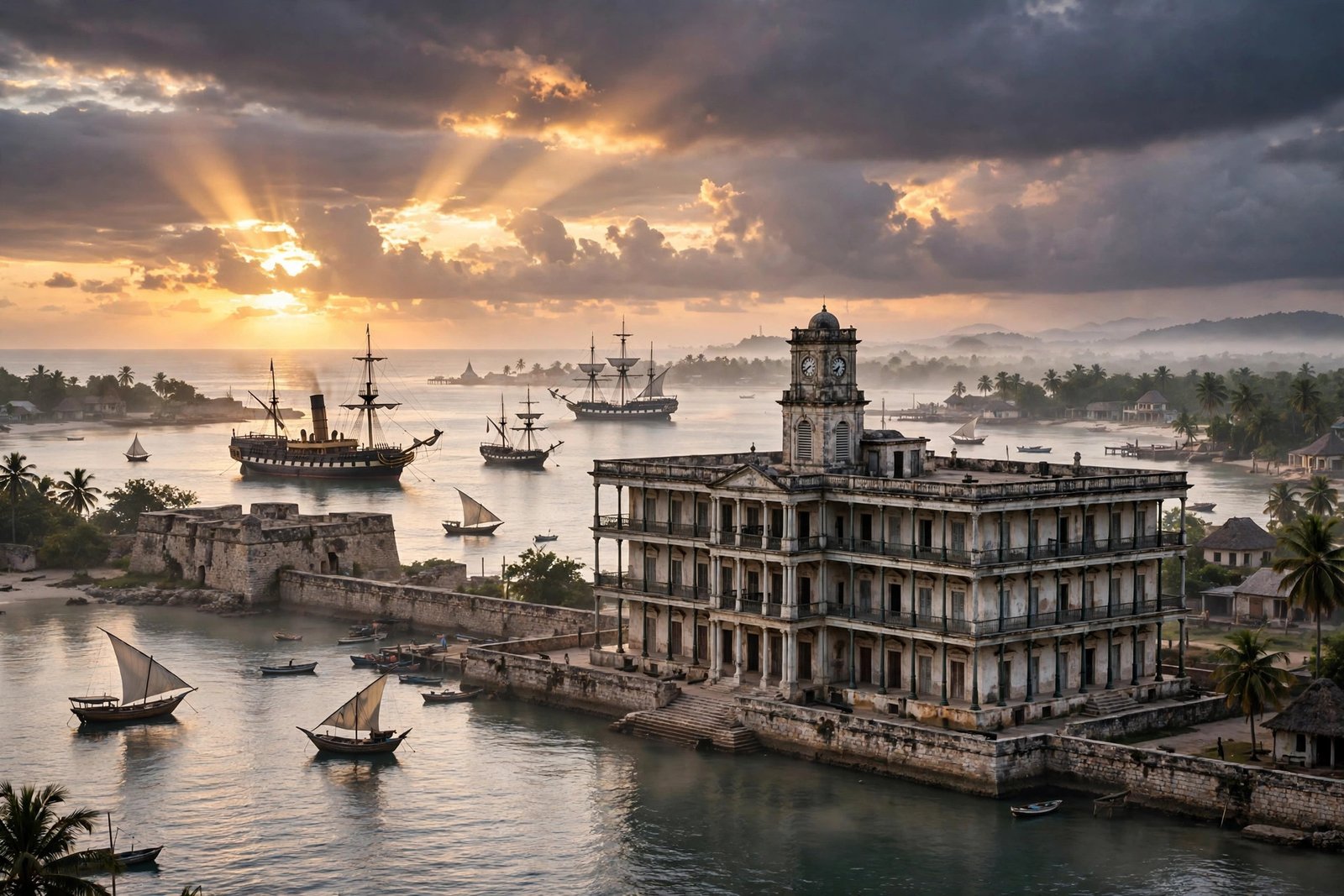
Imagine a war so short that it started after breakfast and was over before most people had finished their morning coffee. No long campaigns, no years of trench warfare, no drawn-out sieges. Just one furious burst of cannon fire, a burning palace, a sinking royal yacht, and then silence. That is the story of the shortest war in history, a real conflict fought on the island of Zanzibar in 1896 that lasted roughly 38 minutes from the first shot to the last.
It sounds like something from a comedy sketch, but the Anglo-Zanzibar War was deadly serious for the people caught in it. Around 500 Zanzibari defenders and civilians were killed or wounded in less than an hour, while the British side suffered a single wounded sailor. The war was wildly one-sided, almost absurdly so, and yet it changed the fate of an island nation for decades. How did a whole war fit inside a single hour? The answer lies in a dead sultan, a disputed throne, and the most powerful navy on Earth.
The Shortest War in History Began With a Dead Sultan
To understand the shortest war in history, you first need to understand Zanzibar in the late 1800s. The island, off the coast of East Africa, was a wealthy trading hub famous for spices, especially cloves, and it sat at the crossroads of African, Arab, Indian, and European trade. Its rulers, the sultans of Zanzibar, governed a prosperous sultanate, but by the 1890s the island was firmly inside Britain’s sphere of influence. Under the Heligoland-Zanzibar Treaty of 1890, Britain had declared Zanzibar a protectorate, which meant London expected a strong say in who ruled the island.
The sultan at the time, Hamad bin Thuwaini, was friendly to British interests. He had ruled for about three years when, on 25 August 1896, he suddenly died. Historians widely believe he was poisoned, and the prime suspect was his cousin, Khalid bin Barghash, who had long wanted the throne for himself. Khalid did not wait for permission from anyone. Within hours of Hamad’s death, he moved into the palace in Zanzibar Town, gathered supporters around him, and declared himself sultan.
There was just one problem. Britain did not want Khalid. London preferred a different candidate, Hamoud bin Mohammed, who was seen as far more cooperative. The British consul and the local British authorities told Khalid to step down. Khalid refused. He believed, or perhaps hoped, that Britain was bluffing and would never actually open fire on the palace. He was about to learn how wrong he was.
A Palace, a Yacht, and an Ultimatum
Khalid did not sit idle while the diplomats argued. He barricaded himself inside the palace on the Zanzibar waterfront and gathered a force of around 2,800 defenders. Most of them were not professional soldiers at all. They were palace servants, slaves, and civilians recruited from the town, armed with a motley collection of weapons. His artillery was equally unimpressive: a handful of Maxim machine guns, an old Gatling gun, a seventeenth-century bronze cannon, and two 12-pounder field guns.
His navy, if it could be called that, consisted of a single vessel: the royal yacht HHS Glasgow, a small ship originally given as a gift and more suited to ceremonies than combat, plus two small boats. Against this, the British assembled a force that belonged to a different century of warfare. Rear-Admiral Harry Rawson commanded a squadron in the harbor that included cruisers and gunboats, supported by around 150 Royal Marines and sailors and roughly 900 soldiers of the pro-British Zanzibari army under Brigadier-General Lloyd Mathews.
On 26 August, the British government authorized its men on the spot to take whatever measures they considered necessary. An ultimatum was delivered to Khalid: give up the palace and the throne by 9:00 a.m. on 27 August, or face the consequences. Khalid asked for more time to talk, sending a message requesting a parley. The British were not interested in delay. Khalid then replied that he did not believe the British would actually open fire. That single misjudgment would cost hundreds of lives within the hour.
38 Minutes of Thunder on the Zanzibar Waterfront
At 9:02 a.m. on 27 August 1896, the British warships opened fire. The bombardment was devastating. Shells smashed into the palace, setting parts of it ablaze and knocking out Khalid’s artillery almost immediately. The old bronze cannon and the field guns stood no chance against modern naval guns firing from the harbor. Within minutes, the palace was burning, its defenders were scattering, and the wooden structure that had symbolized the sultan’s power was collapsing into ruin.
At sea, the mismatch was just as stark. The British ships turned their guns on the HHS Glasgow, which was sunk quickly, though its crew was rescued from the water. The royal yacht’s masts reportedly remained visible above the harbor waterline for years afterward, a strange monument to a war that barely lasted long enough to be called one. By 9:40 a.m., the firing had stopped, the palace flag had been struck, and Khalid had fled to the German consulate, where he sought asylum and eventually went into exile.
The whole engagement, from the first shots at 9:02 to the last shots around 9:40, took about 38 minutes. Some sources give slightly different figures, between 38 and 45 minutes, because ships’ logs disagree about the exact moment the ceasefire was called. But the 38-minute figure is the one most often quoted, and it is the number that earned the conflict its famous record. To put it in perspective, the war lasted less time than a single episode of a television drama.
Why the Shortest War in History Was Over So Fast
So why did this war end so fast when other wars drag on for years? The answer is simple: it was never really a contest. Khalid’s forces were outgunned, outnumbered in firepower, and fighting from a fixed, exposed position against warships they could not reach. His defenders were brave, but bravery cannot stop naval shells. The British, meanwhile, had planned the operation carefully, positioned their ships perfectly, and needed only to destroy the palace artillery to break the defense entirely.
There is also a political reason for the speed. Britain did not want a long war. It wanted a quick, decisive display of power that would settle the succession question in a single morning and warn everyone else in the region that challenging British authority was pointless. In that sense, the bombardment was as much a message as a military operation. It worked. By the afternoon of 27 August, Britain had installed its preferred candidate, Hamoud bin Mohammed, as the new sultan, and life in Zanzibar Town began returning to a tense new normal.
It is worth remembering, though, that the human cost was real. Around 500 of Khalid’s supporters were killed or wounded, many of them civilians who had gathered at the palace out of loyalty or curiosity. On the British side, only one sailor was wounded. The lopsided casualty figures tell the story of the war better than any statistic about its length: this was less a battle between equals and more a demonstration of imperial power against a palace that could not defend itself.
What Happened After the 38 Minutes
The aftermath of the shortest war in history shaped Zanzibar for generations. The new sultan, Hamoud, ruled under British protection, and within a year Britain pushed through the abolition of slavery in Zanzibar, a reform it had long demanded. Khalid himself remained in exile for years. He was eventually captured by the British during the First World War, after which he agreed to renounce his claim to the throne and live quietly in exile.
Zanzibar remained a British protectorate until December 1963, when it became independent. The following year, in 1964, it merged with Tanganyika to form the United Republic of Tanzania, the country we know today. The palace that burned in 1896 was rebuilt, and the site of the bombardment is now part of Stone Town, a UNESCO World Heritage site that draws visitors from around the world. Few tourists strolling its narrow streets realize they are walking through the battlefield of the world’s briefest war.
The Anglo-Zanzibar War also left behind a lesson that still resonates. Wars are not always decided by courage or numbers. Technology, positioning, and the cold logic of power can settle a conflict in minutes when one side holds every advantage. Khalid’s defiance lasted less than an hour because the gap between his palace guard and the Royal Navy was simply too vast to bridge.
Key Takeaways
- The Anglo-Zanzibar War was fought on 27 August 1896 between Britain and the Sultanate of Zanzibar, and it lasted about 38 minutes.
- The trigger was a disputed succession: after the pro-British Sultan Hamad bin Thuwaini died suddenly, his cousin Khalid bin Barghash seized the throne against Britain’s wishes.
- British warships under Rear-Admiral Harry Rawson opened fire at 9:02 a.m. after Khalid ignored an ultimatum to surrender by 9:00 a.m.
- About 500 Zanzibaris were killed or wounded, while only one British sailor was wounded, showing just how one-sided the fighting was.
- Britain installed Hamoud bin Mohammed as sultan the same afternoon, and Zanzibar stayed a British protectorate until independence in 1963.
- History’s strangest military mismatches make great reading: if you enjoyed this, check out the time an army lost a war against birds in Australia and the blood-soaked true story behind Dracula.
Conclusion
The Anglo-Zanzibar War, the shortest war in history, remains one of history’s most astonishing footnotes: a war declared, fought, and finished in less time than it takes to watch a movie’s opening act. It is funny, in a dark way, to imagine generals planning a campaign that ended before lunch. But behind the record-book trivia lies a real story about empire, ambition, and the ordinary people who paid the price when a sultan gambled against the Royal Navy and lost. Next time someone tells you wars always last for years, tell them about the morning of 27 August 1896, when an entire war came and went in 38 minutes.
For more on this remarkable conflict, see the detailed account at Wikipedia’s Anglo-Zanzibar War page, the History Today archive on the war, and BBC History Magazine’s story of the war Britain won in 38 minutes.
Frequently Asked Questions
What was the shortest war in history?
The Anglo-Zanzibar War of 1896 is considered the shortest war in recorded history. Fought between Britain and the Sultanate of Zanzibar on 27 August 1896, it lasted about 38 minutes, from the start of the British naval bombardment at 9:02 a.m. until the firing stopped around 9:40 a.m.
Why did the Anglo-Zanzibar War start?
The war began as a succession dispute. After the pro-British Sultan Hamad bin Thuwaini died suddenly on 25 August 1896, his cousin Khalid bin Barghash seized the throne without British approval. Britain wanted Hamoud bin Mohammed as sultan instead, issued an ultimatum, and opened fire when Khalid refused to step down.
How many people died in the Anglo-Zanzibar War?
Around 500 Zanzibari defenders and civilians were killed or wounded during the bombardment, while the British side suffered just one wounded sailor. The huge imbalance reflects how one-sided the fighting was, with modern warships firing on a palace defended by lightly armed men.
What happened to Sultan Khalid after the war?
Khalid fled to the German consulate in Zanzibar Town as the palace burned and later went into exile. He was captured by the British during the First World War and agreed to give up his claim to the throne, living the rest of his life in exile.
Is the Anglo-Zanzibar War really the shortest war ever?
Yes, by the commonly accepted measure. Some sources quote 40 or 45 minutes because ships’ logs differ on the exact ceasefire time, but the 38-minute figure is the most widely cited, and no other recorded war between states comes close to that brevity.