
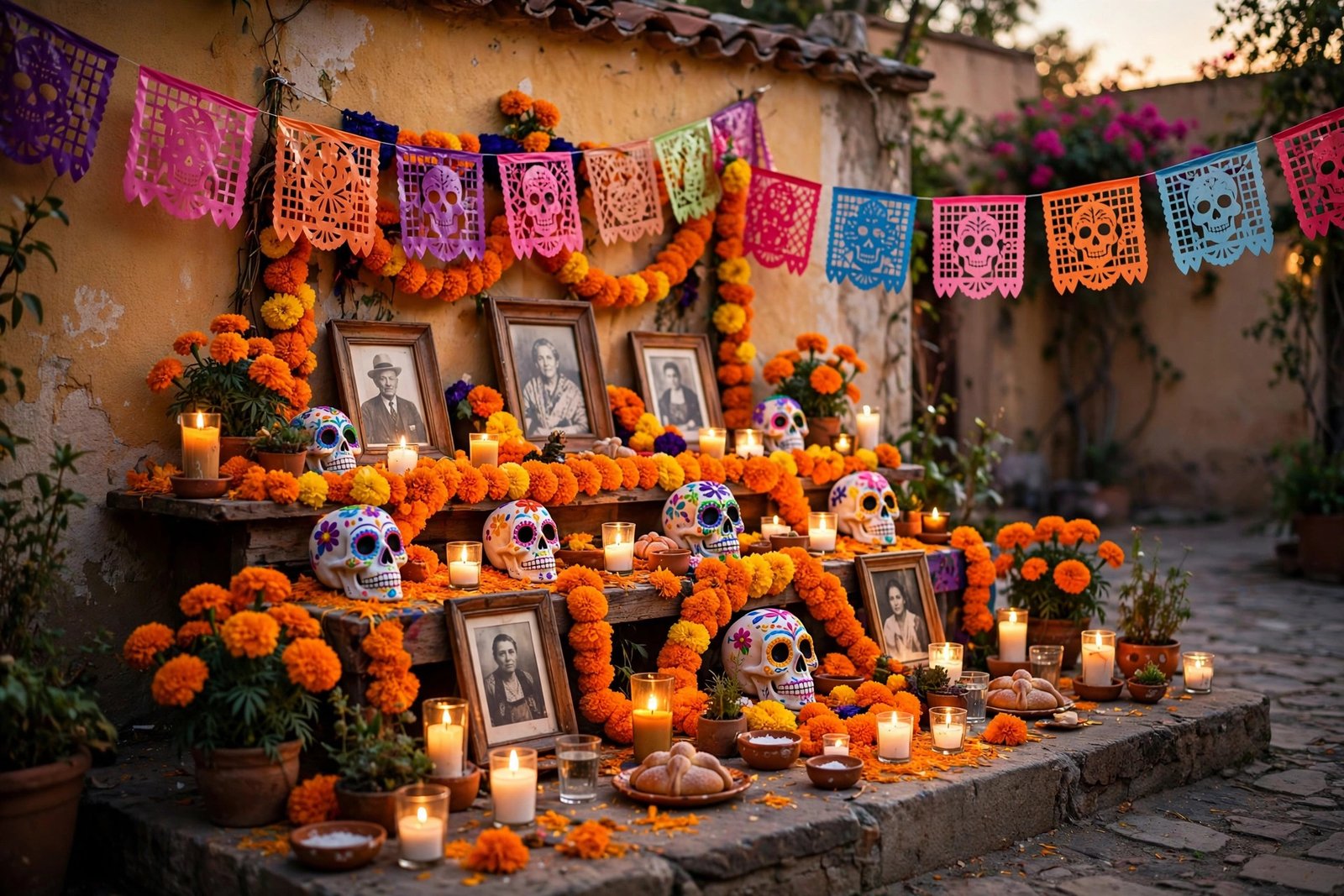
Every year on November 1 and 2, cemeteries across Mexico glow with thousands of candles, fill with the scent of marigold flowers, and buzz with music, food, and family stories. To an outsider, it can look like a spooky festival. But the most surprising Day of the Dead facts reveal something very different: this is not a day for fear, ghosts, or horror. It is a joyful reunion between the living and the dead, a celebration built on love, memory, and centuries of tradition.
Known in Spanish as Día de los Muertos, this holiday invites families to welcome back the spirits of their loved ones for a short visit. People build altars in their homes, cook the favorite foods of those who have passed away, and spend the night beside graves, talking, laughing, and remembering. Far from being a sad occasion, it treats death as a natural part of life, something to honor rather than hide from.
If you have ever wondered what this colorful celebration is really about, you are in the right place. In this article, we dig into the history, symbols, and customs that make this holiday so special, and clear up the biggest misconception of all: why it is definitely not Mexico’s version of Halloween.
Day of the Dead Facts: A Celebration, Not a Funeral
The first thing to understand is the mood. While many cultures treat death as a taboo subject, Mexican tradition approaches it with warmth and even humor. Skeletons dance in parades, sugar skulls carry the names of the living, and families picnic in cemeteries. None of this is meant to be scary. The skeletons, called calaveras, are a playful reminder that death comes for everyone, rich or poor, famous or unknown, so life should be enjoyed while it lasts.
The holiday takes place over two days. November 1 is traditionally dedicated to children who have died, sometimes called angelitos, or little angels. November 2 is dedicated to adults. In many communities, the celebrations actually begin on October 31, with preparations building across several days as families clean graves, shop for flowers, and bake special bread.
At the heart of the holiday is a beautiful belief: that the souls of the departed return to visit their families during this time. The living prepare a welcome for them, with everything a tired traveler might need after a long journey. Food, water, candles, flowers, and photographs all play a part. It is hospitality, extended across the boundary between life and death.
This is also why the holiday is a family affair. Grandparents tell stories about relatives the younger generation never met. Children learn family history not from a textbook, but from an altar covered in photographs and favorite dishes. Memory becomes something you can taste, smell, and touch.
Aztec Roots Stretch Back Thousands of Years
The Day of the Dead did not appear out of nowhere. Its roots reach back to the Aztec civilization and other Indigenous peoples of Mexico, who honored their dead with rituals and festivals long before Europeans arrived. The Aztecs held celebrations dedicated to the goddess Mictecacíhuatl, known as the Lady of the Dead, and believed that death was simply a continuation of life in another form.
In Aztec belief, the dead traveled to the underworld, a place called Mictlán, on a journey that could take years. Families honored them with offerings and rituals along the way. Death was not an ending to be feared but a stage in a longer cycle, much like the seasons changing from harvest to winter and back to spring.
When Spanish colonizers arrived in the 16th century, they brought Catholic traditions, including All Saints’ Day on November 1 and All Souls’ Day on November 2. Over time, these Catholic observances blended with Indigenous customs. The result was something entirely new: a holiday that honors the Catholic calendar dates but keeps its Indigenous soul, with altars, flowers, and food offerings at its center.
That blending is part of what makes the celebration so rich today. It carries layers of history in every element, from the ancient marigold to the colonial church bells that ring across Mexican towns on these nights. These ancient roots are among the most fascinating Day of the Dead facts, because they show a holiday that is thousands of years old and still evolving.
Day of the Dead Facts About Ofrendas, the Altars of Welcome
The ofrenda is the centerpiece of the celebration, and understanding it unlocks the meaning of the whole holiday. An ofrenda is an altar, usually built in the home, covered with offerings for a specific departed loved one. No two ofrendas are exactly alike, because each one is personal.
A traditional ofrenda often has several levels. The top level may hold photographs of the deceased, while lower levels hold their favorite foods and drinks. Families place pan de muerto, a sweet bread baked especially for the occasion, alongside sugar skulls, fruit, and sometimes a bottle of the person’s favorite drink. A glass of water is set out to quench the spirit’s thirst after its journey, and salt is included as a symbol of the continuation of life.
Candles play a vital role. Their flames are said to guide the spirits home, lighting the way through the darkness. In some homes, families light one candle for each departed soul they are welcoming. Incense, traditionally copal, fills the air with a rich scent that is believed to purify the space and attract the spirits.
Perhaps the most moving part of an ofrenda is the personal detail. A grandfather’s hat, a grandmother’s favorite shawl, a child’s beloved toy, or a musician’s instrument might all appear. These objects are not decorations. They are invitations, ways of saying: we remember exactly who you were, and you belong here.
Some ofrendas are built in cemeteries, right beside the grave. Families may spend the whole night there, eating, drinking, playing music, and telling stories. In towns like Mixquic and Janitzio, these overnight vigils draw visitors from around the world, but for the families themselves, the night is deeply personal.
Marigolds and Monarch Butterflies: Nature’s Part in the Story
Few flowers are as tied to a holiday as the marigold, or cempasúchil, is to the Day of the Dead. These bright orange and yellow flowers are scattered everywhere during the celebration: across altars, along pathways, and over graves. Their strong scent and vivid color are believed to help guide the spirits to their altars, like a trail of sunlight leading them home.
In the weeks before the holiday, marigold fields across Mexico burst into bloom, turning whole landscapes gold. The flower’s connection to the sun runs deep in Aztec tradition, where it was associated with the sun god. Petals are often scattered to form paths from the street to the altar, so that no visiting spirit loses its way.
Then there is one of nature’s most poetic coincidences. Every autumn, millions of monarch butterflies migrate from North America to the forests of central Mexico, arriving around the same time as the holiday. For many Mexicans, the butterflies’ arrival feels like the return of the ancestors themselves. The timing is so perfect that it is easy to see why the connection took hold, and the butterflies have become a beloved symbol of the celebration.
Whether or not you believe the butterflies carry souls, their arrival adds a layer of wonder to the holiday. One of the most delightful Day of the Dead facts is that nature itself seems to be taking part in the reunion, with the monarch migration arriving right on schedule each year.
Sugar Skulls, Skeletons, and the Art of Laughing at Death
Sugar skulls, or calaveras de azúcar, are among the most recognizable symbols of the holiday. These decorated skulls, made from sugar paste and adorned with colorful icing, often carry a person’s name written across the forehead. They are given as gifts to friends and family, and they are placed on altars as offerings.
Giving someone a sugar skull with their own name on it might sound strange, but the meaning is affectionate. It is a playful way of acknowledging that death touches everyone, and that facing it with humor is healthier than fearing it. Children especially delight in receiving skulls bearing their names.
The skeleton figures known as calaveras appear in art, parades, and decorations throughout the holiday. Perhaps the most famous is La Catrina, an elegant skeleton lady dressed in a fancy hat and fine clothes. She began as a satirical figure created by Mexican artist José Guadalupe Posada, poking fun at wealthy Mexicans who imitated European fashions while ignoring their Indigenous roots. Today, she is an icon of the holiday, appearing in face paint, costumes, and artwork everywhere.
People also write calaveras literarias, short humorous poems that imagine famous or familiar people as skeletons. These verses, shared in newspapers and classrooms, tease politicians, celebrities, and friends alike. The joke is always the same: death is the great equalizer, and no one escapes it, so we might as well laugh together.
This humor is not disrespectful. It is the opposite. By laughing at death, the celebration takes away its power to terrify, leaving room for grief, love, and memory to breathe. Among the most surprising Day of the Dead facts is that this laughter is itself a form of respect, a way of keeping the dead close instead of pushing them away in fear.
Why It Is Not Mexico’s Halloween
Here is the misconception that needs clearing up once and for all. Because the Day of the Dead falls close to Halloween on the calendar, many people outside Mexico assume it is simply the Mexican version of Halloween. It is not. The two holidays have different origins, different meanings, and different moods.
Halloween traces its roots to the Celtic festival of Samhain and later to Christian observances in Europe, evolving over time into a night of costumes, trick-or-treating, and spooky fun. Its modern form is largely about playful fright. The Day of the Dead, by contrast, is about remembrance and reunion. Its central act is not asking strangers for candy but welcoming your own ancestors home.
- Purpose: Halloween celebrates spookiness and fun; the Day of the Dead honors and remembers specific loved ones who have died.
- Origins: Halloween comes from Celtic and European traditions; the Day of the Dead comes from Aztec and Indigenous Mexican traditions blended with Catholic observances.
- Key activity: Halloween is about costumes and trick-or-treating; the Day of the Dead is about building ofrendas, visiting cemeteries, and sharing family meals.
- Attitude toward death: Halloween plays with fear; the Day of the Dead treats death as a natural, even comforting, part of life’s cycle.
- Symbols: Halloween has pumpkins, ghosts, and witches; the Day of the Dead has marigolds, sugar skulls, and photographs of ancestors.
That said, the two holidays do share some distant DNA. Both grew partly out of ancient beliefs about the boundary between the living and the dead growing thin at this time of year. And in recent decades, Halloween customs like costumes have influenced celebrations in some Mexican cities. But the heart of the holiday remains entirely its own.
If you enjoy Halloween traditions, you might love learning about where trick-or-treating really came from, or why black cats became linked to bad luck. And for another sweet piece of holiday history, read about the surprisingly long story of candy corn. Each one shows how holidays we think we know can hide fascinating histories.
UNESCO Recognition and a Worldwide Celebration
In 2008, UNESCO added Mexico’s Indigenous Festivity dedicated to the Dead to its list of the Intangible Cultural Heritage of Humanity. The recognition honored the holiday as a living tradition that strengthens community bonds and keeps Indigenous heritage alive. It was a landmark moment, confirming what Mexicans had always known: this celebration is a cultural treasure.
Since then, the holiday’s fame has spread even further. Among modern Day of the Dead facts, one of the happiest is how the animated film Coco introduced millions of children around the world to ofrendas, marigolds, and the idea of remembering ancestors with joy. Major parades, like the Desfile de Día de Muertos in Mexico City, now draw huge crowds, with giant skeleton puppets, floats, and dancers filling the streets.
Celebrations have also taken root far beyond Mexico. Mexican communities in the United States, from Los Angeles to Chicago, build ofrendas in museums, schools, and community centers. Cities host festivals, exhibitions, and workshops where visitors can learn to make sugar skulls or paint their faces as calaveras. The holiday’s message, that remembering the dead is an act of love, resonates across cultures.
Yet with fame comes a caution. Many Mexicans ask that visitors approach the holiday with respect, understanding it as a sacred family tradition rather than a costume party. The best way to honor it is to learn its meaning, appreciate its beauty, and remember your own loved ones with the same tenderness.
Takeaways Worth Remembering
- The Day of the Dead is a joyful reunion with departed loved ones, not a horror festival.
- Its roots stretch back to Aztec rituals, later blended with Catholic All Saints’ and All Souls’ Days.
- Ofrendas, marigolds, sugar skulls, and candles each carry deep symbolic meaning.
- November 1 honors departed children, and November 2 honors departed adults.
- UNESCO recognized the celebration as Intangible Cultural Heritage of Humanity in 2008.
- It is not Mexican Halloween: different origins, different purpose, different spirit.
Conclusion: A Holiday That Teaches Us How to Remember
There is a reason the Day of the Dead moves so many people, even those encountering it for the first time. In a world that often rushes past grief, this holiday slows down and makes room for it. It says that the dead are not gone as long as they are remembered, that a favorite meal, a photograph, and a story told aloud can keep a person close.
So this November 1 and 2, whether you build an ofrenda, light a candle, or simply pause to remember someone you have lost, you will be taking part in one of humanity’s most beautiful ideas: that love does not end at death. It changes form, becomes memory, and is passed from one generation to the next, like marigold petals scattered along the path home.
To learn more, explore the National Geographic guide to the holiday and the top things to know about the Day of the Dead, as well as The Collector’s in-depth explainer on what the Day of the Dead is. Both offer rich background on the traditions described here.
When is the Day of the Dead celebrated?
The Day of the Dead is celebrated on November 1 and 2 each year, with November 1 traditionally honoring departed children and November 2 honoring departed adults. Preparations often begin in the days before, as families clean graves, buy marigolds, and bake pan de muerto.
Is the Day of the Dead the same as Halloween?
No. Although the dates are close, the two holidays have different origins and purposes. Halloween grew from Celtic and European traditions and centers on spooky fun, while the Day of the Dead grew from Aztec and Indigenous Mexican traditions and centers on remembering and welcoming departed loved ones.
What is an ofrenda?
An ofrenda is an altar built to welcome the spirits of departed loved ones. It typically holds photographs, candles, marigold flowers, incense, water, salt, pan de muerto, sugar skulls, and the favorite foods and personal belongings of the person being honored.
Why are marigolds used in the celebration?
Marigolds, known as cempasúchil, are bright orange flowers whose strong scent and vivid color are believed to guide spirits to their altars. Petals are often scattered to form paths from the street to the ofrenda, and the flowers are linked to the sun in Aztec tradition.
What are sugar skulls?
Sugar skulls, or calaveras de azúcar, are decorated skulls made from sugar paste, often bearing a person’s name in icing. They are given as gifts and placed on altars, playfully acknowledging that death touches everyone and turning a frightening subject into something joyful and affectionate.