
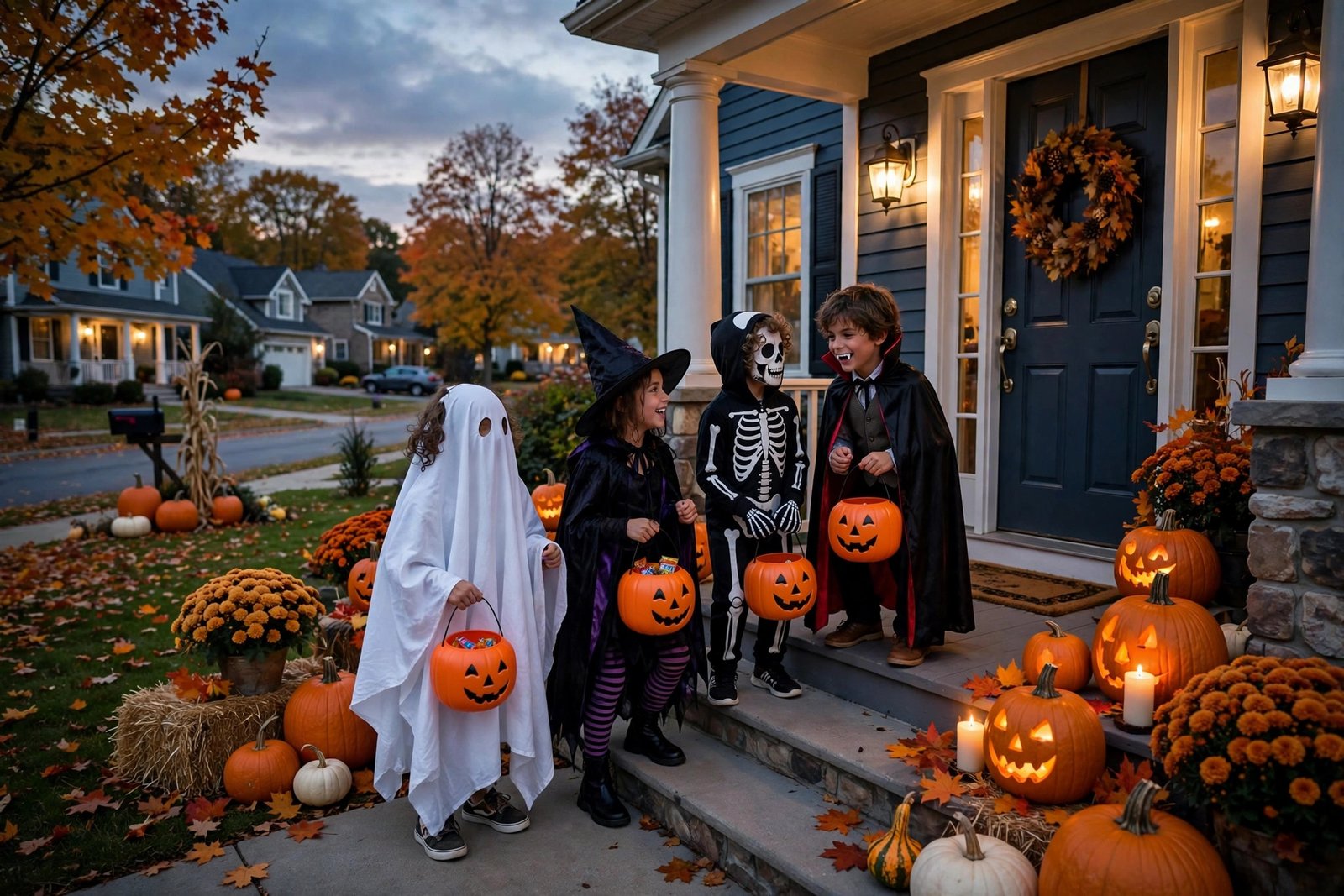
Picture a street full of small ghosts, superheroes, and witches knocking on doors and calling out for sweets. It feels like a custom that has always existed, yet the trick or treat origin is a long, winding story that crosses more than two thousand years, several countries, and many different ideas about death, generosity, and community. It did not begin with candy companies, and it did not begin in one single night. Instead, it grew slowly, as old festivals were reshaped by new religions, new waves of immigration, and new neighborhoods.
That is what makes this history so satisfying. Every part of the modern ritual has an ancestor: the costume, the door-to-door visit, the small performance, the gift of food, and even the playful threat hidden in the phrase itself. Follow those threads backward and you find bonfires in ancient fields, cakes baked for the dead in medieval towns, and children in Scotland and Ireland earning treats with a song. Follow them forward and you arrive at the porch lights, pillowcases, and candy buckets we know today.
The Trick or Treat Origin in Celtic Samhain
Halloween has its roots in Samhain, a Celtic festival that marked the end of the harvest season and the beginning of the darker half of the year. It was celebrated on the night of October 31, a boundary moment when summer gave way to winter. For farming communities, this was a serious turning point. Crops had to be gathered, animals brought in, and preparations made for the cold months ahead. The festival therefore mixed practical work with ritual, feasting, and remembrance.
According to Celtic belief, this was also a night when the boundary between the living and the dead grew thin. People believed that spirits could return to the world of the living, and communities responded with bonfires, offerings, and gatherings meant to honor the dead and protect the living. Food was sometimes left out to placate unwelcome spirits, and some celebrants wore costumes made from animal skins. Historians at HISTORY describe these Samhain customs as one of the earliest influences on modern Halloween, a point explored in their account of how trick-or-treating became a Halloween tradition.
It is important not to overstate what we know. No one left behind a complete instruction manual for Samhain, and later writers have sometimes filled the gaps with dramatic detail. What is well supported is the broad shape: a late-October festival, a concern with the dead, fire, food, and disguise. Those four ingredients would echo through everything that followed, even as their meanings changed.
Souling and Guising: The Medieval Door-to-Door Customs
Centuries later, as Christianity spread through Celtic lands, older seasonal festivals blended with church holy days. November 1 became All Saints Day, and November 2 became All Souls Day, a day for remembering and praying for the dead. Around those dates, a new door-to-door custom appeared in parts of Britain. It was called souling.
In souling, poor people visited the homes of wealthier neighbors and offered to pray for their dead relatives. In return, they received soul cakes, small round pastries made for the occasion. Over time, children increasingly took part, and the custom became a familiar sight in towns and villages. The exchange was simple and human: a prayer, a visit, and a small gift of food. It also established a pattern that still defines Halloween night, namely that a household visit could carry a social meaning beyond the food itself.
A related custom, known as guising, developed in Scotland and Ireland. Children dressed in disguise and went from house to house, but instead of offering prayers, they performed. A song, a poem, a joke, or a short recitation earned them food, coins, or other small treats. The word itself comes from disguise, and the idea was that the costume was part of the bargain. You did not simply ask; you entertained. That playful performance element is easy to recognize today, when a child in costume is expected to say the magic words and, sometimes, to show off the outfit before the candy appears.
These customs were not identical, and they did not merge overnight. They were local, varied, and shaped by each community. Yet together they explain why Halloween eventually involved going house to house in costume rather than simply staying home. Like many folk customs, from knocking on wood to seasonal games, they survived because they were fun, social, and easy to pass on. Readers curious about another everyday superstition can explore why we knock on wood, a custom with its own tangled history.
The Trick or Treat Origin Moves to America
When Irish and Scottish immigrants came to North America, especially in large numbers during the 1800s, they brought Halloween customs with them. In their new neighborhoods, souling and guising were remembered, revived, and adapted. Children dressed up, visited neighbors, and received food, fruit, nuts, coins, and small toys. The custom was not yet national, and it looked different from town to town, but its basic shape was already familiar.
The phrase itself, trick or treat, appeared in North America in the 1920s. It captured the joke at the heart of the visit: give us a treat, or expect a trick. In practice, the trick was rarely serious. It was a piece of theater, a lighthearted bargain that let children play at being mischievous while adults played along. As the trick or treat origin story crossed the Atlantic, it therefore gained a catchphrase that made it easy to remember, easy to chant, and easy to pass from one generation to the next.
During the 1920s and 1930s, Halloween in some American towns also became associated with pranks and rowdy behavior. Community leaders, parents, and schools increasingly promoted organized, family-friendly trick-or-treating as a safer and more sociable alternative. The idea was simple: give young people a structured, fun activity, and the night becomes a neighborhood celebration rather than a night of mischief. That push helped turn a scattered immigrant custom into a shared community event.
How Sugar Rationing, Suburbs, and Candy Changed Everything
The custom spread widely across the United States in the 1940s and 1950s, after wartime sugar rationing ended. Candy, which had been scarce during the war, became plentiful again, and families had more to share. At the same time, new suburban neighborhoods were growing, with rows of houses, sidewalks, and porches that were ideal for door-to-door visits. Trick-or-treating fit this new landscape perfectly. A child could walk a whole block, visit dozens of doors, and return home with a bag full of treats.
That postwar boom turned the trick or treat origin into a national childhood memory. Candy makers began marketing sweets specifically for Halloween, and wrapped, bite-sized treats became the practical standard. They were affordable, easy to hand out, and easy for parents to inspect. Homemade treats, fruit, and coins did not disappear overnight, but candy gradually took center stage. By the 1950s, the image of Halloween in America was firmly fixed: costumes, porch lights, and candy.
Television, magazines, and later films helped spread that image even further. Halloween specials, costume advertisements, and neighborhood stories taught children in places where the custom was still new exactly how the night was supposed to work. The result was a feedback loop. The more people practiced trick-or-treating, the more normal it seemed, and the more normal it seemed, the more people joined in.
What Trick-or-Treating Looks Like Today
Today, trick-or-treating is a large, flexible tradition. In many neighborhoods, families still walk from door to door after dark, with parents nearby and porch lights signaling which houses are welcoming visitors. In other places, communities organize trunk-or-treat events in parking lots, school parties, and mall events, giving children the same costume-and-candy experience in a contained setting. Safety advice has become part of the ritual too: reflective costumes, flashlights, staying in groups, and checking treats at home.
Today’s version still carries the trick or treat origin in its bones. The costume recalls Samhain disguises and guising. The door-to-door visit recalls souling. The chant recalls the playful bargain that gave the custom its name. Even the treats recall centuries of food offerings, from soul cakes to fruit to wrapped candy. What has changed most is the scale and the mood. The night is now overwhelmingly about fun, creativity, and community, rather than fear of the dead or prayers for souls.
That evolution is part of the charm. Halloween has absorbed new ideas without losing its old shape. Black cats, pumpkins, haunted houses, and spooky decorations all add to the atmosphere, and cat lovers may enjoy a lighter seasonal read in National Cat Day facts, which celebrates feline companions, including the black cats so often linked with Halloween imagery.
Takeaways: Why This History Still Matters
- Halloween grew from Samhain, a Celtic festival marking the end of harvest and the start of winter, when the dead were believed to draw near.
- Medieval souling exchanged prayers for soul cakes, while Scottish and Irish guising exchanged performances for food and small treats.
- Immigrants carried these customs to North America, where the phrase trick or treat appeared in the 1920s.
- The custom spread across the United States in the 1940s and 1950s, once sugar rationing ended and suburban neighborhoods made door-to-door visits easy.
- Candy became the standard treat, but the costume, the visit, and the playful bargain are far older than the candy itself.
So the next time a small ghost appears at your door, remember the trick or treat origin behind the smile and the outstretched bucket. You are taking part in a tradition shaped by Celtic farmers, medieval neighbors, Scottish and Irish children, immigrant families, and postwar suburbs. It survived because it kept changing just enough to stay fun, and because at its heart it has always been about the same simple things: dressing up, visiting neighbors, and sharing a little sweetness on a dark autumn night.
When did trick-or-treating begin?
There is no single starting date. It grew over centuries from Celtic, medieval, and later North American customs, and became a widespread American tradition in the 1940s and 1950s.
What was souling?
Souling was a medieval custom in which poor people went door to door offering prayers for the dead in exchange for soul cakes, small pastries given by wealthier households.
What was guising?
Guising was a Scottish and Irish custom in which children in disguise performed a song, joke, or recitation in exchange for food or small treats.
Why do children wear costumes on Halloween?
Costumes trace back to disguises worn during Samhain and later customs, when people dressed up to mark the turning of the seasons and, in folk belief, to blend in with or ward off wandering spirits.
When did candy become the usual treat?
Candy became the standard treat in the United States after wartime sugar rationing ended and the custom spread widely in the 1940s and 1950s, helped by suburban neighborhoods and mass-produced wrapped sweets.