
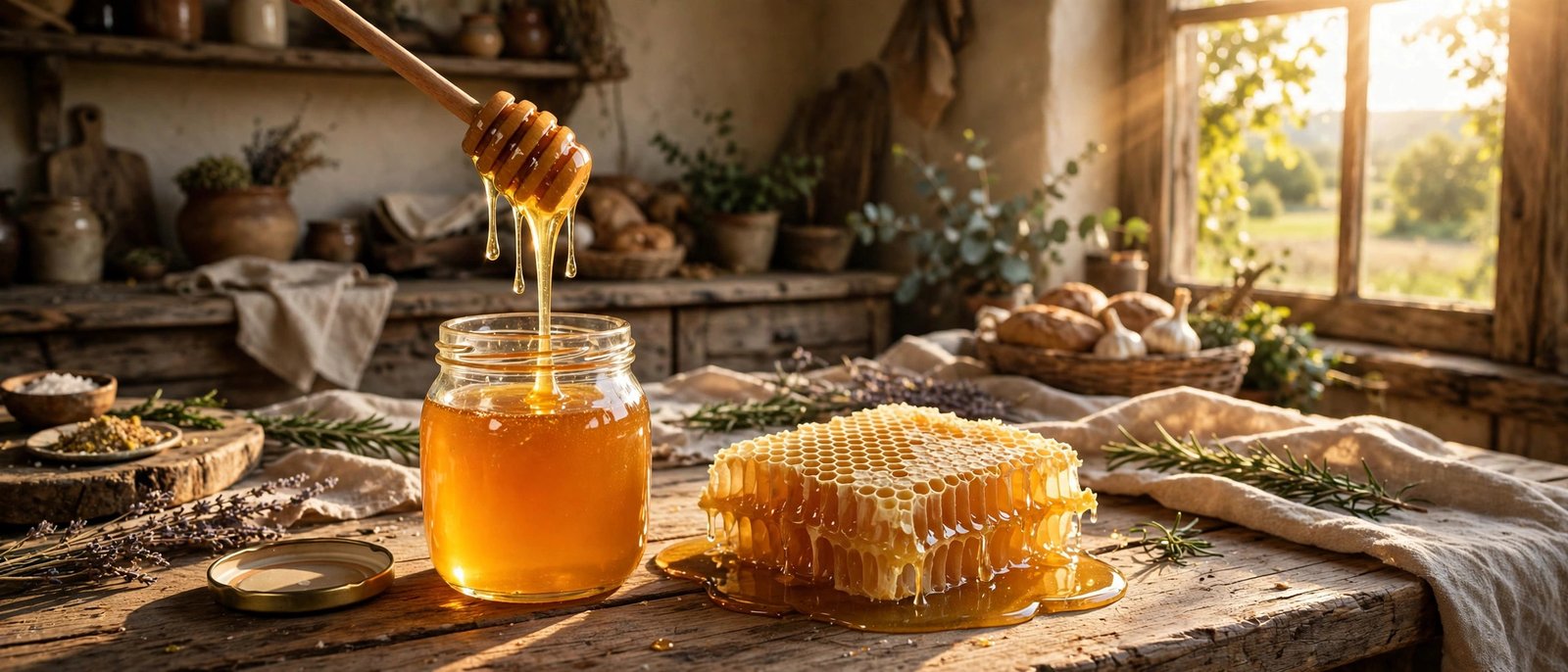
Open a jar of honey that has sat in your cupboard for years and you may expect it to have gone bad, like milk or bread. Instead, it usually smells sweet, tastes familiar, and looks ready to pour. That is no accident. The reason honey never expires is a clever combination of chemistry and bee behavior, a natural preservation system so effective that archaeologists have found pots of honey in ancient Egyptian tombs, thousands of years old, still edible. No refrigerator, no artificial preservatives, and no modern packaging were needed. The bees did the work.
This is not a claim that honey is magic. It is a story about water, acidity, and enzymes, three ordinary defenses that together create an environment where most microbes simply cannot survive. Once you understand those defenses, you will also understand why honey sometimes turns cloudy or solid, why a wet spoon matters more than an old date on a label, and why this golden food has been prized for thousands of years.
Why Honey Never Expires: A Desert for Germs
The first defense is water, or rather, the lack of it. Honey has an extremely low water content. Most of what is in the jar is sugar, with only a small amount of water left behind. That matters because bacteria and mold need available water to grow, feed, and reproduce. Take that water away and they struggle to survive, no matter how long they sit in the jar.
Sugars also pull water toward themselves, a property scientists call hygroscopic. In practice, this means honey does not just lack water; it actively draws moisture out of anything that lands in it. A bacterium that falls into honey can lose water from its own cells, which damages it and stops it from multiplying. Imagine a desert at microscopic scale. There may be plenty of energy in the form of sugar, but without usable water, most microbes cannot make a living there.
Bees work hard to create this dry environment. They collect nectar, which is mostly water, and then process it again and again inside the hive. Worker bees pass nectar between one another, add their own enzymes, and fan the comb with their wings to evaporate water. Only when the honey is thick enough do they seal the cell with wax. That sealed, low-water syrup is the starting point for honey’s long life, and it is why a properly sealed jar at home can stay good for so long.
Acidity and Bee Enzymes: Honey’s Second Line of Defense
Low water alone would be impressive, but honey has more protection. It is naturally acidic, which creates another hostile condition for many bacteria. Most microbes prefer a more neutral environment, and the acidity of honey makes it harder for them to grow. This acidity comes from the nectar, the bees, and the chemical changes that happen as nectar becomes honey.
Then there is a quieter chemical defense: hydrogen peroxide. Bee enzymes, added during honey production, can produce small amounts of hydrogen peroxide when honey is diluted. Hydrogen peroxide is a mild antiseptic, and in honey it helps suppress microbes that might otherwise try to grow. The amounts are small, and they work slowly, but combined with low water and acidity, they form a layered defense. No single factor explains honey’s longevity. It is the combination that does the job.
That layering is a useful lesson in food science. Many preserved foods rely on one trick, such as salt, drying, or refrigeration. Honey relies on several tricks at once, all built into the food itself. Remove one layer and honey becomes more vulnerable, which is why storage matters. Add water, for example, and you dilute the sugars, raise the available moisture, and weaken the whole system.
Honey Never Expires: Proof From Ancient Egyptian Tombs
The most famous proof of honey’s staying power comes from archaeology. Modern archaeologists excavating ancient Egyptian tombs have often found pots of honey among the burial goods, thousands of years old, and yet still preserved. Smithsonian Magazine describes this discovery in the science behind honey’s eternal shelf life, noting that honey can remain in a completely edible form long after the civilization that made it has vanished.
Ancient Egyptians valued honey for food, medicine, and ritual, so it is no surprise that jars were placed in tombs as provisions for the afterlife. What is surprising is how well those jars survived. While bread, meat, and other organic offerings decayed, sealed honey endured, protected by its chemistry and by the dry, sealed conditions of the tomb. Readers fascinated by ancient Egypt can explore another remarkable survival story in the ancient Egyptian mummy mud shell secret, which shows how much ingenuity went into preserving things for eternity.
It is worth being honest about what edible means here. Ancient honey may have darkened, thickened, or crystallized over thousands of years, and no one should rush to taste an archaeological artifact. The point is not that old honey tastes exactly like a fresh jar. The point is that its chemistry prevented the kind of bacterial decay that destroys most foods. That distinction is what makes honey so unusual, and so endlessly fascinating.
Crystallization Is Not Spoilage
If honey truly lasts so long, why does it sometimes turn cloudy, grainy, or solid in the jar? The answer is crystallization, and it is completely natural. Honey is a supersaturated sugar solution, which means it contains more dissolved sugar than water can comfortably hold at room temperature. Over time, some of that sugar, especially glucose, can separate out and form crystals.
That is why honey never expires even when it looks cloudy or feels gritty. Crystallization changes texture, not safety. Some honeys crystallize quickly, others slowly, depending on their floral source, temperature, and how they were processed. Raw honey often crystallizes faster, and many beekeepers see it as a sign of a natural, minimally processed product rather than a flaw.
Reversing crystallization is simple. Place the sealed jar in warm, not boiling, water and stir occasionally until the crystals dissolve. Avoid microwaving honey in plastic or overheating it, which can damage flavor and aroma. Gentle warming is enough. Once the crystals melt, the honey returns to its smooth, liquid form, ready to use again. If you prefer, you can also use crystallized honey as it is. It spreads well, dissolves in hot tea, and tastes just as sweet.
How to Store Honey So It Lasts
Good storage is mostly about protecting honey’s natural defenses. Keep it in a sealed container at room temperature, away from direct heat and sunlight. A kitchen cupboard is ideal. There is no need to refrigerate honey, and cold storage can actually speed up crystallization, leaving you with a solid jar sooner than you wanted.
The most important rule is to keep water out. Always use a clean, dry spoon or dipper, and never return unused honey to the jar after it has touched food or liquid. If you follow these simple rules, honey never expires in any practical sense for your household. A jar opened last year, or even several years ago, is usually fine if it was sealed, dry, and stored at room temperature.
Watch for signs that water has crept in. Fermented honey may smell sour or alcoholic, bubble, or taste sharp rather than sweet. That is different from crystallization, which is harmless. If honey smells off or has visible mold after being diluted or contaminated, it is best to discard it. In normal use, however, this is rare, because honey’s own chemistry works against exactly that kind of spoilage.
Takeaways: The Sweet Science in One Spoonful
- Honey never expires because its low water content starves bacteria and mold of the moisture they need to grow.
- Natural acidity and hydrogen peroxide from bee enzymes add extra layers of protection against microbes.
- Bees create this system by evaporating nectar and sealing low-water honey in wax cells.
- Ancient Egyptian tomb honey, thousands of years old, shows how durable this natural preservation can be.
- Crystallization is natural and reversible with gentle warming, and it is not a sign of spoilage.
- Store honey sealed, dry, and at room temperature, and always use a clean, dry utensil.
The reason honey never expires is not magic, and it is not a modern trick. It is the result of bees turning thin, watery nectar into a thick, acidic, enzyme-protected syrup, sealed away from moisture and microbes. That simple recipe has outlasted empires, survived in tombs, and still sweetens our tea today. If you love everyday mysteries with surprising histories, you may also enjoy the story of the first ballpoint pen, another ordinary object with an extraordinary past. And the next time you open a jar of honey, take a moment to appreciate it. You are tasting one of nature’s oldest and cleverest preservation systems, still working exactly as the bees designed it.
Does honey really last forever?
In practical terms, pure honey kept sealed and dry can last for thousands of years without spoiling, which is why it is often described as having no expiration date. It can still change in texture or flavor over time.
Why does honey crystallize?
Crystallization happens naturally when sugars in honey form crystals. It is not spoilage, and gentle warming usually returns honey to a smooth, liquid state.
Can honey go bad if it gets wet?
Yes, water is the main risk. If water gets into honey, it can dilute it enough for yeasts to ferment it. That is why honey should always be kept sealed and dry, with clean, dry utensils.
Should honey be kept in the refrigerator?
No, refrigeration is not needed and can speed up crystallization. A sealed container at room temperature, away from heat and moisture, is usually best.
Is crystallized honey safe to eat?
Yes. Crystallized honey is still safe to eat, and many people simply stir it or warm it gently until the crystals dissolve.