
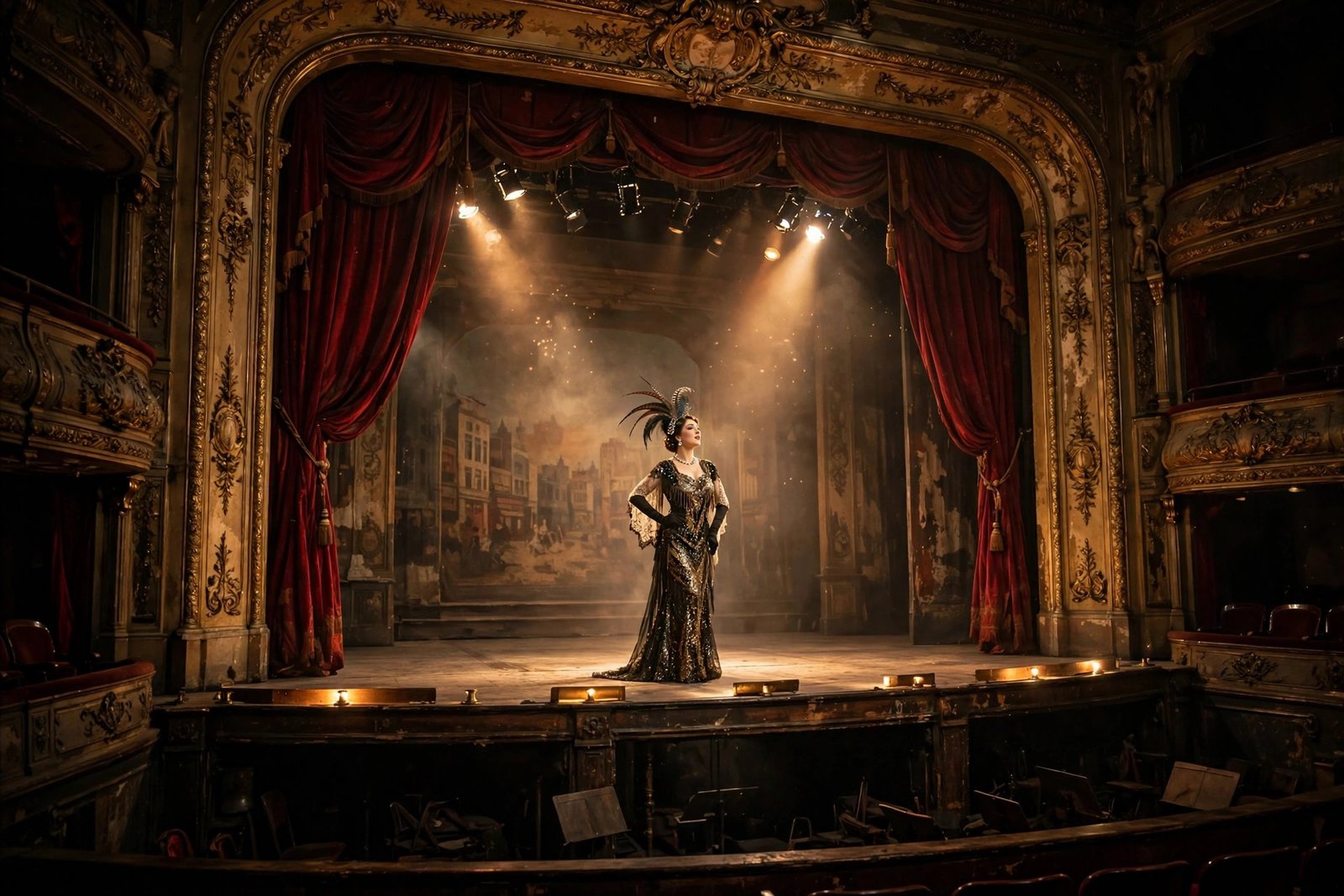
She was born on October 29, 1891, in New York City, into a world of gaslights, crowded tenements, and vaudeville stages — and she grew up to make millions of people laugh, sing along, and feel a little less alone. Fanny Brice was not the typical Broadway beauty of her era, and that was precisely her power. With a comic voice that could slide from a squeaky child to a heartbroken ballad singer in a single evening, she became one of America’s most beloved entertainers: a Ziegfeld Follies star, a radio sensation, and the real-life inspiration for the musical Funny Girl. Her story is warm, funny, and surprisingly modern — a tale of a woman who turned being different into a superpower.
Brice was born Fania Borach to Jewish immigrant parents in New York. She grew up in a lively, hardworking family, and from an early age she loved to perform. She sang, she mimicked people, and she had a natural gift for making a room laugh. Like many performers of her generation, she did not arrive on stage through a fancy school or a wealthy connection. She arrived through talent, persistence, and a willingness to try anything — burlesque, vaudeville, small clubs, and any stage that would have her.
Early success did not come easily, and it did not come all at once. Brice worked her way through the rough-and-tumble world of early twentieth-century entertainment, learning how to hold an audience, how to time a joke, and how to make a song feel personal. She developed characters, accents, and comic routines that audiences remembered long after the curtain fell. By the time Broadway noticed her, she was already a seasoned performer who knew exactly what she could do — and audiences loved her for it.
From Vaudeville Stages to Broadway Stardom
Vaudeville was the training ground for an entire generation of American stars, and Brice thrived in it. Vaudeville bills mixed singers, comedians, dancers, and novelty acts, and a performer had only minutes to win over a crowd. Brice learned to be versatile: she could sing a sentimental ballad beautifully, then turn around and deliver a comic number that brought the house down. That range became her trademark.
Her big breakthrough came when she joined the Ziegfeld Follies, the glamorous Broadway revues produced by Florenz Ziegfeld. The Follies were famous for beautiful costumes, elaborate sets, and a parade of beautiful showgirls. Brice stood out precisely because she was not just another glamorous face. She was funny, expressive, and unmistakably herself. Audiences adored her comic songs and character pieces, and critics began to recognise her as something rare: a performer who could be both hilarious and genuinely moving.
Among her best-known songs were comic numbers that played with language, accent, and character, as well as heartfelt ballads that showed off her voice. One of her signature songs, My Man, became closely associated with her and showcased the emotional depth behind the comedy. When Brice sang it, the laughter stopped and the theatre went quiet. That ability to move between comedy and pathos is what separated a good vaudeville act from a great star, and Brice had it in abundance.
Fanny Brice and the Ziegfeld Follies
The Ziegfeld years made Brice a household name, but they also revealed her independence. She was not content to be a novelty act or a comic sidekick. She wanted strong material, and she wanted to be taken seriously as a performer. In the Follies, she proved night after night that comedy could be an art form, not just a filler between prettier acts. Her characters felt real, her timing was impeccable, and her singing gave her comedy an extra emotional layer.
Offstage, Brice’s life was as dramatic as any stage play. She married the gambler and conman Nicky Arnstein, a relationship that brought both passion and trouble, and which later became central to the story of Funny Girl. Their marriage, its ups and downs, and Arnstein’s legal troubles were widely reported at the time. Brice, however, refused to be defined solely by scandal. She kept working, kept performing, and kept supporting her family through her talent. That resilience became part of her public image: a woman who could laugh through hardship and sing through heartbreak.
It is that blend of humour and heart that still draws people to her story today. Modern audiences who love a performer who transforms completely for a role will recognise the same thrill in stories like Demi Lovato’s Dorothy Gale Halloween look, where a familiar star becomes someone entirely new. Brice was doing that kind of transformation a century ago, night after night, with nothing but her voice, her face, and her comic genius.
Fanny Brice on the Radio: Baby Snooks
Just when it seemed Brice’s career belonged to the stage, she conquered a brand-new medium: radio. In the 1930s, she created one of the most famous characters in radio history, Baby Snooks, a mischievous, squeaky-voiced little girl who drove the adults around her to distraction. The character first appeared in Brice’s stage and radio work and became a sensation on The Baby Snooks Show, where Brice played the child opposite Hanley Stafford as her exasperated father, Daddy.
Baby Snooks was comedy gold. The little girl was cheeky, curious, and always getting into trouble, and Brice’s voice work was so convincing that listeners forgot a grown woman was behind the character. Families gathered around the radio to hear Snooks’s latest misadventure, and the show became one of the most popular comedy programmes of its era. It also proved something important: Brice did not need costumes, sets, or a live audience to be funny. Her voice alone could create a whole world.
Radio also introduced Brice to a new generation. Children who had never seen her on a Broadway stage knew Baby Snooks intimately, and adults who had loved her in the Follies enjoyed hearing her reinvent herself. In an era before television, radio stars were intimate companions in people’s homes, and Brice’s warmth came through the speaker as clearly as it had from the stage. She remained a radio favourite into the 1940s, and Baby Snooks became one of the defining comic characters of the golden age of radio.
That gift for voice and character has echoes in today’s music and performance world, where a distinctive voice can make a song instantly recognisable. Fans who follow powerful vocal performances will enjoy reading about Shaan’s Michael Jackson Billie Jean performance in Dubai going viral — a reminder that a great voice, like Brice’s, can stop a crowd in its tracks.
Funny Girl and a Lasting Legacy
Brice died in 1951, at the age of 59, after a career that had spanned vaudeville, Broadway, and radio. She might have faded into history as a beloved but distant star of another era. Instead, her life became the basis for one of Broadway’s most famous musicals. Funny Girl, which opened on Broadway in 1964 starring Barbra Streisand as Brice, retold her rise to stardom and her turbulent marriage to Nicky Arnstein. The show was a huge hit, and its songs, including People and Don’t Rain on My Parade, became standards.
Funny Girl introduced Brice to millions of people who had never heard Baby Snooks on the radio or seen her in the Follies. Streisand’s portrayal, and later the 1968 film version, cemented Brice’s image as the ultimate underdog star: the funny girl who was told she was not pretty enough for the stage, and who proved everyone wrong by becoming its brightest light. The musical took some liberties with the facts, as stage biographies often do, but its emotional core was true. Brice really did turn difference into stardom, and she really did make audiences love her on her own terms.
The legacy did not stop there. Funny Girl has been revived on Broadway, most recently in the 2020s, bringing Brice’s story to yet another generation. Each revival sparks fresh interest in the real woman behind the musical: the immigrant’s daughter from New York who sang, joked, and charmed her way into American cultural history. For a performer who worked before television, before social media, and before streaming, that kind of staying power is remarkable.
There is also a broader lesson in Brice’s career that feels timely. Today’s stars are often celebrated for being relatable, authentic, and unapologetically themselves — qualities Brice embodied long before those words became buzzwords. She did not try to fit the mould of a conventional leading lady. She built a career around her own voice, her own humour, and her own characters, and audiences rewarded her for it. In that sense, she was ahead of her time.
Takeaways From a Funny Girl’s Life
- Brice was born on October 29, 1891, in New York City, and rose from vaudeville to become a star of the Ziegfeld Follies.
- She was celebrated for both comedy and heartfelt singing, with My Man among her most famous songs.
- On radio, she created Baby Snooks, a mischievous child character who became one of the golden age of radio’s biggest hits.
- Her life and marriage to Nicky Arnstein inspired the Broadway musical Funny Girl, later a hit film starring Barbra Streisand.
- Her legacy endures because she proved that originality, humour, and authenticity can outlast fashion — a lesson for every performer today, from stage stars to viral sensations like Asin raising her daughter without screens while learning 12 languages, where a personal choice becomes a talking point around the world.
So, on this October 29, it is worth raising a smile for the original funny girl. Born in 1891, she sang her way out of vaudeville, made Broadway laugh and cry, invented a radio character children adored, and left behind a story so good that Broadway turned it into a musical. She was not the star anyone expected — and that is exactly why audiences never forgot her. Learn more from Britannica’s biography of Fanny Brice, the Smithsonian Institution, and the Jewish Virtual Library on Fanny Brice.
Who was Fanny Brice?
She was an American comedian, singer, and actress who became a Ziegfeld Follies star and later a beloved radio performer.
When and where was she born?
She was born on October 29, 1891, in New York City, to Jewish immigrant parents.
What was Baby Snooks?
Baby Snooks was a mischievous child character created for radio, voiced by Brice opposite Hanley Stafford as her father.
What is Funny Girl based on?
Funny Girl is a musical based on her life, her rise in the Ziegfeld Follies, and her marriage to Nicky Arnstein.
When did she die?
She died in 1951, at the age of 59, after a career spanning vaudeville, Broadway, and radio.