
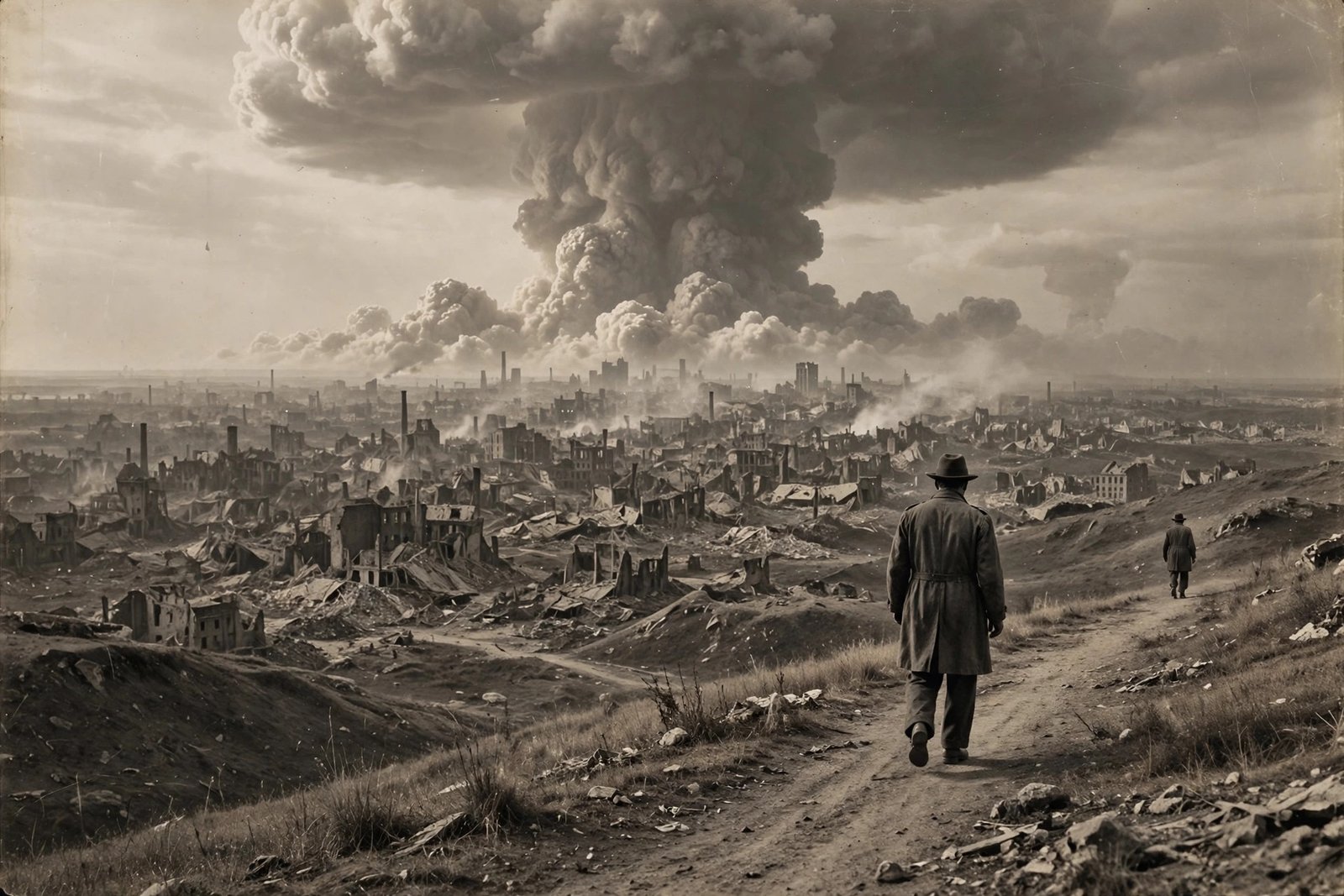
Tsutomu Yamaguchi has one of the most unbelievable survival stories in human history. In August 1945, he was present when an atomic bomb exploded over Hiroshima — and survived. Three days later, he was present when a second atomic bomb exploded over Nagasaki — and survived again. The man who survived two atomic bombs went on to live to the age of 93, and in 2009 the Japanese government officially recognized him as the only person ever certified as a double survivor of both nuclear attacks.
His story sounds impossible. The odds of surviving one atomic blast are already vanishingly small; surviving two is the kind of thing that feels like it belongs in fiction. But every detail of Yamaguchi’s story is documented — by government records, by journalists, and by Yamaguchi himself, who spent his final years making sure the world would never forget what he witnessed.
August 6, 1945: A Business Trip to Hiroshima
Tsutomu Yamaguchi was born on March 16, 1916, in Nagasaki. In the 1930s he joined Mitsubishi Heavy Industries, where he worked as a draughtsman — a technical designer. In the summer of 1945, Yamaguchi was on an extended business trip to Hiroshima, where he and two colleagues, Akira Iwanaga and Kuniyoshi Sato, had spent about three months working on the design of an oil tanker.
On the morning of August 6, 1945, the trip was nearly over. Yamaguchi and his colleagues were preparing to leave Hiroshima and head home to Nagasaki. Before catching the train, Yamaguchi had to stop by the Mitsubishi shipyard — and, in a twist of fate that would change his life, he realized he had forgotten his travel permit back at his dormitory. He got off the bus, went back to retrieve it, and was walking the rest of the way to the shipyard when he heard a single airplane overhead.
It was a B-29 bomber — the Enola Gay. Yamaguchi looked up and saw two small parachutes drifting down. Then came an intense, blinding flash. His naval air-raid training kicked in instantly: he dove to the ground, rolled into an irrigation ditch, locked his fingers over his eyes, and plugged his ears with his thumbs.
Seconds later, the uranium atomic bomb known as Little Boy detonated above Hiroshima. The shockwave picked Yamaguchi up and hurled him through the air before he crashed down in a potato field. He was seriously burned — particularly on one side of his body — and temporarily blinded. But he was alive. Around him, one of history’s great catastrophes was unfolding: tens of thousands of people had been killed in an instant, and the city was burning.
What Yamaguchi did next reveals extraordinary resilience. Despite his burns, he set out the following day on the long rail journey back to Nagasaki. He arrived home on August 8, 1945 — injured, bandaged, but reunited with his wife and young son.
August 9, 1945: The Bomb Falls on His Own Hometown
Three days after Hiroshima, Yamaguchi reported to work at the Mitsubishi office in Nagasaki. He was still wrapped in bandages. His boss could hardly believe his story — and, in one of the most chilling moments in the history of survival, Yamaguchi was in the middle of describing the Hiroshima explosion to his supervisor when the same impossible thing happened again.
At 11:02 a.m. on August 9, 1945, the plutonium bomb known as Fat Man detonated above the Urakami Valley in Nagasaki. Yamaguchi saw the same blinding flash he had witnessed three days earlier. As he later put it: “I thought the mushroom cloud had followed me from Hiroshima.” He threw himself to the ground as the blast tore through the office. Walls collapsed around him. His bandages were ripped off his body by the shockwave.
And yet — impossibly — he survived a second time.
The second blast worsened his injuries terribly. His burns flared up again, his hair fell out, and radiation sickness left him vomiting for days. He had lost hearing in one ear. But incredibly, his wife and infant son also survived: they had been out of the house retrieving supplies, and the shockwave destroyed their home just minutes after they left. The whole family had brushed against death and lived.
For the next week, the Yamaguchis lived in a bomb shelter near the ruins of their home as Japan officially surrendered and World War II came to an end. For a story about other facts that sound too strange to be true, read our piece on historical coincidences that feel made up — though few can match surviving two atomic bombings.
The Lifelong Cost of Having Survived Two Atomic Bombs
What happened to the man who survived two atomic bombs after the war ended? For decades, the answer was: not much, at least publicly. Yamaguchi recovered from his burns and radiation sickness, worked for the U.S. occupation authorities for a time, and became a teacher before eventually returning to Mitsubishi Heavy Industries.
Like many hibakusha — the Japanese term for survivors of the atomic bombings — Yamaguchi faced stigma. People feared radiation exposure, which limited employment and social opportunities for survivors. In 1957, when the Japanese government began officially certifying atomic bombing survivors, Yamaguchi’s papers identified him only as a survivor of the Nagasaki bombing. He said nothing about Hiroshima.
His family actively opposed him speaking out. Their reasoning was painful but understandable: because Yamaguchi looked relatively healthy compared to other survivors, they feared his story might actually minimize the horror of the atomic bombs. If a man could survive two of them and live a normal life, people might conclude the weapons were not so terrible after all. That was never true — Yamaguchi suffered constant health problems for the rest of his life — but the family’s concern kept him quiet for decades.
The radiation’s toll on his family was devastating regardless. Both his wife and his son eventually died of cancer, a tragically common fate among survivors. His son Katsutoshi died of cancer in 2005 at the age of 59. His daughters also reported serious health problems throughout their lives. Yamaguchi himself lost hearing in one ear, and his burn scars never fully healed.
It was only as he grew older — in his eighties and nineties — that Yamaguchi began to speak out forcefully against nuclear weapons. He wrote a memoir, wrote a letter to President Barack Obama on the subject of disarmament, and appeared in a documentary about double-bombing survivors that was screened at the United Nations in 2006. At age 90, he pleaded for the abolition of nuclear weapons at the UN. For more on the strange persistence of history, see our article on the Roman coffin skeleton identified beneath Westminster Abbey — another story where the past refuses to stay buried.
The Only Officially Recognized Double Survivor
Here is where Yamaguchi’s story becomes historically unique. An estimated 165 to 200 people may have experienced both atomic bombings. The producers of the 2006 documentary Twice Survived identified about 165 nijū hibakusha — double explosion-affected people — nine of whom claimed to have been in the blast zone in both cities. Yamaguchi’s own colleagues, Iwanaga and Sato, had been present for both explosions. But none of them ever sought official recognition.
In January 2009, at the age of 92, Yamaguchi finally applied to the Japanese government for nijū hibakusha status — formal recognition as a double atomic bomb survivor. In March 2009, the government granted it. Although others may have endured both bombs, Yamaguchi is the only person who has ever been officially recognized by the Japanese government as having survived both the Hiroshima and Nagasaki bombings.
He understood exactly what the recognition meant. “My double radiation exposure is now an official government record,” he said in a 2009 interview. “It can tell the younger generation the horrifying history of the atomic bombings even after I die.”
Less than a year later, on January 4, 2010, Tsutomu Yamaguchi died of stomach cancer at the age of 93. The man who had walked through the bottom of hell twice — as he once described it — had lived a full, long life against every imaginable odd.
What We Can Learn From the Man Who Survived Two Atomic Bombs
Yamaguchi’s story is more than a record-breaking survival tale. It carries lessons that go far beyond one man’s luck:
- Survival is only the beginning. Living through the blasts was miraculous, but Yamaguchi’s real story was the decades of illness, stigma, and loss that followed. The bombs kept killing long after the mushroom clouds faded.
- Silence has a cost. For decades, Yamaguchi said little about what he endured — partly from stigma, partly from family pressure. When he finally spoke, in his nineties, his testimony became one of the most powerful arguments for nuclear disarmament in the world.
- Official records matter. Yamaguchi cared deeply about his double-survivor status becoming an official government record. He knew that memory fades but documents endure — and that future generations would need proof of what happened.
- Ordinary people endure extraordinary things. Yamaguchi was not a soldier or a hero in the conventional sense. He was a draughtsman on a business trip who forgot his travel permit. History found him twice, and he kept going.
- One voice can carry a warning. From a hospital bed in Nagasaki to the floor of the United Nations, Yamaguchi turned his suffering into a message: no one should ever experience what he experienced. If you enjoy stories where time itself seems to bend, our piece on how Cleopatra lived closer to the iPhone than to the pyramids is another mind-bending true fact.
Conclusion: A Record Nobody Should Ever Break
Tsutomu Yamaguchi holds a distinction that is officially his alone: the only person ever certified by a government as having survived two atomic bombs. It is a record born of unimaginable horror — two cities destroyed, hundreds of thousands dead, a family scarred across generations — and a record that, one hopes, no one will ever share.
What makes his story endure is not just the staggering improbability of it. It is what he did with the life he was given: he survived, he suffered quietly, and then — when it mattered most — he spoke. His testimony, now part of Japan’s official record, will outlive everyone who heard it in person. The mushroom clouds he saw twice will never rise again, if his warning is heeded.
The man who survived two atomic bombs spent his final years making sure the world understood what surviving really cost. That may be his greatest legacy of all.
FAQs
Who was Tsutomu Yamaguchi?
How did Yamaguchi survive two atomic bombs?
Was Yamaguchi the only person to survive both atomic bombings?
When did Tsutomu Yamaguchi die?
What did Yamaguchi do after surviving the bombings?
References: Mental Floss – The Man Who Survived Both Hiroshima and Nagasaki; IFLScience – Tsutomu Yamaguchi: The Only Person Officially Recognized for Surviving Two Atomic Bombs; HistoryNet – Survivor of Hiroshima and Nagasaki Identified; All That’s Interesting – Tsutomu Yamaguchi: The Hibakusha Who Survived Both Atomic Bombs; Weird Darkness – Tsutomu Yamaguchi: The Man Who Survived Two Atomic Bombs.