
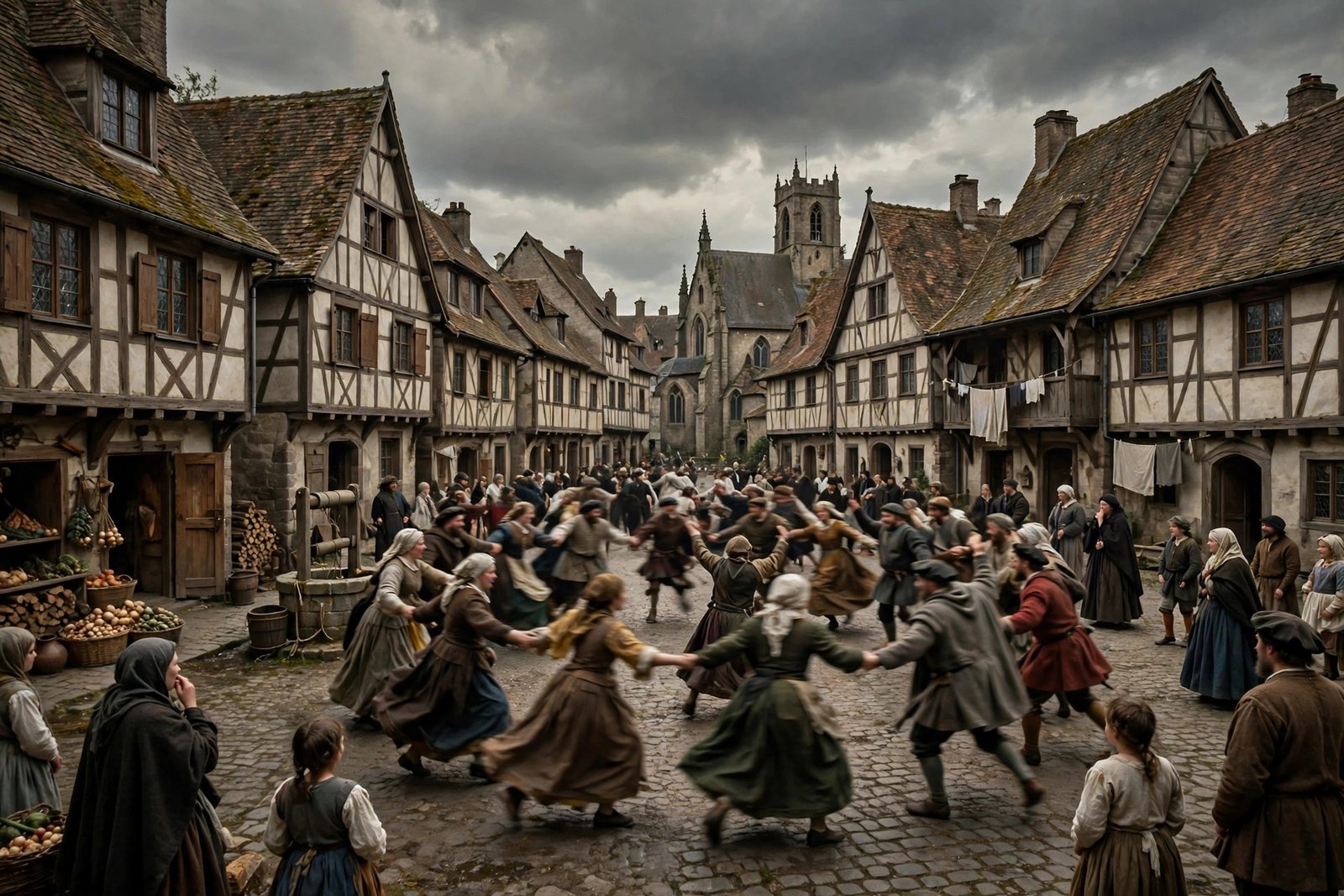
In the summer of 1518, a woman in Strasbourg stepped into the street and started to dance. There was no music. There was no festival. And she could not stop. Within days, dozens of her neighbors were dancing beside her — and within weeks, hundreds. Some of them, historical chronicles report, kept dancing until their hearts gave out. This is the true, documented story of the dancing plague 1518, one of the strangest episodes in all of recorded history.
It sounds like folklore, but it isn’t. Physicians wrote about it. The city council debated it in formal session and issued orders in response. Chroniclers kept describing it for generations afterward. What historians still argue about — fiercely — is why it happened. Here is what the evidence actually shows, and where the mystery begins.
What Was the Dancing Plague of 1518?
The dancing plague 1518 was an outbreak of what historians call dancing mania, or choreomania — a phenomenon in which groups of people begin dancing uncontrollably, seemingly against their will. It struck Strasbourg, then a free city in the Holy Roman Empire in the region of Alsace (today part of France), and it lasted roughly from July to September 1518.
Eyewitness accounts describe the dancers as moving almost involuntarily — unable to stop even when they were clearly in pain, exhausted, or nearing collapse. There was no celebration to explain it. The dancing simply began, spread, and eventually stopped, as mysteriously as it had started.
The episode is also known by its period name: St. Vitus’ Dance. In 1518, many residents of Strasbourg believed that St. Vitus — a Christian martyr of the early 300s — punished sinners by cursing them to dance, and would lift the curse once the victims had suffered enough. That belief didn’t just color how people understood the outbreak; it shaped everything the city did in response.
Frau Troffea: The Woman Who Started It All
The dancing plague began with one woman. On or around July 14, 1518, a resident of Strasbourg known to history as Frau Troffea walked into the street and began to dance. According to contemporary accounts summarized by historian John Waller — author of The Dancing Plague: The Strange, True Story of an Extraordinary Illness — her husband begged her to stop, but she kept moving as the day faded into night while a crowd of onlookers gathered.
Eventually Troffea collapsed and fell asleep. But when she woke the next morning, she started dancing again. Her solitary, compulsive dancing continued for days — and then something eerie happened: other people began to join in.
Within a week, more than 30 people were reportedly dancing. Within a month, the number had grown past 100. By late August, as many as 400 people had been swept up in the dancing plague, according to the chronicles. Troffea herself was eventually tied up and taken away — one of several dancers transported to a shrine of St. Vitus in a nearby town, in hopes the saint would release them.
How the Dancing Plague Spread Through Strasbourg
The spread of the dancing plague resembled an epidemic more than a trend. Dozens of residents at a time were seized by the compulsion to dance in the streets, markets, and squares of Strasbourg. Accounts describe them as hyperventilating, sometimes hallucinating, seeming barely conscious of their surroundings — dancing on with blistered feet, unable to pause for food or rest.
The chronicles report that several dancers collapsed from sheer exhaustion, and some died — reportedly of heart attacks or strokes brought on by the relentless physical strain. Historians urge caution here: the death toll is one of the murkiest parts of the record, with some accounts describing fatalities and others making no mention of deaths at all. What is not disputed is that the dancing went on for weeks and that many of the afflicted suffered terribly.
By the end of August, the outbreak was at its height, with hundreds of people dancing in public spaces across the city. And then, sometime in September 1518, it simply waned. The dancing stopped. Strasbourg returned to normal — leaving behind a stack of bewildered official documents and one of history’s great unsolved mysteries.
The Town’s Bizarre Response: A Stage and Musicians
Strasbourg’s authorities did not know what they were dealing with, and their response shows it. Local physicians examined the dancers and, ruling out supernatural causes, diagnosed the problem as “hot blood.” Their prescription: the afflicted should simply keep dancing until the urge burned itself out.
The city council took that advice to a startling extreme. Officials cleared the outdoor grain market, built a wooden stage, and hired musicians to play for the dancers. The reasoning behind this extraordinary decision was never written down in any surviving document, so historians can only reconstruct it. John Waller, associate professor of the history of medicine at Michigan State University, suggests two likely motives: the authorities believed dancing would help the afflicted purge physical impurities from their bodies, and they viewed the dancing itself as a form of penance.
The plan backfired spectacularly. Instead of dancing the compulsion out, the stage and the music drew in more participants — the rhythms fueled the frenzy rather than calming it. What had been a disturbing outbreak became, for a time, a city-sponsored spectacle of suffering.
Why Strasbourg Was Ready to Snap
To understand the dancing plague, you have to understand Strasbourg in 1518. The city was living through a grim stretch of years: poor harvests had driven grain prices painfully high, leaving much of the population malnourished. Disease was everywhere — smallpox and syphilis were both raging through Europe, and the memory of the Black Death still loomed over every generation. Many residents lived with a constant, grinding fear that they were being punished by God.
This was also an intensely superstitious society steeped in apocalyptic thinking. St. Vitus was widely believed to curse sinners with uncontrollable dancing — and crucially, people in the region had seen dancing mania before. A major outbreak had struck the Rhineland in 1374, and smaller episodes had flared across Italy, France, Holland, and Germany in the centuries since. When Frau Troffea started dancing, the people of Strasbourg didn’t think of medicine. They thought of sin, saints, and curses — and that belief may have been the very thing that turned one woman’s strange behavior into a mass event.
What Caused the Dancing Plague of 1518? The Theories
For 500 years, historians, physicians, and scientists have argued over what really happened in Strasbourg. Here are the leading theories — presented honestly, as theories, because the truth is that no one knows for certain.
- Ergot poisoning. One early theory blames ergot, a toxic fungus that grows on damp rye and other grains used for bread. Ergot contains psychoactive compounds related to LSD and can cause hallucinations, convulsions, and paranoia. But the theory has a serious problem: ergotism also causes extreme pain and violent muscle contractions — symptoms that would make prolonged dancing nearly impossible. Experts also note that ergot’s hallucinogenic effects wear off in less than a day, which doesn’t match symptoms lasting for days or weeks.
- Stress-induced mass hysteria. The most widely supported modern theory, championed by John Waller, is that the outbreak was a case of mass psychogenic illness — what used to be called mass hysteria — triggered by collective trauma. A starving, disease-ridden, deeply religious population, primed by belief in St. Vitus’s dancing curse, channeled its unbearable stress into a contagious physical compulsion. Once a few people were dancing, social contagion did the rest.
- Religious mania. Closely related to the hysteria theory is the idea that the dancers were caught in a genuine religious frenzy — convinced they were cursed by St. Vitus and that only continued dancing (as penance) or a pilgrimage to his shrine could release them. The fact that some dancers were taken to St. Vitus’s shrine supports the idea that religious belief was central to the experience.
- Sydenham’s chorea. In the 17th century, “St. Vitus’ Dance” was identified with Sydenham’s chorea, a neurological disorder that can follow streptococcal infection and causes jerky, dance-like involuntary movements. While the symptoms loosely match, the disorder is vanishingly unlikely to strike hundreds of people in one place over a few weeks.
Waller’s mass-hysteria explanation remains the leading theory among modern historians, largely because it accounts for the social pattern of the outbreak — the way it spread person to person, the role of shared religious belief, and the backdrop of famine and disease. But the ergot theory still has defenders, and the honest answer is that the dancing plague of 1518 keeps its secrets.
Dancing Mania Wasn’t a One-Time Event
Strasbourg 1518 was the most famous outbreak, but it wasn’t the first or the last. Dancing mania flared repeatedly across medieval and early modern Europe. The first recorded outbreak dates to the seventh century, and cases struck every few decades in Italy, France, Holland, and Germany. The great dancing epidemic of 1374 swept through the Rhineland just over a century before Strasbourg‘s.
This long history is part of why historians take the 1518 event seriously. It wasn’t a single hallucination or a tall tale that grew in the telling — it was the best-documented instance of a recurring phenomenon, recorded by physicians, city officials, and chroniclers who had every reason to be precise and no obvious reason to invent it.
Key Takeaways
- What: an outbreak of compulsive, uncontrollable dancing (choreomania) that struck Strasbourg from July to September 1518.
- Who: it began with Frau Troffea on about July 14, 1518, and grew to as many as 400 afflicted people by late August.
- The response: physicians blamed “hot blood”; the city built a stage and hired musicians — which made things worse.
- The cost: chroniclers report dancers collapsing from exhaustion, with some accounts describing fatal heart attacks and strokes; other accounts mention no deaths, so the toll is disputed.
- The leading theory: stress-induced mass hysteria in a famine-stricken, deeply superstitious city — though ergot poisoning and religious mania remain in the debate.
Five centuries later, the dancing plague of 1518 still unsettles us because it sits exactly on the border between the physical and the psychological — between a poisoned loaf of bread and a poisoned state of mind. It reminds us that belief itself can be contagious, that entire communities can be swept up in something no single person chose, and that sometimes the strangest stories in the history books are the true ones. If you love history’s strangest-but-true episodes, check out the Great Molasses Flood of 1919, our roundup of facts that feel fake but are 100% real, and the mind-bending timeline fact that Cleopatra lived closer to the iPhone than to the pyramids.