
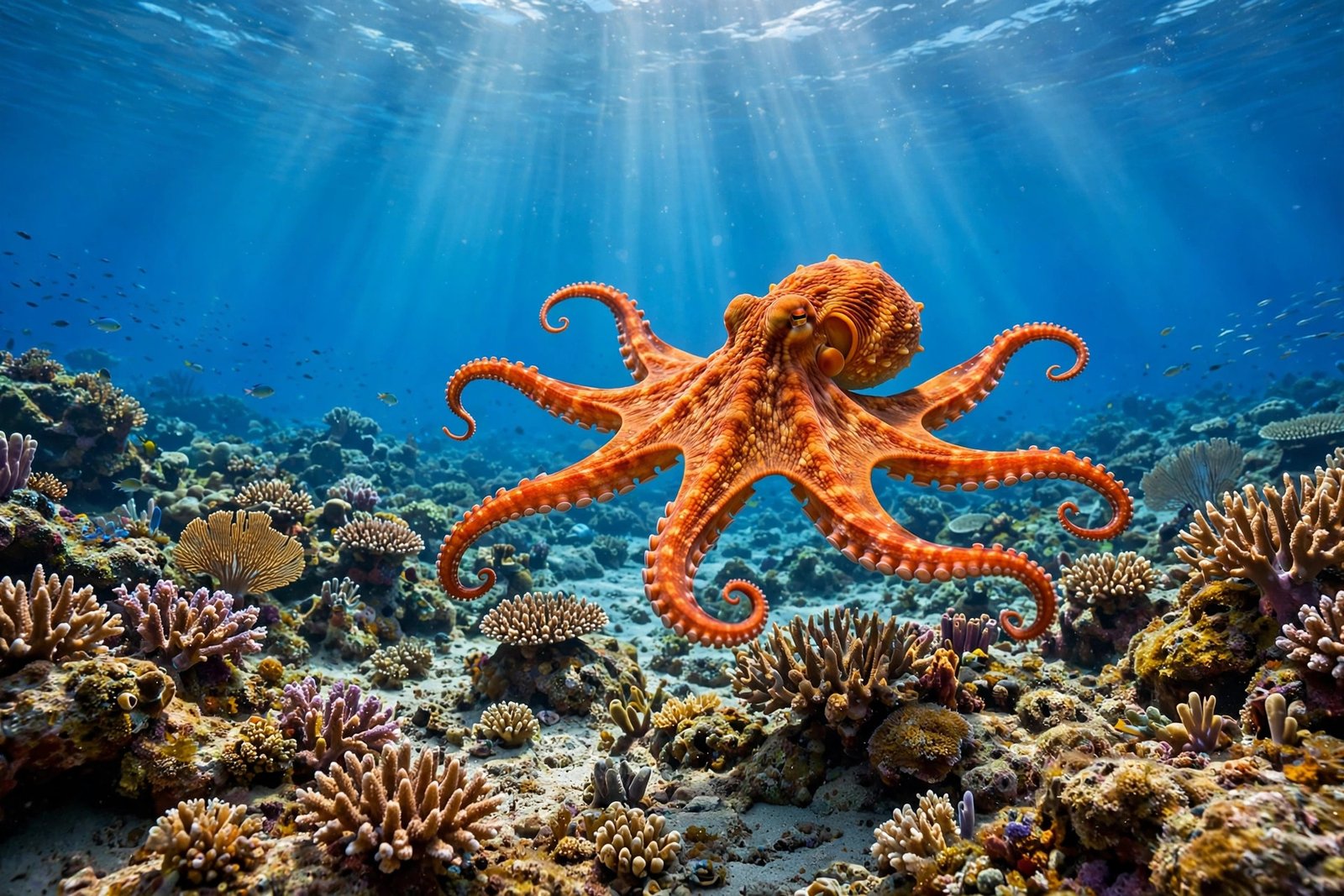
Imagine an animal with three hearts, blue blood, skin that changes color in the blink of an eye, and arms that can taste what they touch. It sounds like a creature from science fiction, but it is real, and it lives in our oceans right now. The octopus three hearts blue blood story is one of the strangest true tales in the animal kingdom, and it is only the beginning. Octopuses are escape artists, problem solvers, and masters of disguise, and the more scientists learn about them, the stranger they get. Here is the full, verified story of the animal that breaks almost every rule you thought you knew about bodies, brains, and blood.
Humans get by with one heart and red blood. An octopus needs three hearts and blood the color of a summer sky, because it lives in cold, low-oxygen water where a human-style circulatory system would struggle. Its body is built around a completely different design, one that has worked for hundreds of millions of years. Once you understand why an octopus has three hearts, you start to see the whole animal differently: every odd feature, from its color-changing skin to its ink, is part of the same brilliant survival plan.
Octopus Three Hearts Blue Blood: How the Three Hearts Work
An octopus has three hearts, and each one has a different job. Two of them, called branchial hearts, sit near the gills and pump blood through them, where the blood releases carbon dioxide and picks up oxygen. The third heart, called the systemic heart, takes that oxygen-rich blood and circulates it around the rest of the body, to the organs and muscles, giving them energy. The three hearts work as a team, and the system is closed, meaning the blood stays inside vessels, just as it does in humans.
Why three hearts instead of one? The answer is the blood itself. Octopus blood is less efficient at carrying oxygen than human blood, so the animal needs extra pumping power to move it around its body. The two branchial hearts handle the gills, and the systemic heart handles the body, sharing the work between them. According to the Smithsonian, this three-heart design is one of the most surprising facts about octopuses, and it is shared by their relatives: squids, cuttlefish, and nautiluses also have three hearts and blue blood.
The hearts are located in the mantle, the muscular structure behind the head that also houses the digestive system and reproductive organs. The deoxygenated blood returns to the systemic heart from the body, is rerouted to the branchial hearts, passes through the gills to get oxygenated, and then returns to the systemic heart to be sent around the body again. It is a neat, efficient loop, and it works beautifully as long as the octopus takes life at its own pace.
Why Octopus Blood Is Blue
The octopus three hearts blue blood connection starts with a single molecule: hemocyanin. Human blood carries oxygen with hemoglobin, a protein built around iron, and iron turns red when it meets oxygen. Octopus blood carries oxygen with hemocyanin, a protein built around copper, and copper turns blue when it meets oxygen. That is the whole secret. The blue blood of the octopus is not a trick of the light or a myth. It is chemistry, visible in every drop.
Hemocyanin is a much larger protein than hemoglobin, and it floats freely in the blood plasma rather than being packed inside red blood cells. It is less efficient at transporting oxygen than hemoglobin, roughly only about a quarter as effective per unit volume of blood, according to researchers. But it has a big advantage in the places where octopuses live. Hemocyanin works better in cold water with little oxygen, which describes the deep ocean perfectly. At the bottom of the sea, water temperatures are very low and there is not much oxygen around, and hemocyanin helps octopuses pull the oxygen they need out of that thin supply.
There is another strange detail. When hemocyanin is not carrying oxygen, it is colorless. Octopus blood only looks blue when it is oxygenated, and it turns nearly clear when the oxygen is released. You will never see the colorless version in a living octopus, because the blood turns blue again the moment it meets oxygen in the water or the air. Hemocyanin is also used by other animals, including horseshoe crabs, lobsters, snails, and spiders, so the octopus is in good company among the blue-blooded creatures of the world.
The Systemic Heart Stops When They Swim
Here is the strangest part of the three-heart system. When an octopus swims, the systemic heart, the one that pumps blood to the body, actually stops beating. That is why octopuses prefer crawling along the seafloor to swimming. Swimming exhausts them, because the very act of swimming shuts down the heart that feeds their muscles. It is a trade-off built into their design, and it shapes everything about how they live.
Most of the time, an octopus moves by crawling, using its eight arms to pull itself along the bottom. When it does need to move fast, it uses jet propulsion: it sucks water into its mantle and then squeezes it out through a funnel-like tube called a siphon, shooting itself backward like a rocket. It is an impressive escape move, but it is tiring, and the animal cannot keep it up for long. After a burst of swimming, an octopus needs to rest and let its heart catch up.
This is also why octopuses are such homebodies. They live in dens, often in rocky crevices or under ledges, and they hunt close to home, returning to the same den again and again. They are not built for long journeys. They are built for a life of short, clever trips, hiding, hunting, and crawling, and their three hearts are perfectly tuned for that life. The immortal jellyfish may have the more famous trick, but the octopus heart system is the stranger piece of biology.
The Nine Brains Mystery Explained
If you have heard that an octopus has nine brains, you have heard a popular claim that needs a little unpacking. The truth is more interesting than the slogan. An octopus has one central brain, located between its eyes and shaped a little like a doughnut, plus a cluster of nerve cells in each of its eight arms that acts like a mini brain. That adds up to nine brains in the popular telling, but scientists describe it differently: one central brain, plus eight arm nerve centers that the central brain can direct from above.
What makes this remarkable is where the neurons live. Octopuses have more than 500 million neurons, and more than two thirds of them sit in the arms and body rather than in the central brain. That means each arm can sense, taste, and react to the world partly on its own. An arm can explore a crack in a rock, decide what it has found, and respond, without waiting for instructions from the central brain. The suckers on each arm do more than grip: they can taste what they touch, letting the octopus sample its food before it ever reaches its mouth.
The result is an animal that thinks with its whole body. Octopuses have been observed opening jars, unscrewing lids, escaping from tanks, and solving puzzles in laboratory tests. In one famous set of experiments, octopuses learned to open a clamshell that had been wired shut. They can also learn by watching other octopuses, a rare ability in the animal world. Their intelligence is different from ours, built on a completely different nervous system, but it is intelligence all the same, and it is one of the reasons scientists find them so fascinating.
Color-Changing Skin, Ink, and Escape Artists
An octopus can change the color and texture of its skin in a fraction of a second, and it does it with remarkable precision. Special pigment cells called chromatophores expand and contract to produce different colors, while tiny muscles raise bumps on the skin to match the texture of rocks, coral, or sand. An octopus can vanish against a reef in moments, or flash bright warning colors when threatened. Some species can even produce moving patterns that ripple across their bodies.
When camouflage fails, an octopus has a backup plan: ink. It squirts a cloud of dark ink into the water, confusing predators while it jets away. Some species can even shape the ink into a decoy blob that looks like a second octopus, buying time to escape. And if an arm is grabbed, an octopus can detach it and grow a new one, a trick that lets it survive encounters that would kill most animals. Like the fin whale, the second-largest animal on Earth, the octopus is a reminder that the ocean holds animals that seem almost impossible, yet are perfectly real.
Escape artistry is an octopus specialty. Because they have no bones, except for a hard beak used for eating, octopuses can squeeze through any gap larger than their beak. In aquariums, they have been known to escape their tanks, cross rooms, climb into neighboring tanks to eat the fish, and return home before morning. The famous octopus Inky escaped from the National Aquarium of New Zealand in 2016 by squeezing through a gap in the lid of his tank, sliding across the floor, and disappearing down a drain to the sea. Keepers only realized he was gone when they found the wet trail he left behind.
More Mind-Bending Octopus Facts
The octopus three hearts blue blood story is only the start. Octopuses are mollusks, relatives of clams and snails, which means they are more closely related to a garden snail than to any fish. They have been around for a very long time, with ancestors swimming in the oceans hundreds of millions of years ago, long before dinosaurs walked the Earth. And despite their intelligence, most octopuses live short lives: many species live only one or two years, and even the largest, the giant Pacific octopus, lives about three to five years and can span 2 to 4 meters from arm tip to arm tip.
There are around 300 known species of octopus, and they live in every ocean on Earth, from shallow tide pools to the deep sea. The giant Pacific octopus is the biggest, while some species are small enough to sit on a coin. They eat crabs, shrimp, mollusks, and small fish, and they hunt mostly at night, using their arms and suckers to probe crevices and flush out prey. A female octopus lays thousands of eggs and guards them devotedly, often refusing to eat while she tends them, and in many species she dies soon after they hatch, having spent her last energy on the next generation.
Octopuses also have a surprising sense of personality. Keepers and researchers report that individual octopuses behave differently from one another: some are bold and curious, others shy and cautious. Some play, squirting water at lights or batting objects around their tanks, and some seem to recognize the people who feed them. It is hard not to wonder what is going on inside that doughnut-shaped brain, and inside the eight mini-brains in its arms, when an octopus looks back at you. The Kemp’s ridley turtle, the world’s rarest sea turtle, is another ocean animal with a story worth knowing, but the octopus remains the sea’s greatest puzzle.
Takeaways: The Octopus Three Hearts Blue Blood Story
- An octopus has three hearts: two branchial hearts pump blood through the gills, and one systemic heart circulates oxygen-rich blood to the body.
- Octopus blood is blue because it uses hemocyanin, a copper-based protein, instead of the iron-based hemoglobin in human blood.
- The systemic heart stops beating when the octopus swims, which is why octopuses prefer crawling along the seafloor.
- The nine brains claim is a simplification: one central brain plus a nerve cluster in each arm, with more than two thirds of the animal’s 500 million neurons in its arms.
- Octopuses can change color and skin texture in a fraction of a second, squirt ink to escape, detach and regrow arms, and squeeze through any gap larger than their beak.
- Most octopuses live only one or two years, and the giant Pacific octopus, the largest species, lives about three to five years.
Conclusion
The octopus three hearts blue blood story is a reminder that nature does not follow our rules. We have one heart and red blood, so we assume that is how bodies work. The octopus shows that there is another way: three hearts, blue blood, a brain in every arm, and skin that can disappear. It is a design that has survived for hundreds of millions of years in the cold, dark, low-oxygen world of the deep ocean, and it works beautifully.
What makes the octopus truly special is not any single feature, but the way all of them fit together. The blue blood needs three hearts. The three hearts shape how the animal moves. The distributed brain lets eight arms think for themselves. The color-changing skin, the ink, and the boneless body complete the picture of an animal built to hide, hunt, and escape in a world that never stops trying to eat it. The next time you see an octopus, remember: you are looking at an animal that is, in almost every way that matters, built differently from you, and that is exactly what makes it so extraordinary.
To learn more, see the Smithsonian’s ten wild facts about octopuses, the New Scientist explainer on octopus hearts, ScienceABC on why octopuses have three hearts, and HowStuffWorks on why octopus blood is blue.
How many hearts does an octopus have?
An octopus has three hearts: two branchial hearts that pump blood through the gills, and one systemic heart that circulates oxygen-rich blood to the rest of the body.
Why is octopus blood blue?
Octopus blood is blue because it carries oxygen with hemocyanin, a copper-based protein. Human blood uses hemoglobin, which contains iron and looks red. When hemocyanin binds oxygen, the copper turns the blood blue.
Does an octopus really have nine brains?
Not exactly. An octopus has one central brain between its eyes, plus a cluster of nerve cells in each of its eight arms that acts like a mini brain. More than two thirds of its 500 million neurons sit in the arms, so each arm can sense and react partly on its own.
Why do octopuses prefer crawling to swimming?
When an octopus swims, its systemic heart, the one that pumps blood to the body, stops beating. Swimming exhausts them, so they usually crawl along the seafloor and only use jet propulsion in short bursts to escape danger.
How long do octopuses live?
Most octopuses live only one or two years. The largest species, the giant Pacific octopus, lives about three to five years and can span 2 to 4 meters from arm tip to arm tip.