
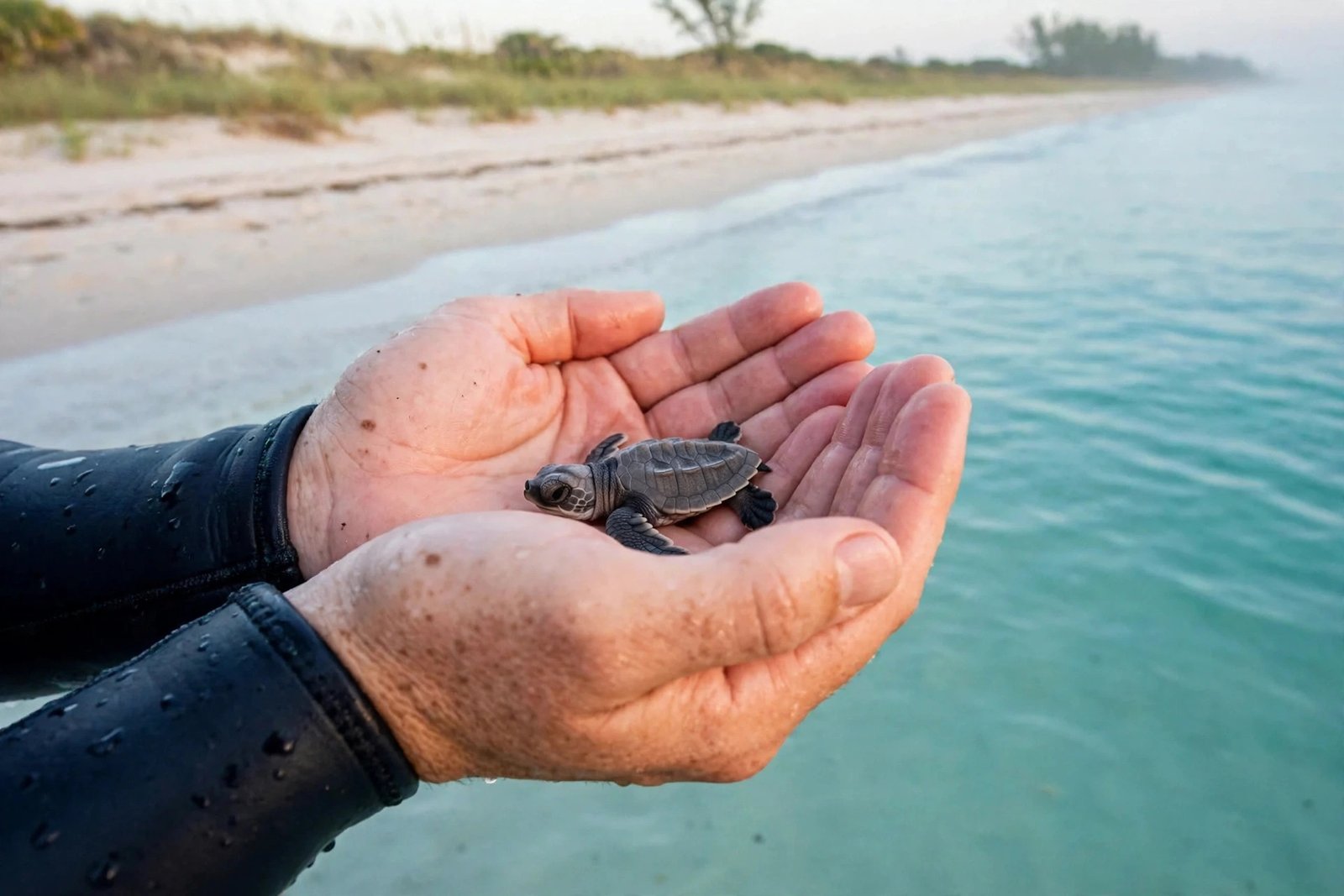
It was supposed to be an ordinary day on the Florida coast. Rescuers from The Turtle Hospital were out on a routine hatchling washback rescue, scooping up tiny baby sea turtles that had been carried back to shore by the waves. They had done this many times before. But when they picked up one little turtle, everything stopped. This one was different. His shell was unusually round, almost like a little heart. And when the team looked closer, they realized they were holding something extraordinary: a Kemp’s ridley sea turtle, the rarest sea turtle species on Earth.
The tiny turtle, now named Jeff, has since become one of the most talked-about rescue animals of the year. His story, first shared in a TikTok video by The Turtle Hospital on November 11, 2026, has captured hearts around the world. But Jeff is far more than a cute viral moment. He is a living reminder of how close an entire species came to disappearing forever, and how every single hatchling matters when a species is fighting for survival.
In this article, we will tell Jeff’s story, explain what makes the Kemp’s ridley so special, and look at the remarkable recovery effort that has pulled this species back from the edge of extinction.
A Routine Rescue Takes an Extraordinary Turn
The Turtle Hospital, a wildlife rehabilitation center in Marathon in the Florida Keys, treats sick and injured sea turtles. Since it was founded in 1986, the hospital has treated more than 2,000 of these endangered creatures, according to the facility’s own history. Its rescue teams respond to strandings, boat strikes, entanglement in fishing gear, and hatchlings that wash back ashore.
That last category, known as a hatchling washback rescue, is what brought Jeff into the hospital’s care. After baby sea turtles hatch and swim out to sea, strong winds and rough surf can push some of them back onto the beach. These tiny turtles, often no bigger than a coin, are exhausted and vulnerable. Rescue teams walk the beaches, collect them, and bring them in for care before releasing them back into the ocean when they are strong enough.
During one such rescue, the team found Jeff. At first glance, he looked like any other post-hatchling. But his shell told a different story. In the TikTok video shared by The Turtle Hospital, rescuers can be heard reacting with delight as they examine him. One person comments on the shape of his shell. Another says, “It looks like a little heart.” The hospital’s caption put it simply: “What started as a routine hatchling washback rescue turned into a pretty incredible discovery.”
The Turtle Hospital identified Jeff as a Kemp’s ridley in the video’s caption, and the news spread fast. The story was picked up by The Cool Down, which reported the rescue on November 17, 2026, and the little turtle with the heart-shaped shell quickly became a favorite across social media. Commenters flooded the video with encouragement. “Hey Jeff! You’re in great hands, bud! Get stronger!” one viewer wrote. Another added, “Jeff! We love you. Following your journey! You are in great hands!”
Why the Kemp’s Ridley Sea Turtle Is the World’s Rarest
To understand why Jeff’s rescue matters so much, you need to understand just how rare his species is. The Kemp’s ridley sea turtle is the smallest sea turtle in the world, and it is also the most endangered. The International Union for Conservation of Nature lists the species as critically endangered, and it is listed as endangered under the United States Endangered Species Act.
The Turtle Hospital described Kemp’s ridleys as the sea turtles at greatest risk of extinction. That is not an exaggeration. The species was once abundant in the Gulf of Mexico. According to NOAA Fisheries, tens of thousands of females nested at Rancho Nuevo in Mexico in the 1940s. An amateur film from 1947 documented tens of thousands of Kemp’s ridleys nesting on a single day at that beach. Then the population crashed.
By the mid-1980s, the numbers had fallen to a shocking low. NOAA Fisheries reports that the number of nests reached a record low of 702 in 1985, representing fewer than 250 nesting females. From tens of thousands of nesting females to fewer than 250 in less than forty years, the species had been pushed to the very edge of extinction. Hunting, egg collection, and entanglement in fishing nets, especially shrimp trawls, had devastated the population.
That history is what makes every Kemp’s ridley hatchling precious. When a species has so few breeding females left, every baby turtle that survives to adulthood counts. Jeff is not just one turtle. He is one small piece of a fragile recovery, and his rescue is a reminder that the species still needs help.
The Heart-Shaped Shell That Gave Jeff Away
One of the first things people noticed about Jeff was his shell. Most sea turtle hatchlings have a fairly oval shell, but Jeff’s was unusually rounded, giving it a heart-like shape that rescuers immediately commented on. That shape is part of what makes this Kemp’s ridley sea turtle so photogenic, and it is one of the reasons his video spread so quickly.
Adult Kemp’s ridleys have a distinctive look. They have a triangular-shaped head with a slightly hooked beak, and large crushing surfaces in their jaws that help them crack open their favorite food: crabs. Hatchlings are darkly colored, almost charcoal gray, on both sides. As they grow, adults turn a grayish-green color on top with a pale, yellowish underside.
Size is another defining feature. The Kemp’s ridley is the smallest sea turtle species in the world. Adults typically measure just 24 to 28 inches in shell length and weigh only 70 to 100 pounds, according to the National Park Service at Padre Island National Seashore. Compare that with a leatherback sea turtle, which can grow to six feet long and weigh nearly a ton, and you start to see how compact these little turtles are.
Jeff is a post-hatchling, which means he has already hatched, left the nest, and started his journey into the open ocean before being washed back ashore. At this stage, a hatchling weighs roughly half an ounce and measures around 1.5 inches long, according to the National Wildlife Federation. He is small enough to fit in the palm of a hand, which makes the fact that he survived his first days at sea even more remarkable.
A Long-Distance Traveler Already
Here is one of the most surprising parts of Jeff’s story. Kemp’s ridleys do not nest in the Florida Keys, even though they are among the five sea turtle species found in those waters. The Turtle Hospital pointed this out in its TikTok caption, writing, “That means this little guy has already traveled quite a distance in his short time in this world!”
Almost all Kemp’s ridley nesting happens in the western Gulf of Mexico. According to NOAA Fisheries, 95 percent of worldwide Kemp’s ridley nesting occurs in the state of Tamaulipas, Mexico. The three main nesting beaches there are Rancho Nuevo, Tepehuajes, and Barra del Tordo. A smaller number of females nest in Veracruz, Mexico, and at Padre Island National Seashore in Texas, which hosts more Kemp’s ridley nests than any other place in the United States.
So how did Jeff end up in Florida? The answer lies in the ocean currents. After hatching, young Kemp’s ridleys ride the currents of the Gulf of Mexico and the Atlantic Ocean. Juveniles are found along the Atlantic coast as far north as Nova Scotia, and they sometimes even turn up in the eastern North Atlantic. Jeff’s journey likely began on a beach in Mexico or Texas, and the currents carried him hundreds of miles before the waves washed him back ashore in Florida.
That is a long way for a creature the size of a coin. It also shows why rescue work matters. A hatchling that washes ashore is exhausted, dehydrated, and easy prey. Without help, many washbacks do not survive. With help, they can be fed, warmed, and released when they are strong enough to swim on their own.
Kemp’s Ridley Sea Turtles: Small, Tough, and Daytime Nesters
The Kemp’s ridley sea turtle has several habits that make it unique among sea turtles. The most famous is its nesting behavior. Kemp’s ridleys are the only sea turtle species that routinely nests during the day. Most sea turtles come ashore under the cover of darkness, but Kemp’s ridleys gather in daylight, in huge synchronized groups.
These mass nesting events are called arribadas, a Spanish word that means “arrivals.” Hundreds or even thousands of females come ashore together over a few days, laying their eggs at the same time. Scientists believe the synchronized nesting may overwhelm predators, giving more hatchlings a chance to survive. It is one of nature’s most spectacular events, and it happens mostly at Rancho Nuevo.
Female Kemp’s ridleys return to nest on the same beach where they hatched, usually between May and July. They typically lay two to three clutches of about 100 eggs each season, according to the National Wildlife Federation. The eggs incubate in the warm sand for 50 to 60 days before the hatchlings emerge and scramble toward the sea.
When it comes to food, Kemp’s ridleys are crab specialists. Their diet consists mainly of swimming crabs, along with fish, jellyfish, mollusks, and sea urchins. Adults spend most of their lives in shallow coastal waters with muddy or sandy bottoms, where their preferred prey is found. They rarely venture into water deeper than about 160 feet.
Like all sea turtles, Kemp’s ridleys are marine reptiles that must come to the surface to breathe. They are remarkable navigators, and females usually return to a beach in the general area where they hatched decades earlier. Scientists do not know exactly how long Kemp’s ridleys live, but like other sea turtles, they are likely long-lived, reaching maturity at around 10 to 15 years of age.
From Near Extinction to a Slow Comeback
Jeff’s rescue is part of a much bigger story: one of the great conservation comebacks in American wildlife history. When the Kemp’s ridley population hit its low point in the 1980s, with fewer than 250 nesting females, extinction looked like a real possibility. But a binational recovery effort between the United States and Mexico changed the course of the species.
The recovery program, which has been running since the mid-1970s, includes protecting nesting beaches in Mexico, relocating and safeguarding eggs, and building a secondary nesting colony at Padre Island National Seashore in Texas as insurance against disaster at the main nesting beach. The National Park Service has been a key partner in this effort for decades.
Another major step was the introduction of turtle excluder devices in shrimp trawls. These devices let sea turtles escape from fishing nets, and they dramatically reduced the number of Kemp’s ridleys killed as bycatch. Combined with beach protection and nest monitoring, the measures helped the population climb back from its lowest point.
The recovery is real, but it is far from complete. The species remains critically endangered, and threats continue: habitat loss, pollution, oil spills, entanglement in fishing gear, and the effects of climate change on nesting beaches and ocean temperatures. Cold-stunning is another danger. When water temperatures drop below about 50 degrees Fahrenheit, Kemp’s ridleys can become cold-stunned, losing the ability to swim and washing ashore. In one recent event, 25 cold-stunned Kemp’s ridleys were flown from New England to The Turtle Hospital in Marathon for treatment, arriving in banana boxes that were perfectly sized for the small turtles.
That is why a single hatchling like Jeff matters. The species is still recovering, and every turtle that survives adds to a population that was nearly wiped out within living memory.
What Happens Next for Jeff
Jeff is now receiving care at The Turtle Hospital, and the facility has said it will keep sharing updates on his progress. For a post-hatchling, that care typically means a warm saltwater tank, regular feeding, and monitoring until he is strong enough for release. The hospital’s team has decades of experience with this work, and its patients often stay anywhere from a month to a year before being released back into the wild, depending on their condition.
Once Jeff is healthy, the plan is to return him to the ocean, where he belongs. The Turtle Hospital’s mission is to rehabilitate injured sea turtles and release them back to their natural habitat, and Jeff’s story fits that mission perfectly. The hospital has said it will continue sharing updates as he makes progress, so the world will be able to follow his journey from rescue to release.
For now, Jeff is safe, warm, and in expert hands. He has already traveled hundreds of miles in his short life, survived being washed ashore, and been identified as one of the rarest animals on the planet. Not bad for a turtle smaller than a cookie.
What Jeff’s Story Teaches Us
Jeff’s rescue carries a few lessons worth remembering:
- Small rescues matter. A routine beach patrol that looks like nothing special can save an animal whose species is hanging on by a thread.
- Every hatchling counts. With so few Kemp’s ridley females nesting each year, each baby turtle that survives is a small victory for the whole species.
- Conservation works. The Kemp’s ridley was nearly gone in the 1980s. Decades of beach protection, fishing gear reform, and rescue work brought it back.
- Ordinary people make the difference. Rescue teams, volunteers, and the people who report stranded turtles are the reason animals like Jeff get a second chance.
- The ocean connects us all. A turtle hatched in Mexico can wash up in Florida. What happens on one beach affects wildlife hundreds of miles away.
If you ever find a stranded sea turtle, do not try to move it yourself. In the Florida Keys, call The Turtle Hospital’s 24-hour stranding hotline at 305-481-7669. Elsewhere in Florida, contact the Florida Fish and Wildlife Conservation Commission at 888-404-3922. A single phone call can be the difference between life and death for a turtle like Jeff.
Conclusion
Jeff arrived as a surprise in the middle of an ordinary rescue, a tiny turtle with a heart-shaped shell who turned out to be one of the rarest animals in the world. His story is a reminder that wonder is still out there, hiding in plain sight on an ordinary beach, waiting for someone to notice. It is also a reminder that the fight to save the Kemp’s ridley is not over. The species has come back from the edge, but it is still critically endangered, and every hatchling still matters.
As The Turtle Hospital wrote, “We’re so glad Jeff found his way to us, and we’ll continue sharing updates as he makes progress.” Millions of people will be watching, cheering for a turtle the size of a coin with a heart on his back. If you love animal stories like this one, you will also enjoy our piece about a California dog reunited with its owner after five years lost, and the tale of a smart bear that escaped a Japanese factory. And for another amazing wildlife discovery, read about the bee with devil horns discovered by scientists.
Jeff’s journey is just beginning. And for a species that was almost lost forever, every new beginning is worth celebrating.
What is a Kemp’s ridley sea turtle?
Who is Jeff the turtle?
Why is the Kemp’s ridley the world’s rarest sea turtle?
Where do Kemp’s ridley sea turtles nest?
What happens to Jeff now?
Sources: The Cool Down — “Routine Florida rescue turns up a tiny Kemp’s ridley, the world’s rarest sea turtle”; NOAA Fisheries — Kemp’s Ridley Turtle; National Wildlife Federation — Kemp’s Ridley Sea Turtle; National Park Service — Kemp’s Ridley Sea Turtles, Padre Island National Seashore.