
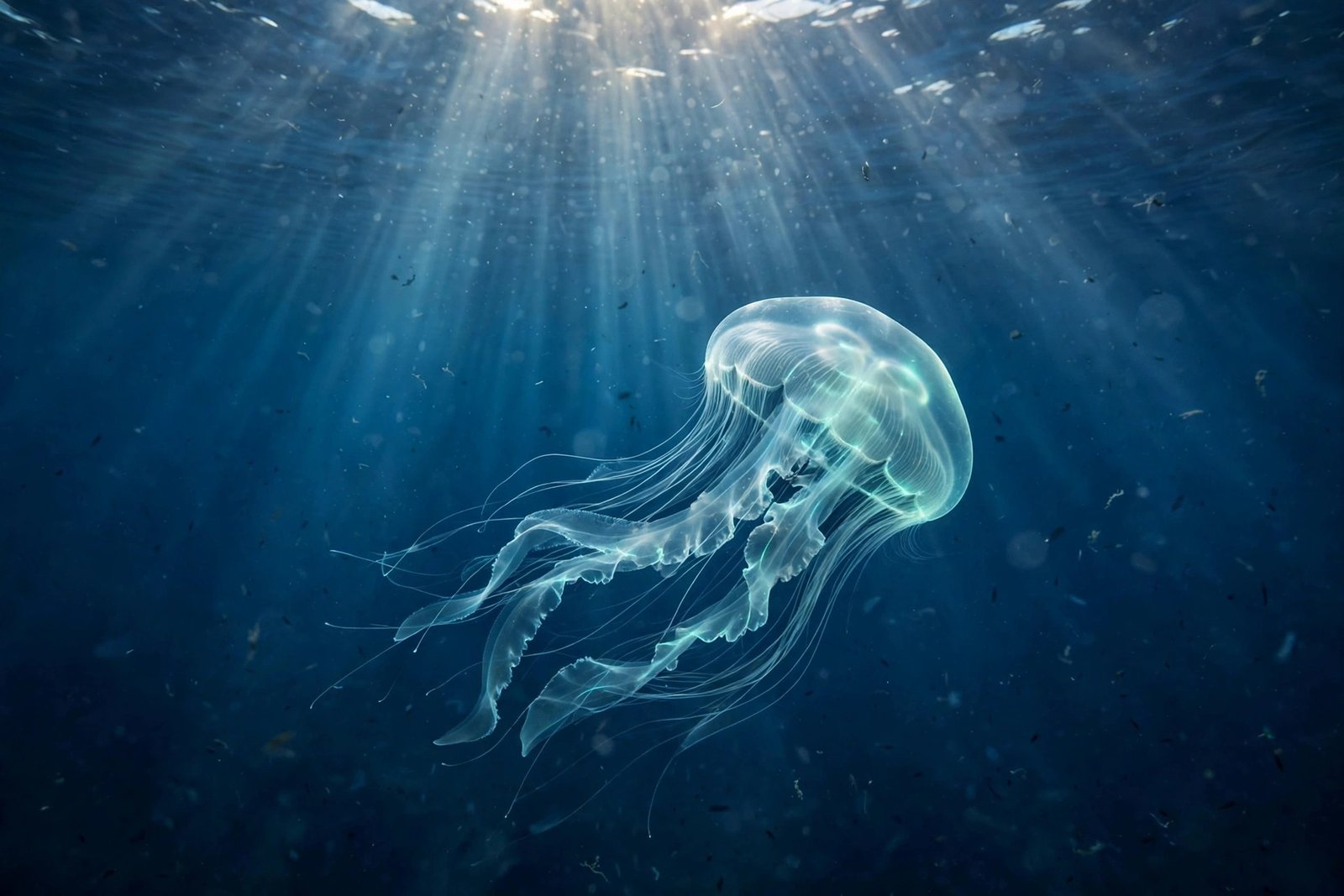
Imagine an animal that grows old, gets injured or hungry, and instead of dying, simply presses rewind on its own life. It shrinks, sinks to the sea floor, and rebuilds itself as a baby version of itself, ready to grow up all over again. It sounds like science fiction, but this creature is real, it is smaller than your pinky nail, and it is drifting through the oceans right now. The immortal jellyfish is the only known animal that can reverse its entire life cycle, and scientists believe it may hold clues to one of humanity’s oldest dreams: defeating aging itself.
Its scientific name is Turritopsis dohrnii, and it was first described in 1883. For more than a century, nobody suspected what it could do. Then, in the 1980s, a German marine biology student noticed something impossible happening in his laboratory jars. Adult jellyfish that should have been nearing the end of their lives were transforming back into their juvenile polyp stage. The discovery stunned biologists and turned this tiny, transparent creature into one of the most studied animals on Earth. This is the story of how it cheats death, what its trick means for science, and why, despite its nickname, it is not truly invincible.
What Is the Immortal Jellyfish?
Turritopsis dohrnii is a species of small hydrozoan jellyfish found in temperate to tropical waters around the world. As an adult medusa, it measures only about 4.5 millimeters across, roughly the size of a contact lens or a small pea. Its bell is transparent, its stomach is a bright red-orange color visible through the jelly, and it trails up to 90 thin tentacles armed with stinging cells called nematocysts, which it uses to catch tiny plankton and other small prey.
Originally described from the Mediterranean Sea, the species has since spread across the world’s oceans, likely hitchhiking in the ballast water of ships. Today it can be found in the Atlantic, Pacific, and Indian Oceans, and in warm coastal waters on several continents. Despite its global spread, it is rarely noticed by beachgoers because of its tiny size and nearly invisible body. You could swim through a cloud of them and never know it.
Like all jellyfish, T. dohrnii belongs to the phylum Cnidaria, the same group that includes corals, sea anemones, and the Portuguese man o’ war. But unlike its relatives, Turritopsis dohrnii carries a biological superpower that no other known animal possesses in quite the same way. It can take its adult body and rebuild it from scratch, returning to the polyp stage it left behind as a juvenile. According to Wikipedia’s overview of the species, this reversal can theoretically go on indefinitely, which is why the animal is described as biologically immortal.
The Life Cycle of an Ordinary Jellyfish
To understand what makes this jellyfish so extraordinary, it helps to know how an ordinary jellyfish lives. Most jellyfish follow a two-stage life cycle. It begins with a fertilized egg that hatches into a tiny swimming larva called a planula. The planula settles onto a hard surface on the sea floor and grows into a polyp, a small, stalk-like creature that looks a bit like a tiny sea anemone. The polyp is sessile, meaning it stays in one place, attached to a rock or the ocean floor.
The polyp reproduces asexually by budding, releasing tiny juvenile jellyfish called ephyrae into the water. Those juveniles grow into adult medusae, the familiar bell-shaped, free-swimming jellyfish. The adults reproduce sexually, releasing eggs and sperm into the water, and then they die. For most jellyfish species, that death is final. The cycle moves in one direction only: from polyp to medusa to death, like a butterfly that can never become a caterpillar again.
That one-way journey is the rule for almost every animal on Earth. Humans grow from babies into adults and cannot return to childhood. Frogs cannot turn back into tadpoles. The idea that an adult could revert to a juvenile form was considered biologically impossible until this jellyfish proved otherwise. As the marine biology resource MarineBio explains, the polyp stage of T. dohrnii forms colonies that can reach about 35 millimeters across, with tentacles that capture prey and bring it to the central body for feeding.
How the Immortal Jellyfish Reverses Its Life
So how does the immortal jellyfish pull off its impossible trick? When an adult medusa is injured, starved, exposed to a sudden change in temperature or salinity, or simply grows old, it can trigger a complete reversal of its development. The bell contracts, the tentacles are reabsorbed, and the animal sinks to the sea floor. Within 24 to 72 hours, it transforms into a cyst-like blob of cells, which then reorganizes itself into a polyp. From that polyp, new medusae eventually bud off, genetically identical to the original adult.
Experiments have shown that this reversal can happen at any stage of the medusa’s life, from newly released juveniles to fully mature adults. In laboratory studies, medusae were triggered to revert by starvation, sudden temperature changes, reduced salinity, and even deliberate physical damage to the bell. According to research summarized by Discover Magazine, the transformation can be repeated again and again, and in captivity individual jellyfish have been observed rejuvenating up to ten times over a two-year period. Biologists have not yet found a natural limit to how many times a single animal can do it.
Think of it this way: imagine a butterfly that, when times get tough, dissolves back into a caterpillar, rebuilds itself, and then becomes a butterfly again. That is essentially what Turritopsis dohrnii does. The new medusa that buds off from the polyp is not a child of the original jellyfish in the usual sense. It is the same genetic individual, starting over. In that sense, the jellyfish does not just reproduce. It reboots.
Transdifferentiation: The Cellular Trick Behind the Reset
The secret behind the reversal is a process called transdifferentiation. In most animals, once a cell becomes specialized, its fate is fixed. A muscle cell stays a muscle cell, a nerve cell stays a nerve cell, and a digestive cell stays a digestive cell. Transdifferentiation breaks that rule. It allows a mature, specialized cell to transform directly into a completely different type of mature cell.
When the immortal jellyfish begins its reversal, its adult cells shed their identities. Muscle cells, nerve cells, and digestive cells all lose their specialized features and reassemble themselves as the cells of a polyp. This requires tissue from both the surface of the jellyfish bell and its circulatory canal system, and it is the only known case of an animal reversing its entire life cycle after reaching sexual maturity. A few other animals can perform limited versions of this trick. Newts, for example, can regenerate the lens of an eye using transdifferentiation. But no other animal is known to use it to restart its whole life.
The process passes through an intermediate cyst stage, a cluster of poorly differentiated cells that reorganizes into a polyp. Polyps typically form about two days after the stolons, the root-like structures that anchor the colony, have developed and fed. From there, the colony grows and eventually buds off fresh medusae, and the cycle begins again. It is one of the most remarkable feats in all of biology, and it happens in an animal with no brain, no heart, and no bones.
How Scientists Discovered the Reversal
The discovery of this jellyfish’s secret was an accident. In the late 1980s, a German marine biology student named Christian Sommer was studying hydrozoans at a research station in Rapallo, on the Italian Riviera. He kept a batch of Turritopsis medusae in jars and forgot about them. When he finally checked on the jars, he expected to find dead jellyfish. Instead, he found that the medusae had transformed into polyps. Sommer and his colleagues published the observation in 1996, and the species went from a biological curiosity to one of the most studied animals in aging research.
Since then, Japanese biologist Shin Kubota of Kyoto University has become the world’s leading expert on the species. Kubota has cultivated T. dohrnii in laboratory tanks for decades, and his long-running observations have provided the clearest evidence that the reversal can happen repeatedly. Over one two-year stretch, his captive jellyfish naturally rejuvenated up to ten times, and some individuals completed the reversal more than ten times in a row. His work at the Shirahama Aquarium has shown that the trick works reliably when the animal is stressed by starvation, injury, or changing water conditions.
The discovery came at a perfect time for science. Researchers studying aging, stem cells, and regenerative medicine suddenly had a living model of an animal that could reset its own cellular age. If scientists could understand how a jellyfish reprogrammed its cells, perhaps they could learn something about how aging works in other animals, including humans. That question has driven a wave of research that continues today.
Why This Jellyfish Still Dies
Before you start imagining oceans full of jellyfish that have been alive since the Roman Empire, it is important to be honest about what “immortal” really means here. This jellyfish is not invincible, and it is not guaranteed to live forever. In the wild, most individuals probably never get the chance to revert. They are eaten by fish, sea turtles, sea slugs, and crustaceans, or they die from disease, rough waves, or other hazards long before old age becomes a problem.
Biologists use the term “biologically immortal” to mean something specific: the animal does not appear to die of old age. It lacks the internal countdown, the senescence, that limits the lifespan of nearly every other animal. But that is very different from being unable to die. A jellyfish that is eaten by a turtle is just as dead as any other animal. And the reversal itself is not guaranteed to work. It is triggered by stress or injury, not switched on at will, and the transformation can fail if conditions are too harsh.
There is another catch. The jellyfish can only reset when it is in its medusa stage and only under the right conditions. In a perfect laboratory tank, with food, clean water, and no predators, the cycle can repeat many times. In the open ocean, perfect conditions do not exist. That is why scientists say it is hard to pinpoint how long T. dohrnii actually lives on average in the wild. Immortality, in this case, is a cellular property, not a documented lifespan. No single jellyfish has ever been observed living forever.
What Its Genome Reveals About Aging
In 2022, a team of researchers from the University of Oviedo in Spain, led by Maria Pascual-Torner and Carlos Lopez-Otin, published a landmark study in the journal Proceedings of the National Academy of Sciences. They sequenced the entire genome of T. dohrnii and compared it with the genome of its close relative Turritopsis rubra, a similar jellyfish that cannot reverse its life cycle. The comparison revealed genetic differences that may explain the jellyfish’s remarkable ability.
The researchers found expansions in gene families linked to DNA repair, telomere maintenance, stem cell pluripotency, and intercellular communication. Telomeres are the protective caps on the ends of chromosomes that shorten as cells divide, and their shortening is closely linked to aging in humans and other animals. The species appears to have extra genetic tools for maintaining its telomeres and repairing damaged DNA, which may be part of how it resets its cellular age.
The study also identified variants linked to replication and chromosome maintenance. Together, these findings suggest that the jellyfish’s immortality is not the result of a single magic gene, but of a whole network of genetic advantages working together. It is an important clue, but it is only the beginning. Understanding which genes matter most, and how they interact during transdifferentiation, is the next frontier. The research is still in its early stages, and any medical application for humans is many years away, if it ever comes at all.
Could This Jellyfish Help Humans Live Longer?
This is the question everyone asks, and the honest answer is: maybe, but not in the way headlines sometimes suggest. This jellyfish will not give humans eternal life. What it might give us is a deeper understanding of how cells age, how they can be reprogrammed, and how damage accumulates over a lifetime. That knowledge could eventually help scientists develop treatments for age-related diseases, improve regenerative medicine, or extend healthy lifespan.
Already, the jellyfish has influenced how researchers think about cellular reprogramming. The idea that a specialized adult cell can be converted into a different cell type was once considered impossible. Today, scientists use similar principles in stem cell research, where adult cells are reprogrammed into stem cells that can become almost any tissue in the body. That work earned a Nobel Prize in 2012, and it shares a conceptual link with what the jellyfish does naturally.
Humans, of course, are far more complex than a 4.5-millimeter jellyfish with no brain. Our bodies have trillions of cells organized into intricate systems, and reprogramming them is enormously more difficult. But the jellyfish proves that nature has already solved the problem of cellular rejuvenation at least once. For scientists, that is a powerful hint that the biology of aging is not as fixed as it once seemed. The ocean, as ever, keeps some of its best secrets in its smallest creatures. If you love stories about nature’s strangest survivors, you will enjoy our look at the Christmas Island red crab migration, another event where millions of tiny animals pull off something that seems impossible.
7 Mind-Blowing Facts About This Jellyfish
- It is smaller than a pea. An adult measures only about 4.5 millimeters across, yet it carries one of the most extraordinary abilities in the animal kingdom.
- It has no brain, heart, or bones. Like all jellyfish, it manages its entire life cycle with a simple nerve net and a body made mostly of water.
- It can reset more than ten times. In laboratory observations, individual jellyfish have completed the reversal over ten times in two years, with no sign of a limit.
- Its reset takes just days. The transformation from adult medusa to polyp happens within 24 to 72 hours, a remarkably fast rebuild for an entire body plan.
- It spread around the world by ship. The species likely traveled the globe in the ballast water of cargo ships, turning a Mediterranean native into a worldwide resident.
- Its cousins cannot do the trick. Related Turritopsis species can reverse development as juveniles, but they largely lose the ability once they reach maturity. Only T. dohrnii keeps it for life.
- Scientists study it to fight aging. Its genome holds clues about DNA repair and telomere maintenance that researchers hope will one day help treat age-related disease in humans.
Key Takeaways
The immortal jellyfish is a tiny marine animal that can reverse its life cycle, turning from an adult medusa back into a juvenile polyp through a process called transdifferentiation. It is biologically immortal in the sense that it does not have to die of old age, but it can still be eaten, diseased, or killed by its environment. Its genome, sequenced in 2022, reveals expanded genes for DNA repair and telomere maintenance. And while it will not make humans immortal, it offers scientists a living model of cellular rejuvenation that could shape the future of aging research. For more jaw-dropping animal facts, check out our roundup of viral facts from Reddit’s Today I Learned, and for a very different kind of human engineering marvel, see how SpaceX caught a Starship booster mid-air.
Conclusion
The immortal jellyfish reminds us that nature still holds surprises that rewrite the textbooks. An animal with no brain and a body the size of a contact lens can do something that no human, no elephant, and no whale can do: it can turn back its own biological clock. Whether it ever helps us live longer or healthier lives, it has already changed how scientists think about aging, and it has earned its place as one of the most amazing animals on the planet. The next time you look at the ocean, remember that somewhere beneath the waves, a tiny jellyfish may be starting its life all over again, for the eleventh time.