
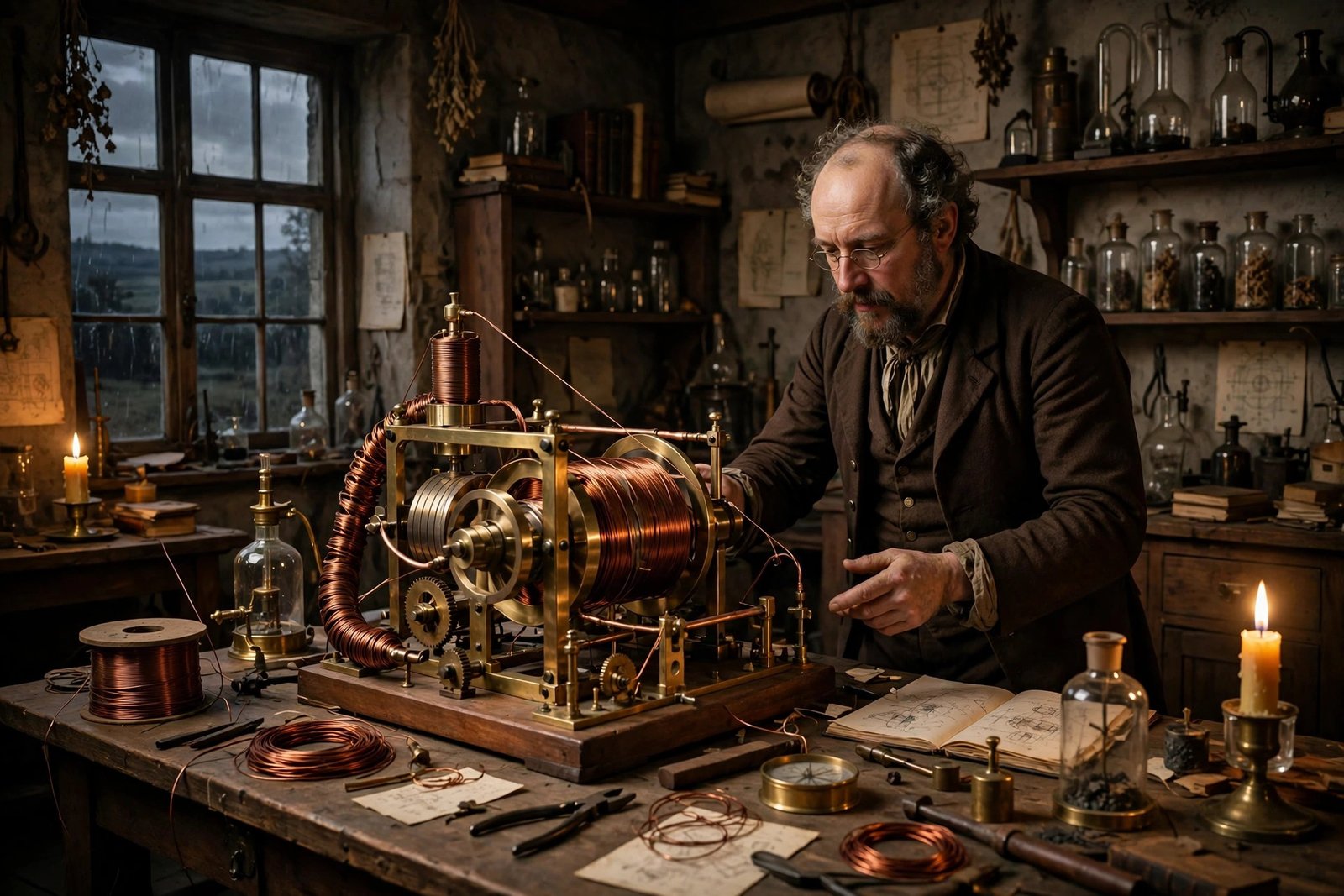
Imagine a world with no wall sockets, no streetlights, no phone chargers, and no humming power stations in the distance. That was everyday life before a quiet experiment in London changed everything. The Faraday dynamo 1831 demonstration proved something that sounds almost like magic: move a magnet near a wire, and electricity appears. It was not a finished power plant, and it did not light up a city overnight, but it contained the seed of the entire modern electrical age.
Michael Faraday was not born into wealth or privilege, and he did not follow the usual path into science. Yet his curiosity, patience, and gift for hands-on experiments made him one of the most important scientists who ever lived. His work on electromagnetic induction gave engineers the principle they needed to build generators, motors, and transformers. Every time you switch on a light, charge a device, or ride in an electric train, you are living in the world his demonstration made possible.
Who Was Michael Faraday?
Michael Faraday was born in 1791 in England, into a working family with little money for formal schooling. As a young man he worked as a bookbinder’s apprentice, a job that turned out to be surprisingly useful. While binding books, he read them, and science books captured his imagination. He attended public lectures when he could, took careful notes, and eventually found work as an assistant to the famous chemist Humphry Davy at the Royal Institution in London. Readers who want the fuller biography can start with the overview of Faraday’s life and work and the Britannica profile of Michael Faraday.
Faraday was a brilliant experimentalist rather than a mathematician. He trusted what he could see, measure, and repeat in the laboratory. He kept detailed notebooks, built his own apparatus, and tested ideas step by step instead of rushing to grand claims. That careful style mattered, because electricity in the early 1800s was still mysterious. Scientists knew about static shocks, batteries, and lightning, but they did not yet have a practical way to produce a steady, useful supply of electric current.
Before Faraday, the main source of electricity was the chemical battery, developed from the work of Alessandro Volta. Batteries were useful for experiments, but they were expensive, short-lived, and messy for large-scale use. What the world needed was a way to make electricity from motion, something that could keep running as long as a wheel turned or water flowed. Faraday found it.
What Was the Faraday Dynamo 1831 Demonstration?
In 1831, Faraday discovered electromagnetic induction: a changing magnetic field can create an electric current in a conductor. In his experiments, he showed that moving a magnet through a coil of wire, or moving a wire through a magnetic field, produced a current. The demonstration associated with October 28, 1831, in today-in-history records, is remembered as the public face of this breakthrough: Faraday’s dynamo, an early electric generator.
The most famous form of the device was the Faraday disk, sometimes called a homopolar generator. A copper disk rotated between the poles of a magnet, and brushes collected current from the disk. It was simple, even crude by modern standards, and the voltage it produced was low. But the principle was enormous. For the first time, mechanical motion had been turned directly into electricity without a chemical battery in between.
It is important not to picture this as a modern power station launch. There was no city grid waiting to be switched on, no rows of light bulbs, and no instant industrial revolution the next morning. What Faraday demonstrated was a principle, proven in a laboratory, that engineers could develop over the following decades. That distinction is exactly why the story is so fascinating: the most world-changing inventions often begin as small, quiet bench experiments that only a few people fully understand at first.
How Did the Dynamo Actually Work?
The idea behind the dynamo is easier to grasp than it sounds, and it still explains how most of the world’s electricity is made today. At its heart are three ingredients: a conductor, usually copper wire or a copper disk; a magnetic field; and motion.
- A conductor: Copper is used because electric charge can move through it easily. In Faraday’s disk, the copper disk itself was the conductor.
- A magnet: The magnet creates an invisible magnetic field around it. Faraday was fascinated by these invisible fields and thought of them as lines of force filling space.
- Motion: When the conductor moves through the magnetic field, or the field changes around the conductor, the magnetic force pushes electric charges inside the conductor and creates a current.
In the disk generator, spinning the disk between magnet poles kept cutting through magnetic lines of force, so current kept flowing. Later generators improved on the design by using coils of wire rotating in a magnetic field, which produced much higher voltages and alternating current. But the core idea never changed: spin something in a magnetic field, and you get electricity. In short, the Faraday dynamo 1831 principle is still at work in every large generator today.
That is why hydroelectric dams, wind turbines, coal and gas plants, and nuclear stations all share the same secret. Different energy sources spin the turbine, but in almost every large power station, the turbine spins a generator, and the generator uses Faraday’s principle of induction. The fuel changes. The physics does not.
From a Lab Bench to the First Power Stations
After Faraday’s discovery, inventors and engineers across Europe and America raced to make better generators. Early machines were improved with stronger magnets, electromagnets instead of permanent magnets, and coils wound to produce more useful currents. By the later 1800s, dynamos were powering arc lamps, electroplating workshops, and early electric lighting systems.
The next great leap was scale. Once generators could produce enough power reliably, inventors like Thomas Edison and others built central power stations and distribution systems. Suddenly, electricity was not just a laboratory curiosity or a rich person’s novelty. It could light streets, run factories, power streetcars, and eventually enter ordinary homes.
Faraday himself did not become a wealthy industrialist from the dynamo, and he famously cared more about understanding nature than about profit or fame. He continued to work at the Royal Institution, gave popular lectures, and helped educate the public about science. The Faraday dynamo 1831 breakthrough mattered because it turned a laboratory curiosity into a practical route to power. His modesty makes the story even more striking: a man who started as a bookbinder’s apprentice gave the world the key to electric power and asked for little in return.
For readers who love facts that sound too strange to be true, the history of science is full of them. If you enjoyed this story, you may also like 8 space facts that sound fake but are real and the surprising time fact about Cleopatra and the pyramids, both of which show how often our sense of what is possible lags behind reality.
How the Faraday Dynamo 1831 Changed Power Forever
Before induction, electricity was something you stored in a battery or created with friction. After induction, electricity became something you could generate continuously, as long as you had motion. That shift changed the economics of power completely. A waterwheel, a steam engine, or later a wind turbine could now become an electricity factory.
The consequences rippled through every part of life. Factories no longer had to cluster around a single steam engine with belts and shafts running everywhere. Electric motors let machines be placed where they were needed. Cities could be lit at night, which changed work, safety, and social life. Communication systems, from the telegraph to the telephone and eventually radio, depended on reliable electrical power and on the deeper understanding of electromagnetism that Faraday helped create.
Faraday’s work also pointed toward a unified picture of nature. His ideas about electric and magnetic fields influenced James Clerk Maxwell, whose equations later described light itself as an electromagnetic wave. In other words, the dynamo was not just a useful gadget. It was a doorway into modern physics, leading from bench experiments to radio, television, and wireless communication.
What Faraday Got Right That Still Matters
Faraday’s genius was not only in one device. It was in a way of thinking that engineers and inventors still use today. Here are the lessons his work leaves behind:
- Start with a principle, not a product: Faraday proved induction first, and practical generators followed. The best inventions often begin as a clear understanding of how nature works.
- Simple experiments can reveal deep truths: A copper disk, a magnet, and a spinning motion were enough to reveal a law of nature that still powers the planet.
- Share knowledge openly: Faraday lectured, published, and taught. His openness let other minds improve the dynamo far faster than secrecy ever could.
- Curiosity beats credentials: Without a university degree, Faraday out-experimented many formally trained scientists of his day, simply by observing carefully and testing relentlessly.
Those lessons are worth remembering whenever a new technology seems impossibly complex. Behind wind farms, electric cars, and giant power grids sits a principle a self-taught experimenter demonstrated with modest equipment in 1831. The scale changed beyond recognition. The science did not.
The Spark That Never Went Out
When you flip a switch tonight, pause for a second and think about the chain behind that light. Somewhere, a turbine is spinning, a generator is turning, and magnetic fields are pushing electric charges through copper, exactly as Faraday first showed. The power station may be miles away, the technology may be vastly more advanced, and the grid may be managed by computers Faraday could never have imagined. Yet the first link in the chain is still his, and the Faraday dynamo 1831 idea remains the starting point for that chain.
That is the real legacy of the dynamo. It was not the biggest machine of its day, and it was not the most powerful. It was the first proof that human beings could make electricity on demand, continuously, from motion. Once that proof existed, the rest of history was a matter of engineering, investment, and imagination. The light did not go out after the demonstration ended. In a very real sense, it has never gone out since.
For more stories where history bends in unexpected directions, explore historical coincidences that feel made up on BolanPost, and keep an eye out for the small experiments and quiet ideas that might be shaping the next century while nobody is watching.
Frequently Asked Questions
What did Michael Faraday invent in 1831?
In 1831, Faraday discovered electromagnetic induction and built an early electric generator, often called the Faraday disk or dynamo. It showed that motion in a magnetic field could produce electric current, a principle still used in power stations today.
How does a dynamo generate electricity?
A dynamo generates electricity by moving a conductor, such as copper wire or a disk, through a magnetic field. That motion pushes electric charges inside the conductor and creates a current. Modern generators use the same idea on a much larger scale.
Was Faraday’s dynamo powerful enough to light a city?
No. The early disk generator produced only a low voltage and was a laboratory demonstration, not a city power supply. Its importance was the principle it proved, which later engineers developed into powerful generators and power stations.
Did Faraday invent the electric motor too?
Faraday made key early contributions to electromagnetic rotation, which pointed toward the electric motor, and his induction work underpinned both motors and generators. Later inventors refined these ideas into practical motors for industry and transport.
Why is Faraday still important today?
Faraday is still important because almost all large-scale electricity generation uses electromagnetic induction, the principle he discovered. His work also shaped modern field theory and influenced Maxwell’s equations, which describe light and electromagnetism.