
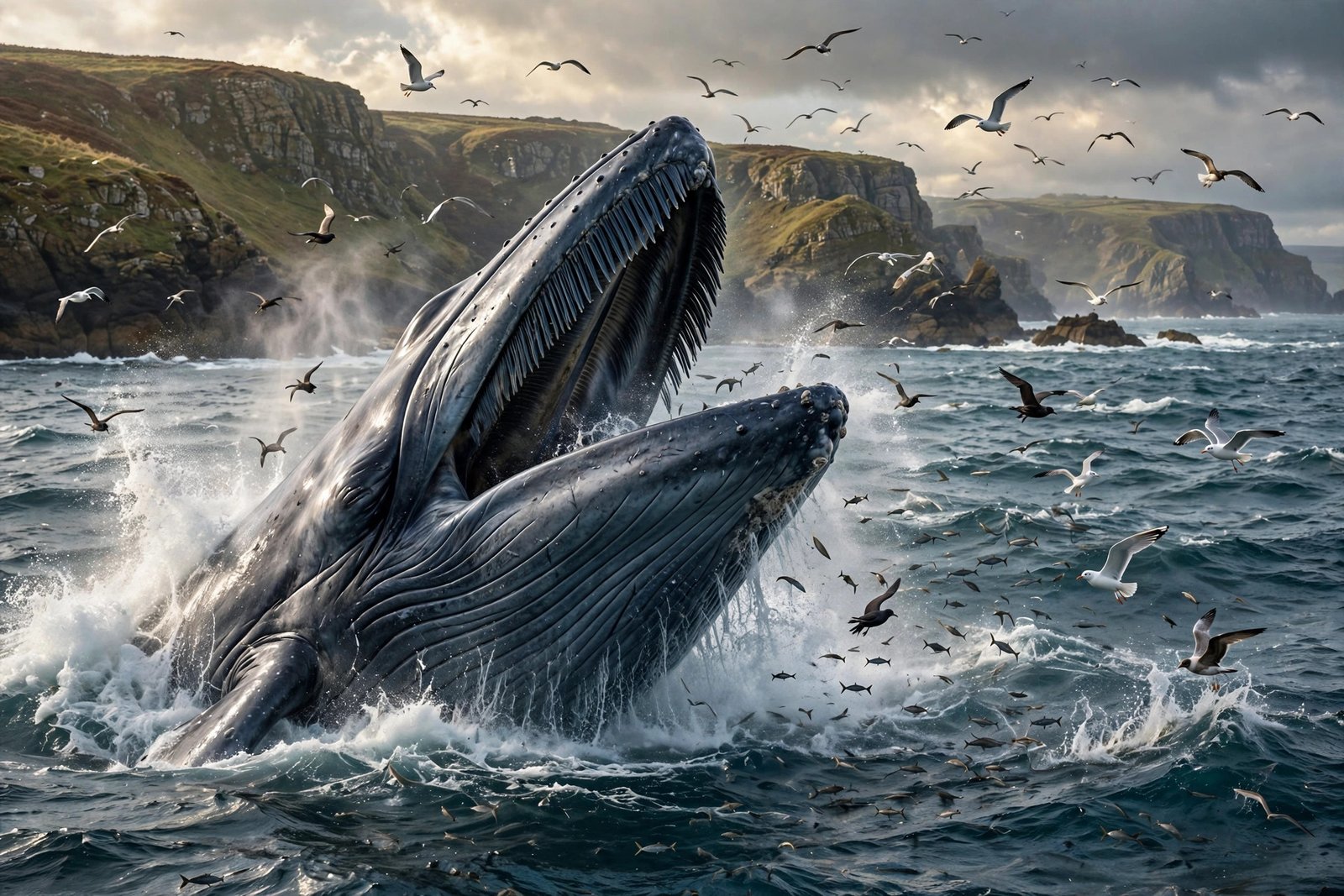
Stop scrolling for a second and picture this: a shadow longer than a school bus sliding beneath grey-green waves, a blow like a geyser erupting into the cold sea air, and then the slow, impossible surfacing of the second-largest animal on the planet. That is the moment an amateur photographer captured off the coast of Wales this week, in rare footage of a fin whale feeding that rippled through the October 20 morning headlines. The fin whale Wales photo and video show the giant doing something few people ever witness: lunging through a shoal of fish, mouth agape, in waters most of us associate with rainy holidays, not ocean leviathans.
If your mental image of whales involves distant Pacific horizons or nature documentaries filmed on the other side of the world, this sighting is about to rearrange your map. Wales — yes, Wales — has quietly become one of the most exciting places on Earth to meet a fin whale. Researchers now consider these giants annual visitors to the Welsh coast, returning every year to feast in the Irish Sea. And this latest fin whale Wales photo is the proof hiding in plain sight. Here is the full story behind the image, the animal, and why scientists are paying very close attention.
The Fin Whale Wales Photo Everyone Is Talking About
According to morning reports, an amateur photographer filming from the Welsh coast captured extraordinary footage of a fin whale feeding — the kind of clip that wildlife professionals dream about for years. The whale can be seen powering through the water with its enormous mouth open, engulfing fish in a feeding maneuver called lunge feeding. For a species that spends most of its life in deep, offshore water, being caught on camera this close to shore, in the act of eating, is genuinely special.
What makes the footage so remarkable is how rarely this happens in British and Irish waters. Lloyd Nelmes of the Sea Trust, the marine arm of the Wildlife Trust of South and West Wales, recently told BBC Wales that for a professional who watches the water every day, an unexpected whale encounter is “unusual” — adding that “for a normal person, it’s insanely rare.” That was about a humpback whale spotted in the Celtic Deep off the Pembrokeshire coast in late September 2026. A fin whale — bigger, faster, and even more elusive — feeding in full view of a camera is rarer still.
But here is the twist: this is not a one-off freak event. It is part of a pattern. The Sea Trust’s multi-year research shows that fin whales now come to West Wales every year to feed on vast shoals of small fish, including herring. Survey teams have encountered more than 20 of the great whales at a time off the Pembrokeshire coast, with massive blows appearing all around as far as the eye could see. The fin whale Wales photo making the rounds this week is simply the most photogenic evidence yet of a quiet marine miracle: the return of giants to Welsh waters.
Wildlife cameraman Dan Abbott, who guides shark trips off Pembrokeshire, has filmed fin whales herding fish in the Celtic Deep — the whales dive deep to push prey toward the surface, then surge upward to swallow hundreds of fish in a single gulp, while dolphins, Atlantic bluefin tuna, and blue sharks dart in to grab the leftovers. “It was the kind of thing you expect to see off the coast of South Africa, not in the Celtic Deep,” he said of the spectacle. This week’s amateur footage captures that same drama — except this time, it was an everyday person with a camera who got the shot.
Wait — Just How Big Is a Fin Whale, Really?
Let us put some numbers on this, because the numbers are honestly hard to believe. A fully grown fin whale can reach up to 85 feet long and weigh between 40 and 80 tons, according to NOAA Fisheries. That makes it the second-largest animal on Earth — second only to the blue whale, the largest animal known to have ever lived. If you are struggling to picture 85 feet, think of it this way: a standard American school bus is about 40 to 45 feet long. A big fin whale is nearly two school buses parked end to end, swimming.
The comparisons get wilder. One Welsh news report noted that a fin whale’s tongue alone can weigh as much as an African elephant. Their hearts are the size of small cars, pumping hundreds of liters of blood with every beat. Inside that cavernous mouth sit between 260 and 480 baleen plates — the comb-like filters the whale uses to strain food from seawater. And here is a detail that sounds made up but is 100 percent real: the fin whale’s coloring is asymmetrical. The lower right jaw is bright white while the rest of the jaw is grey, a lopsided pattern unique among baleen whales that scientists think may help the whale corral prey while hunting. If you enjoy facts that feel impossible, you will love our roundup of Reddit facts that feel fake but are 100 percent real — and for more cosmic-scale weirdness, check out these 8 space facts that sound fake but are real.
Here is the part that rearranges your sense of scale: despite weighing as much as a dozen elephants, the fin whale is built like an athlete. Its body is long, sleek, and streamlined, with a distinctive tall, hooked dorsal fin set about two-thirds of the way down its back. That is where the name comes from — “fin whale” is a nod to that prominent fin. Everything about this animal is engineered for moving an enormous body through water with shocking efficiency.
The “Greyhound of the Sea”: Speed in a 70-Ton Package
Fin whales carry one of the coolest nicknames in the animal kingdom: the “greyhound of the sea.” They earned it honestly. Among the great whales, fin whales are the fastest swimmers — capable of short bursts that would leave most other whales far behind. Watching 70 tons of muscle accelerate through the ocean is, by all accounts, an almost unsettling sight: something that large is not supposed to move that fast.
The secret is in the body plan. Fin whales belong to the rorqual family — the same group as blue whales and humpbacks — which means their throats are pleated with expandable grooves. Those accordion-like folds let the throat balloon outward to gulp staggering volumes of water and prey. The streamlined shape, the powerful tail flukes, and the relatively small, swept-back flippers all reduce drag. The result is an animal that can sprint when it hunts and cruise across entire ocean basins when it migrates, traveling between cold-water feeding grounds and warmer breeding areas every year.
Speed is also a survival tool. Fin whales are among the whale species most frequently struck by large ships, and their quick reactions help — though not always enough. It is a strange and sad irony: one of the ocean’s fastest animals is still vulnerable to the slowest-moving giants of the shipping lanes.
How a Fin Whale Feeds: The Two-Ton Lunch
Now we get to the main event — the behavior captured in the viral footage. Fin whales are lunge feeders, and the maneuver is one of the most dramatic in nature. The whale accelerates toward a dense ball of prey, opens its jaws to an almost unbelievable angle, and engulfs a volume of water that can exceed its own body size. The throat pleats expand like a parachute. Then the mouth closes, the tongue — that elephant-weight muscle — pushes the water back out through the baleen plates, and the trapped krill or fish are swallowed. One lunge can capture hundreds of kilograms of food in seconds.
What does a fin whale eat? It depends on the neighborhood. In Antarctic waters, the diet is almost exclusively krill. In the northern hemisphere, including the waters around Wales, fin whales target small schooling fish like herring and anchovies, plus squid. The common thread is abundance: fin whales need dense concentrations of prey, which is why feeding frenzies — where currents and underwater geography gather fish into “prey balls” — attract not just whales but entire communities of predators.
The Celtic Deep footage filmed by Dan Abbott shows the full choreography. The fin whales dive deep and swim in patterns that herd fish upward, compacting them into a tight ball near the surface. Then the whales lunge through the ball again and again. Around them, common dolphins, Atlantic bluefin tuna, and blue sharks pick off the stragglers. It is a multi-species hunting party, and the fin whale — the biggest animal in the scene by an absurd margin — is the ringleader. Ocean conservation group Oceana notes that even though fin whales feed on some of the smallest prey in the ocean, each whale eats up to 2 tons of food every single day. Two tons. Daily. Let that sink in.
Seeing this behavior in the footage is what elevates the fin whale Wales photo from a pretty picture to a scientific document. Lunge feeding in UK coastal waters is still poorly documented compared to famous feeding grounds like California or the Antarctic. Every clear recording helps researchers understand how, when, and where these animals eat — information that feeds directly into conservation planning.
Why Does Wales Keep Attracting Fin Whales?
Here is the question scientists find most exciting: why Wales, and why now? The honest answer is a mix of detective work and good news. The Sea Trust’s research, carried out over several years off the Pembrokeshire coast, shows fin whales arriving in greater numbers than anyone recorded in the past. Where survey teams once saw one or two animals — or, back in 2005, a group of four — they later encountered at least 20, with towering blows visible in every direction and animals feeding right around the boat.
The leading explanation is food. The Irish Sea and the Celtic Deep hold vast shoals of herring and other small fish, and recovering fish stocks appear to be drawing the whales in. Sea Trust researchers have even documented fin whales visiting Welsh waters in winter — the first winter sightings on record — suggesting the buffet is now good enough to keep some animals around outside the traditional summer feeding season. One survey coordinator described watching a mother fin whale and a juvenile surface side by side, blasting 30-foot columns of vapor into the cold winter air: “In the cold winter air, the blow hung in the sky like a massive crystal plume before slowly dissipating — it was magical.”
There is a climate angle, too. As ocean temperatures shift, the distribution of prey species moves with them, and highly mobile predators like fin whales follow. The growing Welsh gatherings may be a sign of an ecosystem reorganizing itself — which is exactly why scientists want more eyes on the water, more cameras rolling, and more footage like this week’s viral clip.
From Whaling Ships to Comeback Kings
It is worth remembering how close we came to never seeing images like this at all. Like all the great whales, fin whales were hunted relentlessly by commercial whalers, and their populations were severely depleted. NOAA notes that today’s numbers are still a fraction of historical abundance, and the species remains classified as endangered. Whaling is no longer the threat — but ship strikes, entanglement in fishing gear, ocean noise, and climate change are.
And yet, the Welsh story is one of cautious hope. Where fin whales were once a rumor off the British coast, they are now an annual event. Sea Trust photographer Rich Crossen once described a fin whale swimming directly beneath the team’s 10-ton survey vessel, the Celtic Wildcat: “One actually swam right under us, making our 10-tonne vessel wobble as it passed below.” Imagine the mass required to rock a 10-ton boat just by passing underneath it. If you love against-the-odds animal survival stories, do not miss the incredible story of Luna, the dog who survived 34 days in Yellowstone — proof that nature’s resilience stories come in every size.
The recovery is fragile and incomplete, and researchers are careful not to declare victory. But every documented feeding event in Welsh waters is a data point in the right direction — evidence that protection, patience, and recovering prey can bring giants back to places they had all but vanished from.
What the Fin Whale Wales Photo Reveals About Our Oceans
There is a bigger story hiding inside this week’s fin whale Wales photo: the rise of the citizen scientist with a camera. Some of the most valuable whale footage of 2026 has come not from research vessels but from ordinary people in the right place at the right time. In October 2026, an Australian drone pilot named Scott Baxter filmed fin whales in Geographe Bay after spotting a spout on the horizon during a family outing — he thought he was filming a small blue whale and had no idea fin whales were even in the area. Marine scientist Dr. Vanessa Pirotta of Macquarie University praised such contributions, noting that footage from the public offers insights into whale movements that scientists might otherwise miss.
The Welsh footage belongs to the same phenomenon. An amateur photographer, a coastline, a moment of luck — and suddenly the world gets a window into the life of an 85-foot predator most of us will never see in person. Multiply that by thousands of phones and drones along every coast, and you get a crowdsourced ocean observatory more powerful than any single research program.
So the next time someone tells you there is nothing wild left in familiar waters, show them the photo. Somewhere off the Welsh coast right now, the second-largest animal on Earth is herding herring into a ball and swallowing the ocean — and for once, somebody was there to catch it.
Key Takeaways
- The viral footage shows a fin whale — the world’s second-largest animal — lunge feeding off the Welsh coast, a genuinely rare sighting in UK waters.
- Fin whales reach up to 85 feet and 40–80 tons, swim among the fastest of all whales (hence “greyhound of the sea”), and eat up to 2 tons of krill and fish per day.
- The Sea Trust’s research shows fin whales are now annual visitors to Pembrokeshire, drawn by rich herring shoals in the Irish Sea and Celtic Deep — with winter sightings recorded for the first time.
- Once decimated by whaling and still endangered, fin whales face modern threats from ship strikes and fishing gear — making every documented feeding event valuable for conservation.
- Amateur photographers and drone pilots are becoming essential contributors to whale science, capturing behavior researchers rarely witness firsthand.
In the end, the most amazing thing about the fin whale Wales photo is not just the animal — it is the reminder. The ocean still holds wonders the size of city buses, surfacing within sight of ordinary coastlines, waiting for anyone patient enough to watch the water. Keep your camera ready. You never know what is swimming just offshore.
Frequently Asked Questions
How big is a fin whale?
A fully grown fin whale can reach up to 85 feet (about 26 meters) long and weigh 40 to 80 tons, according to NOAA Fisheries. That is roughly the length of two school buses end to end, making it the second-largest animal on Earth after the blue whale.
Is the fin whale really the second-largest animal in the world?
Yes. The fin whale is second in size only to the blue whale, the largest animal known to have ever existed. No land animal — not even the largest dinosaurs — comes close to either of them.
Are fin whale sightings common in Wales?
They were once extremely rare, but the Sea Trust’s research shows fin whales are now annual visitors to the waters off Pembrokeshire, arriving to feed on herring shoals in the Irish Sea and Celtic Deep. Even so, experts describe close encounters as “insanely rare” for ordinary observers.
What does “greyhound of the sea” mean?
It is the fin whale’s nickname, earned because it is among the fastest of the great whales. Its long, streamlined body lets it sprint in short bursts — remarkable for an animal weighing up to 80 tons.
Are fin whales dangerous to humans?
No. Fin whales are baleen whales that feed on krill and small fish; they have no interest in people. Like all marine mammals, they are protected by law and should be observed from a respectful distance without disturbance.