
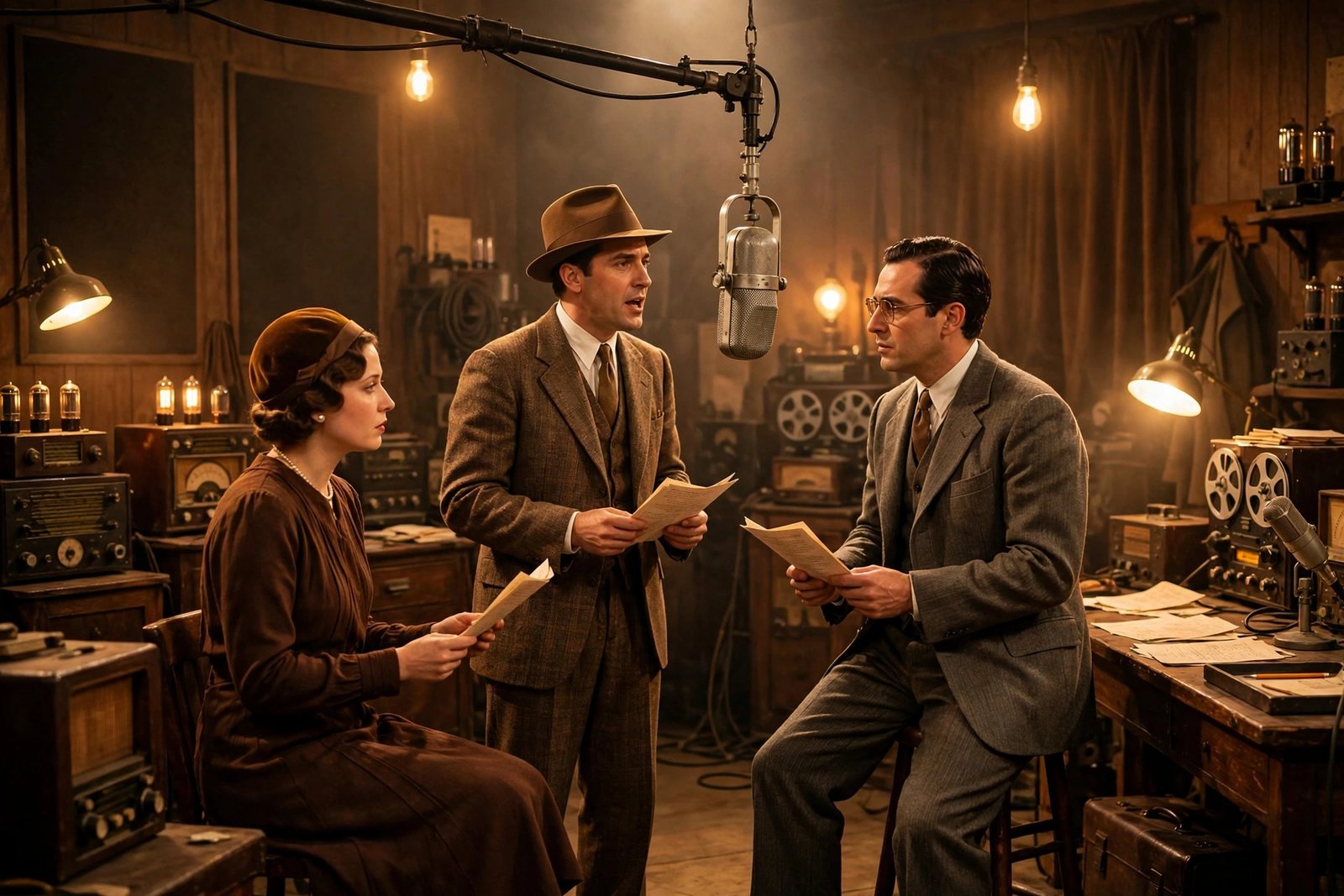
On the night of October 30, 1938, millions of Americans sat down by their radios for an evening of entertainment. What many of them heard instead sounded like the end of the world. The War of the Worlds 1938 broadcast was a radio drama performed as a series of fake news bulletins, and it convinced some listeners that Martians had landed in New Jersey and were marching toward New York City. Nearly nine decades later, the story of the panic it caused is still told, debated, and studied in classrooms around the world.
It is one of the most famous nights in media history, and also one of the most misunderstood. Did the broadcast really send America into a panic, or did newspapers exaggerate the chaos to embarrass a rival medium? The answer, as historians now tell it, is more complicated and more interesting than the legend. This is the story of what happened, why the format fooled people, and what the War of the Worlds 1938 broadcast can still teach us about media literacy today.
What Happened on October 30, 1938?
The broadcast aired on CBS radio as an episode of The Mercury Theatre on the Air, a weekly drama series led by a 23-year-old Orson Welles. That night, the company performed an adaptation of H.G. Wells’ 1898 novel The War of the Worlds, rewritten for radio by Howard E. Koch. The setting was moved from Victorian England to contemporary America, and the story was told not as a traditional play but as a string of breaking news reports.
The show opened with what sounded like an ordinary evening of dance music. Then the music was interrupted by a news flash: strange explosions had been observed on Mars. An astronomer was interviewed. Then came reports of a mysterious object crashing on a farm in Grover’s Mill, New Jersey. The object, listeners were told, was not a meteorite. It was a Martian spacecraft. Creatures emerged, a heat ray vaporized onlookers, and the invasion had begun. Military officials, reporters, and government voices all played their parts in the unfolding drama, each bulletin more urgent than the last.
There were disclaimers. The program opened with an announcement identifying it as a drama, and further announcements were made during the station break and at the end. But many listeners tuned in late and missed the opening. Others were flipping between stations, arriving at CBS after a popular variety show’s opening segment ended elsewhere. For those listeners, there was no context, only the sound of a nation under attack. If you enjoy moments when history pivoted in a single evening, read about Black Tuesday and the 1929 stock market crash.
Why the War of the Worlds 1938 Broadcast Fooled People
The genius of the broadcast was its format. Radio in 1938 was still a young medium, and the rules of broadcasting were still being written. Regular programs were almost never interrupted by breaking news, so when a program was interrupted, listeners assumed something genuinely important was happening. The War of the Worlds 1938 broadcast exploited that trust brilliantly. It sounded like an emergency because it copied the exact rhythms of one: music, interruption, bulletin, interview, escalating urgency.
Several factors made the illusion unusually convincing. First, the performers were superb actors, and the production used realistic sound effects, overlapping voices, and the clipped language of live reporting. Second, the drama used real place names, Grover’s Mill, Princeton, New York City, which made the fictional events feel close to home for listeners in the region. Third, the timing mattered. The world in late 1938 was tense. The Munich crisis had unfolded just a month earlier, and many Americans were already anxious about war in Europe. A population primed for bad news was more ready to believe it.
Fourth, and most importantly, radio itself was trusted. In an era before television and the internet, radio was the fastest source of news, and families gathered around it the way later generations gathered around television. When a familiar voice on the radio said Martians were advancing, some listeners had little reason to doubt it, especially if they had missed the opening disclaimer. The show’s realism was not an accident. Welles and Koch deliberately used present-tense reporting and staccato bulletins to track the Martians’ progress toward Manhattan, turning a 40-year-old novel into something that felt like it was happening right now.
The Panic: What Newspapers Reported
By the next morning, newspapers across the country were reporting chaos. According to their accounts, thousands of frightened listeners flooded police stations, newspaper offices, and radio stations with calls, asking how to flee their cities or how to protect themselves from gas raids. Some reports described people packing their cars and heading for the hills, while others claimed adults needed medical treatment for shock. The story of a nation panicking over a radio play became headline news itself, and Orson Welles, suddenly famous far beyond the theater world, held a press conference the next day to apologize and explain that he had not anticipated the reaction.
The newspaper coverage was dramatic, and it cemented the legend. For decades, textbooks and documentaries repeated the tale of mass hysteria as fact. The broadcast became the classic cautionary example of media power: proof that a single program could move millions of people to fear. Welles himself became a household name, and the episode launched his career toward Hollywood, where he would go on to direct Citizen Kane just a few years later.
But there is a twist in this story that took historians decades to untangle. The newspapers that reported the panic most loudly had a motive. Radio was eating into newspaper advertising revenue, and portraying the new medium as dangerous and irresponsible served the press’s own interests. The panic story, in other words, may have been partly a story newspapers told about radio, rather than a precise account of what listeners actually did. For another tale of a night that became legend, see John Glenn’s return to space at age 77.
How Widespread Was the Panic, Really?
Modern historians have seriously questioned the scale of the panic, and readers deserve to hear both sides. A Princeton study published in 1940 claimed that about six million people heard the program and that around 1.7 million believed it was a real news broadcast. Subsequent scholars have questioned both numbers. Ratings research from the night suggests that only a small share of radio households were tuned to CBS at the time, since most listeners were following a far more popular variety program on a rival network. One often-cited estimate holds that only about 2 percent of those tuning in actually called CBS.
Media historians Jefferson Pooley and Michael Socolow argued in a widely read 2013 analysis that the supposed panic was so small as to be practically immeasurable on the night of the broadcast itself. Historian W. Joseph Campbell has similarly described the panic as greatly exaggerated. Their point is not that nobody was frightened. Some listeners were genuinely scared, and some did call police or newspapers. Their point is that the image of a nation fleeing in terror was largely a creation of the next day’s headlines, not a measured fact of the night itself.
So what should we believe? The honest answer is that both things are true at once. The broadcast did frighten some listeners, particularly those who tuned in late and lived near the fictional landing site. And the scale of that fear was almost certainly amplified by newspapers with an interest in the story. The War of the Worlds 1938 broadcast remains a real event with real consequences, but the legend of nationwide mass hysteria is, at least in part, a myth built on top of it. Knowing the difference matters, because it is itself a lesson in media literacy.
The Broadcast Minute by Minute
Understanding the structure of the show helps explain why it worked. Here is a simplified timeline of the evening:
- 8:00 p.m.: The Mercury Theatre on the Air begins with an opening announcement identifying the show as a dramatization of H.G. Wells’ novel.
- The program presents itself as an evening of dance music, which is then interrupted by a news flash about explosions on Mars.
- A fictional astronomer is interviewed, followed by reports of a crashed object in Grover’s Mill, New Jersey.
- Bulletins escalate rapidly: Martians emerge, a heat ray kills onlookers, and the military responds.
- About 40 minutes in, at the station break, an announcer reminds listeners they are hearing a dramatization.
- The final portion shifts to a more traditional narrative as Welles narrates the Martians’ defeat by Earth’s bacteria.
- The program ends with a closing disclaimer and Welles reminding the audience that the invasion was fiction.
Notice the gap that made all the difference. Between the opening announcement and the station break, roughly 40 minutes passed with no reminder that the show was fiction. Anyone who tuned in during that window heard only the illusion. In an age before instant fact-checking, that window was more than enough.
What the War of the Worlds 1938 Broadcast Teaches Today
The lessons of that October night have never been more relevant. Today, the fake news bulletin has been replaced by the viral clip, the out-of-context screenshot, and the deepfake video. The mechanics are the same: realistic format, emotional urgency, and a trusted channel, all combining to make fiction feel like fact. The 1938 broadcast teaches us to pause before sharing, to check the source, and to ask whether we have the full context before reacting.
One lesson is about format. When something looks and sounds like news, our brains treat it as news. That was true for radio bulletins in 1938, and it is true for social media posts designed to mimic news articles today. A second lesson is about emotion. Fear spreads faster than calm, and content designed to frighten or outrage is more likely to be shared without verification. A third lesson is about the storytellers themselves. Just as newspapers in 1938 had incentives to exaggerate the panic, today’s platforms and publishers have incentives to amplify whatever gets attention. Understanding who benefits from a story is part of understanding the story.
There is also a hopeful lesson. The same broadcast that fooled some listeners also created a generation of more careful listeners. The Federal Communications Commission reviewed its rules, broadcasters became more careful with disclaimers, and audiences learned, slowly, to question what they heard. Media literacy is not a one-time lesson. It is a skill that each new medium forces us to relearn, from radio to television to the internet and beyond. For a story about another technology that changed how we communicate, check out the first ARPANET message in 1969.
Key Takeaways
- On October 30, 1938, Orson Welles and the Mercury Theatre on the Air performed The War of the Worlds as fake news bulletins on CBS radio.
- Listeners who tuned in late missed the opening disclaimer and some believed a Martian invasion was real.
- Newspapers reported widespread panic, but later historians argue the scale was greatly exaggerated.
- The broadcast worked because it mimicked emergency news formats and used real place names at a tense moment in world history.
- The episode remains a foundational lesson in media literacy: verify before you share, and check the full context.
The War of the Worlds 1938 broadcast endures because it sits at the intersection of art, technology, and human psychology. It was a brilliant piece of theater, a landmark in broadcasting, and a warning that has only grown more relevant with time. The Martians never landed, but the questions that night raised, about trust, truth, and the power of a convincing story, are still with us every time we open a feed and wonder what to believe.
Sources: National Geographic, the Smithsonian National Portrait Gallery, and History in the Margins.
What was the War of the Worlds 1938 broadcast?
It was a CBS radio drama aired on October 30, 1938, in which Orson Welles and the Mercury Theatre on the Air performed H.G. Wells’ novel as a series of fake news bulletins about a Martian invasion.
Did people really panic during the War of the Worlds broadcast?
Some listeners who tuned in late were genuinely frightened and called police or newspapers, but historians debate how widespread the panic was, and many argue newspapers greatly exaggerated it.
Why did listeners believe the broadcast was real?
The show mimicked emergency news formats, used real place names, featured realistic acting and sound effects, and many late listeners missed the opening disclaimer identifying it as drama.
Who was Orson Welles?
Orson Welles was a 23-year-old actor and director who led the Mercury Theatre on the Air in 1938. He later became famous as the director of Citizen Kane.
What does the War of the Worlds broadcast teach us today?
It teaches media literacy: verify sources, check full context before reacting, and remember that realistic formats can make fiction feel like fact, especially when fear is involved.