
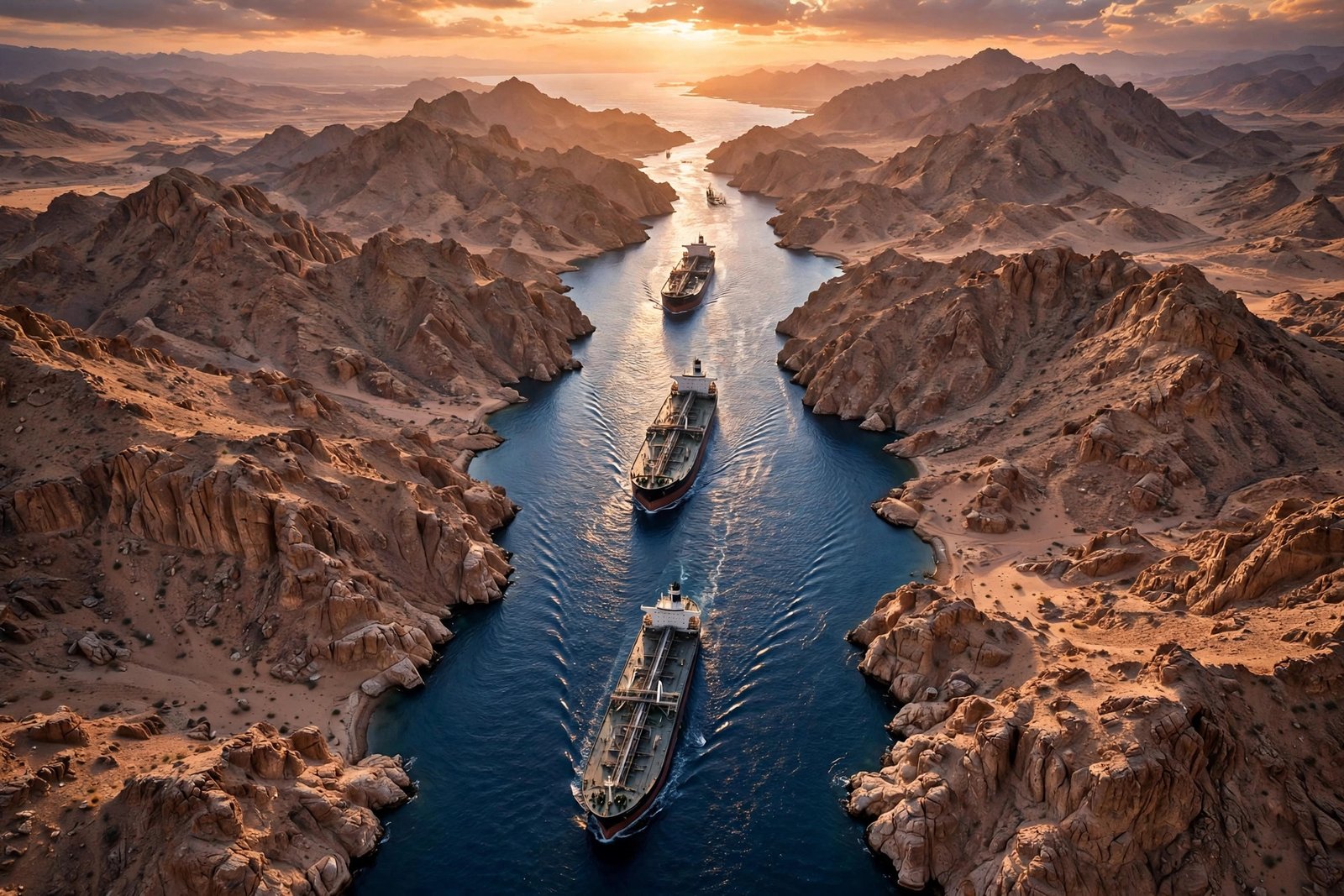
Picture the entire world economy squeezed through a gap of water so narrow you could drive across it in about half an hour. Every day, in normal times, supertankers the length of three football fields glide through it in single file, carrying roughly a fifth of all the oil humanity consumes. On one side sits Iran. On the other sits Oman. And in November 2026, that gap is once again at the centre of a shooting war. The Strait of Hormuz is not just a line on a map. It is the choke point the modern world cannot live without, and the latest strikes, drone attacks and burning tankers show exactly why everyone from oil traders in London to drivers filling up in Ohio should be paying attention.
What makes this waterway so powerful is not its size. It is its position. There is no other sea exit from the Persian Gulf. Every barrel of oil shipped from Saudi Arabia, Iraq, Kuwait, Qatar, the United Arab Emirates, Bahrain and Iran by sea must pass through it. There is no detour, no second channel, no wider road around the back. That single fact explains decades of tension, trillions of dollars in trade, and why a few explosions on a small island can send shivers through global markets within hours.
What and Where Is the Strait of Hormuz?
The strait connects the Persian Gulf in the west to the Gulf of Oman and the Arabian Sea in the east. Iran forms its northern shore, while Oman, including the rocky Musandam Peninsula, forms the southern shore. At its narrowest, the waterway measures roughly 21 nautical miles across, or about 33 to 39 kilometres depending on how it is measured. That sounds roomy until you learn how ships actually use it.
Commercial traffic does not spread across the full width. It follows a traffic separation scheme: two shipping lanes, each about two miles wide, one for inbound ships and one for outbound ships, separated by a two-mile buffer zone. In effect, the world’s most important oil highway runs through a corridor only about six miles wide. Sailors have known for centuries that the Strait of Hormuz rewards whoever controls its shores, and a single incident, a mine, a fire, a collision, can snarl traffic for hours or days.
The Numbers That Explain Why the Strait of Hormuz Matters
Numbers make the stakes concrete. According to the U.S. Energy Information Administration (EIA), oil flows through the strait averaged about 20.9 million barrels per day in the first half of 2025, the equivalent of roughly 20 percent of global petroleum liquids consumption and about a quarter of all the oil traded by sea. The International Energy Agency has published similar figures, counting almost 20 million barrels a day of oil exports through the waterway in 2025.
The gas numbers are just as striking. The EIA estimated that about 11.4 billion cubic feet of liquefied natural gas moved through the strait each day in the first half of 2025, or more than a fifth of global LNG trade, most of it from Qatar. Qatar is the world’s largest LNG exporter, and almost all of its gas leaves by sea through this channel. When the strait is threatened, Europe and Asia do not just worry about petrol. They worry about heating, electricity and industry.
Where does all that oil go? Mostly east. The EIA estimates that about 82 percent of the crude oil and condensate moving through the Strait of Hormuz in 2022 was bound for Asia, with China, India, Japan and South Korea alone taking about 67 percent. That is why a crisis in a Middle Eastern waterway is felt first in Asian refineries and Asian petrol stations, and why China, India and Japan watch every development there so closely. The United States imports relatively little Gulf oil directly these days, but oil is priced globally, so a disruption still reaches American drivers through the world price of crude.
A Waterway With a Long, Tense History
The Strait of Hormuz has been a prize for centuries. Portuguese, British and other naval powers fought over it when the spice and silk trades depended on Gulf waters. In modern times, its story is inseparable from oil and from the rivalry between Iran and its neighbours and the United States.
The darkest chapter came during the Iran-Iraq war of 1980 to 1988. Both sides began attacking oil tankers, and the conflict earned the nickname the Tanker War. Hundreds of ships were hit, insurance rates soared, and the United States began escorting reflagged Kuwaiti tankers through the Gulf. Yet even at the height of that war, the strait was never fully closed. Shipping continued, cautiously, because every side, including Iran and Iraq, needed the oil revenue that flowed through it.
That pattern has repeated ever since. In 2011 and 2012, and again in 2018 and 2019, Iran threatened to close the strait during standoffs over sanctions and its nuclear programme. Each time, the threat moved oil prices and dominated headlines. Each time, the waterway stayed open. Analysts often describe the closure threat as a bargaining chip rather than a plan, because shutting the strait would also strangle Iran’s own oil exports and infuriate its biggest customer, China. The threat is powerful precisely because it is credible enough to scare markets but costly enough that Tehran has never fully carried it out.
Then came February 28, 2026, when the United States and Israel launched a war against Iran. According to reporting from that period, Tehran restricted shipping through the strait for months, cutting off roughly a fifth of global energy supply at the worst point and stranding hundreds of tankers. By late September 2026, flows had partly recovered to roughly 7.4 million barrels a day of crude exports, according to tanker-tracking data reported by Al Jazeera, still far below the prewar level of about 20 million barrels a day. The strait had never been formally closed, but for practical purposes it had been choked, and the world had felt it.
What Happened on November 17, 2026
The latest flare-up began with a drone attack and ended with explosions on an island most people outside the region had never heard of. Here is what was reported on November 17, 2026, with each claim attributed to its source, because in a fast-moving conflict, who says something matters as much as what they say.
According to U.S. Central Command, multiple one-way attack drones launched by Iran’s Islamic Revolutionary Guard Corps (IRGC) toward a U.S. radar system at an air base in Bahrain were intercepted, with no damage to U.S. equipment or personnel. Iran, for its part, claimed responsibility for a drone strike targeting the American-operated radar system in Bahrain.
Hours later, U.S. fighter aircraft struck back. A U.S. official told Al Jazeera that American warplanes used precision munitions to strike an IRGC missile launch site on Qeshm Island, describing the operation as self-defence in response to Iranian aggression against U.S. personnel and assets. Qeshm is Iran’s largest island and sits in the northern approaches to the waterway, making it a natural base for missiles that can threaten shipping.
Iranian state media confirmed the strikes. Ahmad Nafisi, the deputy governor of Hormozgan province, was quoted by the IRNA news agency as saying the U.S. carried out several attacks on Qeshm Island, triggering five to six explosions, but causing no damage to residential, commercial or infrastructure facilities, and that the situation on the island was under control. The two sides agreed on the basic facts, an American strike on Qeshm, while differing sharply on why it happened and what it achieved.
Meanwhile, the sea itself was burning. Iran’s armed forces said three oil tankers had struck naval mines while trying to pass through the strait, and its navy later said the number of vessels reported hit in and around the waterway that day had risen to five, including a tanker that caught fire east of the strait. Oman evacuated 24 crew members from the Panama-flagged Tara Gas tanker after it caught fire about two nautical miles off the Musandam Peninsula, according to Oman’s Maritime Security Centre. The U.S. military, however, said it had recently cleared all mines from the main shipping routes through the strait, and the mine claims could not be independently verified. U.S. Central Command also said last month that it had helped Gulf countries export 1.5 billion barrels of oil through the strait since the summer, a reminder that American warships are actively escorting and protecting commercial traffic there.
There was also a claim from Yemen’s Houthi movement, whose military spokesperson said a drone attack had been launched on pumping stations serving Saudi Arabia’s East-West oil pipeline. The Saudi-led coalition said it had intercepted a drone fired by the Houthis in the Riyadh region. Taken together, the day’s events showed a conflict that is no longer confined to one country or one battlefield. It stretches from Bahrain to Yemen to the narrow channel where the world’s oil flows.
Why a Disruption Here Hits Your Wallet
It is tempting to think of all this as faraway geopolitics. It is not. The link to everyday life is short and direct, and it runs through the price of oil. When traders fear that supply through the strait could be interrupted, they bid up the price of crude. Higher crude means higher petrol and diesel, higher heating bills, higher airfares and higher prices for almost everything that travels by truck, ship or plane.
The second cost is insurance and freight. When mines are reported or tankers catch fire, insurers raise war-risk premiums for ships entering the Gulf, and shipowners demand higher freight rates. In June 2025, freight rates for very large crude carriers on Gulf-to-Asia routes surged by nearly 70 percent in a single week, according to maritime analysts at Drewry. Those costs are passed along the supply chain until they reach consumers.
This is also why financial markets watch the strait like a hawk. A single headline, a mine strike, a seized tanker, a threat from Tehran, can move the price of Brent crude by several dollars in a day. In a world already dealing with inflation and fragile supply chains, that volatility is the last thing households and businesses need.
Could the Strait Actually Be Closed?
The honest answer is that it could be disrupted very badly, but a total, lasting closure has never happened, and there are strong reasons it is hard to achieve. Iran has several tools: naval mines laid by speedboats and small submarines, fast attack craft, coastal missiles, drones and, in the extreme, sinking ships in the channel. Mines are the cheapest and most effective. They are hard to find, slow to clear, and terrifying for civilian crews, which is why reports of mine strikes, even unverified ones, rattle the market so much.
But closing the strait would also require confronting the U.S. Navy and its Gulf allies, who patrol the waterway and have spent decades practising mine clearance and convoy escort. During the Tanker War, the United States reflagged Kuwaiti tankers and escorted them through the Gulf. In 2026, U.S. Central Command has been actively helping tankers transit the strait and says it has cleared mines from the main routes. A full closure would mean open naval war, not just a threat.
There are also partial escape routes, though none is a real substitute. Saudi Arabia built the East-West Pipeline across the Arabian Peninsula to the Red Sea port of Yanbu, which can carry millions of barrels a day and bypass the strait entirely. The pipeline was reported to be running at its maximum capacity of about 7 million barrels a day during the 2026 war, up from 5 million before it. The United Arab Emirates built the Habshan-Fujairah pipeline to the Gulf of Oman, carrying about 1.8 million barrels a day. Iran itself built the Goureh-Jask pipeline to the Gulf of Oman, though it handles only a small volume.
The problem is scale. Before the war, about 15 million barrels a day of crude passed through the strait. The bypass pipelines together carry roughly 9 million barrels a day at most, and they carry crude oil, not the LNG that Qatar exports or the refined products that also transit the waterway. Kuwait, Bahrain and Qatar have no alternative coastline at all, so almost all of their hydrocarbon exports depend on the strait. Pipelines help at the margins, but they cannot replace it.
What to Watch Next
The situation changes by the hour, so it pays to know which signals actually matter. First, watch the tankers. If commercial traffic keeps moving under escort, the disruption is contained. If major shipping companies suspend transits or insurers refuse cover, the crisis is escalating. Second, watch the mine reports. Confirmed mine strikes, as opposed to claims, are the clearest sign that the waterway is becoming unsafe for civilian ships.
Third, watch the oil price and the language from Tehran and Washington. A closure threat is a negotiating tool. An actual attempt to mine the main shipping lanes is a different matter entirely. And fourth, watch Qeshm Island itself. The November 17 strikes show that the island has become a front line, and further strikes there would signal that the conflict is widening rather than winding down.
Key Takeaways
- The strait is the only sea exit from the Persian Gulf, and about a fifth of the world’s oil normally passes through it.
- At its narrowest it is roughly 21 nautical miles wide, but ships use lanes only about two miles wide in each direction.
- It has never been fully closed, not even during the 1980-1988 Tanker War, but it was severely disrupted in 2026.
- On November 17, 2026, the U.S. struck an IRGC missile site on Qeshm Island after an Iranian drone attack in Bahrain, and several tankers were reported hit by mines.
- Bypass pipelines in Saudi Arabia and the UAE help, but they cannot carry the full volume that normally transits the strait.
- Any serious disruption raises oil prices, shipping insurance and fuel costs for consumers worldwide.
Most of us will never see the strait in person. We will never stand on the deck of a supertanker threading that six-mile corridor, or watch the mountains of Musandam slide past on one side and the Iranian coast on the other. But we all live with its consequences every time we fill a tank, heat a home or buy anything that travelled by sea. That is the strange power of this narrow waterway: a strip of sea barely wider than a city, holding a fifth of the world’s energy in its hands. As long as the world runs on oil and gas, the question of who controls the Strait of Hormuz will remain one of the most important questions on Earth. And after the events of November 17, 2026, it is a question nobody can afford to ignore.
Sources: Al Jazeera live coverage, November 17, 2026 (aljazeera.com); TRT World (trtworld.com); Arab News (arabnews.pk); Drewry maritime research (drewry.co.uk); gCaptain (gcaptain.com). Flow figures: U.S. Energy Information Administration and International Energy Agency, as reported by geopolitiki.com. For more BolanPost stories, see Voyager 1, one light-day from Earth, the Simpsons November 17 blackout prediction and what happened in the Microsoft global outage.