
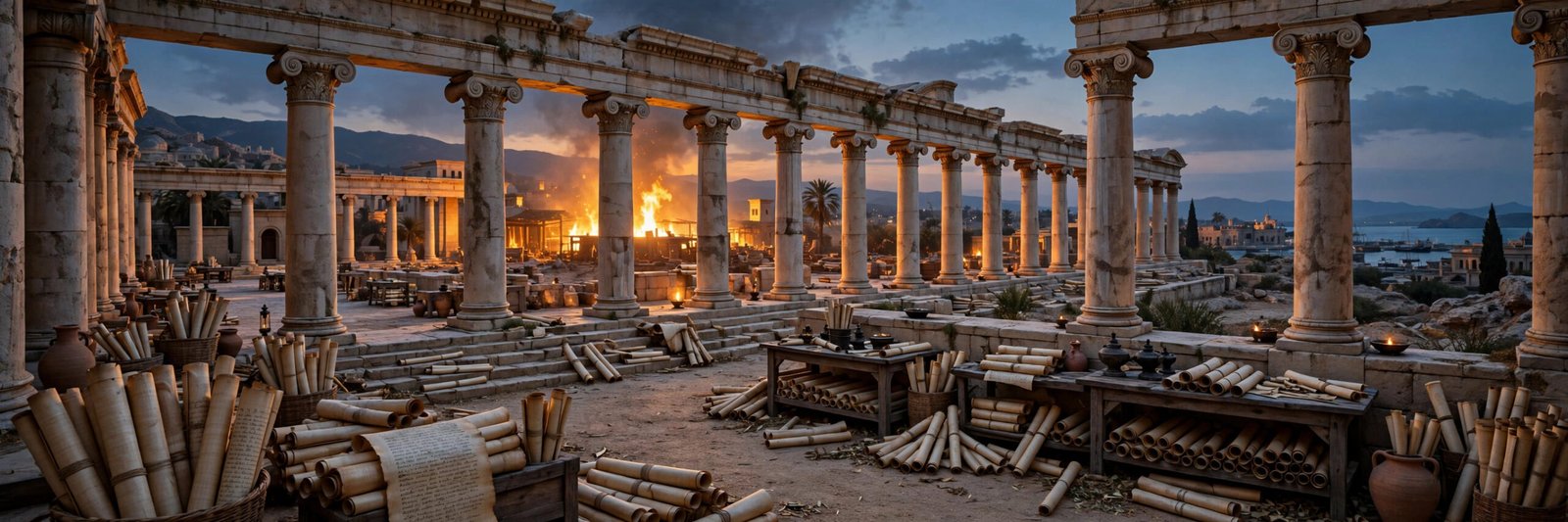
Almost everyone has heard the story. In ancient Egypt stood the greatest library the world had ever known, a treasure house holding all the knowledge of the ancient world, until one terrible night when it burned to the ground and centuries of wisdom turned to ash. It is one of history’s most haunting images, and it has inspired novels, films, and a thousand warnings about the fragility of knowledge. There is only one problem with it. The Library of Alexandria almost certainly did not burn down in a single great fire, and the real story of what happened to it is slower, stranger, and in some ways more unsettling than the legend.
The library was real, and it was extraordinary. Founded in the early third century BCE in Alexandria, Egypt, under the Ptolemaic dynasty, it was part of a research institution called the Mouseion, a community of scholars paid by the king to live, study, and write together. Its ambition was breathtaking: to collect every book in existence, in every known language. At its height, ancient sources suggest it may have held anywhere from 40,000 to 400,000 scrolls, with some later estimates reaching as high as 700,000, though no exact count survives and scholars disagree sharply about the numbers. Whatever the true figure, it was the largest collection of written knowledge the ancient world had ever assembled.
And then it was gone. No catalogue survives, no inventory, no ruins you can walk through and call the library. What survives is a handful of ancient accounts, written decades or centuries after the events they describe, and they do not agree with each other. Some blame Julius Caesar. Some blame Christians. Some blame Muslims. Modern scholars increasingly believe the truth is none of those simple stories, and all of them at once, spread across centuries of war, neglect, and budget cuts.
The Library of Alexandria Was Not a Library Like Ours
To understand what was lost, you first have to understand what the place actually was, because it was not a public library in the modern sense. There were no reading rooms full of ordinary citizens borrowing scrolls. The Library of Alexandria was the research collection of the Mouseion, a temple dedicated to the Muses, the Greek goddesses of the arts and sciences, and it functioned more like a modern university campus than a lending library.
Scholars lived there at royal expense, with lodging, meals, and a salary, and they were expected to produce scholarship. The names associated with Alexandria read like a hall of fame of the ancient mind. Euclid worked out the foundations of geometry there. Eratosthenes, who served as head librarian, calculated the circumference of the Earth with remarkable accuracy using little more than shadows, geometry, and careful measurement. Callimachus created the Pinakes, often described as the world’s first library catalogue, a vast survey of Greek literature. Hipparchus catalogued the stars, Herophilos advanced the study of human anatomy, and Aristarchus of Samos proposed that the Earth revolves around the Sun, an idea that would wait nearly two thousand years to be accepted.
The library’s collecting methods were famously aggressive. The Ptolemaic kings wanted every book in the world, and they were willing to pay, borrow, and occasionally steal to get them. Ships docking at Alexandria reportedly had their books seized, copied, and returned as copies while the library kept the originals. According to one well-known story, Ptolemy III borrowed the official state copies of the great Athenian playwrights Aeschylus, Sophocles, and Euripides, then kept the originals and sent back copies, forfeiting a large deposit. Whether every detail of that tale is true is uncertain, but it captures the spirit of the institution: knowledge was power, and the Ptolemies intended to own it all.
A daughter library was later established in the Serapeum, a temple to the Greco-Egyptian god Serapis, to hold the overflow. This second collection matters to the story of the library’s end, because the two libraries, if the daughter library existed as a real collection, may have met different fates at different times. Some scholars, however, question whether the Serapeum library existed at all, arguing that the evidence for it is late and unreliable, and that the idea may have grown out of legend rather than fact. That disagreement is a good example of how uncertain the whole story is: historians cannot even agree on how many libraries there were.
Caesar and the Fire of 48 BCE
The most famous suspect in the burning is Julius Caesar, and his story is the one most people know. In 48 BCE, Caesar arrived in Alexandria in pursuit of his rival Pompey, and became entangled in a civil war between Cleopatra VII and her brother Ptolemy XIII. Caesar sided with Cleopatra, and the two were besieged in the royal palace complex by Ptolemy XIII’s forces. To break the siege, Caesar ordered his men to set fire to the enemy fleet in the harbour.
The fire spread. That much is agreed. What it destroyed is the question. The Roman historian Plutarch, writing long after the event, said the fire spread from the dockyards and destroyed the Great Library. The historian Cassius Dio wrote that the fire spread to the storehouses of grain and the library. Seneca, writing in the first century CE, lamented the burning of 40,000 scrolls. But Caesar himself, in his own account of the Alexandrian war, is remarkably silent about any damage to the library, which is strange if he had just destroyed the greatest collection of books in the world.
Many modern scholars believe the fire destroyed a warehouse of scrolls near the harbour, perhaps scrolls waiting to be sorted or shipped for export, rather than the main library itself, which stood inside the palace complex. The figure of 40,000 scrolls is repeated in several ancient sources, and it may well describe that warehouse. If so, the loss was still enormous, but it was not the end of the library. The strongest evidence for this view is what happened next: the geographer Strabo visited the Mouseion around 25 to 20 BCE, roughly two decades after Caesar’s fire, and described it as a going concern. Scholars continued to work in Alexandria, and the prodigious output of writers such as Didymus Chalcenterus in the decades after Caesar suggests they still had access to a substantial collection. A library that had been reduced to ash in 48 BCE could not have supported that kind of scholarship.
There is also a competing scholarly view that takes the ancient sources at face value: that the fire of 48 BCE did destroy the main library, and that later references describe a rebuilt or diminished collection. This view has been argued in detail by scholars who note that no ancient source contradicts the story of the fire, and that the Mouseion could have continued without its great library. The honest position is that the evidence is genuinely ambiguous. We know there was a fire, and we know scrolls burned. We do not know with certainty which building burned, or how much of the collection it held.
The Slow Decline: Budget Cuts, Not Flames
If the library survived Caesar, what finally killed it? Here the story takes a turn that is far less dramatic than a burning, and far more familiar. The library depended entirely on royal patronage. When the Ptolemaic dynasty weakened and Egypt became a Roman province, the money and the political will that sustained the Mouseion began to dry up.
The library historian Heather Phillips has argued that much of the library’s downfall was gradual, bureaucratic, and by comparison with the legend, somewhat petty. The Roman emperor Caracalla, whose full name was Marcus Aurelius Antoninus, suspended the revenues of the Mouseion, abolished the stipends of its members, and expelled foreign scholars. Without salaries, the community of resident scholars scattered. Without scholars, a research library is just a warehouse of scrolls, and warehouses are easy to neglect.
War added to the damage. In 272 CE, the emperor Aurelian fought Queen Zenobia of Palmyra, and the fighting devastated the Brucheion, the royal quarter of Alexandria where the Mouseion stood. Some accounts say the library was destroyed in that campaign, but again the evidence is thin. The quarter was damaged, and the library’s fortunes sank further, but there is no clear record that the collection itself was wiped out in a single blow.
Then came the religious conflicts of the fourth and fifth centuries. In 391 CE, the emperor Theodosius I issued a decree sanctioning the demolition of pagan temples, and Theophilus, the bishop of Alexandria, led an attack on the Serapeum, the temple that housed the daughter library. Eyewitness accounts describe the temple being destroyed down to its foundations, but they do not mention a library. The historian Edward Gibbon later blamed the Christians for destroying the library in 391, and that version of the story stuck, but modern scholars note that the contemporary sources for the attack on the Serapeum say nothing about books burning. The temple was destroyed. Whether a library died with it is unknown, and some scholars doubt the Serapeum library ever existed.
A similar story is told about the Arab conquest of Alexandria in the seventh century, when the caliph Umar is said to have ordered the library’s books burned to heat the city’s baths. This tale is now widely regarded by historians as a later invention, with no contemporary evidence behind it. By the time of the Arab conquest, serious scholars agree, both libraries had already perished long before, and there was nothing left to burn.
What the Library of Alexandria Actually Lost
So what was actually lost? This is the hardest question of all, because we cannot catalogue what no longer exists. What we know is what survived through copies made elsewhere, through quotations in later writers, and through the works of scholars who had studied in Alexandria and carried its learning with them.
What was lost, almost certainly, was a vast amount of Greek literature. The library aimed to hold the complete works of every Greek author, and much of what we have today survives only in fragments quoted by later writers. Of the hundreds of Greek tragedies performed in Athens, only a few dozen survive complete. The plays of many authors are known only by their titles. The library also held works of history, science, medicine, and philosophy that are now known only because later writers mentioned them. The astronomer Hipparchus, the physician Herophilos, and dozens of other scholars are known largely through second-hand reports of their work.
But it is also important to say what was not lost, because the legend sometimes implies that all ancient knowledge vanished with the library. It did not. The great works that mattered most to later readers, Homer, Plato, Aristotle, Euclid, and many others, survived because copies existed in many other libraries across the Mediterranean world. The library was not the only copy of everything it held. Much of its collection was duplicated elsewhere, and the scholarship it produced lived on in the scholars it trained and the texts they carried away.
What was lost, then, was not all knowledge, but depth and breadth: the obscure authors, the complete editions, the variant texts, the catalogues, and the working notes of centuries of scholarship. It was the loss of a research collection, not the loss of civilisation itself. That is still a terrible loss, but it is a different and more honest kind of tragedy than the legend suggests.
There is one more loss that is easy to overlook: the loss of the institution itself. The Mouseion was one of the first places in the world where scholars were paid to do nothing but think, argue, and write, supported by the state and free from the need to earn a living. When it faded, that model faded with it, and it would be many centuries before anything like it appeared again. The library’s true legacy may be less about the scrolls it held than about the idea it embodied: that a society should invest in knowledge for its own sake.
Why the Legend Refuses to Die
If the library did not burn in a single night, why does the story persist? Partly because it is a better story. A slow decline caused by budget cuts, political neglect, and a series of smaller disasters is harder to tell than a single night of flames. A single villain, Caesar or a bishop or a caliph, is easier to blame than a century of indifference. The burning library has become a symbol, a warning about what happens when knowledge is left unprotected, and symbols do not need to be accurate to be powerful.
The legend also serves a purpose. Every generation that worries about the loss of knowledge, from the burning of books to the fragility of digital archives, reaches for Alexandria as its cautionary tale. The image of a library burning is a reminder that knowledge is not permanent, that it depends on people who care for it, fund it, and copy it forward. In that sense, the myth is useful even if it is wrong, because the warning it carries is true.
But the real story carries a sharper warning. The library was not destroyed by one enemy in one night. It was destroyed by the slow withdrawal of support, by wars that treated it as collateral damage, by religious conflicts that saw its books as symbols of the old order, and by a world that gradually stopped valuing what it had built. That is a more uncomfortable lesson, because it describes how institutions usually die: not in flames, but in neglect.
Modern Alexandria honours the memory with the Bibliotheca Alexandrina, a vast modern library and cultural centre opened in 2002 on the city’s waterfront, near the site of the ancient Mouseion. It holds millions of books, hosts exhibitions and research, and stands as a deliberate revival of the ancient idea. Whether it can ever match the ambition of the original is an open question, but its existence shows that the dream of Alexandria, a place where all the world’s knowledge is gathered in one place, is still alive.
The next time you hear that the Library of Alexandria burned down in a single night, remember the fuller story. There was a fire, and scrolls did burn, but the library survived it, and what finally ended it was centuries of war, neglect, and lost funding. The greatest library of the ancient world did not die in a blaze of glory. It faded, piece by piece, because the world stopped paying to keep it alive. That is a less dramatic story, but it is a truer one, and it is worth telling.
If you enjoy history’s great unsolved mysteries, you may also like our account of the Tunguska event of 1908, the Siberian explosion that flattened a forest without leaving a crater, and the riddle of the Mary Celeste ghost ship, found drifting with no one aboard. For the scholarship behind this article, see the Britannica account of the library’s fate, the argument that budget cuts, not fire, destroyed it, and the detailed account of the competing theories.
Frequently Asked Questions
Did the Library of Alexandria really burn down in one fire?
Almost certainly not. The most famous fire, set by Julius Caesar in 48 BCE, probably destroyed a warehouse of scrolls near the harbour rather than the main library, which appears to have survived for decades afterwards. Modern scholars believe the library declined gradually over centuries through war, lost funding, and neglect.
How many scrolls did the library hold?
No exact count survives. Ancient sources give figures ranging from 40,000 to 400,000 scrolls, with some later estimates as high as 700,000. Scholars disagree sharply, and the true number at any given time is unknown.
Who burned the Library of Alexandria?
There is no single culprit. Caesar’s fire in 48 BCE is the best documented event, but the library survived it. Later damage came from Aurelian’s war in 272 CE, the attack on the Serapeum in 391 CE, and the gradual loss of royal funding. The story blaming the Arab conquest in the seventh century is now regarded by historians as a later invention.
What famous scholars worked there?
Euclid, the father of geometry, Eratosthenes, who calculated the Earth’s circumference, Callimachus, who created the first great library catalogue, Hipparchus, the astronomer, and Herophilos, the anatomist, are among the best known. Aristarchus of Samos, who proposed that the Earth revolves around the Sun, was also associated with Alexandria.
What was lost when the Library of Alexandria disappeared?
A vast amount of Greek literature, history, science, and scholarship survives only in fragments or in quotations by later writers. But the most important works also existed in copies elsewhere, so the loss was one of depth and breadth rather than the total destruction of ancient knowledge.